
This was written in the Fall of 2010. Although the complete series will remain unfinished for some time, I am publishing these finished sections because when you put hundreds of hours into something, it makes more sense to share what you’ve produced than to keep it in the closet forever. [alex]

Why Marxism Has Failed, and Why Zombie-Marxism Cannot Die
Or My Rocky Relationship with Grampa Karl

by Alex Knight, endofcapitalism.com
Part 3.1 – September 19, 2011
This is part of an essay critiquing the philosophy of Karl Marx for its relevance to 21st century anti-capitalism. The main thrust of the essay is to encourage living common-sense radicalism, as opposed to the automatic reproduction of zombie ideas which have lost connection to current reality. Karl Marx was no prophet. But neither can we reject him. We have to go beyond him, and bring him with us. I believe it is only on such a basis, with a critical appraisal of Marx, that the Left can become ideologically relevant to today’s rapidly evolving political circumstances. [Click here for Part 1 and Part 2.]

What Marx Got Wrong

Marxism has ceased to be applicable to our time not because it is too visionary or revolutionary, but because it is not visionary or revolutionary enough” – Murray Bookchin, “Listen, Marxist!

Although Karl Marx provided us crucial and brilliant anti-capitalist critiques as explored in Part 2, he also contributed several key theoretical errors which continue to haunt the Left. Instead of mindlessly reproducing these dead ideas into contexts where they no longer make sense, we must expose the decay and separate it from the parts of Marx’s thought which are still alive and relevant.

I have narrowed down my objections to five core problems: 1. Linear March of History, 2. Europe as Liberator, 3. Mysticism of the Proletariat, 4. The State, and 5. A Secular Dogma.

I submit that Marx’s foremost shortcoming was his theory of history as a linear progression of higher and higher stages of human society, culminating in the utopia of communism. According to Marx, this “progress” was manifest in the “development of productive forces,” or the ability of humans to remake the world in their own image. The danger of this idea is that it wrongly ascribes an “advance” to the growth of class society. In particular, capitalism is seen as a “necessary” precursor to socialism. This logic implicitly justifies not only the domination of nature by humanity, but the dominance of men over women, and the dominance of Europeans over people of other cultures.

Marx’s elevation of the “proletariat” as the agent of history also created a narrow vision for human emancipation, locating the terrain of liberation within the workplace, rather than outside of it. This, combined with a naive and problematic understanding of the State, only dispensed more theoretical fog that has clouded the thinking of revolutionary strategy for more than a century. Finally, by binding the hopes and dreams of the world into a deterministic formula of economic law, Marx inadvertently created the potential for tragic dogmatism and sectarianism, his followers fighting over who possessed the “correct” interpretation of historical forces.

(These mistakes have become especially apparent with hindsight, after Marxists have attempted to put these ideas into practice over the last 150 years. The goal here is not to fault Marx for failing to see the future, but rather to fault what he actually said, which was wrong in his own time, and is disastrous in ours. In this section I will limit my criticisms to Marx’s ideas only, and deal with the monstrous legacy of “actually existing” Marxism in Part 4.)

Capitalism is "advancing" us right off a cliff.

1. Linear March of History

Rooted in early industrialization and a teleological materialism that assumed progress towards communism was inevitable, traditional Marxist historiography grossly oversimplified real history into a series of linear steps and straightforward transitions, with more advanced stages inexorably supplanting more backward ones. Nowadays we know better. History is wildly contingent and unpredictable. Many alternate paths leave from the current moment, as they have from every previous moment too” – Chris Carlsson, Nowtopia (41).

Much of what is wrong in Marx stems from a deterministic conception of historical development, which imagines that the advance and concentration of economic power is necessarily progressive. According to this view, human liberation, which Marx calls communism, can only exist atop the immense productivity and industrial might of capitalism. All of human history, therefore, is nothing but “progressive epochs in the economic formation of society,” as Marx calls it in his Preface to A Contribution to the Critique of Political Economy (1859):

“In broad outlines Asiatic, ancient, feudal, and modern bourgeois modes of production can be designated as progressive epochs in the economic formation of society. The bourgeois relations of production are the last antagonistic form of the social process of production… the productive forces developing in the womb of bourgeois society create the material conditions for the solution of that antagonism [communism].” Read the rest of this entry »


Upheaval Productions has produced some impressive documentary and interview footage on the most pressing issues of our day.  Here I am reposting 3 of their courageous interviews with 3 modern-day visionaries: Malalai Joya, a heroic voice of reason from the warzone of Afghanistan, Charles Bowden, who continues to shed necessary light on the underlying causes of US-Mexico border violence, drug trade and immigration, and George Katsiaficas, who has spent his life studying revolutions and popular uprisings around the world, and how ordinary people make positive social change.

Each video is about 10 minutes. I learned a lot from all three interviews, and I’m sure you will too.  Enjoy!

Malalai Joya is an Afghan activist, author, and former politician. She served as an elected member of the 2003 Loya Jirga and was a parliamentary member of the National Assembly of Afghanistan, until she was expelled for denouncing other members as warlords and war criminals.

She has been a vocal critic of both the US/NATO occupation and the Karzai government, as well as the Taliban and Islamic fundamentalists. After surviving four assassination attempts she currently lives underground in Afghanistan, continuing her work from safe houses. After the release of her memoir, A Woman Among Warlords, she recently concluded a US speaking tour. She sat down for an interview with David Zlutnick while in San Francisco on April 9, 2011. Read the rest of this entry »


“To me, the struggle is a healing process.  If the struggle itself is not a healing process, it’s not worth it!  There’s something wrong with it. You struggle because you need to liberate yourself.  If the struggle does not liberate you, if it doesnt carry that hope, why bother?”

flyer by Ivan

On March 3 and 4, 2011, acclaimed radical feminist theorist Silvia Federici gave two talks in Philadelphia. On the 3rd, she spoke at the Wooden Shoe anarchist bookstore about her book, Caliban and the Witch, on “The True Nature of Capitalism.” That event literally overflowed with an audience eager to connect the pieces of the historical violence against women, and the ongoing crisis of capitalism.

The next night, on March 4, Silvia spoke at Studio 34 Yoga in West Philly to another packed crowd, on the subject of “Our Struggles, Ourselves: Rethinking Healing Work.”  This was a more personal, and in many ways a much deeper talk, which touched on a multitude of subjects from capitalism’s attacks on humanity and the Earth, to how to build self-reproducing movements that avoid the mistakes of past generations.

Today I am posting the audio recording from that amazing event!

One of Silvia’s most powerful insights that continues to work its way through my brain was the distinction between “suffering,” which may be necessary in movement work, and “sacrifice,” which ultimately harms the movement because it harms us as individuals.  She makes it clear that there should be no place for sacrifice in a movement for our liberation:

“What do we mean when we say sacrifice? Because, it’s very true, in many ways, when we say, ‘I’m not going to go into this career, and instead I’ll do the struggle. I’ll be poor, but eh!’ It may sound like sacrifice. But I would like to say that it’s not!

[Sacrifice] means that I’m taking away something vital from my life, something that I need, and then give it up for the struggle…

It doesn’t mean that the struggle does not make you suffer. But suffering is not sacrifice. It’s really different. There may be pain that comes too. But maybe it’s a pain that is better than the pain you would have if you didn’t struggle.

Maybe it’s a pain that prevents you from dying. Because we can die from numbness, irrelevance, wasting your life in triviality, despair, inertia, passivity, from giving up whatever creativity you have in yourself. So, sometimes it’s worth suffering not to see that in yourself. But i wouldn’t call that sacrifice.”

I am very proud to post this inspiring discussion, including the Question and Answer period, which we recorded in audio format.  There are 2 video recordings which were also made, 1 of each of the talks, and I look forward to making those videos available in the near future.  For now, please enjoy the audio!

Silvia Federici MP3

This is a 2-hour recording, so you might want to download it and put it on your mp3 player or computer.  There is a LOT here, so it may not be possible to get through it all in one sitting!

Also, here I’ll post some notes I’ve taken while re-listening to Silvia’s talk:

At 4 minutes – How can we build movements of resistance without destroying ourselves? How can we build self-reproducing movements?

5:15 – Thesis: We cannot liberate our individual selves without changing the world. At the same time, we cannot change the world without liberating ourselves. Read the rest of this entry »


Yesterday I went to a “Mother’s March” here in Philadelphia, organized by Global Women’s Strike, on the occasion of International Women’s Day (March 8), which was established in 1911.

The Mother's March in San Francisco, March 8 2011.

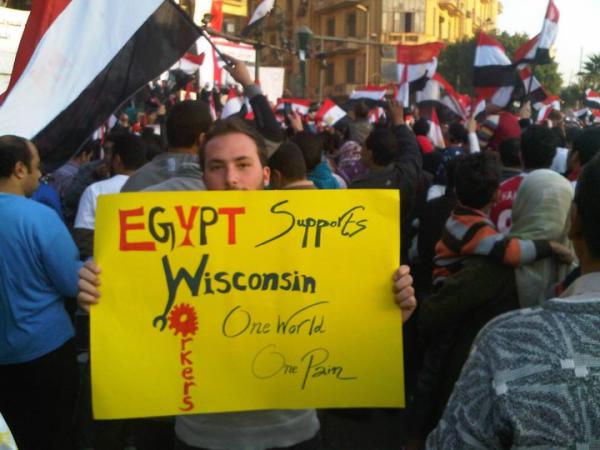
The message of the march was “Invest in Caring, Not Killing,” and drew attention to the absurd budget cuts that our new Governor has proposed here in Pennsylvania, similar to what is going on in Wisconsin, as well as at the federal level as right-wing idealogues are given positions of power. The intention of these cuts appears to be to punish poor and working class families, especially women, for the failures of Wall St. So we see teacher’s unions under attack, as if teachers caused the stock market to crash?

Selma James, the author of the excellent article below, was founder of the Wages for Housework campaign in the 1970s, which brought attention to the fact that women’s labor is systematically unpaid, unrecognized, and undervalued. The same message, of putting resources and value into the caring and nurturing work that upholds the entire society, rather than into destructive activities such as wars and bailouts for the rich, continues to motivate the Global Women’s Strike today.

Last week Silvia Federici, author of Caliban and the Witch, spoke in Philadelphia on many of these themes, and how the attack on women has been a key part of the structure of capitalism since its origin 500 years ago in the fires of the European witch burnings. Silvia’s work has opened my eyes to the ways in which capitalism is dependent on the division between (predominantly male) paid labor and (predominantly female) unpaid labor, which she calls the realms of production and reproduction. It turns out that capitalist profits could not be made if women’s labor was valued the same way as men’s – taking care of children, the elderly, and men’s emotions just isn’t very profitable, even though it is absolutely essential to society.

It’s also important to recognize that the unpaid labor holding up capitalism goes far beyond housework, to slavery, prison labor, the self-disciplining of the body, and the theft of resources and destruction of ecosystems that result from capitalist exploitation of Mother Earth.

I hope to upload the video or audio of Silvia’s inspiring events in the coming days. In the meantime, check out this article by Selma James.

alex

International Women’s Day: how rapidly things change

by Selma James

March 8, 2011

Originally published by The Guardian.

A century ago International Women’s Day was associated with peace, and women’s and girls’ sweated labour – which votes for women were to deal with. Not a celebration, but a mobilisation. And because it was born among factory workers, it had class, real class. Later it came to celebrate women’s autonomy, but changed its class base and lost its edge. This centenary must mark a new beginning.

We live in revolutionary times. We don’t need to be in North Africa or the Middle East to be infected by the hope of change. Enough to witness on TV the woman who, veiled in black from head to foot, led chants in Cairo’s Tahrir Square, routing sexism and Islamophobia in one unexpected blow. She and the millions moving together have shaken us from our provincialism, and shown us how rapidly things can change. Women in Egypt have called for a million women to occupy Tahrir Square today. Who would have predicted that a month ago?

Feminism has tended to narrow its concerns to what is unquestionably about women: abortion, childcare, rape, prostitution, pay equity. But that can separate us from a wider and deeper women’s movement. In Bahrain, for example, women lead the struggle for “jobs, housing, clean water, peace and justice” – as well as every demand we share.

The revolution is spreading. Read the rest of this entry »


As the “democracy uprising” spreads from Tunisia, to Egypt, and now to Wisconsin, it seems the whole world is starting to look a little more like Latin America. Social movements “south of the border” have been pumping out progressive change, and winning, for a couple decades now. This victorious and active Latin left goes back at least to the Venezuelan “Caracazo” of 1989, an uprising very similar to what we’ve been watching lately in Tahrir Square, Cairo. This was long before Chavez showed up on the scene, you may notice.

As the following interview of Ben Dangl highlights, leftist states such as Venezuela are not by themselves particularly revolutionary, and in fact often play a counter-revolutionary role. Democratic, participatory, grassroots social movements have always been the real engine of change. Political leaders can choose to follow those movements (“lead by obeying” in Zapatista language), or they can choose to be largely a facade for neoliberalism and reaction.  The question is not the quality of the leader, but the quality of the movement holding that leader’s feet to the fire.

This is the reason President Obama has been largely a flop.  As FDR said to labor organizers in 1932, “I agree with you, I want to do it, now make me do it.”  Real leadership comes from below.

Let’s hope we can follow the examples of Bolivia, Egypt, and Madison, WI and continue to work towards a global movement for justice. [alex]

Dancing with Dynamite in Latin America

by Nikolas Kozloff
Originally published by Huffington Post.
February 11, 2011.

Recently, I sat down with Benjamin Dangl, author of the recently released Dancing with Dynamite: Social Movements and States in Latin America, for an interview.

NK: You’ve written an extremely ambitious book which takes the reader all across South America. One of the most impressive things about the work is that it is largely based on your own personal interviews with political participants at the grassroots as opposed to mere secondary research. How long did it take to research and what was the most fascinating country that you worked in?

BD: The book is the result of over eight years of research, traveling and interviewing across Latin America. This period of time coincided with the rise to power of most of the region’s current leftist leaders, and so the interviews I draw from in the book reflect a lot of the initial hope and subsequent disappointment among many social movements. The most interesting place I’ve worked in is definitely Bolivia, where the power of the grassroots movements is the strongest, and the impressive relationship between these movements and the government of Evo Morales is constantly changing.

NK: It can be tough in many ways to conduct research in South America. What prompted your interest in the subject matter and what were some of the obstacles that you encountered along the way?

BD: The main things that drew me to writing about politics and social issues in Latin America were the impact US foreign policy and corporate activity had on the region, and the hopeful and relatively under-reported social struggles going on. On the one hand, the connection to the US in the so-called war on drugs, and the corporate looting of natural resources, were all issues I thought more readers of English-based media in the US should know about. And the sophisticated organizing tactics, grassroots strategies and victories of social movements in the region were stories I wanted to help amplify and spread in the US, for the sake of awareness, solidarity and lessons to be learned. The main obstacle in doing this research is the actual cost of the traveling. I’ve worked all kinds of odd jobs over the years, in construction, farming, and various kinds of manual labor, to pay for the plane tickets to get to Latin America in order to conduct research and writing on the ground.

NK: Here in the U.S., many on the left idealize Chávez and the like, yet you suggest that many ostensibly leftist regimes may sap the energy of today’s social movements. How has this happened, and could one say, therefore, that “Pink Tide” regimes may ultimately exert a counter-productive or even pernicious effect upon local politics in their respective countries?

BD: The way this relationship has played out is different in each country. Some Latin American presidents, upon taking power, have been more willing and able than others to collaborate with the social movements that help bring them into office. The relationships in Venezuela and Bolivia are probably the healthiest in this sense. In other countries, such as Brazil with President Lula and the Landless Farmers Movements, the Ecuadorian President Rafael Correa and the indigenous movements there, the relationship has been more difficult, with the governments repressing, criminalizing and demobilizing movements when possible. Dancing with Dynamite looks at how this relationship, this dance, has played out in seven different countries. It tells a story beyond what the presidents and major politicians have been doing or saying, and focuses more on the history of the past decade from the perspective of the grassroots. And this view from below is something I think more people in the US left would benefit from focusing on, if anything to understand the full picture of what’s been driving these momentous changes over the past ten years.

NK: Of all the South American countries you describe, Bolivia seems to have the most revolutionary potential. Why is this so, and what new radical developments can we expect from Bolivia in the coming years?

Read the rest of this entry »


I just saw this film and was blown away by its realism and its heart.  “Land and Freedom” (1995) is roughly based on George Orwell’s experience as a volunteer in the Spanish Revolution / Civil War of 1936 – 1939, which he journaled in his fantastic book Homage to Catalonia.

David is a British radical who goes to Spain to fight the Fascists, and discovers the reality of revolution, counter-revolution, and love.  The film does an excellent job portraying the political debates, struggles and betrayals between the various factions (Fascist, Communist, Anti-Stalinist Marxists, and Anarchists). The entire film is available in one video on youtube (109 min). It is directed by Ken Loach, and is in English and Spanish. Highly recommended!


I am very proud and excited to announce The End of Capitalism’s first, and probably only, LOGO DESIGN CONTEST!

Our audience has been growing rapidly as the crisis has deepened and more and more people are searching for answers. However, the website needs to grow along with this attention. Therefore, endofcapitalism.com is undergoing a total re-design! (See below for a rough draft prototype of the re-design.)

We need to upgrade our appearance. How could this be complete without a logo?

Here’s where you come in. Submit the best logo and win the prizes detailed below.

"sad broker #19"

Style

You can use “sad broker #19” as a starting point. I really like this image. However, if you have a better idea, that’s fine too.

What I love about the sad broker image is that it 1) exemplifies the failing of the capitalist system, 1a) has a downward graph in the background that evokes the death of the stock market, and 2) is campy and light-hearted.

This reflects my basic message that global capitalism is on its last legs, and that that’s a very good thing – an opportunity, not an apocalypse. So I want the logo to be fun and inviting, NOT scary or dark.

It needs to say The End of Capitalism on it.

In terms of colors, I like light ones. Blues, greens, whites. Nature. The idea again is to inspire hope, renewal, joy, not fear.

Logistics

Read the rest of this entry »


Also republished by The Rag Blog and OpEdNews.

A little fun while I take a short break from the Zombie-Marxism series. [alex]

Origins of English Words and Class!

Originally published in shorter form, September 1, 2008

by Alex Knight, endofcapitalism.com

Would you rather receive a hearty welcome or a cordial reception?

Notice the imagery and feelings evoked by the two phrases. The first has a Germanic origin, the second, French. The English language is split along class lines — a reflection of the Norman invasion of England, almost 1000 years ago. German-derived English words carry with them a working class connotation, and French-derived words come off sounding aristocratic and slightly repulsive.

Even though cordial literally means “of the heart” in French (cor is Latin for heart), the picture that comes to my mind is a royal douchebag entering a hall of power amidst classical music and overdressed patrons and nobility. The image I get from hearty welcome is the extreme opposite: a single peasant reaching out to hug me and get me into their little hovel, out of the weather. Class is deeply embedded within our language, each word having its own unique history.

Wikipedia teaches many fun facts. The English language derives mainly from:

  1. Old German — the Angles and Saxons (from Saxony) conquered Britain in the 5th century, mixing with Scandinavians and developing Old English.
  2. Old French — the Normans (from Normandy) conquered England in 1066.

William the Conqueror, first Norman king of England, as depicted on the famous Bayeux Tapestry. His royal descendents would speak French until Henry V, 350 years later.

After the Norman invasion, England was dominated by a small French aristocracy, ruling over a much larger German working class. For more than three centuries, the rulers of England spoke French, while the common person spoke a Germanic language (Old English).

The two cultural groups began to intermarry after the Black Death of the 1340s wiped out half of the population, and over time the languages slowly merged, greatly simplifying the grammar of English, but also leaving a huge combined vocabulary.

The really interesting thing is that a lot of words in English carry a class connotation, based on whether they derive from French or from German. Words that mean basically the same thing will have either a formal, fancy, academic, upper-class connotation, or a casual, down-to-earth, gut-level, working-class feeling depending on the origin of the word.

Check out this list of synonyms! Read the rest of this entry »

Enter your email address and subscribe to get the latest End of Capitalism news right in your inbox..

Join 883 other subscribers
You are here

Friendly Websites

Anda La Lucha
- Andalusia Knoll

Feminist Frequency
- Anita Sarkeesian

Recovering Hipster
- Heather

Praxis Makes Perfect
- Joshua Kahn Russell

Organizing for Power
- Lisa Fithian

Misanthropic Anthropologist

For Student Power
- Patrick St. John

AIDS and Social Justice
- Suzy Subways