
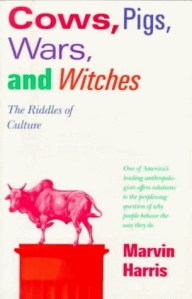
Harris“Cows, Pigs, Wars, and Witches: The Riddles of Culture”

by Marvin Harris

1974 Random House

Why do Jews and Muslims refuse to eat pork? Why were thousands of witches burned at the stake during late medieval Europe? These and other riddles are explored by famous anthropologist Marvin Harris, and his conclusions are simple: people act within social and ecological contexts that make their actions meaningful. Put another way: cultural ideas and practices that seem strange to us may actually be vital and necessary to the people of those cultures.

Harris is especially good at explaining how societies create elaborate rituals to avoid harming the natural ecosystems they depend on, which clarifies the Middle Eastern ban on pig products. It turns out the chubby animals compete with humans for the same foods. Raising them in large numbers would place great strain on a land made fragile by thousands of years of deforestation and desertification. Better to ban them entirely and not risk further ecological damage.

This logic is then extended to elucidate why the institution of warfare probably first arose as a way to limit population pressure on the environment. In Harris’ words, “In most primitive societies, warfare is an effective means of population control because intense, recurring intergroup combat places a premium upon rearing male rather than female infants.” Since the rate of population growth depends on the number of healthy women, privileging males by making their larger bodies necessary for combat is a way of reducing the need to “eat the forest.” Not that male supremacy and violence is the BEST way to curb population growth, but it’s one ritual that societies have adopted to meet that goal.

This discussion of patriarchy leads to an exploration of class. The emergence of “big men”, chiefs, and finally the State is explained as a cascading distortion of the original principles of reciprocity into the rule of redistribution. “Big men” work harder than anyone in their tribe to provide a large feast for their community – with the only goal being prestige. Chiefs similarly pursue prestige, and plan great feasts to show off their managerial skills, but they themselves harvest little food. Finally “we end up with state-level societies ruled over by hereditary kings who perform no basic industrial or agricultural labor and who keep the most and best of everything for themselves.” At the root of this construction of inequality is the impetus to make people work harder to create larger surpluses so that greater social rewards can be given out to show off the leader’s generosity. But only at the State or Imperial level is this hierarchy enforced not by prestige but by force of arms, to stop the poor and working classes from revolting and sharing the fruits of their labor.

The most provocative sections of the book deal with revolutionary movements that fought for this liberation, within the context of the religious wars of Biblical Judea and Late Medieval Europe.

First, Harris tackles the Messiah complex Read the rest of this entry »
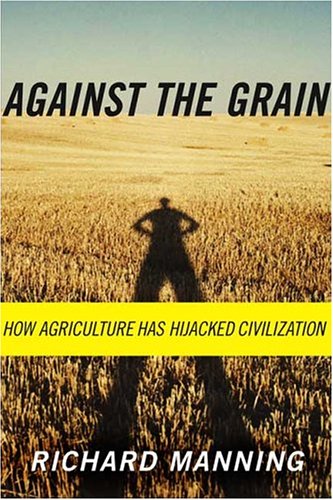

579932“Against the Grain: How Agriculture Has Hijacked Civilization”

Richard Manning

2004 North Point Press

Agriculture has domesticated humans. This is the argument at the center of Richard Manning’s stunning history of food. Written with journalistic flavor, Manning explores the ways that agriculture has diminished human life and threatens the planet itself.

The book begins by exploring the hunter-gatherer lifestyle, in many ways superior to our own even at the height of industrial capitalism. Hunter-gatherers, it turns out, ate a wider variety of tasty foods, worked far less, and lived much more sensually and connected than “civilized” humans. About 10,000 years ago, certain groups of humans traded all this in for security, namely the ability to stay in one spot and harvest grain to be stored for future food.

What this crop manipulation produced, however, was the first wealth inequality known to the species, as leaders left working the fields to their followers. In time, these stationary and hierarchical societies expanded and conquered/killed their hunter-gatherer neighbors. Soon enough crops like wheat, corn, and rice spread across the globe through violence and disease.

Manning focuses on these three crops because, as he explains, some 2/3 of all calories consumed today originate with them. In the US, corn is especially dominant, made into all kinds of commodities, for example corn syrup which can be found in just about everything we eat now. The dominance of these few grains is a consequence of capitalism, as they lend themselves easily to processing and storage – making them ideal commodities.

But an important plot twist in the story of grain’s dominance lies hidden in the open. Farm subsidies, especially in the US and Europe, distort the market to make these crops extremely cheap at the expense of all other nutrition. This has the added effect of enriching a few large agribusiness corporations (like Archer Daniels Midland) that grow or process them from enormous monocrop fields, although at the cost of ruining millions of small farmers all over the world. Our health, and the health of the planet are likewise jeopardized by the overabundance of these few crops produced with massive inputs of oil and chemicals.

Nevertheless, Richard Manning is able to summon the hope at the end of the book that our food system doesn’t have to be this way. Finding a distinction between agriculture and “simply growing food”, he argues that we can build an economy based on feeding people, and not just accumulating wealth. Organic agriculture, permaculture, intercropping, farmer’s markets and co-ops all point in this more just and sustainable direction, and awareness of the superiority of these more human methods has been growing at a phenomenal rate.

If we can nourish ourselves by reconnecting with the land and our sensual natures, perhaps we can also heal society and the planet. Against the Grain is a big step in educating us for that effort. Highly recommended.


yesI’ve recently discovered the brilliance emanating from the pages of Yes! Magazine.

Their latest issue is called The New Economy. Check it out, a lot of the articles are online! It begins with the bold (and correct) declaration:

“This downturn marks the end of an unsustainable economy. Rather than trying to reinflate the old bubble economy, these activists, visionaries, and upstarts are trying something new: an economy that puts people first and works within the carrying capacity of Mother Earth.”

Groundbreaking approaches towards integrating the economy into the fabric of local communities and the ecosystem are presented in extremely accessible language and easy-to-read formats, with lots of great graphs!

Although the magazine shies away from using language like “capitalism”, “socialism”, “anarchism”, etc., the articles overflow with radical prescriptions for social change that challenge the status quo in bold new ways. This is the stuff of revolutions, because it appeals to the masses of Americans without shying away from real solutions, like breaking apart the large banks, investing in local organic gardening, drastically reducing the military budget, and ensuring universal health care.

Most importantly, the magazine fills its pages with a strong current of hope and joy, which is so desperately needed in these times.  We need to remember that the collapse of the old system presents myriad opportunities for new grassroots endeavors, and a sense of joy is our strongest ally in this effort at rebuilding a world based on justice and sustainability.

Take a look, you won’t regret it! Yes!


The End of Capitalism” synopsis , a miniature version of the book-in-progress, has been finished!

The book will put forward the likelihood that the global capitalist system, structured around infinite growth, has reached an endpoint to expansion, both as a result of natural limits, such as peak oil, as well as social limits, manifested by people’s resistance to the system all over the world. The synopsis also explores two possible paths we might take from this momentous turning point: either towards a more militaristic and “fascist” future based on desperately clinging to the past, or a world built by the efforts of hopeful and forward-looking humanity, organizing from the bottom-up. Finally, a “holistic” approach to social change is put forward to inspire readers to imagine and take action for a better world, through the lenses of sustainability, democracy, justice, freedom and love.

I’m looking for responses to the synopsis so i can continue expanding the project for a mass audience, so if you’d like to submit feedback, ideas, comments, or questions, please send them to Alex at activistalex@gmail.com

Thanks. Here is the web version of the full synopsis, and below a link to a (shorter) summary version.  If you’d like to receive a microsoft word copy, please email me and I will send it to you.

Happy Reading!

Synopsis Outline:

  1. Is This the End of Capitalism?
  2. What is Capitalism?
  3. Why is it Collapsing?
  4. What Comes After Capitalism?
  5. Conclusion: The World We Are Building

And here’s the Summary.

alex


[Below are excerpts from Kevin Carson of the P2P Foundation responding to someone who claimed, “post-capitalism talk is largely Utopian fantasy”. I agree with the thrust of Kevin’s argument, capitalism faces collapse on a global scale – but the key social question of our age will not be “can capitalism survive?” but “what new social system(s) will outlive it?”

There are powerful forces seeking to deny us the possibility of relocalizing and democratizing our own economic networks, and which favor a re-nationalization of economic organization and a more brutal resource imperialism. In short, using the State to protect wealth and privilege from the economic chaos, commonly referred to as fascism. Social change is not deterministic, we are faced with widely diverging paths. How we win this struggle and create a post-capitalist world worth living in is the subject of my work. – alex]

“Is post-capitalism a fantasy?”

P2P Foundation, June 7, 2009.

Quotes by Kevin Carson.

I believe that within a generation we’re going to see a radical shortening of supply and distribution chains from Peak Oil, a combined relocalization of most production and an explosion of LETS and barter networks as official money and wage employment dry up for a major part of the population, and a collapse of the old corporate proprietors in the culture and software industries.

The growth of the financial sector compared to physical assets is a major symptom of the problem. Given corporate capitalism’s chronic tendency toward overproduction and overinvestment, you can’t invest the surplus in plant and equipment that will generate even more goods when people can’t consume existing output. So you pile up the surplus investment capital in a FIRE sector that only works until the ponzi scheme collapses.

[O]ne reason for the growth of the FIRE economy from the ’90s on was that the export of industrial capital had reached its limits as a strategy for solving the crisis of overinvestment. China is saturated with more industrial capital than there is a market for. And second, there’s not much future in shipping goods overseas from Chinese factories when fuel costs two or three–or more–times what it did this time last year.

Had oil stayed at its summer 2008 prices indefinitely, some 20% of airline routes would have shut down and a comparable percentage of long-haul trucks left the market. And this was indeed a “hiccup” compared to what we can expect from Peak Oil in the future. Even a supply shortfall of a few percent can cause prices at the pump to double. What can we expect when supply falls by half or two-thirds over the next generation? I expect we’ll see a total collapse of intercontinental supply chains except in vital minerals, and an order of magnitude of reduction of continental supply chains for most manufactured goods.

The factories in China and Vietnam will become useless for anything but producing goods for people in–well, in China and Vietnam. Production of spare parts and modular accessories will grow massively at the expense of production of new goods, and the growth in such production of spare parts and modular accessories will occur mainly in flexible manufacturing nets in relocalized industrial economies. In-season produce will be almost entirely relocalized by backyard gardening and market gardening, and a much larger percentage of our diets will be either in-season or canned local stuff.

We’re barely two years into the real crisis: two years from when real estate prices began to slide, a year from when Peak Oil first became a household word, and nine months since inventories and employment began a free-fall.

To say “everything’s OK so far” this early in the process is IMO about like saying, immediately after Alaric’s first repulse from the gates of Rome, “Well, the system’s still got a lot of life in it.” Or the old joke about the optimist who fell off a 100-story skyscraper and shouted to the people on the 99th floor, “OK so far!”

To say that things look good for capitalism except for Peak Oil is a bit like saying your uncle is just like your aunt except for his testicles.


This is What Democracy Looks Like is the definitive documentary about the 1999 Seattle protests against the World Trade Organization. Shot from the perspective of organizers, this film shows how the most iconic event of the (successful) movement against corporate globalization was created, day-by-day. We follow students, labor, environmentalists, and everyone seeking global justice as they brave police violence in order to shut down the Seattle Trade Summit, which led eventually to the collapse of the WTO. Creative visuals, hot beats, protest footage and powerful interviews combine into a very inspiring form of art – reminding us that when regular people come together, they can change the course of history. WATCH THIS MOVIE!!!

[This is Part 1 of 11 – make sure to click the Up-Arrow button to watch the rest!]


In 1995, multinational oil corporation Shell conspired with the Nigerian government to brutally suppress a popular nonviolent social movement that called for environmental justice in their polluted land. A key moment in this campaign of violence was the military show-trial of Ken Saro-Wiwa, leader of the Ogoni people and nonviolent advocate, which led to his execution.

Shell is currently facing trial in New York in a lawsuit brought by the Wiwa family, charging the oil company with “requesting, financing, and assisting the Nigerian military which used deadly force to repress opposition to Shell’s operations in the Ogoni region of the Niger Delta.”

This short video tells the story of Ken Saro-Wiwa and how corporate and state power merge to violently suppress grassroots social movements in order to protect the exploitation of the environment and workers.


Salt of the Earth is a classic organizing movie about striking Mexican-American miners and their wives. Based on an incredible true story, the 1953 film follows the organizing efforts of the town’s women, who must overcome the company’s classism, the sheriff’s racism, as well as their own husband’s sexism, to win the strike (while the men stay at home and take care of the house and children). Highly recommended!

This is just the first segment of the movie, make sure to click the Up-Arrow button to watch the rest!

Enter your email address and subscribe to get the latest End of Capitalism news right in your inbox..

Join 883 other subscribers
You are here

Friendly Websites

Anda La Lucha
- Andalusia Knoll

Feminist Frequency
- Anita Sarkeesian

Recovering Hipster
- Heather

Praxis Makes Perfect
- Joshua Kahn Russell

Organizing for Power
- Lisa Fithian

Misanthropic Anthropologist

For Student Power
- Patrick St. John

AIDS and Social Justice
- Suzy Subways