
You are currently browsing the category archive for the ‘War’ category.

Child soldiers in the Congo Civil War
A civil war has been raging in the Democratic Republic of the Congo since.. well.. pretty much since the Belgians conquered the area, committed genocide, and called it a colony, as told in the excellent book King Leopold’s Ghost. But in the past 13 years, warfare has escalated and killed over 6 million Congolese, while rape has become an absolute epidemic and one of the main weapons of war. The UN’s top humanitarian official described the sexual violence against Congolese women as “almost unimaginable” for its frequency and ferocity.
This is a conflict that concerns us all, as it sheds crucial light on the functioning of global capitalism. At the center of the war is a mineral called coltan, short for Columbite-tantalite, which is used in capacitors, a necessary piece of electronics found in virtually every electronic device of modern capitalist society, from laptops to cell phones to cameras and jet engines. See Coltan: Learning the Basics. Coltan is just one of several expensive and rare minerals abundant in this remote region of central Africa, but coltan is ONLY available in this part of the world, which makes it extremely valuable.

Millions of children are exploited to mine coltan and other valuable minerals in the Congo
The DRC government, Uganda, Rwanda, and various militias and guerrilla forces are fighting over control of the land where these minerals are mined. The local residents, whose traditional lifestyles have been disrupted by decades of civil war, are forced to dig tiny amounts of these “conflict minerals” from the soil in inhuman conditions, often with their bare hands. An estimated 2 million of the miners are children, and often they are literal or virtual slaves who are on the brink of starvation. It is a situation which can only be described as hell on earth.
When you hear about such extreme exploitation, you can be pretty sure that some folks are making a hell of a lot of money. In this case, it’s western corporations like Nokia, Motorola, Compaq, Dell, IBM, Sony and many more who rely on extremely cheap capacitors in their electronics to make their profits from our Christmas presents. These companies have thus far avoided scrutiny by outsourcing the more direct business of extracting the minerals to smaller companies.
If there is any hope in this terrible situation, it is that capitalism is reaching the end of its ability to exploit the people of the world the way it has for the last centuries, and through the increased awareness of what is happening in places like the Congo, we as a people will say “Never again.” It is primarily the responsibility of those of us in the wealthy countries to put a stop to this paradigm of rape, slavery, and capitalist profit. Only we have the power to end the madness.
Below is a wonderful article that outlines specific solutions to the Congo civil war. [alex]
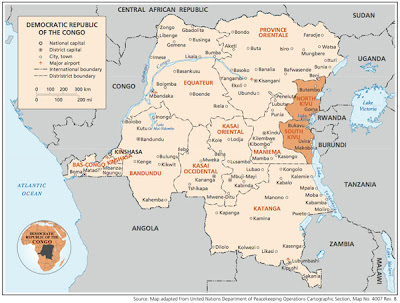
Conflict Minerals: A Cover For US Allies and Western Mining Interests?
Kambale Musavuli and Bodia Macharia
Originally published by Huffington Post, Dec. 14, 2009.
As global awareness grows around the Congo and the silence is finally being broken on the current and historic exploitation of Black people in the heart of Africa, myriad Western based “prescriptions” are being proffered. Most of these prescriptions are devoid of social, political, economic and historical context and are marked by remarkable omissions. The conflict mineral approach or efforts emanating from the United States and Europe are no exception to this symptomatic approach which serves more to perpetuate the root causes of Congo’s challenges than to resolve them.
The conflict mineral approach has an obsessive focus on the FDLR and other rebel groups while scant attention is paid to Uganda (which has an International Court of Justice ruling against it for looting and crimes against humanity in the Congo) and Rwanda (whose role in the perpetuation of the conflict and looting of Congo is well documented by UN reports and international arrest warrants for its top officials). Rwanda is the main transit point for illicit minerals coming from the Congo irrespective of the rebel group (FDLR, CNDP or others) transporting the minerals. According to Dow Jones, Rwanda’s mining sector output grew 20% in 2008 from the year earlier due to increased export volumes of tungsten, cassiterite and coltan, the country’s three leading minerals with which Rwanda is not well endowed. In fact, should Rwanda continue to pilfer Congo’s minerals, its annual mineral export revenues are expected to reach $200 million by 2010. Former Assistant Secretary of State for African Affairs Herman Cohen says it best when he notes “having controlled the Kivu provinces for 12 years, Rwanda will not relinquish access to resources that constitute a significant percentage of its gross national product.” As long as the West continues to give the Kagame regime carte blanche, the conflict and instability will endure. Read the rest of this entry »
 http://www.democracynow.org/2009/12/17/bolivian_president_evo_morales_on_climate
AMY GOODMAN: Just before we went to air today, I interviewed Evo Morales, Bolivia’s first indigenous president. He was re-elected in a landslide victory earlier this month. On Wednesday, Evo Morales called on world leaders to hold temperature increases over the next century to just one degree Celsius, the most ambitious proposal so far by any head of state. Morales also called on the United States and other wealthy nations to pay an ecological debt to Bolivia and other developing nations.
AMY GOODMAN: President Morales, welcome to Democracy Now!
PRESIDENT EVO MORALES: [translated] Thank you very much for the invitation.
AMY GOODMAN: You spoke yesterday here at the Bella Center and said we cannot end global warming without ending capitalism. What did you mean?
PRESIDENT EVO MORALES: [translated] Capitalism is the worst enemy of humanity. Capitalism—and I’m speaking about irrational development—policies of unlimited industrialization are what destroys the environment. And that irrational industrialization is capitalism. So as long as we don’t review or revise those policies, it’s impossible to attend to humanity and life.
AMY GOODMAN: How would you do that? How would you end capitalism?
PRESIDENT EVO MORALES: [translated] It’s changing economic policies, ending luxury, consumerism. It’s ending the struggle to—or this searching for living better. Living better is to exploit human beings. It’s plundering natural resources. It’s egoism and individualism. Therefore, in those promises of capitalism, there is no solidarity or complementarity. There’s no reciprocity. So that’s why we’re trying to think about other ways of living lives and living well, not living better. Not living better. Living better is always at someone else’s expense. Living better is at the expense of destroying the environment.
AMY GOODMAN: President Morales, what are you calling here—for here at the UN climate summit?
PRESIDENT EVO MORALES: [translated] Defense of the rights of Mother Earth. Read the rest of this entry »
Guardian / UK Tuesday, December 1, 2009
A Troop Surge Can Only Magnify the Crime Against Afghanistan
If Barack Obama heralds an escalation of the war, he will betray his own message of hope and deepen my people’s pain
by Malalai Joya
After months of waiting, President Obama is about to announce the new US strategy for Afghanistan. His speech may be long awaited, but few are expecting any surprise: it seems clear he will herald a major escalation of the war. In doing so he will be making something worse than a mistake. It is a continuation of a war crime against the suffering people of my country.
I have said before that by installing warlords and drug traffickers in power in Kabul, the US and Nato have pushed us from the frying pan to the fire. Now Obama is pouring fuel on these flames, and this week’s announcement of upwards of 30,000 more troops to Afghanistan will have tragic consequences.
Already this year we have seen the impact of an increase in troops occupying Afghanistan: more violence, and more civilian deaths. My people, the poor of Afghanistan who have known only war and the domination of fundamentalism, are today squashed between two enemies: the US/Nato occupation forces on one hand and warlords and the Taliban on the other.
While we want the withdrawal of one enemy, we don’t believe it is a matter of choosing between two evils. There is an alternative: the democratic-minded parties and intellectuals are our hope for the future of Afghanistan.
It will not be easy, but if we have a little bit of peace we will be better able to fight our own internal enemies – Afghans know what to do with our destiny. We are not a backward people, and we are capable of fighting for democracy, human and women’s rights in Afghanistan. In fact the only way these values will be achieved is if we struggle for them and win them ourselves.
After eight years of war, the situation is as bad as ever for ordinary Afghans, and women in particular. The reality is that only the drug traffickers and warlords have been helped under this corrupt and illegitimate Karzai government. Read the rest of this entry »
Also published by The Rag Blog and OpEdNews.
 “We stand at a critical moment in Earth’s history, a time when humanity must choose its future. As the world becomes increasingly interdependent and fragile, the future at once holds great peril and great promise. To move forward we must recognize that in the midst of a magnificent diversity of cultures and life forms we are one human family and one Earth community with a common destiny. We must join together to bring forth a sustainable global society founded on respect for nature, universal human rights, economic justice, and a culture of peace. Towards this end, it is imperative that we, the peoples of Earth, declare our responsibility to one another, to the greater community of life, and to future generations. – The Earth Charter” (pg. 1).
David Korten, long-time global justice activist, co-founder of Yes! Magazine, and author of such books as When Corporations Rule the World, lays out the fundamental crossroads facing the world in his 2006 book The Great Turning: From Empire to Earth Community. In response to global climate change, war, oil scarcity, persistent racism and sexism and many other mounting crises, Korten argues we must recognize these as symptoms of a larger system of Empire, so that we might move in a radically different direction of equality, ecological sustainability, and cooperation, which he terms Earth Community. This is a powerful and important book, which excels in overviewing the big picture of threats facing our ecosphere and our communities at the hands of global capitalism1, and translating this into the simplest and most accessible language so we might all do something about it. It’s pretty much anti-capitalism for the masses. And it has the power to inspire many of us to transform our lives and work towards the transformation of society.
Capitalism and Empire
Of course, Korten has made the strategic decision to avoid pointing the finger at “capitalism” as such in order to speak to an American public which largely still confuses the term as equivalent to “freedom” or “democracy.” In fact the “C” word is rarely mentioned in the book, almost never without some sort of modifier as in “corporate capitalism” or “predatory capitalism”, as if those weren’t already features of the system as a whole. Instead, Korten names “Empire” as the culprit responsible for our global economic and ecological predicament, which is defined as a value-system that promotes the views that “Humans are flawed and dangerous”, “Order by dominator hierarchy”, “Compete or die”, “Masculine dominant”, etc. (32).
Korten explains that Empire, “has been a defining feature of the most powerful and influential human societies for some five thousand years, [and] appropriates much of the productive surplus of society to maintain a system of dominator power and elite competition. Racism, sexism, and classism are endemic features” (25). In this way the anarchist concept of the State is repackaged as a transcendent human tendency, which has more to do with conscious decision-making and maturity level than it does with political power. While this compromise does limit the book’s effectiveness in offering solutions later on, it does speak in a language more familiar to the vast non-politicized majority of Americans, and may have the potential to unify a larger movement for change.
Whatever you want to call the system, the danger it presents to the planet is now clear. Korten spells out the grim statistics: “Fossil fuel use is five times what it was [in 1950], and global use of freshwater has tripled… the [Arctic] polar ice cap has thinned by 46 percent over twenty years… [while we’ve seen] a steady increase over the past five decades in severe weather events such as major hurricanes, floods, and droughts. Globally there were only thirteen severe events in the 1950s. By comparison, seventy-two such events occurred during the first nine years of the 1990s” (59-60). If this destruction continues, it’s uncertain if the Earth will survive.
This ecological damage is considered alongside the social damage of billions living without clean water or adequate food, as well as the immense costs of war and genocide. But Korten understands that the danger is relative to where you stand in the social hierarchy – the system creates extreme poverty for many, and an extreme wealth for a few others. He explains how the system is based on a deep inequality that is growing ever worse, “In the 1990s, per capita income fell in fifty-four of the world’s poorest countries… At the other end of the scale, the number of billionaires worldwide swelled from 274 in 1991 to 691 in 2005” (67). The critical point that these few wealthy elites wield excessive power and influence within the system to stop or slow necessary reform could be made more clearly, but at least the book exposes the existence of this upper class, who are usually quite effective at hiding from public scrutiny and outrage over the suffering they are causing.2
Earth Community – Growing a Revolution
Standing at odds with the bastions of Empire is what David Korten calls “Earth Community,” a “higher-order” value-system promoting the views of, “Cooperate and live,” “Love life”, “Defend the rights of all”, “Gender balanced”, etc. (32). Read the rest of this entry »
This essay, written following a listening tour across the US, asks some of the most important questions facing social movements today, including “How Do We Build Intergenerational Movements?”, “What About Multiracial Movement Building?” and “How Do We Develop Strategy?”
I read this when it first came out in the summer of 2006 and it pretty much rocked my socks off and made me excited to get involved in the new SDS, so I figured I’d repost it for folks who never got to read it. [alex]
Ten Questions for Movement Building
by Dan Berger and Andy Cornell
Originally published by Monthly Review Zine.
For five weeks in the late spring of 2006, we toured the eastern half of the United States to promote two books — Letters From Young Activists: Today’s Rebels Speak Out (Nation Books, 2005) and Outlaws of America: The Weather Underground and the Politics of Solidarity (AK Press, 2006) — and to get at least a cursory impression of sectors of the movement in this country. We viewed the twenty-eight events not only as book readings but as conscious political conversations about the state of the country, the world, and the movement.
Of course, such quick visits to different parts of the country can only yield so much information. Because this was May and June, we did not speak on any school campuses and were unable to gather a strong sense of the state of campus-based activism. Further, much of the tour came together through personal connections we’ve developed in anarchist, queer, punk, and white anti-racist communities, and, as with any organizing, the audience generally reflected who organized the event and how they went about it rather than the full array of organizing projects transpiring in each town. Yet several crucial questions were raised routinely in big cities and small towns alike (or, alternately, were elided but lay just beneath the surface of the sometimes tense conversations we were party to). Such commonality of concerns and difficulties demonstrates the need for ongoing discussion of these issues within and between local activist communities. Thus, while we don’t pretend to have an authoritative analysis of the movement, we offer this report as part of a broader dialogue about building and strengthening modern revolutionary movements — an attempt to index some common debates and to offer challenges in the interests of pushing the struggle forward.
Challenges and Debates:
The audiences we spoke with tended to be predominantly white and comprised of people self-identified as being on the left, many of whom are active in one or more organizations locally or nationally. We traveled through the Northeast (including a brief visit to Montreal), the rust belt, the Midwest, parts of the South, and the Mid-Atlantic. Some events tended to draw mostly 60s-generation activists, others primarily people in their 20s, and more than a few were genuinely intergenerational. Not surprisingly, events at community centers and libraries afforded more room for conversation than those at bookstores. Crowds ranged anywhere from 10 to 100 people, although the average event had about 25 people. Even where events were small gatherings of friends, they proved to be useful dialogues about pragmatic work. Our goals for the tour were: establishing a sense of different organizing projects; pushing white people in an anti-racist and anti-imperialist direction while highlighting the interrelationship of issues; and grappling with the difficult issues of organizing, leadership, and intergenerational movement building. The following ten questions emerge from our analysis of the political situation based on our travels and meetings with activists of a variety of ages and range of experiences.
1. What Is Organizing?
Every event we did focused on the need for organizing. This call often fell upon sympathetic ears, but was frequently met with questions about how to actually organize and build lasting radical organizations, particularly in terms of maintaining radical politics while reaching beyond insular communities. There are too few institutions training young or new activists in the praxis of organizing and anti-authoritarian leadership development. Read the rest of this entry »
Also published by The Rag Blog, OpEdNews, Signs of the Times, Interactivist Info Exchange, and Toward Freedom.
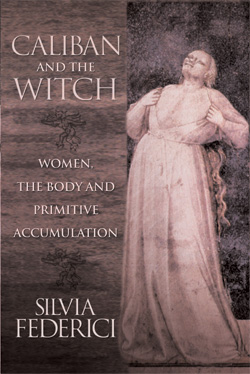 Who Were the Witches? – Patriarchal Terror and the Creation of Capitalism
Alex Knight
November 5, 2009
This Halloween season, there is no book I could recommend more highly than Silvia Federici’s brilliant Caliban and the Witch: Women, the Body, and Primitive Accumulation (Autonomedia 2004), which tells the dark saga of the Witch Hunt that consumed Europe for more than 200 years. In uncovering this forgotten history, Federici exposes the origins of capitalism in the heightened oppression of workers (represented by Shakespeare’s character Caliban), and most strikingly, in the brutal subjugation of women. She also brings to light the enormous and colorful European peasant movements that fought against the injustices of their time, connecting their defeat to the imposition of a new patriarchal order that divided male from female workers. Today, as more and more people question the usefulness of a capitalist system that has thrown the world into crisis, Caliban and the Witch stands out as essential reading for unmasking the shocking violence and inequality that capitalism has relied upon from its very creation.
Who Were the Witches?
Parents putting a pointed hat on their young son or daughter before Trick-or-Treating might never pause to wonder this question, seeing witches as just another cartoonish Halloween icon like Frankenstein’s monster or Dracula. But deep within our ritual lies a hidden history that can tell us important truths about our world, as the legacy of past events continues to affect us 500 years later. In this book, Silvia Federici takes us back in time to show how the mysterious figure of the witch is key to understanding the creation of capitalism, the profit-motivated economic system that now reigns over the entire planet.
During the 15th – 17th centuries the fear of witches was ever-present in Europe and Colonial America, so much so that if a woman was accused of witchcraft she could face the cruellest of torture until confession was given, or even be executed based on suspicion alone. There was often no evidence whatsoever. The author recounts, “for more than two centuries, in several European countries, hundreds of thousands of women were tried, tortured, burned alive or hanged, accused of having sold body and soul to the devil and, by magical means, murdered scores of children, sucked their blood, made potions with their flesh, caused the death of their neighbors, destroyed cattle and crops, raised storms, and performed many other abominations” (169).
In other words, just about anything bad that might or might not have happened was blamed on witches during that time. So where did this tidal wave of hysteria come from that took the lives so many poor women, most of whom had almost certainly never flown on broomsticks or stirred eye-of-newt into large black cauldrons?
Caliban underscores that the persecution of witches was not just some error of ignorant peasants, but in fact the deliberate policy of Church and State, the very ruling class of society. To put this in perspective, today witchcraft would be a far-fetched cause for alarm, but the fear of hidden terrorists who could strike at any moment because they “hate our freedom” is widespread. Not surprising, since politicians and the media have been drilling this frightening message into people’s heads for years, even though terrorism is a much less likely cause of death than, say, lack of health care.1 And just as the panic over terrorism has enabled today’s powers-that-be to attempt to remake the Middle East, this book makes the case that the powers-that-were of Medieval Europe exploited or invented the fear of witches to remake European society towards a social paradigm that met their interests.
Interestingly, a major component of both of these crusades was the use of so-called “shock and awe” tactics to astound the population with “spectacular displays of force,” which helped to soften up resistance to drastic or unpopular reforms.2 In the case of the Witch Hunt, shock therapy was applied through the witch burnings – spectacles of such stupefying violence that they paralyzed whole villages and regions into accepting fundamental restructuring of medieval society.3 Federici describes a typical witch burning as, “an important public event, which all the members of the community had to attend, including the children of the witches, especially their daughters who, in some cases, would be whipped in front of the stake on which they could see their mother burning alive” (186).
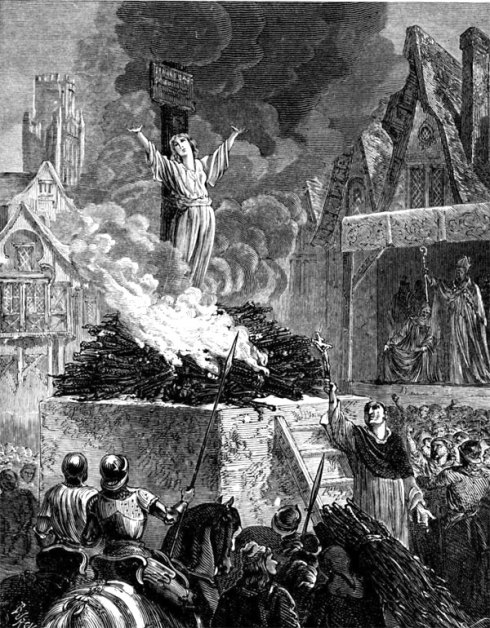
The witch burning was the medieval version of "Shock and Awe"
The book argues that these gruesome executions not only punished “witches” but graphically demonstrated the repercussions for any kind of disobedience to the clergy or nobility. In particular, the witch burnings were meant to terrify women into accepting “a new patriarchal order where women’s bodies, their labor, their sexual and reproductive powers were placed under the control of the state and transformed into economic resources” (170). Read the rest of this entry »


 The End of Capitalism
Recent Comments