
You are currently browsing the category archive for the ‘Racism’ category.
[You know the prison-industrial complex has gotten out of hand when white Southern U.S. Senators are calling it out for being racist. – alex]
Why We Must Fix Our Prisons
By Senator Jim Webb, VA
 America’s criminal justice system has deteriorated to the point that it is a national disgrace. Its irregularities and inequities cut against the notion that we are a society founded on fundamental fairness. Our failure to address this problem has caused the nation’s prisons to burst their seams with massive overcrowding, even as our neighborhoods have become more dangerous. We are wasting billions of dollars and diminishing millions of lives.
Sen. Webb introduces new legislation:
‘It’s time to change the law’
We need to fix the system. Doing so will require a major nationwide recalculation of who goes to prison and for how long and of how we address the long-term consequences of incarceration. Twenty-five years ago, I went to Japan on assignment for PARADE to write a story on that country’s prison system. In 1984, Japan had a population half the size of ours and was incarcerating 40,000 sentenced offenders, compared with 580,000 in the United States. As shocking as that disparity was, the difference between the countries now is even more astounding–and profoundly disturbing. Since then, Japan’s prison population has not quite doubled to 71,000, while ours has quadrupled to 2.3 million.
The United States has by far the world’s highest incarceration rate. With 5% of the world’s population, our country now houses nearly 25% of the world’s reported prisoners. We currently incarcerate 756 inmates per 100,000 residents, a rate nearly five times the average worldwide of 158 for every 100,000. In addition, more than 5 million people who recently left jail remain under “correctional supervision,” which includes parole, probation, and other community sanctions. All told, about one in every 31 adults in the United States is in prison, in jail, or on supervised release. This all comes at a very high price to taxpayers: Local, state, and federal spending on corrections adds up to about $68 billion a year. Read the rest of this entry »
More and more people are using the language of peak oil and becoming aware that the future we once took for granted is now being foreclosed (not incidentally, by the same folks who are foreclosing a lot of our homes). It is increasingly clear that we stand at a cross-roads, and that neither road leads anywhere similar to the global capitalist era we just passed through.
Here are some excerpts from a good article that acknowledges the reasons why the future will be nothing like the past, and lays out the 2 paths we can now head down. I wrote some thoughts at the end to inspire us to think realistically and demand the impossible. [alex]
Time to Deliver: No Turning Back, Part I.
by Sara Robinson
April 7, 2009
Originally published by Campaign for America’s Future
..[T]he two dominant scenarios about the American future that progressives seem to be wrestling with right now [might be described as]:
1) Permanent Decline — Due to Americans’ native hyperindividualism, political apathy, and overweening willingness to accept personal blame for their country’s failures, the corporatists finally succeed in turning the US into Indonesia. This time, we will not find the will to fight back (or, if we do, it will be too late). As a result, in a few years there will be no more middle class, no upward mobility, few remaining public institutions devoted to the common good, no health care, no education, and no hope of ever restoring American ideals or getting back to some semblance of the America we knew.
2) Reinvented Greatness — Americans get over their deeply individualistic nature, come together, challenge and restrain the global corporatist order, and finally establish the social democracy that the Powers That Be — corporate, military, media, conservative — have denied to us since the 1950s. This happens in synergy with a move to energy and food self-sufficiency, the growth of a sustainable economy, a revival of participatory democracy, and a general renewal of American values that pulses new life into our institutions and assures us a much more stable future.
Conservatives and the mainstream media, of course, are also offering a third scenario:
3) Happy Face — Prop up the banks, keep people in their houses, and by and by everything will get back to “normal” (defined as “how it all was a few years ago.”)
[Sara recognizes that this third “road” is an illusion, for the following underlying realities which cannot be ignored any longer. -alex]
1. Energy regime change
The first reason there’s no going back to the way it was is that there’s simply not enough oil left in the ground — or carbon sinks left in the world — to sustain America as we’ve known it. We may well be able to sustain some semblance of that way of life (or perhaps, find our way to one even more satisfying); but we won’t be running it on oil or coal.
And when the oil goes, so goes the empire. Read the rest of this entry »
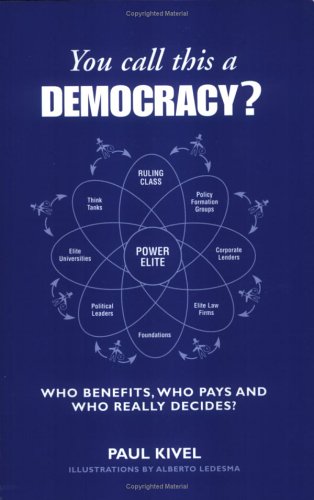
“You Call This a Democracy? Who Benefits, Who Pays, and Who Really Decides?”
by Paul Kivel
2004 Apex Press
Paul Kivel exposes the ruling class of the United States and how it operates in this short, easy-to-read book. With simple concepts and cute illustrations, a nuanced class analysis is presented in a very clear and accessible format.
If the education system was any good at all, “You Call This a Democracy?” would be one of the textbooks used in all high schools. It explains what the ruling class is (those with a family income above $373,000 and net financial wealth of at least $2 million), how it controls the government, media, and economy, and the negative effects we all suffer, such as poverty, wars, disease, pollution, over-working, stress, and meaningless, isolated lives. Kivel particularly does a great job exposing how the ruling class uses racism, sexism, homophobia and other social divisions to keep itself, a relatively small group of basically white Protestant men, in power. Making the connections between systems of oppression is one of the keys to the freedom of everybody, and this book helps move that analysis forward.
There a couple criticisms I could make about the book, first that it doesn’t inspire enough hope or provide much of a systematic solution to the problem that it systematically critiques. And secondly that the book can be cumbersome to read because of a fair amount of repetition coupled with too many general statements about segments of the population. To a certain extent, this was unavoidable in a book of this nature, but I could have used more examples of particular corporations, politicians, and businesspeople and their ilk, even though the examples given in the book are all great.
Definitely check this out if you want to have any idea about the country you’re living in, and how you and your family and everyone you care about are being screwed over by the super-wealthy elite. The path to a democratic future starts when we become informed.
“The war on population always has been, and will continue to be, a war on women’s bodies.”
After reading this article by Betsy Hartmann rebutting recent psuedo-environmental hysteria surrounding overpopulation, I wanted to investigate further how fears of overpopulation facilitate sexist, racist and imperialistic policies by Western countries and NGOs against poor women of color in the Global South.
As Hartmann states with clarity:
“The population controllers have blinders on their eyes when they attribute the cutting down of forests, the polluting of water supplies, and the extinction of species to too many poor people, rather than the unchecked power of large corporations to monopolize resources and ravage the land. Missing from the picture is the question of technological choice: for example, reducing the population of automobiles and investing in public transport worldwide would do much more to curtail climate change than imposing limits on family size.”
This seems to me fundamentally correct. It’s clear that human civilization has overshot the capacity of the Earth to provide for it, that’s not in question. The question is about what forces are responsible for this, and what can we do about it?
For Hartmann and myself, the number of people alive is not nearly as important as the structure of the economic system in which we live. The planet could support 6, or maybe even 9, billion people living a low-impact lifestyle, based on community subsistence and a diet full of fruits and vegetables. But the planet cannot possibly support 6 billion people living like Americans, with their cars, and their computers, and their wars.
As with all things, the debate on “overpopulation” is a political debate, because its a question about who has power and who doesn’t. Placing the blame on poor women is just a way of ignoring the real power-holders: Large multinational corporations and Western capitalist governments.
Below are excerpts from an article that I found helpful in explaining this more clearly. [alex]
10 Reasons to Rethink “Overpopulation”
By the Population and Development Program at Hampshire College
Fears of overpopulation are pervasive in American society. From an early age we are taught that the world is overpopulated and that population pressure is responsible for poverty, hunger, environmental degradation and even political insecurity. If we don’t get population growth under control now, the argument goes, our future is in danger.
Conventional wisdom, however, is not always wise. Placing the blame on population obscures the powerful economic and political forces that threaten the well-being of both people and the planet. It leads to top-down, target-driven population control programs that undermine voluntary family planning and women’s reproductive rights. It reinforces racism, promoting harmful stereotypes of poor people of color. And it prevents the kind of global understanding we need in order to reach across borders to work together for a more just, peaceful and environmentally sustainable world.
Here are ten reasons why we should rethink ‘overpopulation.’
…
2. The focus on population masks the complex causes of poverty and inequality.
A narrow focus on human numbers obscures the way different economic and political systems operate to perpetuate poverty and inequality. It places the blame on the people with the least amount of resources and power rather than on corrupt governments and economic and political elites. It ignores the legacy of colonialism and the continuing unequal relationship between rich and poor countries, including unfavorable terms of trade and the debt burden. It says nothing about the concentration of much wealth in a few hands. In the late 1990s, the 225 people who comprise the ‘ultra-rich’ had a combined wealth of over US $1 trillion, equivalent to the annual income of the poorest 47% of the world’s people.
3. Hunger is not the result of ‘too many mouths’ to feed.
…There is enough food for every man, woman and child to have more than the recommended daily calorie intake. People go hungry because they do not have the land on which to grow food or the money with which to buy it. Read the rest of this entry »
Grace Lee Boggs is a prominent long-time veteran of civil rights and other movements for justice. An Asian-American woman, now in her 80s, she is active in building urban agriculture systems for the community of Detroit. Their efforts to create a sustainable local economy out of a postindustrial urban shell are an example for all urban American cities. [alex]
Detroit: City of Hope
Building a sustainable economy out of the ashes of industry.
By Grace Lee Boggs
Originally published by In These Times
February 17, 2009.
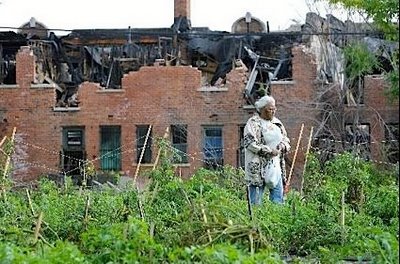
Photographer: Fabrizio Costantini/Bloomberg News. Hazel Williams picks green tomatoes at an Urban Farm off Linwood Avenue in Detroit, on Sept. 22, 2008. Photo by Fabrizio Costantini / Bloomberg.
Detroit is a city of Hope rather than a city of Despair. The thousands of vacant lots and abandoned houses not only provide the space to begin anew but also the incentive to create innovative ways of making our living—ways that nurture our productive, cooperative and caring selves.
The media and pundits keep repeating that today’s economic meltdown is the worst financial crisis since the Great Depression. But in the ’30s, the United States was an overproducing industrial giant, not today’s casino economy.
In the last few decades, once-productive Americans have been transformed into consumers, using more and more of the resources of the earth to foster ways of living that are unsustainable and unsatisfying. This way of life has created suburbs that destroy farmland, wetlands and the natural world, as well as pollute the environment.
The new economy also requires a huge military apparatus to secure global resources and to consume materials for itself, at the same time providing enormous riches for arms merchants and for our otherwise failing auto, air and ship-building sectors.
Instead of trying to resurrect or reform a system whose endless pursuit of economic growth has created a nation of material abundance and spiritual poverty—and instead of hoping for a new FDR to save capitalism with New Deal-like programs—we need to build a new kind of economy from the ground up.
That is what I have learned from 55 years of living and struggling in Detroit, the city that was once the national and international symbol of the miracle of industrialization and is now the national and international symbol of the devastation of deindustrialization.
When I arrived in Detroit in 1953, the population was 2 million, the majority white. Today, it is less than 900,000, majority black. Back then, racism was blatant and overt. Many bars, restaurants and hotels refused service to blacks. Blacks could buy homes in inner city neighborhoods but could not rent apartments in buildings right next door to these homes.
Meanwhile, freeways were enabling white flight to the suburbs, and technology was replacing human beings with robots.
In 1973, we elected our first black mayor, Coleman Young. Young was a gifted politician who was able to eliminate the most egregious examples of racism, especially in the police and fire departments and City Hall. But he was unable to imagine a post-industrial society. So, for 14 years, he tried in vain to woo industrial jobs back to Detroit.
In 1988, toward the end of his fourth term, Young decided that the factories weren’t coming back and that Detroit’s salvation depended on casino gambling, which he said would create 50,000 jobs.
To defeat his proposal, we organized Detroiters Uniting, a coalition of community groups, blue-collar, white-collar and cultural workers, clergy, political leaders and professionals.
Our concern was with how our city had been disintegrating socially, economically, politically, morally and ethically. We were convinced that we could not depend upon one industry or one large corporation to provide us with jobs. It was now up to us—the citizens of Detroit—to create meaningful jobs and income for all citizens.
We needed a new kind of city where citizens take responsibility for their decisions instead of leaving them to politicians or the marketplace.
Greening the Motor City
Read the rest of this entry »

“How the Irish Became White”
by Noel Ignatiev
1995 Routledge
“It is a curious fact,” wrote John Finch, an English Owenite who traveled the United States in 1843, “that the democratic party, and particularly the poorer class of Irish immigrants in America, are greater enemies to the negro population, and greater advocates for the continuance of negro slavery, than any portion of the population in the free States.”
How did the Irish become White? By violently subjugating African Americans, according to this courageous book by Noel Ignatiev.
As a part-Irish American, learning about the injustice that some of my ancestors took part in is deeply troubling, but it’s a history that we need to explore to uncover the true legacy of mass Irish immigration to America, and more fundamentally, the meaning of “Whiteness”.
The Irish in Ireland of the early-19th Century were a revolutionary people: impoverished, agrarian, and determined to break free of the grip of England’s tyranny. But once these same freedom-lovers emigrated to the United States, a peculiar thing happened: they were faced with a society based on racial segregation and industrial capitalism. Moreover, there began a large “Nativist” movement by wealthy Protestant Anglo-Saxons who tried to restrict immigration and subdue Irish/Catholic influence in the New World.
In order to overcome these barriers, the Irish made a strategic choice: escape the bottom-rung of poverty and be accepted into mainstream US society by aggressively aligning themselves with the Democratic Party and doing everything they could to keep African Americans in slavery or otherwise out of the labor market. Thus they earned the right to be considered “White” and receive the benefits and privileges associated with that social category.
Ignatiev makes a compelling case that “When Irish workers encountered Afro-Americans, they fought with them, it is true, but they also fought with immigrants of other nationalities, with each other, and with whomever else they were thrown up against in the marketplace.” In other words, it wasn’t that the Irish were inherently more racist than any other group. Instead, the race riots when rowdy Irish attacked African Americans were largely in response to an economic condition arising in early US capitalism: Northern industrial labor markets were saturated by waves of immigrants and freed slaves competing over lower and lower wages. To secure jobs for themselves, the Irish became the hammer that pounded away at racial segregation to force African Americans out of the factories and into poverty and the ghetto.
By doing so, they also solidified the major distinction between relatively privileged sectors of the US working class and those on the bottom – “Whiteness”. Ignatiev explains: “Since ‘white’ was not a physical description but one term of a social relation which could not exist without its opposite, ‘white man’s work’ was simply, work from which Afro-Americans were excluded.” Read the rest of this entry »
After two weeks of protests and “rebellion” in the streets of Oakland, CA, police have arrested Johannes Mehserle, the BART transit cop who shot and killed unarmed Oscar Grant on an Oakland train platform New Year’s Day. This is significant because this is perhaps the first time a California policeman has faced murder charges for killing someone while on duty.
Oscar Grant, the 22-year-old black man who was killed while lying flat on his stomach unarmed and restrained, has become a symbol for the racism and brutality that are endemic of police forces after his death was captured on video and circulated on Youtube.
This music video tribute by Jasiri X explains the story of Oscar Grant, but does contain somewhat graphic images of the shooting.
Follow the story at the website of Oakland activist Davey D, http://daveyd.com/
Here is a news article about the arrest.
http://hiphopnews.yuku.com/topic/1002
OAKLAND, Calif.
— Several well-placed sources are telling KTVU news that a warrant was issued for former BART officer Johannes Mehserle and that the officer is now in police custody.
Mehserle was the officer involved in the New Year’s Day fatal shooting of 22-year-old Oscar Grant on the platform of the Fruitvale BART station.
KTVU sources say Mehserle was some distance from the Bay Area when he was taken into custody and won’t arrive at the jail Tuesday night. Published reports indicate the BART police officer was arrested in Nevada. Read the rest of this entry »
Third and possibly last in the holiday movie series, Cry Freedom features Denzel Washington as Steve Biko, Black South African revolutionary during the 60s-70s. The movie criticizes the Apartheid system which restricted Blacks from moving around their country and having decent jobs and education, as well as giving the privileged race the ability to kill indiscriminately, very similar to the current situation in Occupied Palestine.
(This is just the first segment of the movie, make sure to click the Up-Arrow button to watch the rest!)


 The End of Capitalism
Recent Comments