
You are currently browsing the category archive for the ‘Racism’ category.
This is one of the most striking and intelligent articles I’ve ever read, encouraging a total reconfiguring of how to view capitalism and revolution. Russell Means was a leader in the American Indian Movement (AIM) of the 1960s and 70s, and remains one of the most outspoken Native Americans in the U.S.
I came across this essay while researching for my upcoming critique of Marxism, and was blown away by its clarity. This is Means’ most famous essay. It was published in Ward Churchill’s book “Marxism and Native Americans”, under the title “The Same Old Song”, and has appeared elsewhere under the names “Marxism is a European Tradition,” and “For America to Live, Europe Must Die.” Yet, it is actually not very available on the internet. I hope by republishing it I will raise some much-needed debate on the nature of the revolutionary project today.
I want to point out one difference I have with the essay, namely that the “European culture” Russell Means criticizes is capitalism, and before it could commit genocide and ecocide on the rest of the planet, this social system had to be imposed upon Europe first. Silvia Federici’s book Caliban and the Witch is key to my understanding of these violent origins of capitalism. The importance of this distinction is to clarify what Means says at the end of the essay, that he is not making a racial argument, but a cultural argument. For me, we need more than that, we need a political/economic argument which cuts to the core of why capitalism is destroying the planet and making us all miserable. Only then does revolutionary change appear possible. [alex]
“For America to Live, Europe Must Die”

Russell Means
Russell Means
Russell Means
Reproduced from Black Hawk Productions.
The following speech was given by Russell Means in July 1980, before several thousand people who had assembled from all over the world for the Black Hills International Survival Gathering, in the Black Hills of South Dakota. It is Russell Means’s most famous speech.
“The only possible opening for a statement of this kind is that I detest writing. The process itself epitomizes the European concept of “legitimate” thinking; what is written has an importance that is denied the spoken. My culture, the Lakota culture, has an oral tradition, so I ordinarily reject writing. It is one of the white world’s ways of destroying the cultures of non-European peoples, the imposing of an abstraction over the spoken relationship of a people.
So what you read here is not what I’ve written. It’s what I’ve said and someone else has written down. I will allow this because it seems that the only way to communicate with the white world is through the dead, dry leaves of a book. I don’t really care whether my words reach whites or not. They have already demonstrated through their history that they cannot hear, cannot see; they can only read (of course, there are exceptions, but the exceptions only prove the rule). I’m more concerned with American Indian people, students and others, who have begun to be absorbed into the white world through universities and other institutions. But even then it’s a marginal sort of concern. It’s very possible to grow into a red face with a white mind; and if that’s a person’s individual choice, so be it, but I have no use for them. This is part of the process of cultural genocide being waged by Europeans against American Indian peoples’ today. My concern is with those American Indians who choose to resist this genocide, but who may be confused as to how to proceed.
(You notice I use the term American Indian rather than Native American or Native indigenous people or Amerindian when referring to my people. There has been some controversy about such terms, and frankly, at this point, I find it absurd. Primarily it seems that American Indian is being rejected as European in origin–which is true. But all the above terms are European in origin; the only non-European way is to speak of Lakota–or, more precisely, of Oglala, Brule, etc.–and of the Dineh, the Miccousukee, and all the rest of the several hundred correct tribal names.
(There is also some confusion about the word Indian, a mistaken belief that it refers somehow to the country, India. When Columbus washed up on the beach in the Caribbean, he was not looking for a country called India. Europeans were calling that country Hindustan in 1492. Look it up on the old maps. Columbus called the tribal people he met “Indio,” from the Italian in dio, meaning “in God.”)
It takes a strong effort on the part of each American Indian not to become Europeanized. The strength for this effort can only come from the traditional ways, the traditional values that our elders retain. It must come from the hoop, the four directions, the relations: it cannot come from the pages of a book or a thousand books. No European can ever teach a Lakota to be Lakota, a Hopi to be Hopi. A master’s degree in “Indian Studies” or in “education” or in anything else cannot make a person into a human being or provide knowledge into traditional ways. It can only make you into a mental European, an outsider.
I should be clear about something here, because there seems to be some confusion about it. When I speak of Europeans or mental Europeans, I’m not allowing for false distinctions. I’m not saying that on the one hand there are the by-products of a few thousand years of genocidal, reactionary, European intellectual development which is bad; and on the other hand there is some new revolutionary intellectual development which is good. I’m referring here to the so-called theories of Marxism and anarchism and “leftism” in general. I don’t believe these theories can be separated from the rest of the of the European intellectual tradition. It’s really just the same old song.
The process began much earlier. Newton, for example, “revolutionized” physics and the so-called natural sciences by reducing the physical universe to a linear mathematical equation. Descartes did the same thing with culture. John Locke did it with politics, and Adam Smith did it with economics. Each one of these “thinkers” took a piece of the spirituality of human existence and converted it into code, an abstraction. They picked up where Christianity ended: they “secularized” Christian religion, as the “scholars” like to say–and in doing so they made Europe more able and ready to act as an expansionist culture. Each of these intellectual revolutions served to abstract the European mentality even further, to remove the wonderful complexity and spirituality from the universe and replace it with a logical sequence: one, two, three. Answer!
This is what has come to be termed “efficiency” in the European mind. Whatever is mechanical is perfect; whatever seems to work at the moment–that is, proves the mechanical model to be the right one–is considered correct, even when it is clearly untrue. This is why “truth” changes so fast in the European mind; the answers which result from such a process are only stopgaps, only temporary, and must be continuously discarded in favor of new stopgaps which support the mechanical models and keep them (the models) alive.
Hegel and Marx were heirs to the thinking of Newton, Descartes, Locke and Smith. Hegel finished the process of secularizing theology–and that is put in his own terms–he secularized the religious thinking through which Europe understood the universe. Then Marx put Hegel’s philosophy in terms of “materialism,” which is to say that Marx despiritualized Hegel’s work altogether. Again, this is in Marx’ own terms. And this is now seen as the future revolutionary potential of Europe. Europeans may see this as revolutionary, but American Indians see it simply as still more of that same old European conflict between being and gaining. The intellectual roots of a new Marxist form of European imperialism lie in Marx’–and his followers’–links to the tradition of Newton, Hegel and the others. Read the rest of this entry »
One of the most descriptive and disturbing articles I’ve yet read about the Tea Party and the rise of neo-fascist movement in the United States. Max Blumenthal does not name it fascism, but it’s clear to me that the “Take Back America” crowd are striving to purify the US and return it to a mythical lost golden era, and they are not afraid to attack immigrants, Arabs, African Americans, queer folks, women, and anyone else that would deny their messianic mission of restoring white male supremacy.
The fabricated outrage over the so-called “Ground Zero Mosque” is only the latest in a long string of xenophobic lies to divide, distract, and diffuse the legitimate outrage of working class Americans. Glenn Beck and Sarah Palin are leading these poor Tea Party suckers to destroy everything they claim to want to protect.
Wearing a tri-corner hat does not make you a patriot. Speaking the truth, and challenging the forces of tyranny, that makes a patriot. The tyrants of today are the corporations and banks that own our country, the Pentagon and security apparatus that violently impose their will, and the lying media like Fox News and CNN that fill our heads with propaganda 24/7. In short, the Tea Party are the unwitting pawns of tyranny.
Only a powerful grassroots progressive movement can blunt their hatred and redirect the public’s outrage towards the capitalist system which has bankrupted us. [alex]
Days of Rage — The Noxious Transformation of the Conservative Movement into a Rabid Fringe
Crusading to restore a holy social order, Tea Partiers have promoted disorder. Claiming to protect democracy, they smashed windows of elected representatives.
By Max Blumenthal in Alternet
reclaimed from Veterans Today.
Editor’s Note: The following is the new epilogue from Max Blumenthal’s book, Republican Gomorrah, now out in paperback (Basic/Nation Books, 2009).
.
 “He will tell you that he wants a strong authority to take from him the crushing responsibility of thinking for himself. Since the Republic is weak, he is led to break the law out of love for obedience. But is it really strong authority that he wish? In reality he demands rigorous order for others, and for himself disorder without responsibility.” — Jean-Paul Sartre, “Anti-Semite and Jew”
I am not sure when I first detected the noxious fumes that would envelop the conservative movement in the Obama era. It might have been early on, in April 2009, when I visited a series of gun shows in rural California and Nevada. Perusing tables piled high with high-caliber semi-automatic weapons and chatting with anyone in my vicinity, I heard urgent warnings of mass roundups, concentration camps, and a socialist government in Washington. “These people that are purchasing these guns are people that are worried about what’s going on in this country,” a gun dealer told me outside a show in Reno. “Good luck Obama,” a young gun enthusiast remarked to me. “We outnumber him 100 to 1.” At this time, the Tea Party movement had not even registered on the national media’s radar.
In September 2009, I led a panel discussion about this book inside an auditorium filled with nearly 100 students and faculty at the University of California-Riverside. Beside me sat Jonathan Walton, an African-American professor of religious studies and prolific writer, and Mark Takano, an erudite, openly gay former Democratic congressional candidate and local community college trustee.
In the middle of our discussion, a dozen College Republicans stormed the front of the stage with signs denouncing me as a “left-wing hack” while a hysterical young man leaped from the crowd, blowing kisses mockingly at Takano while heckling Walton as a “racist.” Afterward, university police officers insisted on escorting me to my ride after the right-wing heckler attempted to follow me as he shouted threats.
Who was this stalker? Just a concerned citizen worried about taxes? His name was Ryan Sorba and he was an operative of a heavily funded national conservative youth outfit, the Intercollegiate Studies Institute. Besides founding dozens of Republican youth groups across the country, Sorba has devoted an exceptional amount of energy to his interest in homosexuals. His intellectual output consists of a tract titled The Born Gay Hoax, arguing that homosexuality is at once a curable disease and a bogus trend manufactured by academic leftists. Adding to his credentials, Sorba has a history of run-ins with the law, he explained when I called him about the order.
My encounter with this aggressive right-wing cadre seemed a strange, isolated event. But the hostility turned out to be symptomatic of the intensifying campaign to delegitimize President Obama and his allies in Congress. The Right’s days of rage were only beginning. Read the rest of this entry »
Republished by Energy Bulletin, Countercurrents and OpEdNews.
The following exchange between Michael Carriere and Alex Knight occurred via email, July 2010. Alex Knight was questioned about the End of Capitalism Theory, which states that the global capitalist system is breaking down due to ecological and social limits to growth and that a paradigm shift toward a non-capitalist future is underway.
This is the final part of a four-part interview. Scroll to the bottom for links to the other sections.
Part 3. Life After Capitalism
MC: Moving forward, how would you ideally envision a post-capitalist world? And if capitalism manages to survive (as it has in the past), is there still room for real change?
AK: First let me repeat that even if my theory is right that capitalism is breaking down, it doesn’t suggest that we’ll automatically find ourselves living in a utopia soon. This crisis is an opportunity for us progressives but it is also an opportunity for right-wing forces. If the right seizes the initiative, I fear they could give rise to neo-fascism – a system in which freedoms are enclosed and violated for the purpose of restoring a mythical idea of national glory.
I think this threat is especially credible here in the United States, where in recent years we’ve seen the USA PATRIOT Act, the Supreme Court’s decision that corporations are “persons,” and the stripping of constitutional rights from those labeled “terrorists,” “enemy combatants”, as well as “illegals.” Arizona’s attempt to institute a racial profiling law and turn every police officer into an immigration official may be the face of fascism in America today. Angry whites joining together with the repressive forces of the state to terrorize a marginalized community, Latino immigrants. While we have a black president now, white supremacist sentiment remains widespread in this country, and doesn’t appear to be going away anytime soon. So as we struggle for a better world we may also have to contend with increasing authoritarianism.
I should also state up front that I have no interest in “writing recipes for the cooks of the future.” I can’t prescribe the ideal post-capitalist world and I wouldn’t try. People will create solutions to the crises they face according to what makes most sense in their circumstances. In fact they’re already doing this. Yet, I would like to see your question addressed towards the public at large, and discussed in schools, workplaces, and communities. If we have an open conversation about what a better world would look like, this is where the best solutions will come from. Plus, the practice of imagination will give people a stronger investment in wanting the future to turn out better. So I’ll put forward some of my ideas for life beyond capitalism, in the hope that it spurs others to articulate their visions and initiate conversation on the world we want.
My personal vision has been shaped by my outrage over the two fundamental crises that capitalism has perpetrated: the ecological crisis and the social crisis. I see capitalism as a system of abuse. The system grows by exploiting people and the planet as means to extract profit, and by refusing to be responsible for the ecological and social trauma caused by its abuse. Therefore I believe any real solutions to our problems must be aligned to both ecological justice and social justice. If we privilege one over the other, we will only cause more harm. The planet must be healed, and our communities must be healed as well. I would propose these two goals as a starting point to the discussion.
How do we heal? What does healing look like? Let me expand from there.
Five Guideposts to a New World
I mentioned in response to the first question that I view freedom, democracy, justice, sustainability and love as guideposts that point towards a new world. This follows from what I call a common sense radical approach, because it is not about pulling vision for the future from some ideological playbook or dogma, but from lived experience. Rather than taking pre-formed ideas and trying to make reality fit that conceptual blueprint, ideas should spring from what makes sense on the ground. The five guideposts come from our common values. It doesn’t take an expert to understand them or put them into practice.
In the first section I described how freedom at its core is about self-determination. I said that defined this way it presents a radical challenge to capitalist society because it highlights the lack of power we have under capitalism. We do not have self-determination, and we cannot as long as huge corporations and corrupt politicians control our destinies.
I’ll add that access to land is fundamental to a meaningful definition of freedom. The group Take Back the Land has highlighted this through their work to move homeless and foreclosed families directly into vacant homes in Miami. Everyone needs access to land for the basic security of housing, but also for the ability to feed themselves. Without “food sovereignty,” or the power to provide for one’s own family, community or nation with healthy, culturally and ecologically appropriate food, freedom cannot exist. The best way to ensure that communities have food sovereignty is to ensure they have access to land.
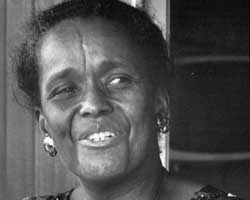
Ella Baker championed the idea of participatory democracy
Similarly, a deeper interpretation of democracy would emphasize participation by an individual or community in the decisions that affect them. For this definition I follow in the footsteps of Ella Baker, the mighty civil rights organizer who championed the idea of participatory democracy. With a lifelong focus on empowering ordinary people to solve their own problems, Ella Baker is known for saying “Strong people don’t need strong leaders.” This was the philosophy of the black students who sat-in at lunch counters in the South to win their right to public accommodations. They didn’t wait for the law to change, or for adults to tell them to do it. The students recognized that society was wrong, and practiced non-violent civil disobedience , becoming empowered by their actions. Then with Ms. Baker’s support they formed the Student Non-violent Coordinating Committee (SNCC) and organized poor blacks in Mississippi to demand their right to vote, passing on the torch of empowerment.
We need to be empowered to manage our own affairs on a large scale. In a participatory democracy, “we, the people” would run the show, not representatives who depend on corporate funding to get elected. “By the people, for the people, of the people” are great words. What if we actually put those words into action in the government, the economy, the media, and all the institutions that affect our lives? Institutions should obey the will of the people, rather than the people obeying the will of institutions. It can happen, but only through organization and active participation of the people as a whole. We must empower ourselves, not wait for someone else to do it. Read the rest of this entry »
Republished by Energy Bulletin, OpEdNews, and Countercurrents, and translated into Turkish for Hafif.org.
The following exchange between Michael Carriere and Alex Knight occurred via email, July 2010. Alex Knight was questioned about the End of Capitalism Theory, which states that the global capitalist system is breaking down due to ecological and social limits to growth and that a paradigm shift toward a non-capitalist future is underway.
This is the third part of a four-part interview. This part is a continuation of Alex’s response to the second question. Click here for Part 2A. Scroll to the bottom for links to the other sections.
Part 2B. Social Limits and the Crisis
MC: Capitalism has faced many moments of crisis over time. Is there something different about the present crisis? What makes the end of capitalism a possibility now?
AK: As I described in the last section, the current crisis can be understood as resulting from a massive collision between capitalism’s relentless need for growth and the world’s limits in capacity to sustain that growth. These limits to growth are both ecological and social. In this section I’ll discuss the concept of social limits to growth.
The Extraordinary Power of Social Movements
Social limits to growth function alongside the ecological limits but are drawn from a different source. By social limits we mean the inability, or unwillingness, of human communities, and humankind as a whole, to support the expansion of capitalism. This broadly includes all forms of resistance to capitalism, a resistance that has arguably been increasing around the world through innumerable forms of alternative lifestyles, refusal to cooperate, protest, and outright rebellion.
As a disclaimer it’s important to recognize that not all resistance is progressive. There are right-wing, fundamentalist, and undemocratic forces that also resist capitalism, for example the Taliban, or North Korea. These are not our allies. They do not share progressive values, we cannot condone their attacks on women, or on freedom more generally, and I don’t see anything to be gained by working with them. However it is important to recognize how these forces are aligned against capitalism and U.S. imperialism, in addition to being aware of the danger they present to our own hopes and dreams.
Progressive resistance, on the other hand, has always taken its strength from grassroots social movements. Silvia Federici writes about the immense and varied peasant movements in medieval Europe that fought for religious and sexual freedom, challenging both feudal lords and emerging capitalist elites. I like to think of these rebels as my European ancestors – they were just commoners but they rose up to fight for a better world. This is the nature of social movements. Ordinary folks, daring to pursue their deepest aspirations, interests and dreams, join together with others who share those desires, and thereby create something extraordinary. The magic exists in the joining-together. Isolated individuals lack the power to accomplish what a group can achieve.
We can appreciate this extraordinary power if we look at how social movements have transformed our lives. A century ago, millions of American workers joined the labor movement and won the 8-hour day, Social Security, and workplace safety. Regular folks carried forward the Civil Rights Movement and broke Southern segregation. The feminist and LGBT movements have transformed the way gender and sexuality are viewed all over the world. It’s hard to overstate how dramatically these and other social movements have improved society. While capitalism has invented ways to co-opt social movements and redirect them into outlets that do not challenge the system on a deep level (like the “non-profit industrial complex”), movements have remained alive and vibrant by empowering people to reach towards a different world.
Have social movements limited capitalist oppression recently? To answer this we need to learn the story of the Global Justice Movement.

Demonstrators tear down a section of security fence in the Mexican resort city of Cancun to confront the World Trade Organization’s Fifth Ministerial summit on Sept. 10, 2003.
The Global Justice Movement
David Graeber, anarchist anthropologist, wrote a remarkable essay called “The Shock of Victory” in which he looks at this movement that suddenly flared up at the turn of the millennium and seemed to disappear just as quickly. Although most Americans may not remember the Global Justice Movement, and those who participated in it may feel demoralized by the fact that capitalism still exists, Graeber points out that many of the movement’s ambitious goals were accomplished. Read the rest of this entry »
Republished by Energy Bulletin, The Todd Blog, OpEdNews, Countercurrents, and translated into Turkish for Hafif.org.
The following exchange between Michael Carriere and Alex Knight occurred via email, July 2010. Alex Knight was questioned about the End of Capitalism Theory, which states that the global capitalist system is breaking down due to ecological and social limits to growth and that a paradigm shift toward a non-capitalist future is underway.
This is the second part of a four-part interview. Scroll to the bottom for links to the other sections.
Part 2A. Capitalism and Ecological Limits
MC: Capitalism has faced many moments of crisis over time. Is there something different about the present crisis? What makes the end of capitalism a possibility now?
AK: This is such an important question, and it’s vital to think and talk about the crisis in this way, with a view toward history. It’s not immediately obvious why this crisis began and why, two years later, it’s not getting better. Making sense of this is challenging. Especially since knowledge of economics has become so enclosed within academic and professional channels where it’s off-limits to the majority of the population. Even progressive intellectuals, who aim to translate and explain the crisis to regular folks, too often fall into the trap of accepting elite explanations as the starting point and then injecting their politics around the edges. This is why there is such an abundance of essays and videos analyzing “credit default swaps”, “collateralized debt obligations,” etc., as if this crisis is about nothing more than greedy speculators overstepping their bounds.
On the contrary, the End of Capitalism Theory insists there are deeper explanations for why this crisis is so severe, widespread, and long-lasting. Here’s one explanation: The devastating quaking of the financial markets, and the lingering aftershocks we’re experiencing in layoffs and cut-backs, are manifestations of much larger tectonic shifts under the surface of the economy. This turmoil originates from deep instabilities within capitalism, the global economic system that dominates our planet. The dramatic crisis we are experiencing now is resulting from a massive underground collision between capitalism’s relentless need for growth on one side, and the world’s limited capacity to sustain that growth on the other.
These limits to growth, like the continental plates, are enormous, permanent qualities of the Earth – they cannot be ignored or simply moved out of the way. The limits to growth are both ecological, such as shortages of resources, and social, such as growing movements for change around the globe. As capitalism rams into these limiting forces, numerous crises (economic, energy, climate, food, water, political, etc.) erupt, and destruction sweeps through society. This collision between capitalism and its limits will continue until capitalism itself collapses and is replaced by other ways of living.
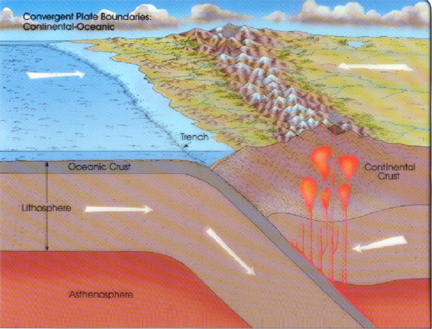
Tectonic Plates Colliding - Capitalism is Ramming into the Limits to Growth, Causing Massive Shocks on the Surface of the Economy
The End of Capitalism Theory argues that capitalism will not be able to overcome these limits to growth, and therefore it is only a matter of time before we are living in a non-capitalist world. A paradigm shift towards a new society is underway. There’s a chance this new future could be even worse, but I hold tremendous hope in the capacity of human beings to invent a better life for themselves when given the chance. Part of my hope springs from the understanding that capitalism has caused terrible havoc all over the world through the violence it perpetrates against humanity and Mother Earth. The end of capitalism need not be a disaster. It can be a triumph. Or, perhaps, a sigh of relief.
Defining the Crisis
Rather than spend our time learning the language of Wall St. and trying to understand the economic crisis from the perspective of the bankers and capitalists, I think we can get much further if we take our own point of reference and then investigate below the surface to try to find the true origins of the crisis. This is what I call a common sense radical approach. Start from where we are, who we are, and what we know, because you don’t need to be an academic to understand the economy – you just need common sense. Then try to get to the root of the issue (radical coming from the Latin word for “root”). What is really going on under the surface? What is the core of the problem? If we can’t come up with a common sense radical explanation of the crisis, we’ll always be stuck within someone else’s dogma. This could be Wall St. dogma, Marxist dogma, Christian dogma, etc. So what is this crisis really about? Read the rest of this entry »
Republished by Countercurrents, OpEdNews, Alliance for Sustainable Communities – Lehigh Valley, The Pigeon Post, Dissident Voice and The (Grace Lee) Boggs Blog!
The following exchange between Michael Carriere and Alex Knight occurred via email, July 2010. Alex Knight was questioned about the End of Capitalism Theory, which states that the global capitalist system is breaking down due to ecological and social limits to growth and that a paradigm shift toward a non-capitalist future is underway.
The interview will be available in four parts. Scroll to the bottom to read all of Prof. Carriere’s questions.
Part 1. Crisis and Opportunity
MC: The current financial crisis is clearly a moment of peril for both individuals and the broader system of capitalism. But would it also make sense to see it as a moment of opportunity?
AK: Absolutely. I see opportunity springing from every crack in the structure of capitalism. For all those who wish to see a different world, this moment is dripping with opportunity because the old order is crumbling before our eyes.

Shock and Awe on the New York Stock Exchange
The crisis extends far beyond the broken financial system. Millions of people are losing their jobs, homes, and savings as the burden of the crisis gets shifted onto the poor and working class. Public faith in the system, both the government and the capitalist economy, has been shattered and is at an all-time low. And it’s not just the economic crisis. The bank bailouts, the endless wars in the Mid East, the BP spill and the meltdown of the climate, and about a dozen other crises have shaken us deeply. It’s become common sense that the system is broken and a major change is needed. Barack Obama was elected in the US precisely by promising this change. Now that he is failing to deliver, more and more people are questioning whether the system can provide any solutions, or whether it’s actually the source of the problem.
Shattered faith is the dominant sentiment today. You can see it in people’s faces – the disappointment, grief, worry, and anger. To me, this loss of faith presents an enormous opening for putting forth a new, non-capitalist way of life. People are ready to hear radical solutions now, like they haven’t been since the Great Depression.
Historic Crossroads
If we go back to 1929, we’ll see some interesting parallels to our current moment. When that depression started, millions lost their livelihoods to pay for the bankers’ crisis. Faith in capitalism sunk to rock bottom. The public flocked to two major ideologies that offered a way out: socialism and fascism.
Socialism presented a solution to the crisis by saying, roughly: “Capitalism is flawed because it divides us into rich and poor, and the rich always take advantage of the poor. We need to organize the poor and workers into unions and political parties so we can take power for the benefit of all.”
Socialism attracted millions of followers, even in the United States. The labor movement was enormous and kept gaining ground through sit-down strikes and other forms of direct action. The Communist Party sent thousands of organizers into the new CIO, at the time a more radical union than the AFL. Socialist viewpoints even started getting through to the mass media and government. Huey Long was elected Senator from Louisiana by promising to “Share Our Wealth,” to radically redistribute the wealth of the country to abolish poverty and unemployment. (He was assassinated.) Socialism challenged President Roosevelt from the left, pushing him to create the social safety net of the New Deal.
On the other side, fascism also emerged as a serious force and attracted a mass following by putting forth something like the following: “The government has sold us out. We are a great nation, but we have been disgraced by liberal elites who are pillaging our economy for the benefit of foreign enemies, dangerous socialists, and undesirable elements (like Jews). We need to restore our national honor and fulfill our God-given mission.”
When people hear the word fascism, they usually think of Nazi Germany or Mussolini’s Italy, where successful fascist movements seized state power and implemented totalitarian control of society. Yet fascism was an international phenomenon during the Depression, and the United States was not immune to its reach. General Smedley Butler, the most decorated Marine in US history, testified before the Senate that wealthy industrialists had approached him as part of a “Business Plot” and tried to convince him to march an army of 500,000 veterans on Washington, DC to install a fascist dictatorship.
Today we are approaching a similar crossroads. When I hear the story of the Business Plot I think about the Tea Party, which has sprung from a base of white supremacist anger, facilitated by right-wing elements of the corporate structure like Fox News. This is an extremely dangerous phenomenon. The “teabaggers” have moved from questioning Obama’s citizenship, to now trying to reverse the gains of the Civil Rights Movement, such as the ability of everyone, regardless of color, to enjoy public accommodations like restaurants.
I think it’s fair to name the Tea Party, Glenn Beck, Sarah Palin, the Christian Right, etc. parts of a potential neo-fascist movement in the United States. Their words and actions too often encourage attacks on people of color, immigrants, Muslims, LGBT folks, and anyone they don’t see as legitimate members of US society. Ultimately, many in this movement are pushing for a different social system taking power in the United States: one that is more authoritarian, less compassionate, more exploitive of the environment, more militaristic, and based on a mythical return to national glory. This is not a throwback to Nazi Germany. It’s a new kind of fascism, a new American fascism. And it’s a serious threat.

Tea Party racism in Denver, April 15, 2009
On the other hand, this crisis is also an opportunity for all of us who see capitalism as a destructive force and believe the message of the recent U.S. Social Forum that “Another World is Possible. Another US is Necessary.” “Socialism” in the post-McCarthy/Cold War era of the United States is a dead word, because it carries a lot of baggage from the Soviet Union. Rightly so, the USSR was a terrible dictatorship that is hardly an example to follow. The question is, how do those of us who are progressive and anti-capitalist articulate our ideas to resonate with a mass audience in this moment?
Common Values
I argue that we need to speak to the population in a language of our common values: democracy, freedom, justice, and sustainability. Read the rest of this entry »
The tar sands are an abomination. In a desperate move to counteract peak oil, Canada and the United States are waging war on Alberta’s ecosystem and indigenous communities, as well as on the planet as a whole. This crime must be stopped.
Clayton Thomas-Muller also recently spoke on Democracy Now!, see the video. [alex]

greenpeace.org
Tar Sands: The World’s Largest Climate Crime
By Clayton Thomas-Muller
Published originally in Left Turn Magazine, Jan/Feb 2010
Often when one looks at the global climate crisis and the critical necessity of forests as carbon storehouses, we have visions of the Amazon rainforest in South America, or the vast rainforest cover in places like Malaysia, Indonesia, across south East Asia and Africa. What many don’t envision is the second largest carbon storehouse on Mother Earth located in Canada’s northern region known as the Boreal Forest.
This soggy, wet, biologically diverse region spreads across the continent east to west. It is home to hundreds of First Nations/Indigenous communities that have utilized these ecologically diverse regions for their livelihood from time immemorial. Many also do not know that the Boreal Forest is second only to the Amazon region in terms of daily forest loss due to industrial expansion. This tree loss is further exacerbated by an infestation of the spruce pine beetle, brought on by milder winters in the north, which has been destroying millions of hectares of trees from southeast Alaska all the way to western Alberta.
Also found beneath the pine-covered ground are vast stores of minerals and fossil fuel deposits, the most famous of which is known as Canada’s Athabasca Tar Sands in Northern Alberta. Second only to Saudi Arabia in terms of recoverable oil reserves, Canada’s tar sands have an estimated 177 billion barrels of recoverable oil. The main difference between these two sources is the fact that the tar sands in Canada are not a conventional form of oil; they are a tarry clay and sand like mixture that at room temperature is hard as a hockey puck.
To remove this oil, one of two methods must be used. The first is surface mining, where industry removes the top layer of muskeg, trees, clay and sand as well as lakes, streams and even rivers to depths of up to 300 feet. They then use the world’s largest steam shovels, earth movers and dump trucks (300 tons per load) to strip mine out the mix that is then hauled off to industrial upgrader facilities and processed into synthetic oil. In the end it works out to around 5 tons of earth for every barrel of oil. Every day they move enough earth to fill the famous home of the Toronto Blue Jays, the Rogers Sky Dome.
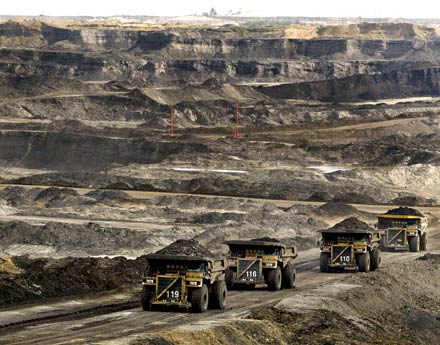
ran.org
If the deposits are more than a depth of 300 feet, producers must use a deep well injection process called “In Situ” or Steam Assisted Gravity Drainage (SAG-D). This process is six times more carbon and water intensive then conventional oil extraction. The industry must also utilize vast amounts of natural gas to superheat fresh water to be injected into Mother Earth to “melt” the bitumen that then is sucked out of the ground with uptake pipes for upgrading.
Thanks to the 600 million cubic feet of natural gas is burned every day for this type of extraction, the tar sands is the single largest source of carbon dioxide emissions in Canada, and the primary reason Canada is not fulfilling its legally binding emission reduction targets under the Kyoto Protocol. By 2030 at the current rate of expansion, the tar sands will be responsible for an emission level between 100-187 million tons of CO2 every year.
Probably most disturbing part of this extraction process are the runoff streams created by the use of water in the separation process. Once water is no longer usable it is dumped into a vast network of ten tailings ponds that can be seen from outer space. Every day these tailings ponds leak eleven million liters of contaminated water into the Athabasca River and ground water in the surrounding area. By the year 2030 if the tar sands continue to grow at the current rate of expansion these tailings ponds volume combined will represent a body of water as large as Lake Ontario.
Frontline Nightmares
As a result of this “Tarmageddon,” many local Indigenous communities have seen an increase in the presence of deadly forms of cancers and other autoimmune diseases in their populations. Many have observed the negative effects on critical traditional food sources such as the fish, moose, muskrat, beaver and plants that they depend on for sustenance and cultural needs. Moose have been found to have levels of arsenic 400 times the acceptable level as well as sores and tumors. Muskrat have been found with bloody noses and their homes smelling of petroleum. Fish with lesions and deformities are a common thing for fisherman in the region. The effect this has on First Nations/Indigenous communities is amplified when considering our fundamental connection to the sacredness of Mother Earth expressed through our reliance on traditional hunting, fishing and gathering practices. Read the rest of this entry »

The Grapes of Wrath
by John Steinbeck
published 1939 during the last Great Depression.
Alex Knight, endofcapitalism.com, May 25, 2010
Also posted on The Rag Blog and TowardFreedom.
Arizona SB1070, signed into law by Governor Jan Brewer on April 23, requires Arizona’s local and state law enforcement to demand the immigration status of anyone they suspect of being in the country illegally, and arrest them if they lack documents proving citizenship or legal residency. Effectively making racial profiling into state policy, this law is the latest in a series of attacks on Latin American immigrants, as well as the entire Latino community, who must live with the fear of being interrogated by police for their brown skin. Then on May 11, Arizona went one step further, outlawing the teaching of ethnic studies classes, or any classes that “are designed primarily for students of a particular ethnic group or advocate ethnic solidarity”. This same law also states that schools must fire English teachers who speak with a “heavy accent.”
Perhaps these new laws make sense if we imagine that undocumented immigrants are merely “aliens”, a danger to the good, mostly white citizens of this great country. But suppose we look at the problem of immigration from the perspective of the immigrants? Why are they risking life and limb to come to a foreign land, far from their home and families? Why aren’t they deterred from making this trip no matter how many walls we put up, no matter how many police collaborate with ICE, no matter how many angry armed “Minutemen” vigilantes are conscripted to guard the border?
John Steinbeck’s classic novel The Grapes of Wrath, following the Joad family as they migrate to California during the “Dust Bowl” of the 1930s, sheds light on these questions in a way that perhaps every American can relate to. One of the most popular and well-written American books of all time, The Grapes of Wrath provides a very human perspective on the harsh lives of migrants, personified by the Joads – a family of poor sharecroppers from Oklahoma. Evicted from their family farm, just as the millions of Mexicans who have suffered enclosure from their land and become homeless and jobless because of NAFTA, the Joads travel to California in a desperate search of work, only to encounter the harassment of authorities and the hatred of the local population.
There are important differences between the “Okies” who traveled to the Southwest in the 1930s and Latino migrantes of the 2000s. The Joads, of course, were white, and did not cross a national border when they made their exodus. But at its core the story of the Joads is the story of the migrant workers, their troubles, their fears, but also their humanity, and their hope. It is a story that can inspire us to recognize the historic nature of the moment in which we live, understand why these enormous transformations are occurring, and recognize that justice for the immigrants is justice for everyone, regardless of color or citizenship status.
Enclosure
In order to understand the migrantes we first have to understand the story of their displacement, or the enclosure of their land, which has left them homeless and with no other options than to leave their homeland in search of a wage. What can The Grapes of Wrath tell us about this reality?
People usually do not resort to risky and desperate moves unless they have nothing left to lose. Steinbeck begins the Joads’ story with the loss of everything they had: the small farm on which they had sustained their family for generations by growing cotton. Young Tom Joad, fresh out of prison, returns to his home to find it deserted. “The Reverend Casy and young Tom stood on the hill and looked down on the Joad place… Where the dooryard had been pounded hard by the bare feet of children and by stamping horses’ hooves and by the broad wagon wheels, it was cultivated now, and the dark green, dusty cotton grew… ‘Jesus!’ he said at last. ‘Hell musta popped here. There ain’t nobody livin’ there.'” (51).

Mexican farmer with corn / image courtesy of "© Juan_de" on flickr
Whether as tenants or small landholders, either for subsistence or for markets, the vast majority of the poor migrantes now coming to this country are fleeing the loss of their farms and their livelihoods, just as the Joads. Perhaps for generations, maybe hundreds or even thousands of years, they had lived in connection with the land and had been able to depend on it for the survival of their families and culture. The loss of this land is devastating to those cultures, but larger forces stand to gain by driving these people into homelessness. Read the rest of this entry »


 The End of Capitalism
Recent Comments