You are currently browsing the category archive for the ‘Organizing’ category.
Republished by Countercurrents, OpEdNews, Alliance for Sustainable Communities – Lehigh Valley, The Pigeon Post, Dissident Voice and The (Grace Lee) Boggs Blog!
The following exchange between Michael Carriere and Alex Knight occurred via email, July 2010. Alex Knight was questioned about the End of Capitalism Theory, which states that the global capitalist system is breaking down due to ecological and social limits to growth and that a paradigm shift toward a non-capitalist future is underway.
The interview will be available in four parts. Scroll to the bottom to read all of Prof. Carriere’s questions.
Part 1. Crisis and Opportunity
MC: The current financial crisis is clearly a moment of peril for both individuals and the broader system of capitalism. But would it also make sense to see it as a moment of opportunity?
AK: Absolutely. I see opportunity springing from every crack in the structure of capitalism. For all those who wish to see a different world, this moment is dripping with opportunity because the old order is crumbling before our eyes.
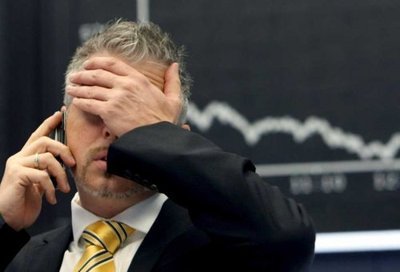
Shock and Awe on the New York Stock Exchange
The crisis extends far beyond the broken financial system. Millions of people are losing their jobs, homes, and savings as the burden of the crisis gets shifted onto the poor and working class. Public faith in the system, both the government and the capitalist economy, has been shattered and is at an all-time low. And it’s not just the economic crisis. The bank bailouts, the endless wars in the Mid East, the BP spill and the meltdown of the climate, and about a dozen other crises have shaken us deeply. It’s become common sense that the system is broken and a major change is needed. Barack Obama was elected in the US precisely by promising this change. Now that he is failing to deliver, more and more people are questioning whether the system can provide any solutions, or whether it’s actually the source of the problem.
Shattered faith is the dominant sentiment today. You can see it in people’s faces – the disappointment, grief, worry, and anger. To me, this loss of faith presents an enormous opening for putting forth a new, non-capitalist way of life. People are ready to hear radical solutions now, like they haven’t been since the Great Depression.
Historic Crossroads
If we go back to 1929, we’ll see some interesting parallels to our current moment. When that depression started, millions lost their livelihoods to pay for the bankers’ crisis. Faith in capitalism sunk to rock bottom. The public flocked to two major ideologies that offered a way out: socialism and fascism.
Socialism presented a solution to the crisis by saying, roughly: “Capitalism is flawed because it divides us into rich and poor, and the rich always take advantage of the poor. We need to organize the poor and workers into unions and political parties so we can take power for the benefit of all.”
Socialism attracted millions of followers, even in the United States. The labor movement was enormous and kept gaining ground through sit-down strikes and other forms of direct action. The Communist Party sent thousands of organizers into the new CIO, at the time a more radical union than the AFL. Socialist viewpoints even started getting through to the mass media and government. Huey Long was elected Senator from Louisiana by promising to “Share Our Wealth,” to radically redistribute the wealth of the country to abolish poverty and unemployment. (He was assassinated.) Socialism challenged President Roosevelt from the left, pushing him to create the social safety net of the New Deal.
On the other side, fascism also emerged as a serious force and attracted a mass following by putting forth something like the following: “The government has sold us out. We are a great nation, but we have been disgraced by liberal elites who are pillaging our economy for the benefit of foreign enemies, dangerous socialists, and undesirable elements (like Jews). We need to restore our national honor and fulfill our God-given mission.”
When people hear the word fascism, they usually think of Nazi Germany or Mussolini’s Italy, where successful fascist movements seized state power and implemented totalitarian control of society. Yet fascism was an international phenomenon during the Depression, and the United States was not immune to its reach. General Smedley Butler, the most decorated Marine in US history, testified before the Senate that wealthy industrialists had approached him as part of a “Business Plot” and tried to convince him to march an army of 500,000 veterans on Washington, DC to install a fascist dictatorship.
Today we are approaching a similar crossroads. When I hear the story of the Business Plot I think about the Tea Party, which has sprung from a base of white supremacist anger, facilitated by right-wing elements of the corporate structure like Fox News. This is an extremely dangerous phenomenon. The “teabaggers” have moved from questioning Obama’s citizenship, to now trying to reverse the gains of the Civil Rights Movement, such as the ability of everyone, regardless of color, to enjoy public accommodations like restaurants.
I think it’s fair to name the Tea Party, Glenn Beck, Sarah Palin, the Christian Right, etc. parts of a potential neo-fascist movement in the United States. Their words and actions too often encourage attacks on people of color, immigrants, Muslims, LGBT folks, and anyone they don’t see as legitimate members of US society. Ultimately, many in this movement are pushing for a different social system taking power in the United States: one that is more authoritarian, less compassionate, more exploitive of the environment, more militaristic, and based on a mythical return to national glory. This is not a throwback to Nazi Germany. It’s a new kind of fascism, a new American fascism. And it’s a serious threat.
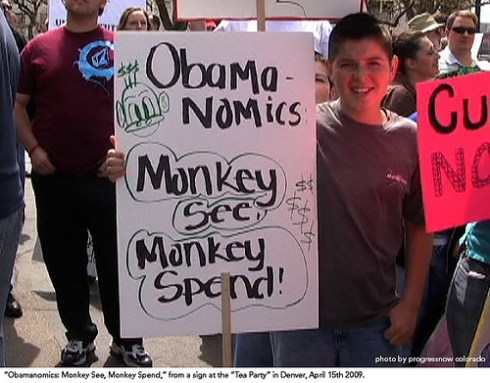
Tea Party racism in Denver, April 15, 2009
On the other hand, this crisis is also an opportunity for all of us who see capitalism as a destructive force and believe the message of the recent U.S. Social Forum that “Another World is Possible. Another US is Necessary.” “Socialism” in the post-McCarthy/Cold War era of the United States is a dead word, because it carries a lot of baggage from the Soviet Union. Rightly so, the USSR was a terrible dictatorship that is hardly an example to follow. The question is, how do those of us who are progressive and anti-capitalist articulate our ideas to resonate with a mass audience in this moment?
Common Values
I argue that we need to speak to the population in a language of our common values: democracy, freedom, justice, and sustainability. Read the rest of this entry »
 Economic collapse. Ecological disaster. Who’s going to make sense of this chaos? YOU!
Joanna Grim and Alex Knight will facilitate a participatory workshop to explore the questions: Is capitalism coming to an end? if so, Why? and What does this mean for the future of our planet? Are we headed towards a neo-fascist nightmare or is this an opportunity to create real democracy and sustainability?
The End of Capitalism? At the Crossroads of Crisis and Sustainability
When: Wednesday, 06/23/2010 – 3:30pm – 5:30pm
Where: WSU Old Main: 1134, Detroit Michigan!
Who: YOU! along with members of the End of Capitalism Study Group, who recently studied the book “Caliban and the Witch” by Silvia Federici on the origins of capitalism in the witch hunts of Europe.
Why: It’s up to us to figure out what the heck is happening to our world! Bring your ideas and hear ours!
Workshop description:
The ongoing global economic crisis has dramatically called into question the future of capitalism – a system that relies on perpetual growth but exists on a finite Earth. In this workshop, participants will take a “big picture” look at the ecological limits and social limits which lie below the current economic crisis and which threaten capitalist growth. These include climate change, peak oil, the Global Justice Movement and resistance from unexpected sources, like the Chinese labor movement. We will then imagine possible non-capitalist futures, both democratic/sustainable and authoritarian/fascist, in order to understand the historic crossroads at which our movements find themselves.
The goal of this workshop will be to broaden and deepen the anti-capitalist analysis of participants, while creating an open but directed space for us to articulate our vision of the world we are working towards, and the major dangers that are in our path. It will be led by youth members of the End of Capitalism Study Group, and build from the ideas of endofcapitalism.com. This will be a participatory workshop, not a speech, and old/dogmatic ideas will be questioned by new critical perspectives, with the goal of discovering deeper truth about our world and our work for social change in the 21st Century.
More info: http://organize.ussf2010.org/ws/end-capitalism-crossroads-crisis-and-sustainability
The US Social Forum is the nation’s largest gathering of progressive individuals and organizations. It is more than a conference, it is a movement-building process. This year’s Social Forum is the second one, and will be held in Detroit, MI from June 22-26. check out http://ussf2010.org/
RSVP on Facebook: http://www.facebook.com/event.php?eid=113425255370297
Engaging the Crisis: Organizing Against Budget Cuts and Community Power in Philadelphia
by Kristin Campbell
Reposted from Organizing Upgrade, March 1, 2010
Organizing Upgrade is honored to offer a preview of this insightful reflection on organizing – Engaging the Crisis: Organizing Against Budget Cuts and Building Community Power in Philadelphia – which will appear in Left Turn magazine #36 (April/May 2010). You can subscribe to Left Turn online at www.leftturn.org or become a monthly sustainer at www.leftturn.org/donate.
On November 6, 2008, just days after Philadelphians poured onto the streets to celebrate the Phillies winning the World Series championship and Barack Obama the US presidency, Mayor Michael Nutter announced a drastic plan to deal with the cities $108 million budget gap. Severe budget cuts were announced, including the closure of 11 public libraries, 62 public swimming pools, 3 public ice skating rinks, and several fire engines. Nutter also stated that 220 city workers would be laid off and that 600 unfilled positions would be eliminated entirely, amounting to the loss of nearly 1,000 precious city jobs. In classic neo-liberal style, the public sector was to sacrifice, while taxpayer money would bail out the private banking institutions.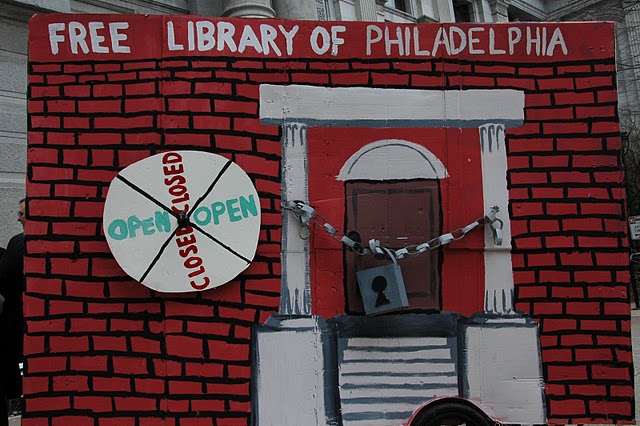
City in crisis
Well before the economic crises of 2008, a decades-long process of economic restructuring and deindustrialization had left Philadelphia, with a population just over 1.4 million, an incredibly under-resourced city. Philadelphia has the highest poverty rate out of the ten largest cities in the US, an eleven percent unemployment rate and a high-school dropout rate that hovers dangerously around 50 percent.
The proposed budget cuts sparked waves of popular outrage especially concerning the closure of the libraries, many of which are located in low-income communities of color and serve as bedrock institutions for many basic resources. Eleanor Childs, a principal of a school that heavily relies on West Philadelphia’s Durham library, and later a member of the Coalition to Save the Libraries, recalls “a groundswell of concern about the closing of the libraries… people rose up. We had our pitchforks. We were ready to fight to keep our libraries open.”
Nutter’s administration set up eight townhall meetings across Philadelphia, designed to calm the citywide uproar. Thousands of people filled the townhall meetings poised to question how such drastic decisions were made without any public input. Under the banner “Tight Times, Tough Choices,” Mayor Nutter and senior city officials attempted to explain the necessity of such deep service cuts. They explained that the impact of the economic crisis on the city had only become apparent in recent weeks, and because the city could not raise significant revenue to offset its financial loses in the timeframe that was needed, rapid cuts were mandatory and effective January 1, 2009.
Community response
In the following days and weeks, Philadelphians quickly mobilized against the decision that their public services and city workers pay for the fallout of a economic system that had already left so many of them struggling. Neighborhood leaders organized impromptu rallies at the eleven branch libraries. Along with organizing people to turn out at the Mayor’s townhall meetings, these rallies gained media attention on both the nightly news and in the major newspapers, demonstrating widespread opposition to the budget cuts. Sherrie Cohen, member of the Coalition to Save the Libraries and long-time resident of the Ogontz neighborhood of North Philly remembers her neighbors coming together to say, “We are not going to let this library close. It’s not gonna happen. We fought for 36 years for a library in our neighborhood.” Read the rest of this entry »
.
Sexism, egos, and lies: Sometimes you wake up and it is not different
By Lisa Fithian / March 22, 2010
Originally posted on The Rag Blog.
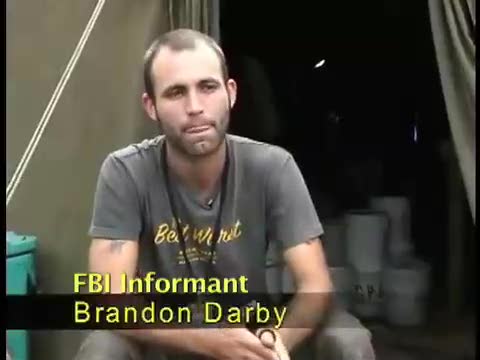
Brandon. Darby. Still from a video / videochannels.com
On December 31, 2008, the Austin Informant Working Group released a statement titled: “Sometimes You Wake Up and It’s Different: Statement on Brandon Darby, the ‘Unnamed’ Informant/Provocateur in the ‘Texas 2.’” It’s been over a year since then and here is my long-overdue version of that story.
It was on December 18, 2008, that I learned unquestionably that Brandon Michael Darby, an Austin activist, was an FBI informant leading up to the 2008 Republican National Convention protests in St. Paul, MN. He was the key witness in the case of two young men from Midland, TX, Bradley Crowder (23) and David McKay (22) who, thanks to Brandon’s involvement, have been convicted of manufacturing Molotov cocktails.
They are now serving two and four years, respectively, in federal prison. In 2010, Brandon will be a key witness in another important case to the Government — the case of the RNC 8, Minneapolis organizers who are facing state conspiracy charges.
The case of the “Texas 2” gained national media attention as a result of Brandon’s unique blend of egomania, the media’s attraction to charismatic and controversial men, and the persistence of the U.S. government to criminalize and crush a growing anti-authoritarian movement. I found myself strangely entwined in the story — past, present and future.
I knew Brandon, and I was given a set of the FBI documents because, as it became apparent from reading them, I was one of the primary people he was reporting on to the FBI. (I, like many others engaged in political protest, am suspect because of my politics not my actions.) Now all of us who knew Brandon and worked closely with him, have been coming to terms with what he did, how he was able to do it, how we were used and abused in the process, and what we might do differently next time.
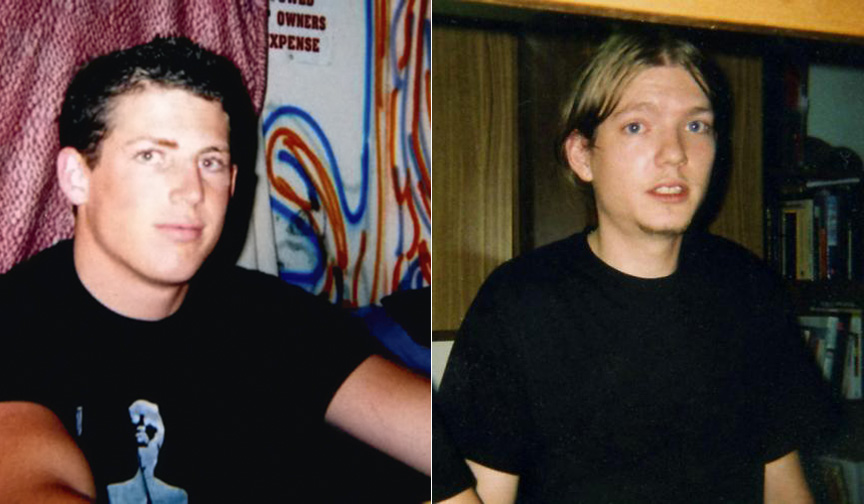
The Texas 2: David McKay and Bradley Crowder.
Waking up
Some of us were more surprised than others when Brandon revealed himself as an informant. My first reaction was deep sadness. I then went through a range of emotions: disbelief, shock, anger, outrage, and at times vindication. I am still hurt and angry, not just with Brandon, but with the whole system that supports and enables him.
I am still struggling with forgiveness for choices made in activist communities and by some of my friends. I understand how difficult it was; Brandon, at times, was also my friend. In the end we must examine the behavior we experienced, reflect on the array of choices we had, and explore what we could do differently to insure this does not happen again.
Brandon’s behavior was problematic long before 2008. Whether or not he was actually working for the state, he was doing their job for them by breeding discord within our politically active communities. I raised my concerns about Brandon’s behavior in New Orleans, in Austin, and also in Minneapolis. Read the rest of this entry »
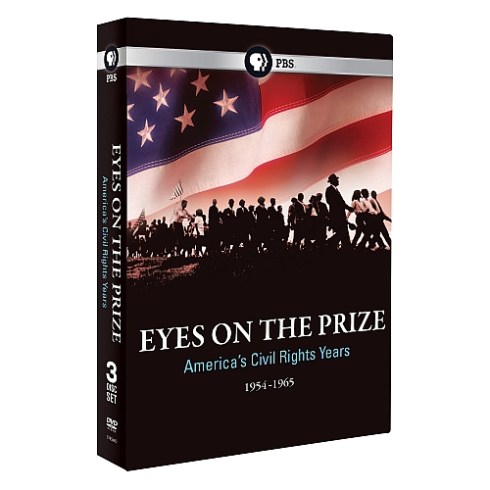 One of the best documentary series ever produced, Eyes on the Prize is a 14-part study of the Civil Rights Movement in the United States. This series is so important because it shows how ordinary people, when organized, can affect dramatic social change.
The Civil Rights Movement remains the most inspiring example of successful social movements in the United States, breaking down the evil system of racial segregation and opening up possibilities for Black people, as well as for other races, that never existed before. It’s important to remember that 50 years ago, most African Americans could not vote, but now we have a Black President.
Obviously the work of the Civil Rights Movement remains unfinished, as we still live in a racist society with many other severe social problems caused by capitalism as well. But as Eyes on the Prize displays so dramatically, the hope we seek lies not in politicians but in our very own hands. We must learn from the past in order to change the future.
I watched episode 1 today and will be viewing the others over the next few weeks. Would you like to watch and discuss the series with me? Please respond by leaving a comment!
Love and struggle,
alex
p.s. anyone know how to embed these videos on WordPress?
Episode 1: Awakenings (1954-1956)
Subjects: Origins of the Civil Rights Movement, Segregation, Black Soldiers in World War II, Brown v. Board of Education, Emmett Till, Rosa Parks, Montgomery Bus Boycott, Martin Luther King Jr, White Citizens Council, Ku Klux Klan, White Allies
Episode 2: Fighting Back (1957-1962)
Subjects: NAACP, Integration v. Segregation, Little Rock AR, The Little Rock 9, James Meredith, University of Mississippi
Episode 3: Ain’t Scared of Your Jails (1960-1961)
Subjects: Student Sit-ins, Nashville TN, Direct Action, Civil Disobedience, Student Nonviolent Coordinating Committee (SNCC), Ella Baker, Boycott Movement, Congress of Racial Equality (CORE), Freedom Rides, Southern Jails
Episode 4: No Easy Walk (1961-1963)
Subjects: Martin Luther King Jr, Southern Christian Leadership Conference (SCLC), Freedom Songs, Albany GA, Bull Connor, Birmingham AL, Fire Hoses and Dogs, John Lewis, March on Washington, John F. Kennedy, Civil Rights Act
Episode 5: Mississippi: Is This America? (1962-1964)
Subjects: Medgar Evers, Murder of Goodman, Chaney, and Schwerner, SNCC, Voting Registration Drives, Mississippi Freedom Summer, Mississippi Freedom Democratic Party, Failure of the Democratic Party
[This is the BEST video in the series. What SNCC did in Mississippi changed America forever.]
Episode 6: Bridge to Freedom (1965) Read the rest of this entry »
Are we living through the twilight of democracy, or the dawn of a new day?
That is up to us.
The Chambersburg Declaration is a brief but promising political document coming out of Pennsylvania, specifically the Community Environmental Legal Defense Fund. Explanation follows. [alex]
photo by neeloyunus on flickr
BY THE UNDERSIGNED IN CHAMBERSBURG, PENNSYLVANIA, ON
SATURDAY, FEBRUARY 20TH, 2010
We declare:
– That the political, legal, and economic systems of the United States allow, in each generation, an elite few to impose policy and governing decisions that threaten the very survival of human and natural communities;
– That the goal of those decisions is to concentrate wealth and greater governing power through the exploitation of human and natural communities, while promoting the belief that such exploitation is necessary for the common good;
– That the survival of our communities depends on replacing this system of governance by the privileged with new community-based democratic decision-making systems;
– That environmental and economic sustainability can be achieved only when the people affected by governing decisions are the ones who make them;
– That, for the past two centuries, people have been unable to secure economic and environmental sustainability primarily through the existing minority-rule system, laboring under the myth that we live in a democracy;
– That most reformers and activists have not focused on replacing the current system of elite decision-making with a democratic one, but have concentrated merely on lobbying the factions in power to make better decisions; and
– That reformers and activists have not halted the destruction of our human or natural communities because they have viewed economic and environmental ills as isolated problems, rather than as symptoms produced by the absence of democracy.
Therefore, let it be resolved:
– That a people’s movement must be created with a goal of revoking the authority of the corporate minority to impose political, legal, and economic systems that endanger our human and natural communities; Read the rest of this entry »
This is one of the most timely and insightful articles I’ve read in a long time – the editorial from the new issue of Turbulence magazine. They discuss the economic crisis within the frame of the collapse of the neoliberal order that has been the standard-bearer of global capitalism for the last 30-35 years, resulting in a state of “limbo” where no “deal” exists tying the system together. Nevertheless, the system persists like a zombie, dead and discredited but carried forward by sheer momentum and the fact that nothing else has shown itself capable of replacing it. Our job then, is to hold up an alternative way of life (a new “common ground”) that values communities and the planet above narrow profit, and that job becomes easier by studying analysis like this. Thanks, Turbulence! [alex]
Life in Limbo?
By Turbulence
We are trapped in a state of limbo, neither one thing nor the other. For more than two years, the world has been wracked by a series of interrelated crises, and they show no sign of being resolved anytime soon. The unshakable certainties of neoliberalism, which held us fast for so long, have collapsed. Yet we seem unable to move on. Anger and protest have erupted around different aspects of the crises, but no common or consistent reaction has seemed able to cohere. A general sense of frustration marks the attempts to break free from the morass of a failing world.
There is a crisis of belief in the future, leaving us with the prospect of an endless, deteriorating present that hangs around by sheer inertia. In spite of all this turmoil – this time of ‘crisis’ when it seems like everything could, and should, have changed – it paradoxically feels as though history has stopped. There is an unwillingness, or inability, to face up to the scale of the crisis. Individuals, companies and governments have hunkered down, hoping to ride out the storm until the old world re-emerges in a couple of years. Attempts to wish the ‘green shoots’ of recovery into existence mistake an epochal crisis for a cyclical one; they are little more than wide-eyed boosterism. Yes, astronomical sums of money have prevented the complete collapse of the financial system, but the bailouts have been used to prevent change, not initiate it. We are trapped in a state of limbo.
Crisis in the middle
And yet, something did happen. Recall those frightening yet heady days that began in late 2008, when everything happened so quickly, when the old dogmas fell like autumn leaves? They were real. Something happened there: the tried and tested ways of doings things, well-rehearsed after nearly 30 years of global neoliberalism, started to come unstuck. What had been taken as read no longer made sense. There was a shift in what we call the middle ground: the discourses and practices that define the centre of the political field.
To be sure, the middle ground is not all that there is, but it is what assigns the things in the world around it a greater or lesser degree of relevance, validity or marginality. It constitutes a relatively stable centre against which all else is measured. The farther from the centre an idea, project or practice is, the more likely it is to be ignored, publicly dismissed or disqualified, or in some way suppressed. The closer to it, the more it stands a chance of being incorporated – which in turn will shift the middle more or less. Neither are middle grounds defined ‘from above’, as in some conspiratorial nightmare. They emerge out of different ways of doing and being, thinking and speaking, becoming intertwined in such a way as to reinforce each other individually and as a whole. The more they have become unified ‘from below’ as a middle ground, the more this middle ground acquires the power of unifying ‘from above’. In this sense, the grounds of something like ‘neoliberalism’ were set before something was named as such; but the moment when it was named is a qualitative leap: the point at which relatively disconnected policies, theories and practices became identifiable as forming a whole.
The naming of things like Thatcherism in the UK, or Reaganism in the US, marked such a moment for something that had been constituting itself for some time before, and which has for the past three decades dominated the middle ground: neoliberalism, itself a response to the crisis of the previous middle, Fordism/Keynesianism. The era of the New Deal and its various international equivalents had seen the rise of a powerful working class that had grown used to the idea that its basic needs should be met by the welfare state, that real wages would rise, and that it was always entitled to more. Initially, the centrepiece of the neoliberal project was an attack on this ‘demanding’ working class and the state institutions wherein the old class compromise had been enshrined. Welfare provisions were rolled back, wages held steady or forced downwards, and precariousness increasingly became the general condition of work.
But this attack came at a price. The New Deal had integrated powerful workers’ movements – mass-based trade unions – into the middle ground, helping to stabilise a long period of capitalist growth. And it provided sufficiently high wages to ensure that all the stuff generated by a suddenly vastly more productive industrial system – based on Henry Ford’s assembly line and Frederick Taylor’s ‘scientific management’ – could be bought. Bit by bit, the ferocious attack on the working classes of the global North was offset by low interest rates (i.e. cheap credit) and access to cheap commodities, mass-produced in areas where wages were at their lowest (like China). In the global South, the prospect of one day attaining similar living conditions was promised as a possibility. In this sense, neoliberal globalisation was the globalisation of the American dream: get rich or die trying. Read the rest of this entry »
In November, community members in Spokane Washington articulated these Community Bill of Rights, to give neighbors the ability to control their neighborhoods and their futures. It was defeated by massive opposition of corporate and political elites, but the model of communities organizing at the grassroots level for basic economic, social and ecological rights is something that I’m sure will be reproduced and improved upon in the New Year. Happy 2010! [alex]
Spokane Considers Community Bill of Rights
by Mari Margil, November 4, 2009
Thousands of people voted to protect nine basic rights, ranging from the right of the environment to exist and flourish to the rights of residents to have a locally based economy and to determine the future of their neighborhoods.
Of all the candidates, bills, and proposals on ballots around the country yesterday, one of the most exciting is a proposition that didn’t pass.
In Spokane, Washington, despite intense opposition from business interests, a coalition of residents succeeded in bringing an innovative “Community Bill of Rights” to the ballot. Proposition 4 would have amended the city’s Home Rule Charter (akin to a local constitution) to recognize nine basic rights, ranging from the right of the environment to exist and flourish to the rights of residents to have a locally based economy and to determine the future of their neighborhoods.

Communities Take Power - Barnstead, New Hampshire was the first town in the nation to ban corporate water mining.
A coalition of the city’s residents drafted the amendments after finding that they didn’t have the legal authority to make decisions about their own neighborhoods; the amendments were debated and fine-tuned in town hall meetings.
Although the proposition failed to pass, it garnered approximately 25 percent of the vote—despite the fact that opponents of the proposal (developers, the local Chamber of Commerce, and the Spokane Homebuilders) outspent supporters by more than four to one. In particular, they targeted the Sixth Amendment, which would have given residents the ability, for the very first time, to make legally binding, enforceable decisions about what development would be appropriate for their own neighborhood. If a developer sought to build a big-box store, for example, it would need to conform to the neighborhood’s plans.
Nor is development the only issue in which resident would have gained a voice. The drafters and supporters of Proposition 4 sought to build a “healthy, sustainable, and democratic Spokane” by expanding and creating rights for neighborhoods, residents, workers, and the natural environment.
Legal Rights for Communities
Patty Norton, a longtime neighborhood advocate who lives in the Peaceful Valley neighborhood of Spokane, and her neighbors spent years fighting a proposed condominium development that would loom 200 feet high, casting a literal shadow over Peaceful Valley’s historic homes.
Proposition 4 would ensure that “decisions about our neighborhoods are made by the people living there, not big developers,” Patty said. Read the rest of this entry »


 The End of Capitalism
Recent Comments