You are currently browsing the category archive for the ‘Environmental Justice’ category.
One of Philadelphia’s larger newspapers puts Paul Glover, local currency and mutual aid-based health care advocate, on its cover story. As always, Paul makes wise and witty proposals to help us solve our economic and ecological woes, and now people are finally listening!
My favorite solution: “Neighborhood watch instead of neighborhood watch TV.” [alex]
Prepare for the Best
A guide to surviving — and thriving in — Philadelphia’s new green future.
Published: Jan 28, 2009
CityPaper
The Dark Season closes around Philadelphia. Wolves howl, “Tough times coming!” Young professionals with good jobs study budget cuts, watch stocks flail. Career bureaucrats are laid off; college students wonder who’s hiring. Old-timers remember when Philadelphia staggered through the terrible Depression years without jobs or dollars, while crime and hunger rose. Some districts here never escaped that Depression — they’re still choosing between heating and eating.
 |
As usual, the future will be different. Philadelphia’s responses to global warming and market cooling, high fuel and food prices, health unsurance, mortgages, student debt and war will decide whether our future here becomes vastly better or vastly worse. Whether we’re the Next Great City or Next Great Medieval Village. Imagine Philadelphia with one-tenth the oil and natural gas.
But to hell with tragedy. Let’s quit dreading news. Take the Rocky road. There are Philadelphia solutions for every Philadelphia problem.
Imagine instead that, 20 years from now, Philadelphia’s green economy enables everyone to work a few hours creatively daily, then relax with family and friends to enjoy top-quality local, healthy food. To enjoy clean low-cost warm housing, clean and safe transport, high-quality handcrafted clothes and household goods. To enjoy creating and playing together, growing up and growing old in supportive neighborhoods where everyone is valuable. And to do this while replenishing rather than depleting the planet. Pretty wild, right?
Entirely realistic. Not a pipe dream. And more practical than cynical. The tools, skills and wealth exist.
Mayor Michael Nutter foresees we’ll become the “Greenest City in the United States.” So it’s common-sensible to ask, “What are the tools of such a future?” “What jobs will be created?” “Who has the money?” “Where are the leaders?” “How will Philadelphia look?” “What can we learn from other cities?”
Some of the proposals sketched here can be easily ridiculed, because they disturb comfortable work habits, ancient traditions and sacred hierarchies. Yet they open more doors than are closing. They help us get ready for the green economy, and get there first. Big changes are coming so we might as well enjoy the ride. You have good ideas, too — bring ’em on.
From “Yes We Can” to “Now We Do”
As President Barack Obama says, “Change comes not from the top down, but from the bottom up.” Philadelphia’s chronic miseries suggest that primary dependence on legislators, regulators, police, prisons, bankers and industry won’t save us. They’re essential partners, but the people who will best help us are us. Read the rest of this entry »
 “The Tyranny of Oil: The World’s Most Powerful Industry and What We Must Do to Stop it”
by Antonia Juhasz
2008 HarperCollins
Ever wondered why the US government spends trillions of dollars to launch massive wars against Middle Eastern nations that have never attacked us, but refuses to do absolutely anything about the ongoing climate crisis? This book is for you.
The Tyranny of Oil is an exposee of “Big Oil”, meaning Exxon-Mobil, Chevron, BP, ConocoPhillips, and Royal Dutch Shell, the largest oil corporations in the world (and some of THE largest corporations in the world). The book exposes how these enormous oil octopi have gained virtually total control over the US government, and use their money and political power to make big profits at the expense of the public and the planet. (For example, Exxon Mobil in 2003 posted the largest profits of any corporation in history, then proceeded to beat that record each of the next 5 years).
It all starts with the origin of Big Oil, the mother, Standard Oil. Juhasz stresses the importance of monopolies and corporate mergers, in a sense missing the deeper analysis of capitalism, but nevertheless we come to understand how enormous companies wielding enormous profits can and do undermine democracy.
The book progresses to tell a story about Big Oil’s development and control over the government agencies that are supposed to be regulating it, and finally Big Oil’s plans for the future (War and Trashing the Planet, basically), before an inspirational chapter on What We Can Do. (There’s also a shoutout to SDS here and to our No War No Warming action in DC last year! Cool!)
This is essential reading for all US citizens, because if you aren’t familiar with the concepts she lays out, you frankly have no understanding of the country you live in. Environmental racism, corporate lobbyists and corrupt government agencies, the criminal behavior of Cheney’s Energy Task Force, deregulation and Enron-style fraud, tar sands, and the list goes on.
My only major complaint of the book was the virtual silence on the looming and imminent reality of Peak Oil and how this will transform everything. Juhasz does recognize the scarcity of oil and the likelihood of oil peaking, but chooses to essentially overlook its importance, instead blaming oil companies and speculators for driving up the cost of oil.
This is not just a minor quibble, because the BIG TRUTH is that we’re not just in a struggle against Big Oil, we’re in a struggle against capitalism, and it’s a fight that is reaching perhaps its final act. Peak Oil will challenge the dominant for-profit institutions of power, and can create an opening for social justice activists and organizers to push for much more radical change than appears possible within the current system. Nevertheless, this is probably a subject for another book (mine!), and Juhasz treads on steady ground by appealing to a more mainstream audience and demonizing the oil companies exclusively. This is a very effective book, highly recommended!
Finally, my favorite quote (pg. 325):
“As Paul Wolfowitz said in 1991, ‘The combination of the enormous resources of the Persian Gulf, the power that those resources represent – it’s power. It’s not just that we need gas for our cars, it’s that anyone who controls those resources has enormous capability to build up military forces.'”
[This is a huge victory, Mountaintop Removal is a horrible destructive practice of coal mining in Appalachia that destroys communities and the environment. Organizers, including Rainforest Action Network and many members and chapters of Students for a Democratic Society (SDS), have been fighting this for a long time through creative nonviolent actions and pressure, and today we can celebrate a major victory as Bank of America caves to our demands! – alex]
From Bank of America’s website:
“Bank of America is particularly concerned about surface mining conducted through mountain top removal in locations such as central Appalachia. We therefore will phase out financing of companies whose predominant method of extracting coal is through mountain top removal. While we acknowledge that surface mining is economically efficient and creates jobs, it can be conducted in a way that minimizes environmental impacts in certain geographies.”
We are thrilled that just two and a half weeks after RAN’s day of action against coal and coal finance, Bank of America has made a public commitment to stop financing the devastating practice of mountaintop removal mining. This has been a major demand of the banks for the Global Finance campaign and we applaud Bank of America as it takes a step in the right direction – a step away from coal. Congratulations to everyone who has helped to pressure Bank of America to end it’s financing of coal and mountaintop removal – this is a truly incredible grassroots victory!
We will have more information about Bank of America’s announcement soon, as we work with our team and our allies to respond. For now, let’s celebrate!
Originally posted by Annie on Rainforest Action Network’s website.
Originally published by the Christian Science Monitor, slightly edited.
Militants step up ‘oil war’ in Niger Delta
Attacks on foreign oil company facilities threaten to disrupt global oil supply.
By Jonathan Adamsfrom the September 17, 2008 edition
Militants in southern Nigeria have sharply stepped up attacks on foreign interests after declaring an “oil war” Sunday. The campaign, which the militants have dubbed “Hurricane Barbarossa,” entered its third day Tuesday with an attack on a Royal Dutch Shell pipeline after attacks on Shell and Chevron facilities in previous days.
The Nigerian government has tried to downplay the threat. But the violence looks set to further disturb oil supplies from Nigeria, the United States’ fifth-largest source of oil, at a time when global supplies are already being squeezed.
Agence France-Presse (AFP) reported Tuesday that the main militant group, the Movement for the Emancipation of the Niger Delta (MEND), said it had “blown up and destroyed” a Shell pipeline. Read the rest of this entry »
A little 20-min. video that gives a basic lesson in political economy for the average American consumer. Brilliant!

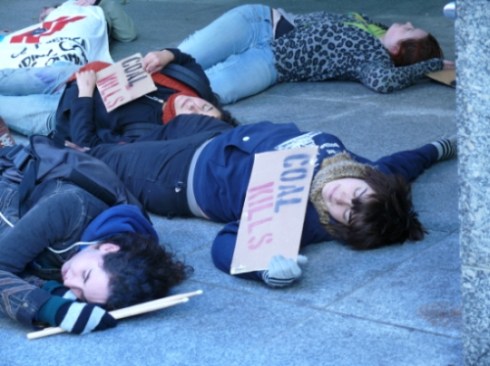
On November 16th, SDSers had a ‘cough-in’ and ‘die-in’ from the terrible fumes coming from Bank of America, as part of Rainforest Action Network’s ‘Nationwide Day of Action’ against new Coal-fired power plants and destructive mining practices such as Mountaintop Removal. more pics below…


 The End of Capitalism
Recent Comments