
You are currently browsing the category archive for the ‘Enclosures’ category.
The tar sands are an abomination. In a desperate move to counteract peak oil, Canada and the United States are waging war on Alberta’s ecosystem and indigenous communities, as well as on the planet as a whole. This crime must be stopped.
Clayton Thomas-Muller also recently spoke on Democracy Now!, see the video. [alex]

greenpeace.org
Tar Sands: The World’s Largest Climate Crime
By Clayton Thomas-Muller
Published originally in Left Turn Magazine, Jan/Feb 2010
Often when one looks at the global climate crisis and the critical necessity of forests as carbon storehouses, we have visions of the Amazon rainforest in South America, or the vast rainforest cover in places like Malaysia, Indonesia, across south East Asia and Africa. What many don’t envision is the second largest carbon storehouse on Mother Earth located in Canada’s northern region known as the Boreal Forest.
This soggy, wet, biologically diverse region spreads across the continent east to west. It is home to hundreds of First Nations/Indigenous communities that have utilized these ecologically diverse regions for their livelihood from time immemorial. Many also do not know that the Boreal Forest is second only to the Amazon region in terms of daily forest loss due to industrial expansion. This tree loss is further exacerbated by an infestation of the spruce pine beetle, brought on by milder winters in the north, which has been destroying millions of hectares of trees from southeast Alaska all the way to western Alberta.
Also found beneath the pine-covered ground are vast stores of minerals and fossil fuel deposits, the most famous of which is known as Canada’s Athabasca Tar Sands in Northern Alberta. Second only to Saudi Arabia in terms of recoverable oil reserves, Canada’s tar sands have an estimated 177 billion barrels of recoverable oil. The main difference between these two sources is the fact that the tar sands in Canada are not a conventional form of oil; they are a tarry clay and sand like mixture that at room temperature is hard as a hockey puck.
To remove this oil, one of two methods must be used. The first is surface mining, where industry removes the top layer of muskeg, trees, clay and sand as well as lakes, streams and even rivers to depths of up to 300 feet. They then use the world’s largest steam shovels, earth movers and dump trucks (300 tons per load) to strip mine out the mix that is then hauled off to industrial upgrader facilities and processed into synthetic oil. In the end it works out to around 5 tons of earth for every barrel of oil. Every day they move enough earth to fill the famous home of the Toronto Blue Jays, the Rogers Sky Dome.
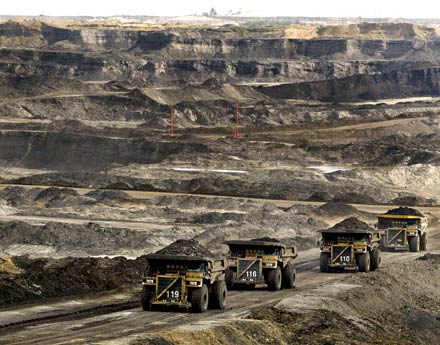
ran.org
If the deposits are more than a depth of 300 feet, producers must use a deep well injection process called “In Situ” or Steam Assisted Gravity Drainage (SAG-D). This process is six times more carbon and water intensive then conventional oil extraction. The industry must also utilize vast amounts of natural gas to superheat fresh water to be injected into Mother Earth to “melt” the bitumen that then is sucked out of the ground with uptake pipes for upgrading.
Thanks to the 600 million cubic feet of natural gas is burned every day for this type of extraction, the tar sands is the single largest source of carbon dioxide emissions in Canada, and the primary reason Canada is not fulfilling its legally binding emission reduction targets under the Kyoto Protocol. By 2030 at the current rate of expansion, the tar sands will be responsible for an emission level between 100-187 million tons of CO2 every year.
Probably most disturbing part of this extraction process are the runoff streams created by the use of water in the separation process. Once water is no longer usable it is dumped into a vast network of ten tailings ponds that can be seen from outer space. Every day these tailings ponds leak eleven million liters of contaminated water into the Athabasca River and ground water in the surrounding area. By the year 2030 if the tar sands continue to grow at the current rate of expansion these tailings ponds volume combined will represent a body of water as large as Lake Ontario.
Frontline Nightmares
As a result of this “Tarmageddon,” many local Indigenous communities have seen an increase in the presence of deadly forms of cancers and other autoimmune diseases in their populations. Many have observed the negative effects on critical traditional food sources such as the fish, moose, muskrat, beaver and plants that they depend on for sustenance and cultural needs. Moose have been found to have levels of arsenic 400 times the acceptable level as well as sores and tumors. Muskrat have been found with bloody noses and their homes smelling of petroleum. Fish with lesions and deformities are a common thing for fisherman in the region. The effect this has on First Nations/Indigenous communities is amplified when considering our fundamental connection to the sacredness of Mother Earth expressed through our reliance on traditional hunting, fishing and gathering practices. Read the rest of this entry »
Sakura Saunders’ excellent article from ZNet exposing one form of the “modern Enclosures” – displacing communities from their land to make money for transnational corporations, in this case mining companies in Papua New Guinea. Read this closely!
As described by Silvia Federici’s excellent book Caliban and the Witch, the Enclosures are the violence and displacement that created the first class of landless workers in Europe, commodifying their labor with the wage. And these Enclosures have continued to expand and develop alongside the system of capitalism, in fact I will make the argument that this violence is the base, the foundation, for the system as a whole, and it could not function without it.
We must never forget that at every moment, capitalism is committing violence against poor and indigenous communities in order to make its profits. As Sakura cites, “more than 10 million people are involuntarily displaced every year to make room for development projects.” So much for ‘laissez-faire’! [alex]
Mining Through Roots
Displacement, Poverty and the Global Extractive Industry
Monday, June 14, 2010
In the highlands of Papua New Guinea, several villages rest on a man-made island literally surrounded by an open pit gold mine and its expanding waste dumps. As the waste dumps have grown, they’ve devoured homes, schools, and most of the areas once used for gardening, making the indigenous population rely on money to acquire food while crowding them into increasingly squashed living quarters. At the same time, these same communities – the original landowners of the mine site – are criminalized for what the company calls “illegal mining,” a practice of panning for gold that the local community considers its birthright.
This so-called illegal mining is used by the company as a pretext for detentions, killings, and even the burning down of an entire hillside of homes*. Meanwhile, public funds are diverted from schools and hospitals to deal with “law and order” issues and the construction of a multi-million dollar fence to surround the mine site.
This scenario – the protection of the have’s from the have-not’s by a process of criminalization, militarization and the construction of walls – is an all-too-familiar response to the social issues created by global capitalism and colonization. Immigration policies criminalize people, militarize borders, and separate communities along boundaries set up to trap people in an economic reality that conspires against them. Meanwhile, the developed nations that aggressively protect their borders against new entrants have created a global economic and military system that forces people out of rural areas that are then used by large industry to extract resources, be they cash crops, minerals, lumber, oil and gas, or the industrial infrastructure needed to produce and export these goods (such as dams, highways, and pipelines). This rural to urban migration turns cities into sweatshops with expendable labor and the corresponding rights, leaving few options for the dispossessed. Labor exploitation becomes codified in Temporary Foreign Worker Programs, where developed countries attempt to receive maximum benefit from the desperation of the world’s impoverished. Read the rest of this entry »

The Grapes of Wrath
by John Steinbeck
published 1939 during the last Great Depression.
Alex Knight, endofcapitalism.com, May 25, 2010
Also posted on The Rag Blog and TowardFreedom.
Arizona SB1070, signed into law by Governor Jan Brewer on April 23, requires Arizona’s local and state law enforcement to demand the immigration status of anyone they suspect of being in the country illegally, and arrest them if they lack documents proving citizenship or legal residency. Effectively making racial profiling into state policy, this law is the latest in a series of attacks on Latin American immigrants, as well as the entire Latino community, who must live with the fear of being interrogated by police for their brown skin. Then on May 11, Arizona went one step further, outlawing the teaching of ethnic studies classes, or any classes that “are designed primarily for students of a particular ethnic group or advocate ethnic solidarity”. This same law also states that schools must fire English teachers who speak with a “heavy accent.”
Perhaps these new laws make sense if we imagine that undocumented immigrants are merely “aliens”, a danger to the good, mostly white citizens of this great country. But suppose we look at the problem of immigration from the perspective of the immigrants? Why are they risking life and limb to come to a foreign land, far from their home and families? Why aren’t they deterred from making this trip no matter how many walls we put up, no matter how many police collaborate with ICE, no matter how many angry armed “Minutemen” vigilantes are conscripted to guard the border?
John Steinbeck’s classic novel The Grapes of Wrath, following the Joad family as they migrate to California during the “Dust Bowl” of the 1930s, sheds light on these questions in a way that perhaps every American can relate to. One of the most popular and well-written American books of all time, The Grapes of Wrath provides a very human perspective on the harsh lives of migrants, personified by the Joads – a family of poor sharecroppers from Oklahoma. Evicted from their family farm, just as the millions of Mexicans who have suffered enclosure from their land and become homeless and jobless because of NAFTA, the Joads travel to California in a desperate search of work, only to encounter the harassment of authorities and the hatred of the local population.
There are important differences between the “Okies” who traveled to the Southwest in the 1930s and Latino migrantes of the 2000s. The Joads, of course, were white, and did not cross a national border when they made their exodus. But at its core the story of the Joads is the story of the migrant workers, their troubles, their fears, but also their humanity, and their hope. It is a story that can inspire us to recognize the historic nature of the moment in which we live, understand why these enormous transformations are occurring, and recognize that justice for the immigrants is justice for everyone, regardless of color or citizenship status.
Enclosure
In order to understand the migrantes we first have to understand the story of their displacement, or the enclosure of their land, which has left them homeless and with no other options than to leave their homeland in search of a wage. What can The Grapes of Wrath tell us about this reality?
People usually do not resort to risky and desperate moves unless they have nothing left to lose. Steinbeck begins the Joads’ story with the loss of everything they had: the small farm on which they had sustained their family for generations by growing cotton. Young Tom Joad, fresh out of prison, returns to his home to find it deserted. “The Reverend Casy and young Tom stood on the hill and looked down on the Joad place… Where the dooryard had been pounded hard by the bare feet of children and by stamping horses’ hooves and by the broad wagon wheels, it was cultivated now, and the dark green, dusty cotton grew… ‘Jesus!’ he said at last. ‘Hell musta popped here. There ain’t nobody livin’ there.'” (51).

Mexican farmer with corn / image courtesy of "© Juan_de" on flickr
Whether as tenants or small landholders, either for subsistence or for markets, the vast majority of the poor migrantes now coming to this country are fleeing the loss of their farms and their livelihoods, just as the Joads. Perhaps for generations, maybe hundreds or even thousands of years, they had lived in connection with the land and had been able to depend on it for the survival of their families and culture. The loss of this land is devastating to those cultures, but larger forces stand to gain by driving these people into homelessness. Read the rest of this entry »

Child soldiers in the Congo Civil War
A civil war has been raging in the Democratic Republic of the Congo since.. well.. pretty much since the Belgians conquered the area, committed genocide, and called it a colony, as told in the excellent book King Leopold’s Ghost. But in the past 13 years, warfare has escalated and killed over 6 million Congolese, while rape has become an absolute epidemic and one of the main weapons of war. The UN’s top humanitarian official described the sexual violence against Congolese women as “almost unimaginable” for its frequency and ferocity.
This is a conflict that concerns us all, as it sheds crucial light on the functioning of global capitalism. At the center of the war is a mineral called coltan, short for Columbite-tantalite, which is used in capacitors, a necessary piece of electronics found in virtually every electronic device of modern capitalist society, from laptops to cell phones to cameras and jet engines. See Coltan: Learning the Basics. Coltan is just one of several expensive and rare minerals abundant in this remote region of central Africa, but coltan is ONLY available in this part of the world, which makes it extremely valuable.

Millions of children are exploited to mine coltan and other valuable minerals in the Congo
The DRC government, Uganda, Rwanda, and various militias and guerrilla forces are fighting over control of the land where these minerals are mined. The local residents, whose traditional lifestyles have been disrupted by decades of civil war, are forced to dig tiny amounts of these “conflict minerals” from the soil in inhuman conditions, often with their bare hands. An estimated 2 million of the miners are children, and often they are literal or virtual slaves who are on the brink of starvation. It is a situation which can only be described as hell on earth.
When you hear about such extreme exploitation, you can be pretty sure that some folks are making a hell of a lot of money. In this case, it’s western corporations like Nokia, Motorola, Compaq, Dell, IBM, Sony and many more who rely on extremely cheap capacitors in their electronics to make their profits from our Christmas presents. These companies have thus far avoided scrutiny by outsourcing the more direct business of extracting the minerals to smaller companies.
If there is any hope in this terrible situation, it is that capitalism is reaching the end of its ability to exploit the people of the world the way it has for the last centuries, and through the increased awareness of what is happening in places like the Congo, we as a people will say “Never again.” It is primarily the responsibility of those of us in the wealthy countries to put a stop to this paradigm of rape, slavery, and capitalist profit. Only we have the power to end the madness.
Below is a wonderful article that outlines specific solutions to the Congo civil war. [alex]
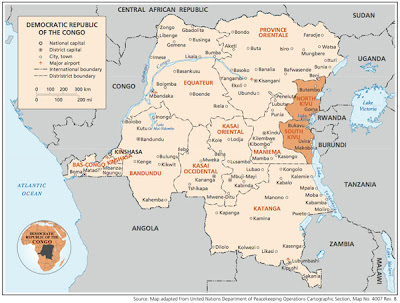
Conflict Minerals: A Cover For US Allies and Western Mining Interests?
Kambale Musavuli and Bodia Macharia
Originally published by Huffington Post, Dec. 14, 2009.
As global awareness grows around the Congo and the silence is finally being broken on the current and historic exploitation of Black people in the heart of Africa, myriad Western based “prescriptions” are being proffered. Most of these prescriptions are devoid of social, political, economic and historical context and are marked by remarkable omissions. The conflict mineral approach or efforts emanating from the United States and Europe are no exception to this symptomatic approach which serves more to perpetuate the root causes of Congo’s challenges than to resolve them.
The conflict mineral approach has an obsessive focus on the FDLR and other rebel groups while scant attention is paid to Uganda (which has an International Court of Justice ruling against it for looting and crimes against humanity in the Congo) and Rwanda (whose role in the perpetuation of the conflict and looting of Congo is well documented by UN reports and international arrest warrants for its top officials). Rwanda is the main transit point for illicit minerals coming from the Congo irrespective of the rebel group (FDLR, CNDP or others) transporting the minerals. According to Dow Jones, Rwanda’s mining sector output grew 20% in 2008 from the year earlier due to increased export volumes of tungsten, cassiterite and coltan, the country’s three leading minerals with which Rwanda is not well endowed. In fact, should Rwanda continue to pilfer Congo’s minerals, its annual mineral export revenues are expected to reach $200 million by 2010. Former Assistant Secretary of State for African Affairs Herman Cohen says it best when he notes “having controlled the Kivu provinces for 12 years, Rwanda will not relinquish access to resources that constitute a significant percentage of its gross national product.” As long as the West continues to give the Kagame regime carte blanche, the conflict and instability will endure. Read the rest of this entry »
Also published by The Rag Blog, OpEdNews, Signs of the Times, Interactivist Info Exchange, and Toward Freedom.
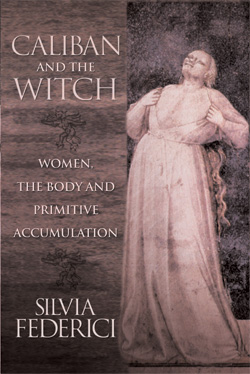 Who Were the Witches? – Patriarchal Terror and the Creation of Capitalism
Alex Knight
November 5, 2009
This Halloween season, there is no book I could recommend more highly than Silvia Federici’s brilliant Caliban and the Witch: Women, the Body, and Primitive Accumulation (Autonomedia 2004), which tells the dark saga of the Witch Hunt that consumed Europe for more than 200 years. In uncovering this forgotten history, Federici exposes the origins of capitalism in the heightened oppression of workers (represented by Shakespeare’s character Caliban), and most strikingly, in the brutal subjugation of women. She also brings to light the enormous and colorful European peasant movements that fought against the injustices of their time, connecting their defeat to the imposition of a new patriarchal order that divided male from female workers. Today, as more and more people question the usefulness of a capitalist system that has thrown the world into crisis, Caliban and the Witch stands out as essential reading for unmasking the shocking violence and inequality that capitalism has relied upon from its very creation.
Who Were the Witches?
Parents putting a pointed hat on their young son or daughter before Trick-or-Treating might never pause to wonder this question, seeing witches as just another cartoonish Halloween icon like Frankenstein’s monster or Dracula. But deep within our ritual lies a hidden history that can tell us important truths about our world, as the legacy of past events continues to affect us 500 years later. In this book, Silvia Federici takes us back in time to show how the mysterious figure of the witch is key to understanding the creation of capitalism, the profit-motivated economic system that now reigns over the entire planet.
During the 15th – 17th centuries the fear of witches was ever-present in Europe and Colonial America, so much so that if a woman was accused of witchcraft she could face the cruellest of torture until confession was given, or even be executed based on suspicion alone. There was often no evidence whatsoever. The author recounts, “for more than two centuries, in several European countries, hundreds of thousands of women were tried, tortured, burned alive or hanged, accused of having sold body and soul to the devil and, by magical means, murdered scores of children, sucked their blood, made potions with their flesh, caused the death of their neighbors, destroyed cattle and crops, raised storms, and performed many other abominations” (169).
In other words, just about anything bad that might or might not have happened was blamed on witches during that time. So where did this tidal wave of hysteria come from that took the lives so many poor women, most of whom had almost certainly never flown on broomsticks or stirred eye-of-newt into large black cauldrons?
Caliban underscores that the persecution of witches was not just some error of ignorant peasants, but in fact the deliberate policy of Church and State, the very ruling class of society. To put this in perspective, today witchcraft would be a far-fetched cause for alarm, but the fear of hidden terrorists who could strike at any moment because they “hate our freedom” is widespread. Not surprising, since politicians and the media have been drilling this frightening message into people’s heads for years, even though terrorism is a much less likely cause of death than, say, lack of health care.1 And just as the panic over terrorism has enabled today’s powers-that-be to attempt to remake the Middle East, this book makes the case that the powers-that-were of Medieval Europe exploited or invented the fear of witches to remake European society towards a social paradigm that met their interests.
Interestingly, a major component of both of these crusades was the use of so-called “shock and awe” tactics to astound the population with “spectacular displays of force,” which helped to soften up resistance to drastic or unpopular reforms.2 In the case of the Witch Hunt, shock therapy was applied through the witch burnings – spectacles of such stupefying violence that they paralyzed whole villages and regions into accepting fundamental restructuring of medieval society.3 Federici describes a typical witch burning as, “an important public event, which all the members of the community had to attend, including the children of the witches, especially their daughters who, in some cases, would be whipped in front of the stake on which they could see their mother burning alive” (186).
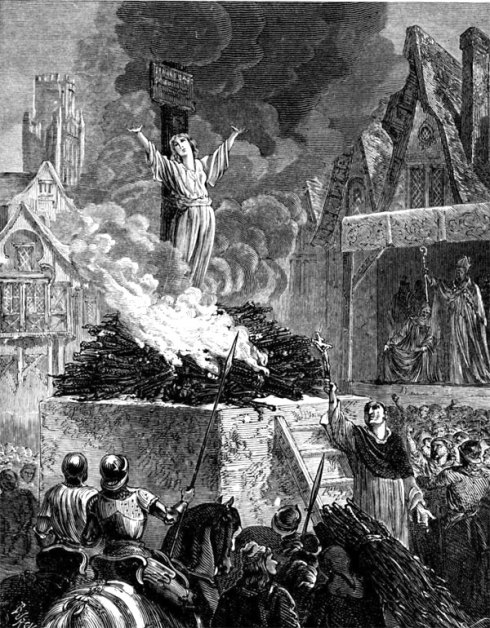
The witch burning was the medieval version of "Shock and Awe"
The book argues that these gruesome executions not only punished “witches” but graphically demonstrated the repercussions for any kind of disobedience to the clergy or nobility. In particular, the witch burnings were meant to terrify women into accepting “a new patriarchal order where women’s bodies, their labor, their sexual and reproductive powers were placed under the control of the state and transformed into economic resources” (170). Read the rest of this entry »
An excellent talk on the relation between mental health and capitalism/neoliberalism. This is worth watching all the way through if you can. Dr. Stephen Bezruchka discusses the pharmaceutical/psychiatric industry and the spiraling rates of anti-depressants and other drugs given out to adults and children. This medicating of America doesn’t seem to be curbing mental illness or mental disorders, which are more prevalent in the US today than ever before, or in any other countries.
He suggests a more “caring and sharing” society, focused especially on better childhood development and reducing the gap between rich and poor, would do much to help us heal our over-stressed and depressed nation. This is a great line of thought, as understanding psychological disorder within the context of political decision-making allows us to imagine strategies to overcome it. Human-made problems have human solutions.


 The End of Capitalism
Recent Comments