You are currently browsing the category archive for the ‘Class’ category.
Republished by Energy Bulletin, OpEdNews, and Countercurrents, and translated into Turkish for Hafif.org.
The following exchange between Michael Carriere and Alex Knight occurred via email, July 2010. Alex Knight was questioned about the End of Capitalism Theory, which states that the global capitalist system is breaking down due to ecological and social limits to growth and that a paradigm shift toward a non-capitalist future is underway.
This is the third part of a four-part interview. This part is a continuation of Alex’s response to the second question. Click here for Part 2A. Scroll to the bottom for links to the other sections.
Part 2B. Social Limits and the Crisis
MC: Capitalism has faced many moments of crisis over time. Is there something different about the present crisis? What makes the end of capitalism a possibility now?
AK: As I described in the last section, the current crisis can be understood as resulting from a massive collision between capitalism’s relentless need for growth and the world’s limits in capacity to sustain that growth. These limits to growth are both ecological and social. In this section I’ll discuss the concept of social limits to growth.
The Extraordinary Power of Social Movements
Social limits to growth function alongside the ecological limits but are drawn from a different source. By social limits we mean the inability, or unwillingness, of human communities, and humankind as a whole, to support the expansion of capitalism. This broadly includes all forms of resistance to capitalism, a resistance that has arguably been increasing around the world through innumerable forms of alternative lifestyles, refusal to cooperate, protest, and outright rebellion.
As a disclaimer it’s important to recognize that not all resistance is progressive. There are right-wing, fundamentalist, and undemocratic forces that also resist capitalism, for example the Taliban, or North Korea. These are not our allies. They do not share progressive values, we cannot condone their attacks on women, or on freedom more generally, and I don’t see anything to be gained by working with them. However it is important to recognize how these forces are aligned against capitalism and U.S. imperialism, in addition to being aware of the danger they present to our own hopes and dreams.
Progressive resistance, on the other hand, has always taken its strength from grassroots social movements. Silvia Federici writes about the immense and varied peasant movements in medieval Europe that fought for religious and sexual freedom, challenging both feudal lords and emerging capitalist elites. I like to think of these rebels as my European ancestors – they were just commoners but they rose up to fight for a better world. This is the nature of social movements. Ordinary folks, daring to pursue their deepest aspirations, interests and dreams, join together with others who share those desires, and thereby create something extraordinary. The magic exists in the joining-together. Isolated individuals lack the power to accomplish what a group can achieve.
We can appreciate this extraordinary power if we look at how social movements have transformed our lives. A century ago, millions of American workers joined the labor movement and won the 8-hour day, Social Security, and workplace safety. Regular folks carried forward the Civil Rights Movement and broke Southern segregation. The feminist and LGBT movements have transformed the way gender and sexuality are viewed all over the world. It’s hard to overstate how dramatically these and other social movements have improved society. While capitalism has invented ways to co-opt social movements and redirect them into outlets that do not challenge the system on a deep level (like the “non-profit industrial complex”), movements have remained alive and vibrant by empowering people to reach towards a different world.
Have social movements limited capitalist oppression recently? To answer this we need to learn the story of the Global Justice Movement.

Demonstrators tear down a section of security fence in the Mexican resort city of Cancun to confront the World Trade Organization’s Fifth Ministerial summit on Sept. 10, 2003.
The Global Justice Movement
David Graeber, anarchist anthropologist, wrote a remarkable essay called “The Shock of Victory” in which he looks at this movement that suddenly flared up at the turn of the millennium and seemed to disappear just as quickly. Although most Americans may not remember the Global Justice Movement, and those who participated in it may feel demoralized by the fact that capitalism still exists, Graeber points out that many of the movement’s ambitious goals were accomplished. Read the rest of this entry »
Republished by Energy Bulletin, The Todd Blog, OpEdNews, Countercurrents, and translated into Turkish for Hafif.org.
The following exchange between Michael Carriere and Alex Knight occurred via email, July 2010. Alex Knight was questioned about the End of Capitalism Theory, which states that the global capitalist system is breaking down due to ecological and social limits to growth and that a paradigm shift toward a non-capitalist future is underway.
This is the second part of a four-part interview. Scroll to the bottom for links to the other sections.
Part 2A. Capitalism and Ecological Limits
MC: Capitalism has faced many moments of crisis over time. Is there something different about the present crisis? What makes the end of capitalism a possibility now?
AK: This is such an important question, and it’s vital to think and talk about the crisis in this way, with a view toward history. It’s not immediately obvious why this crisis began and why, two years later, it’s not getting better. Making sense of this is challenging. Especially since knowledge of economics has become so enclosed within academic and professional channels where it’s off-limits to the majority of the population. Even progressive intellectuals, who aim to translate and explain the crisis to regular folks, too often fall into the trap of accepting elite explanations as the starting point and then injecting their politics around the edges. This is why there is such an abundance of essays and videos analyzing “credit default swaps”, “collateralized debt obligations,” etc., as if this crisis is about nothing more than greedy speculators overstepping their bounds.
On the contrary, the End of Capitalism Theory insists there are deeper explanations for why this crisis is so severe, widespread, and long-lasting. Here’s one explanation: The devastating quaking of the financial markets, and the lingering aftershocks we’re experiencing in layoffs and cut-backs, are manifestations of much larger tectonic shifts under the surface of the economy. This turmoil originates from deep instabilities within capitalism, the global economic system that dominates our planet. The dramatic crisis we are experiencing now is resulting from a massive underground collision between capitalism’s relentless need for growth on one side, and the world’s limited capacity to sustain that growth on the other.
These limits to growth, like the continental plates, are enormous, permanent qualities of the Earth – they cannot be ignored or simply moved out of the way. The limits to growth are both ecological, such as shortages of resources, and social, such as growing movements for change around the globe. As capitalism rams into these limiting forces, numerous crises (economic, energy, climate, food, water, political, etc.) erupt, and destruction sweeps through society. This collision between capitalism and its limits will continue until capitalism itself collapses and is replaced by other ways of living.
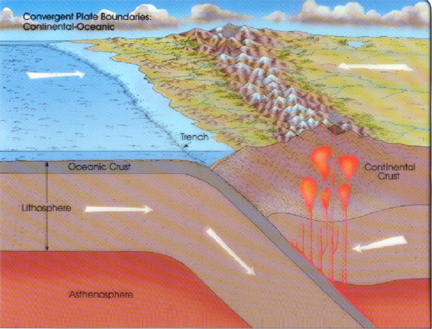
Tectonic Plates Colliding - Capitalism is Ramming into the Limits to Growth, Causing Massive Shocks on the Surface of the Economy
The End of Capitalism Theory argues that capitalism will not be able to overcome these limits to growth, and therefore it is only a matter of time before we are living in a non-capitalist world. A paradigm shift towards a new society is underway. There’s a chance this new future could be even worse, but I hold tremendous hope in the capacity of human beings to invent a better life for themselves when given the chance. Part of my hope springs from the understanding that capitalism has caused terrible havoc all over the world through the violence it perpetrates against humanity and Mother Earth. The end of capitalism need not be a disaster. It can be a triumph. Or, perhaps, a sigh of relief.
Defining the Crisis
Rather than spend our time learning the language of Wall St. and trying to understand the economic crisis from the perspective of the bankers and capitalists, I think we can get much further if we take our own point of reference and then investigate below the surface to try to find the true origins of the crisis. This is what I call a common sense radical approach. Start from where we are, who we are, and what we know, because you don’t need to be an academic to understand the economy – you just need common sense. Then try to get to the root of the issue (radical coming from the Latin word for “root”). What is really going on under the surface? What is the core of the problem? If we can’t come up with a common sense radical explanation of the crisis, we’ll always be stuck within someone else’s dogma. This could be Wall St. dogma, Marxist dogma, Christian dogma, etc. So what is this crisis really about? Read the rest of this entry »
Republished by Countercurrents, OpEdNews, Alliance for Sustainable Communities – Lehigh Valley, The Pigeon Post, Dissident Voice and The (Grace Lee) Boggs Blog!
The following exchange between Michael Carriere and Alex Knight occurred via email, July 2010. Alex Knight was questioned about the End of Capitalism Theory, which states that the global capitalist system is breaking down due to ecological and social limits to growth and that a paradigm shift toward a non-capitalist future is underway.
The interview will be available in four parts. Scroll to the bottom to read all of Prof. Carriere’s questions.
Part 1. Crisis and Opportunity
MC: The current financial crisis is clearly a moment of peril for both individuals and the broader system of capitalism. But would it also make sense to see it as a moment of opportunity?
AK: Absolutely. I see opportunity springing from every crack in the structure of capitalism. For all those who wish to see a different world, this moment is dripping with opportunity because the old order is crumbling before our eyes.
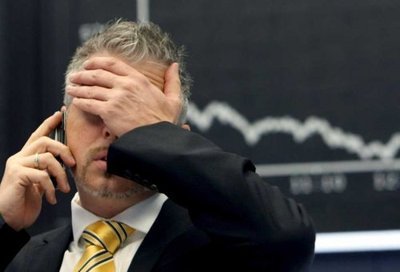
Shock and Awe on the New York Stock Exchange
The crisis extends far beyond the broken financial system. Millions of people are losing their jobs, homes, and savings as the burden of the crisis gets shifted onto the poor and working class. Public faith in the system, both the government and the capitalist economy, has been shattered and is at an all-time low. And it’s not just the economic crisis. The bank bailouts, the endless wars in the Mid East, the BP spill and the meltdown of the climate, and about a dozen other crises have shaken us deeply. It’s become common sense that the system is broken and a major change is needed. Barack Obama was elected in the US precisely by promising this change. Now that he is failing to deliver, more and more people are questioning whether the system can provide any solutions, or whether it’s actually the source of the problem.
Shattered faith is the dominant sentiment today. You can see it in people’s faces – the disappointment, grief, worry, and anger. To me, this loss of faith presents an enormous opening for putting forth a new, non-capitalist way of life. People are ready to hear radical solutions now, like they haven’t been since the Great Depression.
Historic Crossroads
If we go back to 1929, we’ll see some interesting parallels to our current moment. When that depression started, millions lost their livelihoods to pay for the bankers’ crisis. Faith in capitalism sunk to rock bottom. The public flocked to two major ideologies that offered a way out: socialism and fascism.
Socialism presented a solution to the crisis by saying, roughly: “Capitalism is flawed because it divides us into rich and poor, and the rich always take advantage of the poor. We need to organize the poor and workers into unions and political parties so we can take power for the benefit of all.”
Socialism attracted millions of followers, even in the United States. The labor movement was enormous and kept gaining ground through sit-down strikes and other forms of direct action. The Communist Party sent thousands of organizers into the new CIO, at the time a more radical union than the AFL. Socialist viewpoints even started getting through to the mass media and government. Huey Long was elected Senator from Louisiana by promising to “Share Our Wealth,” to radically redistribute the wealth of the country to abolish poverty and unemployment. (He was assassinated.) Socialism challenged President Roosevelt from the left, pushing him to create the social safety net of the New Deal.
On the other side, fascism also emerged as a serious force and attracted a mass following by putting forth something like the following: “The government has sold us out. We are a great nation, but we have been disgraced by liberal elites who are pillaging our economy for the benefit of foreign enemies, dangerous socialists, and undesirable elements (like Jews). We need to restore our national honor and fulfill our God-given mission.”
When people hear the word fascism, they usually think of Nazi Germany or Mussolini’s Italy, where successful fascist movements seized state power and implemented totalitarian control of society. Yet fascism was an international phenomenon during the Depression, and the United States was not immune to its reach. General Smedley Butler, the most decorated Marine in US history, testified before the Senate that wealthy industrialists had approached him as part of a “Business Plot” and tried to convince him to march an army of 500,000 veterans on Washington, DC to install a fascist dictatorship.
Today we are approaching a similar crossroads. When I hear the story of the Business Plot I think about the Tea Party, which has sprung from a base of white supremacist anger, facilitated by right-wing elements of the corporate structure like Fox News. This is an extremely dangerous phenomenon. The “teabaggers” have moved from questioning Obama’s citizenship, to now trying to reverse the gains of the Civil Rights Movement, such as the ability of everyone, regardless of color, to enjoy public accommodations like restaurants.
I think it’s fair to name the Tea Party, Glenn Beck, Sarah Palin, the Christian Right, etc. parts of a potential neo-fascist movement in the United States. Their words and actions too often encourage attacks on people of color, immigrants, Muslims, LGBT folks, and anyone they don’t see as legitimate members of US society. Ultimately, many in this movement are pushing for a different social system taking power in the United States: one that is more authoritarian, less compassionate, more exploitive of the environment, more militaristic, and based on a mythical return to national glory. This is not a throwback to Nazi Germany. It’s a new kind of fascism, a new American fascism. And it’s a serious threat.
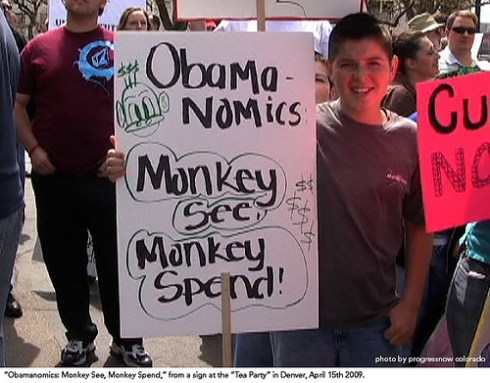
Tea Party racism in Denver, April 15, 2009
On the other hand, this crisis is also an opportunity for all of us who see capitalism as a destructive force and believe the message of the recent U.S. Social Forum that “Another World is Possible. Another US is Necessary.” “Socialism” in the post-McCarthy/Cold War era of the United States is a dead word, because it carries a lot of baggage from the Soviet Union. Rightly so, the USSR was a terrible dictatorship that is hardly an example to follow. The question is, how do those of us who are progressive and anti-capitalist articulate our ideas to resonate with a mass audience in this moment?
Common Values
I argue that we need to speak to the population in a language of our common values: democracy, freedom, justice, and sustainability. Read the rest of this entry »
A short article I wrote for local Philly paper The Defenestrator, with a few tips on how to avoid paying back student loans. Student debt functions as an enclosure on youth – it keeps post-college youth from pursuing their dreams or working with others for a better world, because they feel pressured to pay their debt back. This affects students even before they graduate – rather than study what they care about, students feel immense pressure to study a subject that will land them a good job.
A few statistics:
- By 2008 average college tuition had increased by 439% since the 1980s, meaning it’s over 5 times as expensive as a generation ago. This doesn’t include books, housing, meal plans, etc.
- Graduating college seniors in 2008 had an average debt of $23,200. 67% of seniors graduated with student debt. (Project on Student Debt)
- As recently as 1993, less than half of seniors graduated with debt.
- Prior to 1980, 80% of government financial aid was given in the form of grants and scholarships that did not have to be repaid. Today, 80% of gov’t financial aid comes in the form of loans.
- 78% of undergraduates worked full or part-time jobs while taking classes in 2003-04. In 1984, it was 49%.
- In 1970, 40% of new college students considered “being very well-off financially” to be very important, and about 70% considered “developing a meaningful philosophy of life” to be very important. In 2005, 70% considered “being very well-off financially” to be very important, and about 40% considered “developing a meaningful philosophy of life” very important.
Please comment if you have other suggestions on how to break free of student debt! [alex]
Break the Chains of Student Debt!
Alex Knight, June 3, 2010
Paying back student loans can be a real downer. Loans can make organizing after college virtually impossible as they force debtors to work a full-time corporate or nonprofit job, or join the military just to pay them off. When I graduated from college, I had $50,000 worth of student loan debt. I felt I was forced to get a full-time job, and pay them off as quickly as possible so in the future I could finally dedicate myself to social change work. Luckily I didn’t have to make this choice, as there are other options available! Here are a few worth knowing about.
First, you can defer or get a forbearance, to delay payments. Often with these you can delay paying your loans for years, although interest may accrue during that time, and you may be forced to make special payments. For example Sallie Mae used to require you to pay $100 for a 6-month forbearance on private loans, but now they’ve chopped this to $200 for only a 3-month forbearance, which often makes it almost pointless. Nevertheless, you can often easily qualify for an “unemployment” deferment, even if you are working part-time.
Second, you can try to run from your loans altogether and go into default. The only problem with this, besides destroying your credit rating, is if you have co-signers on your loans, such as parents. If you go into default, you’d also be screwing them over.
A third option has recently emerged, which should be taken advantage of as much as possible. It’s called Income-Based Repayment, and it can be used to reduce or eliminate your monthly payments for most Federal loans (not those pesky private ones, unfortunately). Through the federal government’s Direct Loan program, which was recently enlarged by Obama’s Health Care reform, you can consolidate your federal loans into an IBR (or Income-Contigent Repayment – ICR) plan. Payments then become “based” or “contingent” on your income, so if you work part-time and don’t make a lot of money, you won’t have to pay a lot, and you could even eliminate your monthly payments entirely if you earn less than 150% of the poverty line. If you’re a full-time activist like me, you almost certainly qualify. And after 25 years, your debt will be forgiven.
So check out IBR, and don’t let student loans stop you from dedicating your life to building the social movements our communities and world so desperately need!
Income-Based Repayment
 Income-Based Repayment (IBR) is a new payment option for federal student loans. It can help borrowers keep their loan payments affordable with payment caps based on their income and family size. For most eligible borrowers, IBR loan payments will be less than 10 percent of their income – and even smaller for borrowers with low earnings. IBR will also forgive remaining debt, if any, after 25 years of qualifying payments.
Who can use IBR? IBR is available to federal student loan borrowers in both the Direct and Guaranteed (or FFEL) loan programs, and covers most types of federal loans made to students, but not those made to parents. To enter IBR, you have to have enough debt relative to your income to qualify for a reduced payment. That means it would take more than 15 percent of whatever you earn above 150% of poverty level to pay off your loans on a standard 10-year payment plan. Use our calculator to see if you’re likely to be eligible.
How does IBR make payments more affordable? IBR uses a kind of sliding scale to determine how much you can afford to pay on your federal loans. If you earn below 150% of the poverty level for your family size, your required loan payment will be $0. If you earn more, your loan payment will be capped at 15 percent of whatever you earn above that amount.
Except for the highest earners, that usually works out to less than 10 percent of your total income. Read the rest of this entry »
Sakura Saunders’ excellent article from ZNet exposing one form of the “modern Enclosures” – displacing communities from their land to make money for transnational corporations, in this case mining companies in Papua New Guinea. Read this closely!
As described by Silvia Federici’s excellent book Caliban and the Witch, the Enclosures are the violence and displacement that created the first class of landless workers in Europe, commodifying their labor with the wage. And these Enclosures have continued to expand and develop alongside the system of capitalism, in fact I will make the argument that this violence is the base, the foundation, for the system as a whole, and it could not function without it.
We must never forget that at every moment, capitalism is committing violence against poor and indigenous communities in order to make its profits. As Sakura cites, “more than 10 million people are involuntarily displaced every year to make room for development projects.” So much for ‘laissez-faire’! [alex]
Mining Through Roots
Displacement, Poverty and the Global Extractive Industry
Monday, June 14, 2010
In the highlands of Papua New Guinea, several villages rest on a man-made island literally surrounded by an open pit gold mine and its expanding waste dumps. As the waste dumps have grown, they’ve devoured homes, schools, and most of the areas once used for gardening, making the indigenous population rely on money to acquire food while crowding them into increasingly squashed living quarters. At the same time, these same communities – the original landowners of the mine site – are criminalized for what the company calls “illegal mining,” a practice of panning for gold that the local community considers its birthright.
This so-called illegal mining is used by the company as a pretext for detentions, killings, and even the burning down of an entire hillside of homes*. Meanwhile, public funds are diverted from schools and hospitals to deal with “law and order” issues and the construction of a multi-million dollar fence to surround the mine site.
This scenario – the protection of the have’s from the have-not’s by a process of criminalization, militarization and the construction of walls – is an all-too-familiar response to the social issues created by global capitalism and colonization. Immigration policies criminalize people, militarize borders, and separate communities along boundaries set up to trap people in an economic reality that conspires against them. Meanwhile, the developed nations that aggressively protect their borders against new entrants have created a global economic and military system that forces people out of rural areas that are then used by large industry to extract resources, be they cash crops, minerals, lumber, oil and gas, or the industrial infrastructure needed to produce and export these goods (such as dams, highways, and pipelines). This rural to urban migration turns cities into sweatshops with expendable labor and the corresponding rights, leaving few options for the dispossessed. Labor exploitation becomes codified in Temporary Foreign Worker Programs, where developed countries attempt to receive maximum benefit from the desperation of the world’s impoverished. Read the rest of this entry »

The Grapes of Wrath
by John Steinbeck
published 1939 during the last Great Depression.
Alex Knight, endofcapitalism.com, May 25, 2010
Also posted on The Rag Blog and TowardFreedom.
Arizona SB1070, signed into law by Governor Jan Brewer on April 23, requires Arizona’s local and state law enforcement to demand the immigration status of anyone they suspect of being in the country illegally, and arrest them if they lack documents proving citizenship or legal residency. Effectively making racial profiling into state policy, this law is the latest in a series of attacks on Latin American immigrants, as well as the entire Latino community, who must live with the fear of being interrogated by police for their brown skin. Then on May 11, Arizona went one step further, outlawing the teaching of ethnic studies classes, or any classes that “are designed primarily for students of a particular ethnic group or advocate ethnic solidarity”. This same law also states that schools must fire English teachers who speak with a “heavy accent.”
Perhaps these new laws make sense if we imagine that undocumented immigrants are merely “aliens”, a danger to the good, mostly white citizens of this great country. But suppose we look at the problem of immigration from the perspective of the immigrants? Why are they risking life and limb to come to a foreign land, far from their home and families? Why aren’t they deterred from making this trip no matter how many walls we put up, no matter how many police collaborate with ICE, no matter how many angry armed “Minutemen” vigilantes are conscripted to guard the border?
John Steinbeck’s classic novel The Grapes of Wrath, following the Joad family as they migrate to California during the “Dust Bowl” of the 1930s, sheds light on these questions in a way that perhaps every American can relate to. One of the most popular and well-written American books of all time, The Grapes of Wrath provides a very human perspective on the harsh lives of migrants, personified by the Joads – a family of poor sharecroppers from Oklahoma. Evicted from their family farm, just as the millions of Mexicans who have suffered enclosure from their land and become homeless and jobless because of NAFTA, the Joads travel to California in a desperate search of work, only to encounter the harassment of authorities and the hatred of the local population.
There are important differences between the “Okies” who traveled to the Southwest in the 1930s and Latino migrantes of the 2000s. The Joads, of course, were white, and did not cross a national border when they made their exodus. But at its core the story of the Joads is the story of the migrant workers, their troubles, their fears, but also their humanity, and their hope. It is a story that can inspire us to recognize the historic nature of the moment in which we live, understand why these enormous transformations are occurring, and recognize that justice for the immigrants is justice for everyone, regardless of color or citizenship status.
Enclosure
In order to understand the migrantes we first have to understand the story of their displacement, or the enclosure of their land, which has left them homeless and with no other options than to leave their homeland in search of a wage. What can The Grapes of Wrath tell us about this reality?
People usually do not resort to risky and desperate moves unless they have nothing left to lose. Steinbeck begins the Joads’ story with the loss of everything they had: the small farm on which they had sustained their family for generations by growing cotton. Young Tom Joad, fresh out of prison, returns to his home to find it deserted. “The Reverend Casy and young Tom stood on the hill and looked down on the Joad place… Where the dooryard had been pounded hard by the bare feet of children and by stamping horses’ hooves and by the broad wagon wheels, it was cultivated now, and the dark green, dusty cotton grew… ‘Jesus!’ he said at last. ‘Hell musta popped here. There ain’t nobody livin’ there.'” (51).

Mexican farmer with corn / image courtesy of "© Juan_de" on flickr
Whether as tenants or small landholders, either for subsistence or for markets, the vast majority of the poor migrantes now coming to this country are fleeing the loss of their farms and their livelihoods, just as the Joads. Perhaps for generations, maybe hundreds or even thousands of years, they had lived in connection with the land and had been able to depend on it for the survival of their families and culture. The loss of this land is devastating to those cultures, but larger forces stand to gain by driving these people into homelessness. Read the rest of this entry »
Chris Hedges, author of American Fascists: The Christian Right and the War on America, has been warning us of the threat of neo-fascism in the United States for a few years now. This is one of his best pieces on the subject, comparing what is happening here and now with the Sarah Palins, Glenn Becks, and Tea Partiers to what happened to Yugoslavia 20 years ago.
However I must disagree with Hedges on the phrase ‘liberal elite’ – the ruling class is hardly liberal, unless it’s liberal to invade countries and kill millions of innocent civilians based on lies, or to plunder the atmosphere and seas, or to torture and spy on Americans and others, or any of the other awful things the government and its corporate cronies are carrying out all the time. Barack Obama may have a liberal streak as an individual, but he is carrying out a violent, imperialistic capitalist agenda for the real rulers. [alex]
Is America ‘Yearning for Fascism’?
Chris Hedges
Originally published by TruthDig, March 29, 2010
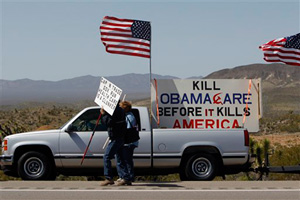
Tea Baggers - AP / Jae C. Hong
The language of violence always presages violence. I watched it in war after war from Latin America to the Balkans. The impoverishment of a working class and the snuffing out of hope and opportunity always produce angry mobs ready to kill and be killed. A bankrupt, liberal elite, which proves ineffectual against the rich and the criminal, always gets swept aside, in times of economic collapse, before thugs and demagogues emerge to play to the passions of the crowd. I have seen this drama. I know each act. I know how it ends. I have heard it in other tongues in other lands. I recognize the same stock characters, the buffoons, charlatans and fools, the same confused crowds and the same impotent and despised liberal class that deserves the hatred it engenders.
“We are ruled not by two parties but one party,” Cynthia McKinney, who ran for president on the Green Party ticket, told me. “It is the party of money and war. Our country has been hijacked. And we have to take the country away from those who have hijacked it. The only question now is whose revolution gets funded.”
The Democrats and their liberal apologists are so oblivious to the profound personal and economic despair sweeping through this country that they think offering unemployed people the right to keep their unemployed children on their nonexistent health care policies is a step forward. They think that passing a jobs bill that will give tax credits to corporations is a rational response to an unemployment rate that is, in real terms, close to 20 percent. They think that making ordinary Americans, one in eight of whom depends on food stamps to eat, fork over trillions in taxpayer dollars to pay for the crimes of Wall Street and war is acceptable. They think that the refusal to save the estimated 2.4 million people who will be forced out of their homes by foreclosure this year is justified by the bloodless language of fiscal austerity. The message is clear. Laws do not apply to the power elite. Our government does not work. And the longer we stand by and do nothing, the longer we refuse to embrace and recognize the legitimate rage of the working class, the faster we will see our anemic democracy die.
The unraveling of America mirrors the unraveling of Yugoslavia. The Balkan war was not caused by ancient ethnic hatreds. It was caused by the economic collapse of Yugoslavia. The petty criminals and goons who took power harnessed the anger and despair of the unemployed and the desperate. They singled out convenient scapegoats from ethnic Croats to Muslims to Albanians to Gypsies. They set in motion movements that unleashed a feeding frenzy leading to war and self-immolation. There is little difference between the ludicrous would-be poet Radovan Karadzic, who was a figure of ridicule in Sarajevo before the war, and the moronic Glenn Beck or Sarah Palin. There is little difference between the Oath Keepers and the Serbian militias. We can laugh at these people, but they are not the fools. We are.
The longer we appeal to the Democrats, who are servants of corporate interests, the more stupid and ineffectual we become. Sixty-one percent of Americans believe the country is in decline, according to a recent NBC News/Wall Street Journal poll, and they are right. Only 25 percent of those polled said the government can be trusted to protect the interests of the American people. If we do not embrace this outrage and distrust as our own it will be expressed through a terrifying right-wing backlash. Read the rest of this entry »
Engaging the Crisis: Organizing Against Budget Cuts and Community Power in Philadelphia
by Kristin Campbell
Reposted from Organizing Upgrade, March 1, 2010
Organizing Upgrade is honored to offer a preview of this insightful reflection on organizing – Engaging the Crisis: Organizing Against Budget Cuts and Building Community Power in Philadelphia – which will appear in Left Turn magazine #36 (April/May 2010). You can subscribe to Left Turn online at www.leftturn.org or become a monthly sustainer at www.leftturn.org/donate.
On November 6, 2008, just days after Philadelphians poured onto the streets to celebrate the Phillies winning the World Series championship and Barack Obama the US presidency, Mayor Michael Nutter announced a drastic plan to deal with the cities $108 million budget gap. Severe budget cuts were announced, including the closure of 11 public libraries, 62 public swimming pools, 3 public ice skating rinks, and several fire engines. Nutter also stated that 220 city workers would be laid off and that 600 unfilled positions would be eliminated entirely, amounting to the loss of nearly 1,000 precious city jobs. In classic neo-liberal style, the public sector was to sacrifice, while taxpayer money would bail out the private banking institutions.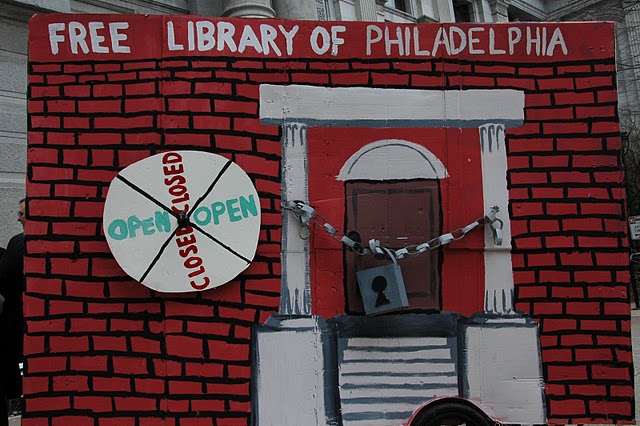
City in crisis
Well before the economic crises of 2008, a decades-long process of economic restructuring and deindustrialization had left Philadelphia, with a population just over 1.4 million, an incredibly under-resourced city. Philadelphia has the highest poverty rate out of the ten largest cities in the US, an eleven percent unemployment rate and a high-school dropout rate that hovers dangerously around 50 percent.
The proposed budget cuts sparked waves of popular outrage especially concerning the closure of the libraries, many of which are located in low-income communities of color and serve as bedrock institutions for many basic resources. Eleanor Childs, a principal of a school that heavily relies on West Philadelphia’s Durham library, and later a member of the Coalition to Save the Libraries, recalls “a groundswell of concern about the closing of the libraries… people rose up. We had our pitchforks. We were ready to fight to keep our libraries open.”
Nutter’s administration set up eight townhall meetings across Philadelphia, designed to calm the citywide uproar. Thousands of people filled the townhall meetings poised to question how such drastic decisions were made without any public input. Under the banner “Tight Times, Tough Choices,” Mayor Nutter and senior city officials attempted to explain the necessity of such deep service cuts. They explained that the impact of the economic crisis on the city had only become apparent in recent weeks, and because the city could not raise significant revenue to offset its financial loses in the timeframe that was needed, rapid cuts were mandatory and effective January 1, 2009.
Community response
In the following days and weeks, Philadelphians quickly mobilized against the decision that their public services and city workers pay for the fallout of a economic system that had already left so many of them struggling. Neighborhood leaders organized impromptu rallies at the eleven branch libraries. Along with organizing people to turn out at the Mayor’s townhall meetings, these rallies gained media attention on both the nightly news and in the major newspapers, demonstrating widespread opposition to the budget cuts. Sherrie Cohen, member of the Coalition to Save the Libraries and long-time resident of the Ogontz neighborhood of North Philly remembers her neighbors coming together to say, “We are not going to let this library close. It’s not gonna happen. We fought for 36 years for a library in our neighborhood.” Read the rest of this entry »


 The End of Capitalism
Recent Comments