You are currently browsing the yearly archive for 2010.
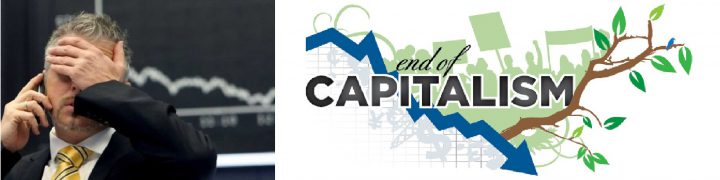
This is one of the most timely and insightful articles I’ve read in a long time – the editorial from the new issue of Turbulence magazine. They discuss the economic crisis within the frame of the collapse of the neoliberal order that has been the standard-bearer of global capitalism for the last 30-35 years, resulting in a state of “limbo” where no “deal” exists tying the system together. Nevertheless, the system persists like a zombie, dead and discredited but carried forward by sheer momentum and the fact that nothing else has shown itself capable of replacing it. Our job then, is to hold up an alternative way of life (a new “common ground”) that values communities and the planet above narrow profit, and that job becomes easier by studying analysis like this. Thanks, Turbulence! [alex]
Life in Limbo?
By Turbulence
We are trapped in a state of limbo, neither one thing nor the other. For more than two years, the world has been wracked by a series of interrelated crises, and they show no sign of being resolved anytime soon. The unshakable certainties of neoliberalism, which held us fast for so long, have collapsed. Yet we seem unable to move on. Anger and protest have erupted around different aspects of the crises, but no common or consistent reaction has seemed able to cohere. A general sense of frustration marks the attempts to break free from the morass of a failing world.
There is a crisis of belief in the future, leaving us with the prospect of an endless, deteriorating present that hangs around by sheer inertia. In spite of all this turmoil – this time of ‘crisis’ when it seems like everything could, and should, have changed – it paradoxically feels as though history has stopped. There is an unwillingness, or inability, to face up to the scale of the crisis. Individuals, companies and governments have hunkered down, hoping to ride out the storm until the old world re-emerges in a couple of years. Attempts to wish the ‘green shoots’ of recovery into existence mistake an epochal crisis for a cyclical one; they are little more than wide-eyed boosterism. Yes, astronomical sums of money have prevented the complete collapse of the financial system, but the bailouts have been used to prevent change, not initiate it. We are trapped in a state of limbo.
Crisis in the middle
And yet, something did happen. Recall those frightening yet heady days that began in late 2008, when everything happened so quickly, when the old dogmas fell like autumn leaves? They were real. Something happened there: the tried and tested ways of doings things, well-rehearsed after nearly 30 years of global neoliberalism, started to come unstuck. What had been taken as read no longer made sense. There was a shift in what we call the middle ground: the discourses and practices that define the centre of the political field.
To be sure, the middle ground is not all that there is, but it is what assigns the things in the world around it a greater or lesser degree of relevance, validity or marginality. It constitutes a relatively stable centre against which all else is measured. The farther from the centre an idea, project or practice is, the more likely it is to be ignored, publicly dismissed or disqualified, or in some way suppressed. The closer to it, the more it stands a chance of being incorporated – which in turn will shift the middle more or less. Neither are middle grounds defined ‘from above’, as in some conspiratorial nightmare. They emerge out of different ways of doing and being, thinking and speaking, becoming intertwined in such a way as to reinforce each other individually and as a whole. The more they have become unified ‘from below’ as a middle ground, the more this middle ground acquires the power of unifying ‘from above’. In this sense, the grounds of something like ‘neoliberalism’ were set before something was named as such; but the moment when it was named is a qualitative leap: the point at which relatively disconnected policies, theories and practices became identifiable as forming a whole.
The naming of things like Thatcherism in the UK, or Reaganism in the US, marked such a moment for something that had been constituting itself for some time before, and which has for the past three decades dominated the middle ground: neoliberalism, itself a response to the crisis of the previous middle, Fordism/Keynesianism. The era of the New Deal and its various international equivalents had seen the rise of a powerful working class that had grown used to the idea that its basic needs should be met by the welfare state, that real wages would rise, and that it was always entitled to more. Initially, the centrepiece of the neoliberal project was an attack on this ‘demanding’ working class and the state institutions wherein the old class compromise had been enshrined. Welfare provisions were rolled back, wages held steady or forced downwards, and precariousness increasingly became the general condition of work.
But this attack came at a price. The New Deal had integrated powerful workers’ movements – mass-based trade unions – into the middle ground, helping to stabilise a long period of capitalist growth. And it provided sufficiently high wages to ensure that all the stuff generated by a suddenly vastly more productive industrial system – based on Henry Ford’s assembly line and Frederick Taylor’s ‘scientific management’ – could be bought. Bit by bit, the ferocious attack on the working classes of the global North was offset by low interest rates (i.e. cheap credit) and access to cheap commodities, mass-produced in areas where wages were at their lowest (like China). In the global South, the prospect of one day attaining similar living conditions was promised as a possibility. In this sense, neoliberal globalisation was the globalisation of the American dream: get rich or die trying. Read the rest of this entry »
In November, community members in Spokane Washington articulated these Community Bill of Rights, to give neighbors the ability to control their neighborhoods and their futures. It was defeated by massive opposition of corporate and political elites, but the model of communities organizing at the grassroots level for basic economic, social and ecological rights is something that I’m sure will be reproduced and improved upon in the New Year. Happy 2010! [alex]
Spokane Considers Community Bill of Rights
by Mari Margil, November 4, 2009
Thousands of people voted to protect nine basic rights, ranging from the right of the environment to exist and flourish to the rights of residents to have a locally based economy and to determine the future of their neighborhoods.
Of all the candidates, bills, and proposals on ballots around the country yesterday, one of the most exciting is a proposition that didn’t pass.
In Spokane, Washington, despite intense opposition from business interests, a coalition of residents succeeded in bringing an innovative “Community Bill of Rights” to the ballot. Proposition 4 would have amended the city’s Home Rule Charter (akin to a local constitution) to recognize nine basic rights, ranging from the right of the environment to exist and flourish to the rights of residents to have a locally based economy and to determine the future of their neighborhoods.

Communities Take Power - Barnstead, New Hampshire was the first town in the nation to ban corporate water mining.
A coalition of the city’s residents drafted the amendments after finding that they didn’t have the legal authority to make decisions about their own neighborhoods; the amendments were debated and fine-tuned in town hall meetings.
Although the proposition failed to pass, it garnered approximately 25 percent of the vote—despite the fact that opponents of the proposal (developers, the local Chamber of Commerce, and the Spokane Homebuilders) outspent supporters by more than four to one. In particular, they targeted the Sixth Amendment, which would have given residents the ability, for the very first time, to make legally binding, enforceable decisions about what development would be appropriate for their own neighborhood. If a developer sought to build a big-box store, for example, it would need to conform to the neighborhood’s plans.
Nor is development the only issue in which resident would have gained a voice. The drafters and supporters of Proposition 4 sought to build a “healthy, sustainable, and democratic Spokane” by expanding and creating rights for neighborhoods, residents, workers, and the natural environment.
Legal Rights for Communities
Patty Norton, a longtime neighborhood advocate who lives in the Peaceful Valley neighborhood of Spokane, and her neighbors spent years fighting a proposed condominium development that would loom 200 feet high, casting a literal shadow over Peaceful Valley’s historic homes.
Proposition 4 would ensure that “decisions about our neighborhoods are made by the people living there, not big developers,” Patty said. Read the rest of this entry »


 The End of Capitalism
Recent Comments