Engaging the Crisis: Organizing Against Budget Cuts and Community Power in Philadelphia
by Kristin Campbell
Reposted from Organizing Upgrade, March 1, 2010
Organizing Upgrade is honored to offer a preview of this insightful reflection on organizing – Engaging the Crisis: Organizing Against Budget Cuts and Building Community Power in Philadelphia – which will appear in Left Turn magazine #36 (April/May 2010). You can subscribe to Left Turn online at www.leftturn.org or become a monthly sustainer at www.leftturn.org/donate.
On November 6, 2008, just days after Philadelphians poured onto the streets to celebrate the Phillies winning the World Series championship and Barack Obama the US presidency, Mayor Michael Nutter announced a drastic plan to deal with the cities $108 million budget gap. Severe budget cuts were announced, including the closure of 11 public libraries, 62 public swimming pools, 3 public ice skating rinks, and several fire engines. Nutter also stated that 220 city workers would be laid off and that 600 unfilled positions would be eliminated entirely, amounting to the loss of nearly 1,000 precious city jobs. In classic neo-liberal style, the public sector was to sacrifice, while taxpayer money would bail out the private banking institutions.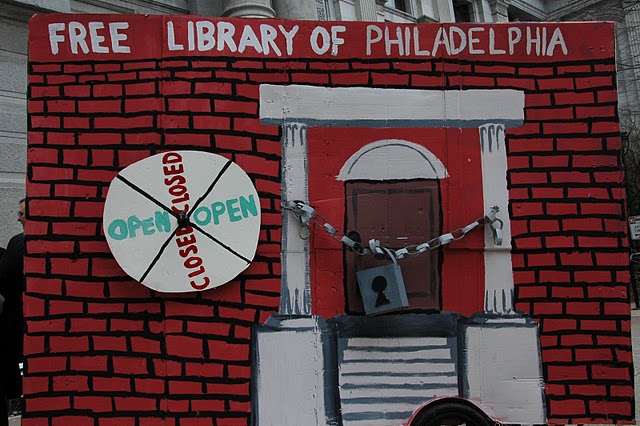
City in crisis
Well before the economic crises of 2008, a decades-long process of economic restructuring and deindustrialization had left Philadelphia, with a population just over 1.4 million, an incredibly under-resourced city. Philadelphia has the highest poverty rate out of the ten largest cities in the US, an eleven percent unemployment rate and a high-school dropout rate that hovers dangerously around 50 percent.
The proposed budget cuts sparked waves of popular outrage especially concerning the closure of the libraries, many of which are located in low-income communities of color and serve as bedrock institutions for many basic resources. Eleanor Childs, a principal of a school that heavily relies on West Philadelphia’s Durham library, and later a member of the Coalition to Save the Libraries, recalls “a groundswell of concern about the closing of the libraries… people rose up. We had our pitchforks. We were ready to fight to keep our libraries open.”
Nutter’s administration set up eight townhall meetings across Philadelphia, designed to calm the citywide uproar. Thousands of people filled the townhall meetings poised to question how such drastic decisions were made without any public input. Under the banner “Tight Times, Tough Choices,” Mayor Nutter and senior city officials attempted to explain the necessity of such deep service cuts. They explained that the impact of the economic crisis on the city had only become apparent in recent weeks, and because the city could not raise significant revenue to offset its financial loses in the timeframe that was needed, rapid cuts were mandatory and effective January 1, 2009.
Community response
In the following days and weeks, Philadelphians quickly mobilized against the decision that their public services and city workers pay for the fallout of a economic system that had already left so many of them struggling. Neighborhood leaders organized impromptu rallies at the eleven branch libraries. Along with organizing people to turn out at the Mayor’s townhall meetings, these rallies gained media attention on both the nightly news and in the major newspapers, demonstrating widespread opposition to the budget cuts. Sherrie Cohen, member of the Coalition to Save the Libraries and long-time resident of the Ogontz neighborhood of North Philly remembers her neighbors coming together to say, “We are not going to let this library close. It’s not gonna happen. We fought for 36 years for a library in our neighborhood.” Read the rest of this entry »



 The End of Capitalism
Recent Comments