
In November, community members in Spokane Washington articulated these Community Bill of Rights, to give neighbors the ability to control their neighborhoods and their futures. It was defeated by massive opposition of corporate and political elites, but the model of communities organizing at the grassroots level for basic economic, social and ecological rights is something that I’m sure will be reproduced and improved upon in the New Year. Happy 2010! [alex]
Spokane Considers Community Bill of Rights
by Mari Margil, November 4, 2009
Of all the candidates, bills, and proposals on ballots around the country yesterday, one of the most exciting is a proposition that didn’t pass.
In Spokane, Washington, despite intense opposition from business interests, a coalition of residents succeeded in bringing an innovative “Community Bill of Rights” to the ballot. Proposition 4 would have amended the city’s Home Rule Charter (akin to a local constitution) to recognize nine basic rights, ranging from the right of the environment to exist and flourish to the rights of residents to have a locally based economy and to determine the future of their neighborhoods.

Communities Take Power - Barnstead, New Hampshire was the first town in the nation to ban corporate water mining.
A coalition of the city’s residents drafted the amendments after finding that they didn’t have the legal authority to make decisions about their own neighborhoods; the amendments were debated and fine-tuned in town hall meetings.
Although the proposition failed to pass, it garnered approximately 25 percent of the vote—despite the fact that opponents of the proposal (developers, the local Chamber of Commerce, and the Spokane Homebuilders) outspent supporters by more than four to one. In particular, they targeted the Sixth Amendment, which would have given residents the ability, for the very first time, to make legally binding, enforceable decisions about what development would be appropriate for their own neighborhood. If a developer sought to build a big-box store, for example, it would need to conform to the neighborhood’s plans.
Nor is development the only issue in which resident would have gained a voice. The drafters and supporters of Proposition 4 sought to build a “healthy, sustainable, and democratic Spokane” by expanding and creating rights for neighborhoods, residents, workers, and the natural environment.
Legal Rights for Communities
Patty Norton, a longtime neighborhood advocate who lives in the Peaceful Valley neighborhood of Spokane, and her neighbors spent years fighting a proposed condominium development that would loom 200 feet high, casting a literal shadow over Peaceful Valley’s historic homes.
Proposition 4 would ensure that “decisions about our neighborhoods are made by the people living there, not big developers,” Patty said. Read the rest of this entry »


 From Seattle to Detroit: 10 Lessons for Movement Building on the 10th Anniversary of the WTO Shutdown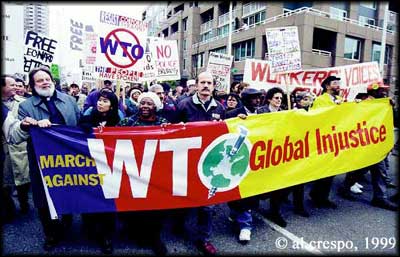
 http://www.democracynow.org/2009/12/17/bolivian_president_evo_morales_on_climate


 The End of Capitalism
Recent Comments