
You are currently browsing the category archive for the ‘Resistance’ category.
a self-explanatory call to action from Jobs with Justice that is right on. [alex]

|

After a wild but empowering week of demonstrations in Pittsburgh, here’s a short media recap of some of the highlights. [alex]
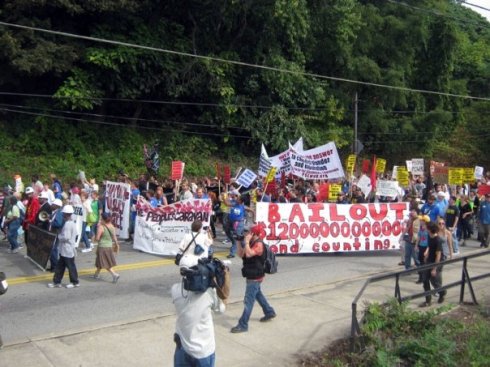
$12 Trillion has been given by the US government to large banks and corporations since last year
Great short news video on why the protesters were in Pittsburgh.
Exposes the police repression felt by the whole city last week, not just protesters.
The successes of mass protest.
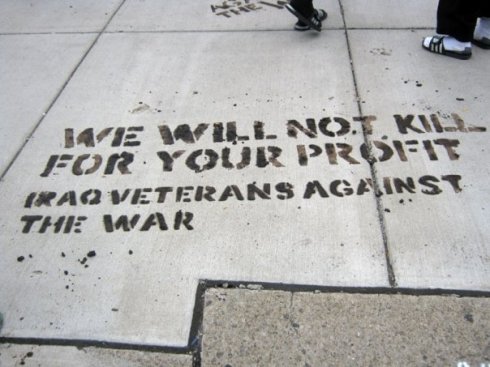
IVAW held a press conference and action Friday morning about no longer sacrificing for war
Finally, see this audio report from Free Speech Radio News for more context.
Organizers from Philly will be traveling across PA ahead of the G20 summit in Pittsburgh next week to meet with grassroots movements and strengthen statewide social change networks. This is being called the People’s Caravan. There are still spots available, so please RSVP if you’d like to join the caravan! – alex
A Call to Join the People’s Caravan
Pennsylvania, along with the rest of the world, is in crisis. Many people do not have access to decent housing, education, healthcare, jobs, healthy food, transportation and communication. While we are told that there are not resources to provide for our basic needs, bankers and the ultra-rich get trillions of dollars in bail-out funding, and our services are cut and costly wars are waged. From pools, libraries and health centers in urban areas closing, to factory lay-offs and families losing their farms, Pennsylvanians are feeling the impact of an economic and political system that has placed profit over people. We will not pay for their crisis!
In the coal mines, steel mills, textile mills, family farms and in the front seats of rigs, poor and working Pennsylvanians built this state. As one industry after another has collapsed in Pennsylvania, we’ve become poorer. Our economic crisis didn’t start in 2007. Now, all across the state, local governments and business people are spending our taxpayers’ money on developments that benefit developers and not the communities that paid for it. Meanwhile, our population has been in decline for generations because too many of our young people see no future in our state, and need to look for jobs elsewhere.
What is the G-20?
The G-20 summit is a gathering of financial ministers and heads of states of the 20 richest countries in the world. They are meeting in Pittsburgh, September 24-25 to advance their agenda: cutting essential social services; privatizing schools, healthcare, and social security, promoting “free-trade,” which cuts labor and environmental standards across the globe and places corporate profit above human needs. They are meeting to rebuild the world’s economies- in a way that keeps them on top.
Pittsburgh’s history of economic decline is why it was chosen to host the G-20. It will be promoted as an example of how to rebuild an economy. They’ve done this by bringing in companies that provide low wage jobs while reaping large profit and rebuilding the region with little thought to community benefit. This is unfortunately a familiar story to not just Pennsylvania, but much of the country.
The Caravan
We want to take this opportunity to focus on Pennsylvania, and strengthen our statewide networks. We want to meet up with people who are organizing locally for their dignity and a better Pennsylvania. Whether you are working for better wages, organizing for childcare, demanding healthcare, fighting pollution, struggling to keep your home and put food on the table or to keep your family’s farm; we all have an interest in making our voices heard and working together to advance an agenda for economic human rights.
We will be taking our own vehicles, carpooling and splitting the travel costs. The caravan will depart Philadelphia on Monday morning, September 21, stopping in Lancaster, traveling to York for the afternoon, and then spend the evening in Harrisburg. On Tuesday, September 22, we will rally at the state capitol, make a stop in Altoona, and arrive in Pittsburgh for the G-20 summit.
Join Us!
This is a perfect time to make connections between our struggles and communities so that we can break our isolation and work together. We want you to invite your neighbors, church, family, school, VFW chapter, and your community organizations to join us on this caravan. While we bring stories of our struggles in Philadelphia, we want to learn from people struggling throughout the rest of Pennsylvania.
Contact us if you are interested in organizing a local event along the route that can benefit your work, joining or supporting the caravan. We need RSVP’s, and we can tell you about costs, ride information and answer any other questions.
http://www.g20caravan.info
g20caravan@riseup.net
215-586-9198
The following is an editorial from The Philadelphia Inquirer, Sept. 2, 2009. For more information about Troy’s case, see Amnesty International and the NAACP.
Editorial: The risk in getting it wrong
If justice is served, Troy Davis won’t become another Cameron Willingham. Davis is facing execution in Georgia for the 1989 murder of an off-duty Savannah police officer, but whether he actually committed the crime is questionable. Questions were also raised about the guilt of Willingham, but he was executed in Texas five years ago for murder in an alleged arson fire that killed his three children. Now, there is new scientific evidence that Willingham was innocent.
An arson expert hired by the Texas Forensic Science Commission has issued a report that says there was no basis for a conclusion that arson caused the 1991 fire. He said the blaze that killed the three children may have been accidentally set.
“I have been persecuted 12 years for something I didn’t do,” were Willingham’s last words.
His case epitomizes why capital punishment must end. Even if it happens only once, that’s too often when the result might be the execution of an innocent person.
Davis received a last-minute reprieve last month, when the U.S. Supreme Court ordered his case reheard to consider new evidence that might clear him. It was the first time in half a century that the high court took such a step.
“The substantial risk of putting an innocent man to death clearly provides an adequate justification for holding an evidentiary hearing,” said Justice John Paul Stevens in the majority opinion.
Until the Supreme Court’s ruling, lower federal and state courts had repeatedly denied Davis’ appeal for a new trial.
Georgia prosecutors maintain they convicted the right person. But they have presented neither physical evidence nor a weapon linking Davis to the crime. And seven of the nine witnesses who testified that Davis was the killer have since either recanted or changed their stories.
Pope Benedict XVI, former President Jimmy Carter, and Archbishop Desmond Tutu are among those who have called for clemency for Davis.
States such as Pennsylvania, which remain committed to the death penalty, should take note.
Davis’ and Willingham’s cases again raise strong questions about capital punishment and whether it can ever be fairly administered, especially when the defendant is poor or a minority, like Davis, and statistically more likely to get a death sentence.
Two men sent to Pennsylvania’s death row were later exonerated. The risk of a wrongful execution is simply too great to continue with capital punishment.
 The Ecology of Freedom: The Emergence and Dissolution of Hierarchy
by Murray Bookchin
1982 Cheshire Books
Murray Bookchin (R.I.P., 2006) was one of the most important American theorists of the 20th century. He is most known for pioneering and promoting social ecology, which holds that “the very notion of the domination of nature by man stems from the very real domination of human by human.” In other words, the only way to resolve the ecological crisis is to create a free and democratic society.
The Ecology of Freedom is one of Bookchin’s classic works, in which he not only outlines social ecology, but exposes hierarchy, “the cultural, traditional and psychological systems of obedience and command”, from its emergence in pre-‘civilized’ patriarchy all the way to capitalism today. The book explains that hierarchy is exclusively a human phenomena, one which has only existed for a relatively short period of time in humanity’s 2 million year history. For that reason, and also because he finds examples of people resisting and overturning hierarchies ever since their emergence, Bookchin believes we can create a world based on social equality, direct democracy and ecological sustainability.
It seems to me this fundamental hope in human possibility is the most essential contribution of this book. In discussing healthier forms of life than we currently inhabit, Bookchin makes a distinction between “organic societies”, which were pre-literate, hunter-gatherer human communities existing before hierarchy took over, and “ecological society”, which he hopes we will create to bring humanity back into balance with nature, but without losing the intellectual and artistic advances of “civilization” (his quote-marks).
Of ‘organic society’ he says “I use the term to denote a spontaneously formed, noncoercive, and egalitarian society – a ‘natural’ society in the very definite sense that it emerges from innate human needs for association, interdependence, and care.” This, he explains, is where we come from. Not a utopia free of problems, but a real society based on the principle of “unity of diversity,” meaning respect for each member of the community, regardless of sex, age, etc. – an arrangement that is free of domination. Read the rest of this entry »
George Orwell was an English radical who wrote some of the most important books of the 20th Century, including Homage to Catalonia, about his experiences in the Spanish Civil War, Animal Farm (see cartoon adaptation), an allegory to Stalinism, and the infamous totalitarian novel 1984 (see film adaptation).
Orwell was an acclaimed writer because he wrote in clear and efficient English. He gave us this 1946 article, “Politics and the English Language” on how to write effectively. Check this out before penning/keying your next masterpiece! [alex]
A scrupulous writer, in every sentence that he writes, will ask himself at least four questions, thus:
- What am I trying to say?
- What words will express it?
- What image or idiom will make it clearer?
- Is this image fresh enough to have an effect?
And he will probably ask himself two more:
- Could I put it more shortly?
- Have I said anything that is avoidably ugly?
But you are not obliged to go to all this trouble. You can shirk it by simply throwing your mind open and letting the ready-made phrases come crowding in. They will construct your sentences for you — even think your thoughts for you, to a certain extent — and at need they will perform the important service of partially concealing your meaning even from yourself. It is at this point that the special connection between politics and the debasement of language becomes clear.
[Orwell goes on to explain how English writing is deteriorating from clear, crisp words into vague and opaque phrase-mongering, citing specific examples of particularly bad writing from intellectuals and politicians.]
In our time, political speech and writing are largely the defense of the indefensible. Things like the continuance of British rule in India, the Russian purges and deportations, the dropping of the atom bombs on Japan, can indeed be defended, but only by arguments which are too brutal for most people to face, and which do not square with the professed aims of the political parties.
Thus political language has to consist largely of euphemism, question-begging and sheer cloudy vagueness. Defenseless villages are bombarded from the air, the inhabitants driven out into the countryside, the cattle machine-gunned, the huts set on fire with incendiary bullets: this is called pacification. Millions of peasants are robbed of their farms and sent trudging along the roads with no more than they can carry: this is called transfer of population or rectification of frontiers. People are imprisoned for years without trial, or shot in the back of the neck or sent to die of scurvy in Arctic lumber camps: this is called elimination of unreliable elements. Such phraseology is needed if one wants to name things without calling up mental pictures of them.
Consider for instance Read the rest of this entry »


 The End of Capitalism
Recent Comments