You are currently browsing the category archive for the ‘Resistance’ category.

The Grapes of Wrath
by John Steinbeck
published 1939 during the last Great Depression.
Alex Knight, endofcapitalism.com, May 25, 2010
Also posted on The Rag Blog and TowardFreedom.
Arizona SB1070, signed into law by Governor Jan Brewer on April 23, requires Arizona’s local and state law enforcement to demand the immigration status of anyone they suspect of being in the country illegally, and arrest them if they lack documents proving citizenship or legal residency. Effectively making racial profiling into state policy, this law is the latest in a series of attacks on Latin American immigrants, as well as the entire Latino community, who must live with the fear of being interrogated by police for their brown skin. Then on May 11, Arizona went one step further, outlawing the teaching of ethnic studies classes, or any classes that “are designed primarily for students of a particular ethnic group or advocate ethnic solidarity”. This same law also states that schools must fire English teachers who speak with a “heavy accent.”
Perhaps these new laws make sense if we imagine that undocumented immigrants are merely “aliens”, a danger to the good, mostly white citizens of this great country. But suppose we look at the problem of immigration from the perspective of the immigrants? Why are they risking life and limb to come to a foreign land, far from their home and families? Why aren’t they deterred from making this trip no matter how many walls we put up, no matter how many police collaborate with ICE, no matter how many angry armed “Minutemen” vigilantes are conscripted to guard the border?
John Steinbeck’s classic novel The Grapes of Wrath, following the Joad family as they migrate to California during the “Dust Bowl” of the 1930s, sheds light on these questions in a way that perhaps every American can relate to. One of the most popular and well-written American books of all time, The Grapes of Wrath provides a very human perspective on the harsh lives of migrants, personified by the Joads – a family of poor sharecroppers from Oklahoma. Evicted from their family farm, just as the millions of Mexicans who have suffered enclosure from their land and become homeless and jobless because of NAFTA, the Joads travel to California in a desperate search of work, only to encounter the harassment of authorities and the hatred of the local population.
There are important differences between the “Okies” who traveled to the Southwest in the 1930s and Latino migrantes of the 2000s. The Joads, of course, were white, and did not cross a national border when they made their exodus. But at its core the story of the Joads is the story of the migrant workers, their troubles, their fears, but also their humanity, and their hope. It is a story that can inspire us to recognize the historic nature of the moment in which we live, understand why these enormous transformations are occurring, and recognize that justice for the immigrants is justice for everyone, regardless of color or citizenship status.
Enclosure
In order to understand the migrantes we first have to understand the story of their displacement, or the enclosure of their land, which has left them homeless and with no other options than to leave their homeland in search of a wage. What can The Grapes of Wrath tell us about this reality?
People usually do not resort to risky and desperate moves unless they have nothing left to lose. Steinbeck begins the Joads’ story with the loss of everything they had: the small farm on which they had sustained their family for generations by growing cotton. Young Tom Joad, fresh out of prison, returns to his home to find it deserted. “The Reverend Casy and young Tom stood on the hill and looked down on the Joad place… Where the dooryard had been pounded hard by the bare feet of children and by stamping horses’ hooves and by the broad wagon wheels, it was cultivated now, and the dark green, dusty cotton grew… ‘Jesus!’ he said at last. ‘Hell musta popped here. There ain’t nobody livin’ there.'” (51).

Mexican farmer with corn / image courtesy of "© Juan_de" on flickr
Whether as tenants or small landholders, either for subsistence or for markets, the vast majority of the poor migrantes now coming to this country are fleeing the loss of their farms and their livelihoods, just as the Joads. Perhaps for generations, maybe hundreds or even thousands of years, they had lived in connection with the land and had been able to depend on it for the survival of their families and culture. The loss of this land is devastating to those cultures, but larger forces stand to gain by driving these people into homelessness. Read the rest of this entry »
Also published on The Rag Blog.
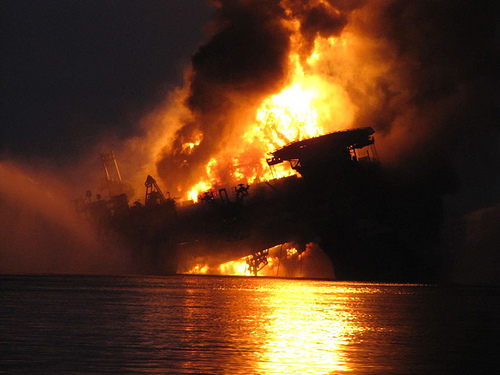
BP Oil Disaster in the Gulf - Energy Department Photo. retrieved from http://www.flickr.com/photos/leonarddoyle/4583740105/in/set-72157624005298860/
Just two weeks after the Massey Energy coal explosion on April 5 that killed 29 miners in West Virginia, the BP oil rig Deepwater Horizon exploded in the Gulf of Mexico, killing 11 more workers. These back-to-back tragedies have brought attention to the fossil fuel industry’s terrible safety record – in both cases there were known safety violations on site, but the government did nothing to prevent disaster from occurring. See the interview below which explains how the federal government approved this BP rig and many more without conducting the environmental review they are legally obligated to.
Unlike the industry executives attempting to shift blame and avoid responsibility, we must look beneath the surface to discover the deeper meaning of these horrible crises.
Is the universe giving us a warning that fossil fuels are going to destroy us? Because if global climate change continues at the rate it has, in the not-too-distant future we will see many thousands, or even millions more deaths as crops dry up, floods destroy coastal wetlands, and diseases migrate to temperate regions. This is no joke. Families and communities are being destroyed so coal and oil corporations can boost their profit margins.
We need to be open to hearing the lessons that are all around us, especially from those who have been silenced and beaten down by capitalism.
Immediately after the Massey explosion and the BP explosion, was Earth Day – April 22. And on this date, indigenous and poor people from around the globe were meeting in Cochabamba, Bolivia for the World People’s Conference on Climate Change, a grassroots response to the corporate fraud that was the Copenhagen Summit. Bolivian President Evo Morales, who was proclaimed “World Hero of Mother Earth” by the United Nations General Assembly in October, hosted the conference, proclaiming “The capitalist system looks to obtain the maximum possible gain, promoting unlimited growth on a finite planet. Capitalism is the source of asymmetries and imbalance in the world.”
30,000 people from 140 countries convened and approved the “Cochabamba Protocol”, which calls for an International Climate Justice tribunal to prosecute climate criminals, and condemns REDDs which put a price on wild forests and encourage development, along with carbon market schemes. The protocal proposes a Universal Declaration of Mother Earth and demands that industrialized polluting nations cut carbon emissions by 50 percent as part of a new, binding climate agreement.
Global momentum is building towards confronting capitalism in terms of the ecological devastation it is causing. Here in the United States, Rising Tide North America is calling for a “Day of Action, Night of Mourning” this Friday, May 14 to call for BP to pay for all cleanup and long-term ecological effects of their spill, for the abolition of offshore oil drilling, and for “a rapid and just transition away from fossil fuels.”
[alex]
Government Exempted BP from Environmental Review
Video/interview published by Democracy Now!
May 7, 2010
JUAN GONZALEZ: Well now to the Gulf of Mexico where the enormous oil slick in the Gulf continues to expand. Interior Secretary Ken Salazar has ordered a 3-week halt to all new offshore drilling permits. Emphasizing that the companies involved had made “major mistakes,” Salazar spoke to reporters Thursday outside BP’s Houston crisis center. He noted that lifting the moratorium on new permits will depend on the outcome of a federal investigation over the Gulf spill and the recommendations to be delivered to President Obama at the end of the month.
- SECRETARY KEN SALAZAR: Minerals Management Service will not be issuing any permits for the construction of new offshore wells. That process will be concluded here on May the 28th. At that point in time, we’ll make decisions about how we plan on moving forward. There is some very major mistakes that were made by companies that were involved. But today is not really the day to deal with those issues. Today and the days ahead really are about trying to get control of the problem.
JUAN GONZALEZ: Secretary Salazar added that the existing offshore oil and natural gas drilling will continue, even as public meetings to discuss new oil drilling off the Virginia coast have been canceled for this month.
AMY GOODMAN: Salazar’s announcement comes on the heel of a Washington Post exposé revealing that the Minerals Management Service had approved BP’s drilling plan in the Gulf of Mexico without any environmental review. The article notes that the agency under Secretary Salazar had quote “categorically excluded” BP’s drilling as well as hundreds of other offshore drilling permits from environmental review. The agency was able to do this using a loophole in the National Environmental Policy Act created for minimally intrusive actions like building outhouses and hiking trails. Well, for more on this story, we’re joined now from Tucson, Arizona by Kieran Suckling, executive director of the Center for Biological Diversity. Welcome to DEMOCRACY NOW!, Kieran. Explain this loophole, how you found it, and what it means for the Gulf.
KIERAN SUCKLING: Well, when a federal government is going to approve a project, it has to go through an environmental review. But for projects that have very, very little impact like building an outhouse or a hiking trail, they can use something called a categorical exclusion and say there’s no impact here at all so we don’t need to spend energy or time doing a review. Well, we looked at the oil drilling permits being issued by the Minerals Management Service in the Gulf, and we were shocked to find out that they were approving hundreds of massive oil drilling permits using this categorical exclusion instead of doing a full environmental impact study. And then, we found out that BP’s drilling permit—the very one that exploded—was done under this loophole and so it was never reviewed by the federal government at all. It was just rubber-stamped. Read the rest of this entry »
Disobeying the Banks: An Interview with Enric Duran
by Scott Pierpont
Originally published by the Institute for Anarchist Studies
On September 17th, 2008, Barcelona-based anticapitalist Enric Duran announced that he had expropriated 492,000 euros. For several years, Duran took out loans that he never intended to pay back and donated all of the money to social movements constructing alternatives to capitalism. This announcement came with the publication of 200,000 free newspapers called Crisi (Catalan for “Crisis”), with an article explaining Duran’s action, and other pieces offering a systemic critique of the current financial and ecological crises. The action got the attention of tens of thousands of everyday people as well as major media outlets, who soon dubbed Duran the “Robin Hood of the Banks.” Duran left the country to avoid prosecution. The group that published the newspapers formed Podem Viure Sense Capitalisme (We Can Live With Out Capitalism) and began region-wide organizing through their website, http://podem.cat, bringing together debtors, squatters, alternative economy networks, environmentalists, and everyday people to build a large-scale alternative to capitalism.
Duran returned to Spain six months after the announcement to participate in the release of another publication. On March 17th, 300,000 copies of Podem (We Can) were distributed across Spain in Catalan as well as Spanish. Duran announced the publication during a student protest at the University of Barcelona, and was soon after arrested by the Mossos d’Esquadra, the Catalan regional police on charges of “ongoing fraud” that were brought against Duran by 6 of the 39 financial entities he took money from. He spent two months in jail. He is currently free on bail, having had his passport seized and required to present himself before a judge once a week. None of the charges have been formally brought to trial.
Since then, Duran has been organizing with the We Can campaign. Focused on networking and the distribution of information about alternatives to capitalism, We Can connects with thousands of people participating in alternative economy projects. Many use the group’s website, which includes a “Debtors’ Community” where people get practical advice on how to avoid paying their debts. Duran has published a book, Insumisión a la banca (Disobeying the Banks), the proceeds from which go to We Can, and continues to give talks and participate in national networks on degrowth and alternative currencies.
This interview was taped in Barcelona in December 2009.
The announcement of your action (September 17th, 2008, two days after Lehman Brothers went down) coincided with a dramatic moment during the financial crisis. Was the date chosen for that reason?
That was the goal, to coincide with a moment of ferment in the crises. When the action began at the end of 2005, the crisis hadn’t arrived yet. But the question became when to make it public so it would coincide with an important moment in the crisis. The end of my action was part of the plan, my strategy, by the summer of 2007, when the crisis began in the United States. In the end it was made public in September 2008, coinciding with the breakdown of the international financial order. It was a complete stroke of luck because it wasn’t possible to put an exact date, as we needed a month to prepare the publication and organize people to pass it out. It was really a stroke of luck.
And you planned this action for three years?
Planning, no…it was three years of execution. Between 2005 and 2008 I carried out the various parts of this action. There was a period of research at the beginning, of figuring out how to do it, but very quickly I moved on to practice, because practice is the best way of experimenting and learning.
In your book you mentioned that this technique of taking out loans was inspired by someone you met who falsified pay stubs. But you also mentioned Lucio Urtubia and his action against Citibank. Do you consider your action an expropriation, just as Lucio’s action was?
Yes, the principle examples were expropriations carried out in a non-aggressive way, an intellectual way, such as falsification, or taking out loans and not paying them back, as I did. I don’t know of any precedent involving loans in a political way, but I did have the example of that person who had told me about it before. So I guess the example of Lucio inspired my broader conception of expropriation and direct action, as did the examples of civil disobedience like Martin Luther King in the United States, or those in other countries who showed that public, illegal action can have a major impact on social consciousness. Read the rest of this entry »
Chris Hedges, author of American Fascists: The Christian Right and the War on America, has been warning us of the threat of neo-fascism in the United States for a few years now. This is one of his best pieces on the subject, comparing what is happening here and now with the Sarah Palins, Glenn Becks, and Tea Partiers to what happened to Yugoslavia 20 years ago.
However I must disagree with Hedges on the phrase ‘liberal elite’ – the ruling class is hardly liberal, unless it’s liberal to invade countries and kill millions of innocent civilians based on lies, or to plunder the atmosphere and seas, or to torture and spy on Americans and others, or any of the other awful things the government and its corporate cronies are carrying out all the time. Barack Obama may have a liberal streak as an individual, but he is carrying out a violent, imperialistic capitalist agenda for the real rulers. [alex]
Is America ‘Yearning for Fascism’?
Chris Hedges
Originally published by TruthDig, March 29, 2010
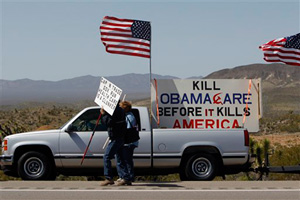
Tea Baggers - AP / Jae C. Hong
The language of violence always presages violence. I watched it in war after war from Latin America to the Balkans. The impoverishment of a working class and the snuffing out of hope and opportunity always produce angry mobs ready to kill and be killed. A bankrupt, liberal elite, which proves ineffectual against the rich and the criminal, always gets swept aside, in times of economic collapse, before thugs and demagogues emerge to play to the passions of the crowd. I have seen this drama. I know each act. I know how it ends. I have heard it in other tongues in other lands. I recognize the same stock characters, the buffoons, charlatans and fools, the same confused crowds and the same impotent and despised liberal class that deserves the hatred it engenders.
“We are ruled not by two parties but one party,” Cynthia McKinney, who ran for president on the Green Party ticket, told me. “It is the party of money and war. Our country has been hijacked. And we have to take the country away from those who have hijacked it. The only question now is whose revolution gets funded.”
The Democrats and their liberal apologists are so oblivious to the profound personal and economic despair sweeping through this country that they think offering unemployed people the right to keep their unemployed children on their nonexistent health care policies is a step forward. They think that passing a jobs bill that will give tax credits to corporations is a rational response to an unemployment rate that is, in real terms, close to 20 percent. They think that making ordinary Americans, one in eight of whom depends on food stamps to eat, fork over trillions in taxpayer dollars to pay for the crimes of Wall Street and war is acceptable. They think that the refusal to save the estimated 2.4 million people who will be forced out of their homes by foreclosure this year is justified by the bloodless language of fiscal austerity. The message is clear. Laws do not apply to the power elite. Our government does not work. And the longer we stand by and do nothing, the longer we refuse to embrace and recognize the legitimate rage of the working class, the faster we will see our anemic democracy die.
The unraveling of America mirrors the unraveling of Yugoslavia. The Balkan war was not caused by ancient ethnic hatreds. It was caused by the economic collapse of Yugoslavia. The petty criminals and goons who took power harnessed the anger and despair of the unemployed and the desperate. They singled out convenient scapegoats from ethnic Croats to Muslims to Albanians to Gypsies. They set in motion movements that unleashed a feeding frenzy leading to war and self-immolation. There is little difference between the ludicrous would-be poet Radovan Karadzic, who was a figure of ridicule in Sarajevo before the war, and the moronic Glenn Beck or Sarah Palin. There is little difference between the Oath Keepers and the Serbian militias. We can laugh at these people, but they are not the fools. We are.
The longer we appeal to the Democrats, who are servants of corporate interests, the more stupid and ineffectual we become. Sixty-one percent of Americans believe the country is in decline, according to a recent NBC News/Wall Street Journal poll, and they are right. Only 25 percent of those polled said the government can be trusted to protect the interests of the American people. If we do not embrace this outrage and distrust as our own it will be expressed through a terrifying right-wing backlash. Read the rest of this entry »
Engaging the Crisis: Organizing Against Budget Cuts and Community Power in Philadelphia
by Kristin Campbell
Reposted from Organizing Upgrade, March 1, 2010
Organizing Upgrade is honored to offer a preview of this insightful reflection on organizing – Engaging the Crisis: Organizing Against Budget Cuts and Building Community Power in Philadelphia – which will appear in Left Turn magazine #36 (April/May 2010). You can subscribe to Left Turn online at www.leftturn.org or become a monthly sustainer at www.leftturn.org/donate.
On November 6, 2008, just days after Philadelphians poured onto the streets to celebrate the Phillies winning the World Series championship and Barack Obama the US presidency, Mayor Michael Nutter announced a drastic plan to deal with the cities $108 million budget gap. Severe budget cuts were announced, including the closure of 11 public libraries, 62 public swimming pools, 3 public ice skating rinks, and several fire engines. Nutter also stated that 220 city workers would be laid off and that 600 unfilled positions would be eliminated entirely, amounting to the loss of nearly 1,000 precious city jobs. In classic neo-liberal style, the public sector was to sacrifice, while taxpayer money would bail out the private banking institutions.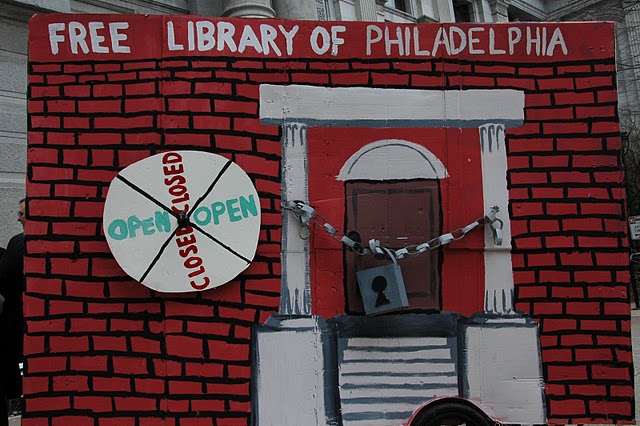
City in crisis
Well before the economic crises of 2008, a decades-long process of economic restructuring and deindustrialization had left Philadelphia, with a population just over 1.4 million, an incredibly under-resourced city. Philadelphia has the highest poverty rate out of the ten largest cities in the US, an eleven percent unemployment rate and a high-school dropout rate that hovers dangerously around 50 percent.
The proposed budget cuts sparked waves of popular outrage especially concerning the closure of the libraries, many of which are located in low-income communities of color and serve as bedrock institutions for many basic resources. Eleanor Childs, a principal of a school that heavily relies on West Philadelphia’s Durham library, and later a member of the Coalition to Save the Libraries, recalls “a groundswell of concern about the closing of the libraries… people rose up. We had our pitchforks. We were ready to fight to keep our libraries open.”
Nutter’s administration set up eight townhall meetings across Philadelphia, designed to calm the citywide uproar. Thousands of people filled the townhall meetings poised to question how such drastic decisions were made without any public input. Under the banner “Tight Times, Tough Choices,” Mayor Nutter and senior city officials attempted to explain the necessity of such deep service cuts. They explained that the impact of the economic crisis on the city had only become apparent in recent weeks, and because the city could not raise significant revenue to offset its financial loses in the timeframe that was needed, rapid cuts were mandatory and effective January 1, 2009.
Community response
In the following days and weeks, Philadelphians quickly mobilized against the decision that their public services and city workers pay for the fallout of a economic system that had already left so many of them struggling. Neighborhood leaders organized impromptu rallies at the eleven branch libraries. Along with organizing people to turn out at the Mayor’s townhall meetings, these rallies gained media attention on both the nightly news and in the major newspapers, demonstrating widespread opposition to the budget cuts. Sherrie Cohen, member of the Coalition to Save the Libraries and long-time resident of the Ogontz neighborhood of North Philly remembers her neighbors coming together to say, “We are not going to let this library close. It’s not gonna happen. We fought for 36 years for a library in our neighborhood.” Read the rest of this entry »
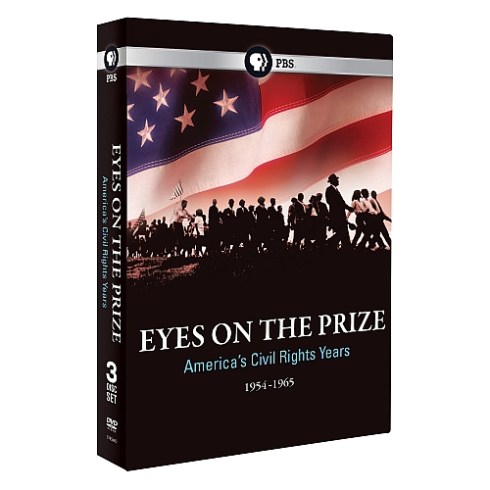 One of the best documentary series ever produced, Eyes on the Prize is a 14-part study of the Civil Rights Movement in the United States. This series is so important because it shows how ordinary people, when organized, can affect dramatic social change.
The Civil Rights Movement remains the most inspiring example of successful social movements in the United States, breaking down the evil system of racial segregation and opening up possibilities for Black people, as well as for other races, that never existed before. It’s important to remember that 50 years ago, most African Americans could not vote, but now we have a Black President.
Obviously the work of the Civil Rights Movement remains unfinished, as we still live in a racist society with many other severe social problems caused by capitalism as well. But as Eyes on the Prize displays so dramatically, the hope we seek lies not in politicians but in our very own hands. We must learn from the past in order to change the future.
I watched episode 1 today and will be viewing the others over the next few weeks. Would you like to watch and discuss the series with me? Please respond by leaving a comment!
Love and struggle,
alex
p.s. anyone know how to embed these videos on WordPress?
Episode 1: Awakenings (1954-1956)
Subjects: Origins of the Civil Rights Movement, Segregation, Black Soldiers in World War II, Brown v. Board of Education, Emmett Till, Rosa Parks, Montgomery Bus Boycott, Martin Luther King Jr, White Citizens Council, Ku Klux Klan, White Allies
Episode 2: Fighting Back (1957-1962)
Subjects: NAACP, Integration v. Segregation, Little Rock AR, The Little Rock 9, James Meredith, University of Mississippi
Episode 3: Ain’t Scared of Your Jails (1960-1961)
Subjects: Student Sit-ins, Nashville TN, Direct Action, Civil Disobedience, Student Nonviolent Coordinating Committee (SNCC), Ella Baker, Boycott Movement, Congress of Racial Equality (CORE), Freedom Rides, Southern Jails
Episode 4: No Easy Walk (1961-1963)
Subjects: Martin Luther King Jr, Southern Christian Leadership Conference (SCLC), Freedom Songs, Albany GA, Bull Connor, Birmingham AL, Fire Hoses and Dogs, John Lewis, March on Washington, John F. Kennedy, Civil Rights Act
Episode 5: Mississippi: Is This America? (1962-1964)
Subjects: Medgar Evers, Murder of Goodman, Chaney, and Schwerner, SNCC, Voting Registration Drives, Mississippi Freedom Summer, Mississippi Freedom Democratic Party, Failure of the Democratic Party
[This is the BEST video in the series. What SNCC did in Mississippi changed America forever.]
Episode 6: Bridge to Freedom (1965) Read the rest of this entry »
This essay strikes me as deeply explanatory for the absurd political events that have been taking place in the US in the past year – from trillion-dollar bank bailouts, to the inability to create any meaningful health care reform, to the absolute mocking of the world’s attempts to deal with the catastrophe of climate change – the US government seems to have completely given up on pretending to represent the American public and aligned itself with huge financial and corporate interests, right out in the open.
Those of us with a radical understanding of power know this government has always served the interests of the powerful as its primary mission. But in the past, the politicians at least paid lip service to the public interest in order to save face. This was the era of “hegemony”, roughly meaning the consent of the ruled to their domination.
The public was being screwed, but somehow it was ideologically prepared to believe that “we, the people” had the ultimate say. This was supposed to be a democracy, after all. Sure, the police, prison system, military, and federal enforcement agencies would step in if things got out of hand, but much more effective at keeping the system intact was the “cop in our heads”. As long as we truly believed that it was all for our own good, the corporations just rolled right along, plundering the planet and destroying our communities. And the media made sure we believed it. That’s hegemony.
The reign of George W. Bush really started the break from this paradigm, as we saw for example the outright defiance of the US Constitution and US law when it came to imprisonment of political enemies, justifying torture, spying on millions of American citizens’ phone calls, excessive lying in order to invade and occupy strategic countries, etc etc. At first the public somewhat accepted these moves as “necessary” in the face of terrorism, but Bush’s popularity waned terribly in his second term as people became more informed of what was really happening. In this light Obama’s rhetoric about “change” seems to have initially served to reinvigorate the system with a revived hegemony – to give the US a new image, one of tolerance, diplomacy, and the rule of law.
But the first year of Obama has already shattered these illusions. Obama and his Democrats now appear totally befuddled, their strategy (of putting a smiling face and a few meaningless reforms on a fundamentally broken system) lies in rubble. And a resurgent, perhaps racist, Right appears ready to sweep back into control by playing with the public’s justified resentment and frustration of a continually deteriorating situation.
In this context Jeff Strabone asks us if hegemony is becoming a thing of the past: “Will the state shamelessly turn itself completely over to serving the interests of a powerful few without bothering to pretend that it’s not?”
 I’ve written in my synopsis about the end of capitalism and the possible emergence of neo-fascism, a militarization of society in order to preserve the interests of the powerful, regardless of the environmental and social costs. It seems to me that one indicator of this possible paradigm shift is the increasing shamelessness of the elites. In market-driven capitalism, image is crucial. If a corporation gets bad publicity, they stand to lose money in the stock market. This is one of the few areas of capitalism that is open to democratic intervention. Another area where the public can occasionally intervene is through electing progressive representatives into office.
But it’s these avenues that appear to be closing to us now. Goldman Sachs, Exxon-Mobil, and Blackwater have all gotten terrible publicity in the past few years for their theivery, pollution and murder; but their stocks have never soared higher. Then the public gave Obama and the Democrats an enormous mandate to “change” the country, only to see them cave immediately on almost every campaign promise. The bank bailouts, torturing, and bombing of civilians have, if anything, increased in Obama’s tenure thus far. Perhaps the final insult was the Supreme Court’s decision last week that corporations are “people” with a First Amendment “right to speak” by directly buying politicians. Have they no shame? Apparently not.
So if the consent of the governed is no longer sought, and we’re truly moving into a post-hegemonic era, what can we do to make sure that the breakdown of the capitalist system leads to something better, and not far worse? As Mr. Strabone proclaims, it’s time for civil disobedience. The system has failed us, we must cut off our allegiance from it, confront the powers that be, and start envisioning and constructing the world we want to see replace capitalism. I, for one, wish to see that world based on shared values of democracy, justice, sustainability, freedom and love, and I urge all of you to consider the alternative. [alex]
Post-Shame: Time for Civil Disobedience
by Jeff Strabone
Originally published by Daily Kos.
Tue Jan 26, 2010
One of the duties of the modern nation-state is persuasion. Each state aims to keep its citizens convinced of the legitimacy of its rule. The state may be run chiefly for the enrichment of a few at the cost of the many, but the endurance of the state is widely thought to depend on its ability to sell its rule to the many as a common-sense truism. Or at least that was how it used to work. We may be entering a new era in the evolution of the state, one where the state approaches a state of utter shamelessness.
Antonio Gramsci, in his prison notebooks, called this persuasive activity ‘hegemony’. According to Gramsci, hegemony occludes the domination of the state and the classes whose interests it serves. One does not have to be an Italian communist of the 1920s to see the usefulness of Gramsci’s groundbreaking insight. Broadly speaking, all political actors pursue their agendas by trying to narrow other people’s imaginations in order to make desired outcomes seem common-sensical and undesired outcomes outside the ambit of reasonable thought.
It seems to me that over the past decade, in the United States, the state and a narrow circle of powerful interests—banks, energy companies, and private health insurers in particular—have simply given up trying to persuade the rest of us that their interests were our interests. Could we be moving in the twenty-first century to a state that practices domination without hegemony? Or, to put it in plain English, will the state shamelessly turn itself completely over to serving the interests of a powerful few without bothering to pretend that it’s not? And if it does, how should we respond?
I am not the only one asking these questions. Read the rest of this entry »
This a review of the newish movie ‘Collapse’, review written by a woman of color named Erinn, which I saw on the Bring the Ruckus website. ‘Collapse’ apparently features Michael Ruppert talking about his apocalyptic visions for the world, filmed from his hideout bunker underground somewhere. Ruppert maintains a horrific blog and used to edit From the Wilderness, a conspiracy-oriented website that intermixes information about peak oil with 9/11 Truth stuff and other scary things.
I was glad to read Erinn’s review, even though I’m not planning to see this film, because it highlights both the racist/classist elements, as well as the lack of grounding in analysis about social change, that continues to hinder the peak oil “movement.”
What Ruppert, and other scaremongers like William Catton of Overshoot and Jay Hanson of dieoff.com have failed to comprehend is that peak oil and other ecological limits do not in themselves guarantee social disaster just because capitalism is collapsing. There are non-capitalist, non-fossil fuel-driven ways of organizing society, some of which would be much better, and some much worse.
Peak oil does present us with a stark dilemma, but like any dilemma we have two paths we can go down – of course there’s the path of continued plunder and violence, militarism and neo-fascism – but there’s also that of freedom, democracy, and sustainability. By hiding this second path from their readers and viewers, Ruppert and other ‘doomers’ inadvertently present compelling arguments for the first.
There’s still plenty of resources to meet everyone’s basic needs of food, shelter, water, etc. But because those in power have control over production, resources are being diverted to socially and ecologically inappropriate ends, like the military, banks, private jets, prisons, tar sands, etc. Never ever forget that there is always a fundamental political choice of how to allocate resources. Until the peak oil ‘movement’ catches on to this reality, it will continue to be dominated by scared, privileged white folks worried about a future catastrophe yet who don’t see the catastrophes that are already affecting most of the peoples of the world.
“We must rapidly begin the shift from a thing-oriented society to a person-oriented society. When machines and computers, profit motives and property rights, are considered more important than people, the giant triplets of racism, extreme materialism, and militarism are incapable of being conquered.” – Dr. Martin Luther King, Jr.
Happy MLK Day!
[alex knight]
by Erinn
So, I went to see a movie called “Collapse.” I read about this movie a little bit before seeing it (full disclosure: I get caught it weird Internet spaces and was reading an article about Mein Kampf. This movie was mentioned in the article for some reason). The premise of the movie is pretty simple: Michael Ruppert believes that he know how and why the US and global economies are currently collapsing (Get it? That’s the movie title…and the country…). The ticket was like $4, which in LA is pretty much like highway robbery.
Originally I went to see this film because it looked interesting and because of the whole $4 thing. About 30 minutes into the movie, I realized that there was a larger discussion to be had here that went beyond reviewing a film. There are aspects of this film that I found interesting and problematic from a practical political perspective, but I think that there is even a more interesting discussion here on the limitations of some supposedly “leftist” and “revolutionary” political ideologies and the complicated nature of the political moment that is in our near future.
So, just to summarize: The film really focuses on Ruppert and the Peak Oil Movement (which to be fair I know little about.) For those of you that are in the same boat as I am, the Peak Oil Movement refers to the idea/scientific principle that there is a limited amount of fossil fuels in the world. Ruppert looks at the fact that Saudi Arabia, which has the largest, recorded landed oil reserves, now drills for oil offshore. As offshore oil drilling is a much more costly endeavor than drilling for oil on land, this could be an indication that the oil in Saudi Arabia, and thus countries with even less oil, is on the global decline as a “dependable” resource. Ruppert identifies the fact that the economic system that the US and the rest of the world operates with requires “infinite resources” while depending on the “finite resource” of oil as the central paradox of our existence today. The movie goes on to note the limitations of other fuel possibilities (with the exception of solar and wind power, Mike identifies other fuel resources as economically and environmentally unfeasible) and declares that “revolution” (which isn’t ever defined in the film) will come from the anger people feel because of the fuel and food shortages that will plague the world in the upcoming decades.
Ruppert constructs a parable to help the audience understand his perspective. He describes the Titanic and himself as a boat-builder on the ship. He’s just been informed that the ship is going to sink and that there are not enough boats on the ship to save everyone on board the ship. (While telling this parable Ruppert seems to be ignoring the racial and gendered histories of this moment…aka white dudes locking poor and “colored” folks in the engine room of the ship.)
Ruppert says that as a boat-builder, he can select from a group of three sets of people to help: Read the rest of this entry »


 The End of Capitalism
Recent Comments