
You are currently browsing the category archive for the ‘Racism’ category.
 “The Tyranny of Oil: The World’s Most Powerful Industry and What We Must Do to Stop it”
by Antonia Juhasz
2008 HarperCollins
Ever wondered why the US government spends trillions of dollars to launch massive wars against Middle Eastern nations that have never attacked us, but refuses to do absolutely anything about the ongoing climate crisis? This book is for you.
The Tyranny of Oil is an exposee of “Big Oil”, meaning Exxon-Mobil, Chevron, BP, ConocoPhillips, and Royal Dutch Shell, the largest oil corporations in the world (and some of THE largest corporations in the world). The book exposes how these enormous oil octopi have gained virtually total control over the US government, and use their money and political power to make big profits at the expense of the public and the planet. (For example, Exxon Mobil in 2003 posted the largest profits of any corporation in history, then proceeded to beat that record each of the next 5 years).
It all starts with the origin of Big Oil, the mother, Standard Oil. Juhasz stresses the importance of monopolies and corporate mergers, in a sense missing the deeper analysis of capitalism, but nevertheless we come to understand how enormous companies wielding enormous profits can and do undermine democracy.
The book progresses to tell a story about Big Oil’s development and control over the government agencies that are supposed to be regulating it, and finally Big Oil’s plans for the future (War and Trashing the Planet, basically), before an inspirational chapter on What We Can Do. (There’s also a shoutout to SDS here and to our No War No Warming action in DC last year! Cool!)
This is essential reading for all US citizens, because if you aren’t familiar with the concepts she lays out, you frankly have no understanding of the country you live in. Environmental racism, corporate lobbyists and corrupt government agencies, the criminal behavior of Cheney’s Energy Task Force, deregulation and Enron-style fraud, tar sands, and the list goes on.
My only major complaint of the book was the virtual silence on the looming and imminent reality of Peak Oil and how this will transform everything. Juhasz does recognize the scarcity of oil and the likelihood of oil peaking, but chooses to essentially overlook its importance, instead blaming oil companies and speculators for driving up the cost of oil.
This is not just a minor quibble, because the BIG TRUTH is that we’re not just in a struggle against Big Oil, we’re in a struggle against capitalism, and it’s a fight that is reaching perhaps its final act. Peak Oil will challenge the dominant for-profit institutions of power, and can create an opening for social justice activists and organizers to push for much more radical change than appears possible within the current system. Nevertheless, this is probably a subject for another book (mine!), and Juhasz treads on steady ground by appealing to a more mainstream audience and demonizing the oil companies exclusively. This is a very effective book, highly recommended!
Finally, my favorite quote (pg. 325):
“As Paul Wolfowitz said in 1991, ‘The combination of the enormous resources of the Persian Gulf, the power that those resources represent – it’s power. It’s not just that we need gas for our cars, it’s that anyone who controls those resources has enormous capability to build up military forces.'”
 “Defying Dixie: The Radical Roots of Civil Rights (1919-1950)”
by Glenda Gilmore
2008 W.W. Norton
I picked up this book randomly when I saw it in the library, and it turned out to be a worthwhile read. Gilmore, a white female professor from North Carolina, surveys the “radical roots of civil rights” through the efforts of the Communist Party in the South during the 1920s through 1940s.
Gilmore tells the story by focusing on a few individual black radicals who have been forgotten by history, especially Lovett Fort-Whiteman and Pauli Murray.
Whiteman, an extravagant early supporter of the Soviet Union, founded some of the first communist organizations for African Americans, before being scared out of the country by the feds, becoming a darling in the Soviet Union, then ultimately winding up in one of Stalin’s gulags in Siberia, where he worked/starved to death.
Murray had more luck, despite being a transgendered black woman in the South in the 1940s. With a bold attitude, she attempted to integrate various institutions, like the University of North Carolina Law program, and although she herself was not successful in these efforts, her example paved the way for future victories within the Black Freedom Movement.
We also learn quite a bit about Langston Hughes, Thurgood Marshall, A. Philip Randolph, Max Yergan, and many other heroic characters who fought early and often for equality in the apartheid South.
More interesting to me though was what I learned about movement strategy, for example we explore how the first integrated unions in the South scared the bejesus out of the capitalists, or what it meant for the Communist Party to bring the country’s attention to the case of the Scottsboro “Boys”, or how the “Popular Front” strategy of allying with liberals succeeded, and failed.
The writing is interesting, but could be more purposeful. Defying Dixie focuses probably too much on the Communists, and not on other radicals, but still this book really clarified for me important stuff like the Depression, the South in the 1930s, and the early Civil Rights Movement, and how once-radical ideas like social equality of the races is now accepted fact (even though still not fully realized).
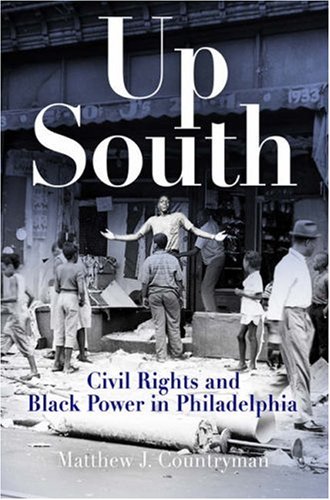
“Up South: Civil Rights and Black Power in Philadelphia”
by Matthew J. Countryman
2007 University of Pennsylvania
This book was not quite what I expected, but I’m not sure what I was expecting. The strength of Up South is that it gives a broad overview of the 1940s-60s civil rights/black power movement in Philadelphia, which was very helpful for me as someone who wanted to learn more about the history of the city I’m living in, especially about the work against racism in one of the most racially divided cities in America.
The book captures a really interesting narrative from postwar liberalism to early-60s protest, to late-60s radicalism, to 70s electoral politics. Along the way we meet some of the most important players, like Cecil B. Moore, Philadelphia Welfare Rights Organization, and Council of Organizations Philadelphia Police Accountability and Responsibility (COPPAR). We learn a bit about their strategies, we learn about the white backlash and Frank Rizzo, and attempts by the system to co-opt and dilute the movement through politics and money.
However, the book also lacks in some substantial ways. For one thing, the author is a professor in Michigan, who as far as I know is not from Philadelphia and is not black. This doesn’t mean he has nothing valuable to contribute from his research, but it does mean the writing is overly academic and emotionally detached.
My other major complaint is that while the book doesn’t heat up until about pg. 120 with chapter 4, the conclusion is way too short and very unsatisfying. It’s only 1 page, front and back, and only hints at the issues which are crying out to be examined.
For example, did the huge protests and deep radicalism of the late 60s really get co-opted into pointless electoral campaigns? How is that possible, and why did it happen?
Why wasn’t there sustained grassroots pressure to hold the newly-elected black politicans accountable, or if there was, why did it fail?
How did the Rizzo Mayorship of the 70s affect the black freedom movement in Philly? In what ways did Rizzo gain greater power in moving from his position as Police Commissioner, and in what ways was he held more accountable as Mayor? More generally, how much did it matter who was in charge of the city government, as far as the movements were concerned?
These are just a few questions that I wish had been addressed in the book more substantially, but I think the fact that the book left me wanting to know more actually points to the success of the book in captivating my interest.
This wasn’t the holistic and movement-centered study that I was looking for, but it helped me clarify my questions on the subject so I recommend it for anyone living in Philadelphia and wanting to know more about the history of their city.

 “No Surrender: Writings from an Anti-Imperialist Political Prisoner”
by David Gilbert
2004 Abraham Guillen Press/Arm the Spirit
I recommend this book. David Gilbert, lifelong political prisoner in New York since 1981, and former member of the Weather Underground (now being exploited in McCain political ads), here writes on many subjects of interest to all anti-imperialist activists.
David’s a great writer; very straightforward, focused, but with tenderness and humor, and he has a way of making sense of complicated and terrible political dramas in short and effective little essays. In addition to essays on Gilbert’s own history in SDS and Weather, the best samples here are on the U.S. white working class historically, the prison system, Colombia, Afghanistan, and neoliberalism. But Gilbert delves into a wide array of subjects from feminism to AIDS to institutional racism in many forms, and always with an amazing insight without requiring a lot of effort on the part of the reader.
It’s a damn shame that this man is behind bars, but luckily he’s still able to share his wisdom with us. Check this out!
Originally published by the Christian Science Monitor, slightly edited.
Militants step up ‘oil war’ in Niger Delta
Attacks on foreign oil company facilities threaten to disrupt global oil supply.
By Jonathan Adamsfrom the September 17, 2008 edition
Militants in southern Nigeria have sharply stepped up attacks on foreign interests after declaring an “oil war” Sunday. The campaign, which the militants have dubbed “Hurricane Barbarossa,” entered its third day Tuesday with an attack on a Royal Dutch Shell pipeline after attacks on Shell and Chevron facilities in previous days.
The Nigerian government has tried to downplay the threat. But the violence looks set to further disturb oil supplies from Nigeria, the United States’ fifth-largest source of oil, at a time when global supplies are already being squeezed.
Agence France-Presse (AFP) reported Tuesday that the main militant group, the Movement for the Emancipation of the Niger Delta (MEND), said it had “blown up and destroyed” a Shell pipeline. Read the rest of this entry »
 “I’ve Got the Light of Freedom: The Organizing Tradition and the Mississippi Freedom Struggle”
by Charles Payne
1991 by University of California Press
I’ve Got the Light of Freedom is a book about organizing, for organizers. It chronicles SNCC and the Mississippi Freedom movement from its beginnings to ends, especially highlighting the individual organizers and families that put the movement together and sustained it.
The book is great because it analyzes the movement from a variety of perspectives, including understanding the strategies, tactics, gender dynamics, class dynamics, white/black organizing dynamics, local/rural dynamics, mentorship and leadership development, state and white repression, and the rise and fall of trust and community that were the backbone of the movement. The thread throughout is the brilliance of the Ella Baker/Septima Clark school of organizing, based on meeting people where they’re at and developing their leadership so they can lead their own fights. It’s about valuing the day-to-day work that sustains organizations above the flashy actions or speeches, and about seeing our work as part of a long-term struggle towards freedom that will need to involve millions of people.
My criticisms Read the rest of this entry »

“Outlaws of America: The Weather Underground and the Politics of Solidarity”
by Dan Berger
2005 by AK Press
Outlaws of America is an interesting and refreshing look at a somewhat overdone subject, the Weather Underground. The use of interviews with David Gilbert, Bernardine Dohrn and many other former members of WUO, as well as an array of former members from revolutionary groups like the Black Liberation Army and Puerto Rican nationalist groups really brings the subject to life. Dan Berger also emphasizes throughout the book the relevance to today’s movements, and points particularly to the prison abolition and global justice movements as places where the legacy of Weather can be seen.
The book delves into the difficult past/present of armed struggle and state repression, and does a good job of keeping criticisms of the group grounded in the bigger picture of state violence. Some of the 70s history is unnecessary for most readers, but there’s also a lot of proactive criticism of the lack of feminist and queer analysis or practice within Weather, and even the racist mistakes which happened too often and too dramatically for comfort. These are the most important lessons I drew. Read the rest of this entry »
Check out this awesome essay by Paul Kivel – it really helped me understand my class background (as a member of the “buffer zone”) and how I can relate to others in an accountable way to achieve social change! – Alex
Social Service or Social Change?
Who Benefits from your Work
by Paul Kivel
copyright 2000
MY FIRST ANSWER TO THE QUESTION POSED IN THE TITLE is that we need both, of course. We need to provide services for those most in need, for those trying to survive, for those barely making it. We need to work for social change so that we create a society in which our institutions and organizations are equitable and just and all people are safe, adequately fed, adequately housed, well educated, able to work at safe, decent jobs, and able to participate in the decisions that affect their lives. Although the title of this article may be misleading in contrasting social service provision and social change work, the two do not necessarily go together easily and in many instances do not go together at all. There are some groups working for social change that are providing social service; there are many more groups providing social services that are not working for social change. In fact, many social service agencies may be intentionally or inadvertently working to maintain the status quo.
The Economic Pyramid
I want to begin by providing a context for this discussion: the present political/economic system here in the United States. Currently our economic structure looks like the pyramid in Figure One in which 1% of the population controls about 47% of the net financial wealthii of the country, and the next 19% of the population controls another 44%. That leaves 80% of the population struggling to gain a share of just 9% of the remaining financial wealth. That majority of 80% doesn’t divide very easily into 9% of resources, which means that many of us spend most of our time trying to get enough money to feed, house, clothe, and otherwise support ourselves and our families.
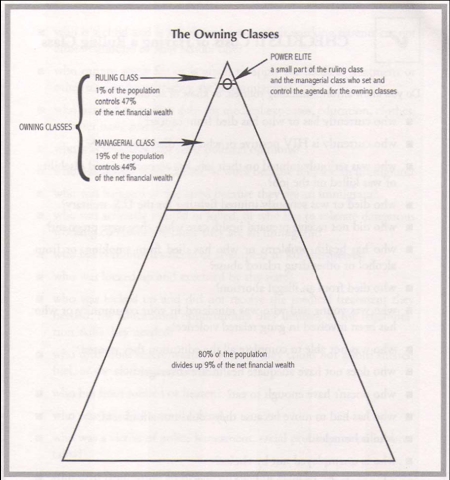
Illustration by Alberto Ledesma Read the rest of this entry »


 The End of Capitalism
Recent Comments