
You are currently browsing the category archive for the ‘Patriarchy’ category.
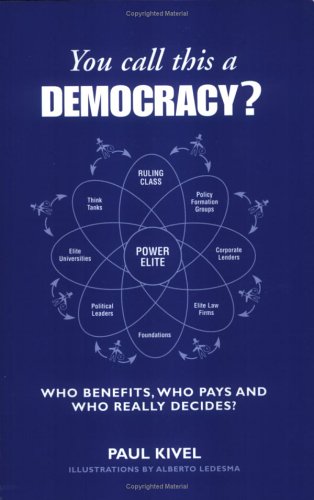
“You Call This a Democracy? Who Benefits, Who Pays, and Who Really Decides?”
by Paul Kivel
2004 Apex Press
Paul Kivel exposes the ruling class of the United States and how it operates in this short, easy-to-read book. With simple concepts and cute illustrations, a nuanced class analysis is presented in a very clear and accessible format.
If the education system was any good at all, “You Call This a Democracy?” would be one of the textbooks used in all high schools. It explains what the ruling class is (those with a family income above $373,000 and net financial wealth of at least $2 million), how it controls the government, media, and economy, and the negative effects we all suffer, such as poverty, wars, disease, pollution, over-working, stress, and meaningless, isolated lives. Kivel particularly does a great job exposing how the ruling class uses racism, sexism, homophobia and other social divisions to keep itself, a relatively small group of basically white Protestant men, in power. Making the connections between systems of oppression is one of the keys to the freedom of everybody, and this book helps move that analysis forward.
There a couple criticisms I could make about the book, first that it doesn’t inspire enough hope or provide much of a systematic solution to the problem that it systematically critiques. And secondly that the book can be cumbersome to read because of a fair amount of repetition coupled with too many general statements about segments of the population. To a certain extent, this was unavoidable in a book of this nature, but I could have used more examples of particular corporations, politicians, and businesspeople and their ilk, even though the examples given in the book are all great.
Definitely check this out if you want to have any idea about the country you’re living in, and how you and your family and everyone you care about are being screwed over by the super-wealthy elite. The path to a democratic future starts when we become informed.
“The war on population always has been, and will continue to be, a war on women’s bodies.”
After reading this article by Betsy Hartmann rebutting recent psuedo-environmental hysteria surrounding overpopulation, I wanted to investigate further how fears of overpopulation facilitate sexist, racist and imperialistic policies by Western countries and NGOs against poor women of color in the Global South.
As Hartmann states with clarity:
“The population controllers have blinders on their eyes when they attribute the cutting down of forests, the polluting of water supplies, and the extinction of species to too many poor people, rather than the unchecked power of large corporations to monopolize resources and ravage the land. Missing from the picture is the question of technological choice: for example, reducing the population of automobiles and investing in public transport worldwide would do much more to curtail climate change than imposing limits on family size.”
This seems to me fundamentally correct. It’s clear that human civilization has overshot the capacity of the Earth to provide for it, that’s not in question. The question is about what forces are responsible for this, and what can we do about it?
For Hartmann and myself, the number of people alive is not nearly as important as the structure of the economic system in which we live. The planet could support 6, or maybe even 9, billion people living a low-impact lifestyle, based on community subsistence and a diet full of fruits and vegetables. But the planet cannot possibly support 6 billion people living like Americans, with their cars, and their computers, and their wars.
As with all things, the debate on “overpopulation” is a political debate, because its a question about who has power and who doesn’t. Placing the blame on poor women is just a way of ignoring the real power-holders: Large multinational corporations and Western capitalist governments.
Below are excerpts from an article that I found helpful in explaining this more clearly. [alex]
10 Reasons to Rethink “Overpopulation”
By the Population and Development Program at Hampshire College
Fears of overpopulation are pervasive in American society. From an early age we are taught that the world is overpopulated and that population pressure is responsible for poverty, hunger, environmental degradation and even political insecurity. If we don’t get population growth under control now, the argument goes, our future is in danger.
Conventional wisdom, however, is not always wise. Placing the blame on population obscures the powerful economic and political forces that threaten the well-being of both people and the planet. It leads to top-down, target-driven population control programs that undermine voluntary family planning and women’s reproductive rights. It reinforces racism, promoting harmful stereotypes of poor people of color. And it prevents the kind of global understanding we need in order to reach across borders to work together for a more just, peaceful and environmentally sustainable world.
Here are ten reasons why we should rethink ‘overpopulation.’
…
2. The focus on population masks the complex causes of poverty and inequality.
A narrow focus on human numbers obscures the way different economic and political systems operate to perpetuate poverty and inequality. It places the blame on the people with the least amount of resources and power rather than on corrupt governments and economic and political elites. It ignores the legacy of colonialism and the continuing unequal relationship between rich and poor countries, including unfavorable terms of trade and the debt burden. It says nothing about the concentration of much wealth in a few hands. In the late 1990s, the 225 people who comprise the ‘ultra-rich’ had a combined wealth of over US $1 trillion, equivalent to the annual income of the poorest 47% of the world’s people.
3. Hunger is not the result of ‘too many mouths’ to feed.
…There is enough food for every man, woman and child to have more than the recommended daily calorie intake. People go hungry because they do not have the land on which to grow food or the money with which to buy it. Read the rest of this entry »
I Want a Twenty-Four-Hour Truce During Which There Is No Rape
Speech by Andrea Dworkin.
This was a speech given at the Midwest Regional Conference of the National Organization for Changing Men in the fall of 1983 in St Paul, Minnesota. One of the organizers kindly sent me a tape and a transcript of my speech. The magazine of the men’s movement, M., published it. I was teaching in Minneapolis. This was before Catharine MacKinnon and I had proposed or developed the civil rights approach to pornography as a legislative strategy. Lots of people were in the audience who later became key players in the fight for the civil rights bill. I didn’t know them then. It was an audience of about 500 men, with scattered women. I spoke from notes and was actually on my way to Idaho–an eight-hour trip each way (because of bad air connections) to give a one-hour speech on Art–fly out Saturday, come back Sunday, can’t talk more than one hour or you’ll miss the only plane leaving that day, you have to run from the podium to the car for the two-hour drive to the plane. Why would a militant feminist under this kind of pressure stop off on her way to the airport to say hi to 500 men? In a sense, this was a feminist dream-come-true. What would you say to 500 men if you could? This is what I said, how I used my chance. The men reacted with considerable love and support and also with considerable anger. Both. I hurried out to get my plane, the first hurdle for getting to Idaho. Only one man in the 500 threatened me physically. He was stopped by a woman bodyguard (and friend) who had accompanied me.
I have thought a great deal about how a feminist, like myself, addresses an audience primarily of political men who say that they are antisexist. And I thought a lot about whether there should be a qualitative difference in the kind of speech I address to you. And then I found myself incapable of pretending that I really believe that that qualitative difference exists. I have watched the men’s movement for many years. I am close with some of the people who participate in it. I can’t come here as a friend even though I might very much want to. What I would like to do is to scream: and in that scream I would have the screams of the raped, and the sobs of the battered; and even worse, in the center of that scream I would have the deafening sound of women’s silence, that silence into which we are born because we are women and in which most of us die.
And if there would be a plea or a question or a human address in that scream, it would be this: why are you so slow? Why are you so slow to understand the simplest things; not the complicated ideological things. You understand those. The simple things. The cliches. Simply that women are human to precisely the degree and quality that you are.
And also: that we do not have time. We women. We don’t have forever. Some of us don’t have another week or another day to take time for you to discuss whatever it is that will enable you to go out into those streets and do something. We are very close to death. All women are. And we are very close to rape and we are very close to beating. And we are inside a system of humiliation from which there is no escape for us. We use statistics not to try to quantify the injuries, but to convince the world that those injuries even exist. Those statistics are not abstractions. It is easy to say, “Ah, the statistics, somebody writes them up one way and somebody writes them up another way.” That’s true. But I hear about the rapes one by one by one by one by one, which is also how they happen. Those statistics are not abstract to me. Every three minutes a woman is being raped. Every eighteen seconds a woman is being beaten. There is nothing abstract about it. It is happening right now as I am speaking.
And it is happening for a simple reason. There is nothing complex and difficult about the reason. Men are doing it, because of the kind of power that men have over women. That power is real, concrete, exercised from one body to another body, exercised by someone who feels he has a right to exercise it, exercised in public and exercised in private. It is the sum and substance of women’s oppression. Read the rest of this entry »
 “The Will to Change: Men, Masculinity and Love”
by bell hooks
2004 Washington Square Press
bell hooks defines this project as an attempt to love men enough to understand how patriarchy affects them, and understand how their pain can help them transform and challenge patriarchy. For me it was a profound experience reading this because it touched on so many aspects of my life as a male, from childhood, to school, to sex and relationships, to friendships, etc. It allowed me to see old memories in new ways, and understand that my feelings of pain, confusion and shame were a result of the violent circumstances that I was subjected to growing up in this culture.
In the past I had “understood” patriarchy as something that primarily only affected women, and saw my job mostly as limiting the damage done to the women in my life and organizing. bell hooks pushed me to look inside myself first and foremost and see how this system has terrorized me personally, and how challenging patriarchy is necessary for my own liberation, as well as the liberation of all men, and everybody.
What struck me most significantly was the idea that patriarchy is all the time enforced by violence, and that men are taught through violence to reject their emotions and become cold-blooded and distant, which allows them to commit violence on others.
“Violence is boyhood socialization. The way we ‘turn boys into men’ is through injury… We take them away from their feelings, from sensitivity to others. The very phrase ‘be a man’ means suck it up and keep going. Disconnection is not fallout from traditional masculinity. Disconnection is masculinity.”
I could think of hundreds or thousands of times that I’ve felt this threat of violence keeping me within the shallow emotionless world of patriarchal masculinity. Most often it looks like jokes, put-downs, humiliation, scorn, and exclusion, but violence is at the heart of the matter. In fact, middle school and high school in retrospect look like a 7 year-long gauntlet of violent social training.
Learning to express the pain I’ve felt without shame, and wield my anger not against myself (or others) but against patriarchal society, isn’t something that can change overnight. But bell hooks’ wisdom has opened up new possibilities for me and for all men, and it’s up to us to take the initiative, educate ourselves, get in touch with our own emotions, our own human-ness and connection to others in a non-dominating way, and work together in love and resistance. We don’t just owe it to women, trans and genderqueer folks, we owe it to ourselves.
“Communities of resistance should be places where people can return to themselves more easily, where the conditions are such that they can heal themselves and recover their wholeness.” – Thich Nhat Hanh, The Raft is Not the Shore

 “No Surrender: Writings from an Anti-Imperialist Political Prisoner”
by David Gilbert
2004 Abraham Guillen Press/Arm the Spirit
I recommend this book. David Gilbert, lifelong political prisoner in New York since 1981, and former member of the Weather Underground (now being exploited in McCain political ads), here writes on many subjects of interest to all anti-imperialist activists.
David’s a great writer; very straightforward, focused, but with tenderness and humor, and he has a way of making sense of complicated and terrible political dramas in short and effective little essays. In addition to essays on Gilbert’s own history in SDS and Weather, the best samples here are on the U.S. white working class historically, the prison system, Colombia, Afghanistan, and neoliberalism. But Gilbert delves into a wide array of subjects from feminism to AIDS to institutional racism in many forms, and always with an amazing insight without requiring a lot of effort on the part of the reader.
It’s a damn shame that this man is behind bars, but luckily he’s still able to share his wisdom with us. Check this out!
 “I’ve Got the Light of Freedom: The Organizing Tradition and the Mississippi Freedom Struggle”
by Charles Payne
1991 by University of California Press
I’ve Got the Light of Freedom is a book about organizing, for organizers. It chronicles SNCC and the Mississippi Freedom movement from its beginnings to ends, especially highlighting the individual organizers and families that put the movement together and sustained it.
The book is great because it analyzes the movement from a variety of perspectives, including understanding the strategies, tactics, gender dynamics, class dynamics, white/black organizing dynamics, local/rural dynamics, mentorship and leadership development, state and white repression, and the rise and fall of trust and community that were the backbone of the movement. The thread throughout is the brilliance of the Ella Baker/Septima Clark school of organizing, based on meeting people where they’re at and developing their leadership so they can lead their own fights. It’s about valuing the day-to-day work that sustains organizations above the flashy actions or speeches, and about seeing our work as part of a long-term struggle towards freedom that will need to involve millions of people.
My criticisms Read the rest of this entry »

“Outlaws of America: The Weather Underground and the Politics of Solidarity”
by Dan Berger
2005 by AK Press
Outlaws of America is an interesting and refreshing look at a somewhat overdone subject, the Weather Underground. The use of interviews with David Gilbert, Bernardine Dohrn and many other former members of WUO, as well as an array of former members from revolutionary groups like the Black Liberation Army and Puerto Rican nationalist groups really brings the subject to life. Dan Berger also emphasizes throughout the book the relevance to today’s movements, and points particularly to the prison abolition and global justice movements as places where the legacy of Weather can be seen.
The book delves into the difficult past/present of armed struggle and state repression, and does a good job of keeping criticisms of the group grounded in the bigger picture of state violence. Some of the 70s history is unnecessary for most readers, but there’s also a lot of proactive criticism of the lack of feminist and queer analysis or practice within Weather, and even the racist mistakes which happened too often and too dramatically for comfort. These are the most important lessons I drew. Read the rest of this entry »
Check out this awesome essay by Paul Kivel – it really helped me understand my class background (as a member of the “buffer zone”) and how I can relate to others in an accountable way to achieve social change! – Alex
Social Service or Social Change?
Who Benefits from your Work
by Paul Kivel
copyright 2000
MY FIRST ANSWER TO THE QUESTION POSED IN THE TITLE is that we need both, of course. We need to provide services for those most in need, for those trying to survive, for those barely making it. We need to work for social change so that we create a society in which our institutions and organizations are equitable and just and all people are safe, adequately fed, adequately housed, well educated, able to work at safe, decent jobs, and able to participate in the decisions that affect their lives. Although the title of this article may be misleading in contrasting social service provision and social change work, the two do not necessarily go together easily and in many instances do not go together at all. There are some groups working for social change that are providing social service; there are many more groups providing social services that are not working for social change. In fact, many social service agencies may be intentionally or inadvertently working to maintain the status quo.
The Economic Pyramid
I want to begin by providing a context for this discussion: the present political/economic system here in the United States. Currently our economic structure looks like the pyramid in Figure One in which 1% of the population controls about 47% of the net financial wealthii of the country, and the next 19% of the population controls another 44%. That leaves 80% of the population struggling to gain a share of just 9% of the remaining financial wealth. That majority of 80% doesn’t divide very easily into 9% of resources, which means that many of us spend most of our time trying to get enough money to feed, house, clothe, and otherwise support ourselves and our families.
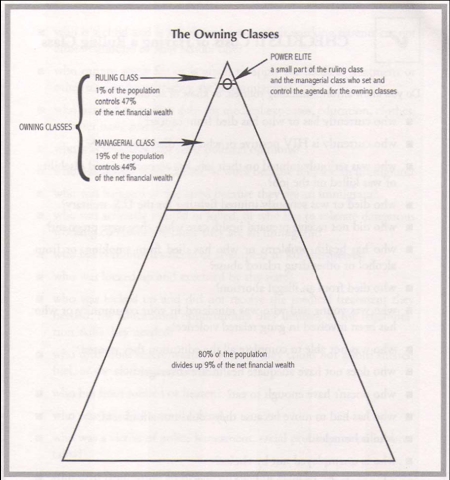
Illustration by Alberto Ledesma Read the rest of this entry »


 The End of Capitalism
Recent Comments