
You are currently browsing the category archive for the ‘New World’ category.
Are we living through the twilight of democracy, or the dawn of a new day?
That is up to us.
The Chambersburg Declaration is a brief but promising political document coming out of Pennsylvania, specifically the Community Environmental Legal Defense Fund. Explanation follows. [alex]

photo by neeloyunus on flickr
BY THE UNDERSIGNED IN CHAMBERSBURG, PENNSYLVANIA, ON
SATURDAY, FEBRUARY 20TH, 2010
We declare:
– That the political, legal, and economic systems of the United States allow, in each generation, an elite few to impose policy and governing decisions that threaten the very survival of human and natural communities;
– That the goal of those decisions is to concentrate wealth and greater governing power through the exploitation of human and natural communities, while promoting the belief that such exploitation is necessary for the common good;
– That the survival of our communities depends on replacing this system of governance by the privileged with new community-based democratic decision-making systems;
– That environmental and economic sustainability can be achieved only when the people affected by governing decisions are the ones who make them;
– That, for the past two centuries, people have been unable to secure economic and environmental sustainability primarily through the existing minority-rule system, laboring under the myth that we live in a democracy;
– That most reformers and activists have not focused on replacing the current system of elite decision-making with a democratic one, but have concentrated merely on lobbying the factions in power to make better decisions; and
– That reformers and activists have not halted the destruction of our human or natural communities because they have viewed economic and environmental ills as isolated problems, rather than as symptoms produced by the absence of democracy.
Therefore, let it be resolved:
– That a people’s movement must be created with a goal of revoking the authority of the corporate minority to impose political, legal, and economic systems that endanger our human and natural communities; Read the rest of this entry »

Review also posted on The Rag Blog.
Review of Men’s Work: How to Stop the Violence That Tears Our Lives Apart
by Paul Kivel
Ballantine Books, 1992
Paul Kivel, cofounder of the Oakland Men’s Project, has given all men (and those concerned about them) a tremendous gift in the form of this inspirational book. This Valentine’s Day, let us accept this gift so that we might heal our relationships to the ones we love and to ourselves.
Men’s Work draws on Kivel’s decades of experience in the movement to end male violence, along with his life experiences as a father, son, partner, and friend, to speak about the trauma and feelings of powerlessness men experience to in our capitalist, patriarchal society. He describes how men reproduce this system by hurting women, trans folks, children, and themselves.
He explains that this is crisis cannot be solved by locking up male offenders, because this will only cause more violence and trauma. Instead, Kivel has devoted his life to helping men understand the roots of their behavior so that they might change, to become more caring and compassionate. One helpful way he approaches these roots is through the “Act Like a Man” box, which shows how patriarchal masculinity limits and hurts men:
men…………………………. men are…
yell at people………………. aggressive
have no emotions………… responsible
get good grades………….. mean
stand up for themselves… bullies
don’t cry……………………. tough
don’t make mistakes…….. angry
know about sex………….. successful
take care of people………. strong
don’t back down…………. in control
push people around…….. active
can take it………………… dominant over women
All men have received this male training, and know that when they step outside these boundaries they will face abuse, scorn, name-calling, accusations of homosexuality or femininity, or violence. The fear of this abuse is ultimately what keeps us inside the Box.
Paul relates, “It is not an irrational fear. This fear in me was built by getting beaten up after school by some older kid in the neighborhood who didn’t like me, by being teased and called names because sometimes I cried after I got beaten up. This fear was built by all the times my dad put me down because I wasn’t good enough in sports., at school, or whatever he decided was the standard that day.” Hearing a man brave enough to tell these kinds of stories was empowering and validated my own experiences.
The book also includes a wealth of activities that the Oakland Men’s Project developed to help men think about violence, masculinity, abuse and privilege, so that they might change their behavior. Read the rest of this entry »
This essay strikes me as deeply explanatory for the absurd political events that have been taking place in the US in the past year – from trillion-dollar bank bailouts, to the inability to create any meaningful health care reform, to the absolute mocking of the world’s attempts to deal with the catastrophe of climate change – the US government seems to have completely given up on pretending to represent the American public and aligned itself with huge financial and corporate interests, right out in the open.
Those of us with a radical understanding of power know this government has always served the interests of the powerful as its primary mission. But in the past, the politicians at least paid lip service to the public interest in order to save face. This was the era of “hegemony”, roughly meaning the consent of the ruled to their domination.
The public was being screwed, but somehow it was ideologically prepared to believe that “we, the people” had the ultimate say. This was supposed to be a democracy, after all. Sure, the police, prison system, military, and federal enforcement agencies would step in if things got out of hand, but much more effective at keeping the system intact was the “cop in our heads”. As long as we truly believed that it was all for our own good, the corporations just rolled right along, plundering the planet and destroying our communities. And the media made sure we believed it. That’s hegemony.
The reign of George W. Bush really started the break from this paradigm, as we saw for example the outright defiance of the US Constitution and US law when it came to imprisonment of political enemies, justifying torture, spying on millions of American citizens’ phone calls, excessive lying in order to invade and occupy strategic countries, etc etc. At first the public somewhat accepted these moves as “necessary” in the face of terrorism, but Bush’s popularity waned terribly in his second term as people became more informed of what was really happening. In this light Obama’s rhetoric about “change” seems to have initially served to reinvigorate the system with a revived hegemony – to give the US a new image, one of tolerance, diplomacy, and the rule of law.
But the first year of Obama has already shattered these illusions. Obama and his Democrats now appear totally befuddled, their strategy (of putting a smiling face and a few meaningless reforms on a fundamentally broken system) lies in rubble. And a resurgent, perhaps racist, Right appears ready to sweep back into control by playing with the public’s justified resentment and frustration of a continually deteriorating situation.
In this context Jeff Strabone asks us if hegemony is becoming a thing of the past: “Will the state shamelessly turn itself completely over to serving the interests of a powerful few without bothering to pretend that it’s not?”
 I’ve written in my synopsis about the end of capitalism and the possible emergence of neo-fascism, a militarization of society in order to preserve the interests of the powerful, regardless of the environmental and social costs. It seems to me that one indicator of this possible paradigm shift is the increasing shamelessness of the elites. In market-driven capitalism, image is crucial. If a corporation gets bad publicity, they stand to lose money in the stock market. This is one of the few areas of capitalism that is open to democratic intervention. Another area where the public can occasionally intervene is through electing progressive representatives into office.
But it’s these avenues that appear to be closing to us now. Goldman Sachs, Exxon-Mobil, and Blackwater have all gotten terrible publicity in the past few years for their theivery, pollution and murder; but their stocks have never soared higher. Then the public gave Obama and the Democrats an enormous mandate to “change” the country, only to see them cave immediately on almost every campaign promise. The bank bailouts, torturing, and bombing of civilians have, if anything, increased in Obama’s tenure thus far. Perhaps the final insult was the Supreme Court’s decision last week that corporations are “people” with a First Amendment “right to speak” by directly buying politicians. Have they no shame? Apparently not.
So if the consent of the governed is no longer sought, and we’re truly moving into a post-hegemonic era, what can we do to make sure that the breakdown of the capitalist system leads to something better, and not far worse? As Mr. Strabone proclaims, it’s time for civil disobedience. The system has failed us, we must cut off our allegiance from it, confront the powers that be, and start envisioning and constructing the world we want to see replace capitalism. I, for one, wish to see that world based on shared values of democracy, justice, sustainability, freedom and love, and I urge all of you to consider the alternative. [alex]
Post-Shame: Time for Civil Disobedience
by Jeff Strabone
Originally published by Daily Kos.
Tue Jan 26, 2010
One of the duties of the modern nation-state is persuasion. Each state aims to keep its citizens convinced of the legitimacy of its rule. The state may be run chiefly for the enrichment of a few at the cost of the many, but the endurance of the state is widely thought to depend on its ability to sell its rule to the many as a common-sense truism. Or at least that was how it used to work. We may be entering a new era in the evolution of the state, one where the state approaches a state of utter shamelessness.
Antonio Gramsci, in his prison notebooks, called this persuasive activity ‘hegemony’. According to Gramsci, hegemony occludes the domination of the state and the classes whose interests it serves. One does not have to be an Italian communist of the 1920s to see the usefulness of Gramsci’s groundbreaking insight. Broadly speaking, all political actors pursue their agendas by trying to narrow other people’s imaginations in order to make desired outcomes seem common-sensical and undesired outcomes outside the ambit of reasonable thought.
It seems to me that over the past decade, in the United States, the state and a narrow circle of powerful interests—banks, energy companies, and private health insurers in particular—have simply given up trying to persuade the rest of us that their interests were our interests. Could we be moving in the twenty-first century to a state that practices domination without hegemony? Or, to put it in plain English, will the state shamelessly turn itself completely over to serving the interests of a powerful few without bothering to pretend that it’s not? And if it does, how should we respond?
I am not the only one asking these questions. Read the rest of this entry »
This is one of the most timely and insightful articles I’ve read in a long time – the editorial from the new issue of Turbulence magazine. They discuss the economic crisis within the frame of the collapse of the neoliberal order that has been the standard-bearer of global capitalism for the last 30-35 years, resulting in a state of “limbo” where no “deal” exists tying the system together. Nevertheless, the system persists like a zombie, dead and discredited but carried forward by sheer momentum and the fact that nothing else has shown itself capable of replacing it. Our job then, is to hold up an alternative way of life (a new “common ground”) that values communities and the planet above narrow profit, and that job becomes easier by studying analysis like this. Thanks, Turbulence! [alex]
Life in Limbo?
By Turbulence
We are trapped in a state of limbo, neither one thing nor the other. For more than two years, the world has been wracked by a series of interrelated crises, and they show no sign of being resolved anytime soon. The unshakable certainties of neoliberalism, which held us fast for so long, have collapsed. Yet we seem unable to move on. Anger and protest have erupted around different aspects of the crises, but no common or consistent reaction has seemed able to cohere. A general sense of frustration marks the attempts to break free from the morass of a failing world.
There is a crisis of belief in the future, leaving us with the prospect of an endless, deteriorating present that hangs around by sheer inertia. In spite of all this turmoil – this time of ‘crisis’ when it seems like everything could, and should, have changed – it paradoxically feels as though history has stopped. There is an unwillingness, or inability, to face up to the scale of the crisis. Individuals, companies and governments have hunkered down, hoping to ride out the storm until the old world re-emerges in a couple of years. Attempts to wish the ‘green shoots’ of recovery into existence mistake an epochal crisis for a cyclical one; they are little more than wide-eyed boosterism. Yes, astronomical sums of money have prevented the complete collapse of the financial system, but the bailouts have been used to prevent change, not initiate it. We are trapped in a state of limbo.
Crisis in the middle
And yet, something did happen. Recall those frightening yet heady days that began in late 2008, when everything happened so quickly, when the old dogmas fell like autumn leaves? They were real. Something happened there: the tried and tested ways of doings things, well-rehearsed after nearly 30 years of global neoliberalism, started to come unstuck. What had been taken as read no longer made sense. There was a shift in what we call the middle ground: the discourses and practices that define the centre of the political field.
To be sure, the middle ground is not all that there is, but it is what assigns the things in the world around it a greater or lesser degree of relevance, validity or marginality. It constitutes a relatively stable centre against which all else is measured. The farther from the centre an idea, project or practice is, the more likely it is to be ignored, publicly dismissed or disqualified, or in some way suppressed. The closer to it, the more it stands a chance of being incorporated – which in turn will shift the middle more or less. Neither are middle grounds defined ‘from above’, as in some conspiratorial nightmare. They emerge out of different ways of doing and being, thinking and speaking, becoming intertwined in such a way as to reinforce each other individually and as a whole. The more they have become unified ‘from below’ as a middle ground, the more this middle ground acquires the power of unifying ‘from above’. In this sense, the grounds of something like ‘neoliberalism’ were set before something was named as such; but the moment when it was named is a qualitative leap: the point at which relatively disconnected policies, theories and practices became identifiable as forming a whole.
The naming of things like Thatcherism in the UK, or Reaganism in the US, marked such a moment for something that had been constituting itself for some time before, and which has for the past three decades dominated the middle ground: neoliberalism, itself a response to the crisis of the previous middle, Fordism/Keynesianism. The era of the New Deal and its various international equivalents had seen the rise of a powerful working class that had grown used to the idea that its basic needs should be met by the welfare state, that real wages would rise, and that it was always entitled to more. Initially, the centrepiece of the neoliberal project was an attack on this ‘demanding’ working class and the state institutions wherein the old class compromise had been enshrined. Welfare provisions were rolled back, wages held steady or forced downwards, and precariousness increasingly became the general condition of work.
But this attack came at a price. The New Deal had integrated powerful workers’ movements – mass-based trade unions – into the middle ground, helping to stabilise a long period of capitalist growth. And it provided sufficiently high wages to ensure that all the stuff generated by a suddenly vastly more productive industrial system – based on Henry Ford’s assembly line and Frederick Taylor’s ‘scientific management’ – could be bought. Bit by bit, the ferocious attack on the working classes of the global North was offset by low interest rates (i.e. cheap credit) and access to cheap commodities, mass-produced in areas where wages were at their lowest (like China). In the global South, the prospect of one day attaining similar living conditions was promised as a possibility. In this sense, neoliberal globalisation was the globalisation of the American dream: get rich or die trying. Read the rest of this entry »
In November, community members in Spokane Washington articulated these Community Bill of Rights, to give neighbors the ability to control their neighborhoods and their futures. It was defeated by massive opposition of corporate and political elites, but the model of communities organizing at the grassroots level for basic economic, social and ecological rights is something that I’m sure will be reproduced and improved upon in the New Year. Happy 2010! [alex]
Spokane Considers Community Bill of Rights
by Mari Margil, November 4, 2009
Thousands of people voted to protect nine basic rights, ranging from the right of the environment to exist and flourish to the rights of residents to have a locally based economy and to determine the future of their neighborhoods.
Of all the candidates, bills, and proposals on ballots around the country yesterday, one of the most exciting is a proposition that didn’t pass.
In Spokane, Washington, despite intense opposition from business interests, a coalition of residents succeeded in bringing an innovative “Community Bill of Rights” to the ballot. Proposition 4 would have amended the city’s Home Rule Charter (akin to a local constitution) to recognize nine basic rights, ranging from the right of the environment to exist and flourish to the rights of residents to have a locally based economy and to determine the future of their neighborhoods.

Communities Take Power - Barnstead, New Hampshire was the first town in the nation to ban corporate water mining.
A coalition of the city’s residents drafted the amendments after finding that they didn’t have the legal authority to make decisions about their own neighborhoods; the amendments were debated and fine-tuned in town hall meetings.
Although the proposition failed to pass, it garnered approximately 25 percent of the vote—despite the fact that opponents of the proposal (developers, the local Chamber of Commerce, and the Spokane Homebuilders) outspent supporters by more than four to one. In particular, they targeted the Sixth Amendment, which would have given residents the ability, for the very first time, to make legally binding, enforceable decisions about what development would be appropriate for their own neighborhood. If a developer sought to build a big-box store, for example, it would need to conform to the neighborhood’s plans.
Nor is development the only issue in which resident would have gained a voice. The drafters and supporters of Proposition 4 sought to build a “healthy, sustainable, and democratic Spokane” by expanding and creating rights for neighborhoods, residents, workers, and the natural environment.
Legal Rights for Communities
Patty Norton, a longtime neighborhood advocate who lives in the Peaceful Valley neighborhood of Spokane, and her neighbors spent years fighting a proposed condominium development that would loom 200 feet high, casting a literal shadow over Peaceful Valley’s historic homes.
Proposition 4 would ensure that “decisions about our neighborhoods are made by the people living there, not big developers,” Patty said. Read the rest of this entry »
Also published by The Rag Blog and OpEdNews.
 “We stand at a critical moment in Earth’s history, a time when humanity must choose its future. As the world becomes increasingly interdependent and fragile, the future at once holds great peril and great promise. To move forward we must recognize that in the midst of a magnificent diversity of cultures and life forms we are one human family and one Earth community with a common destiny. We must join together to bring forth a sustainable global society founded on respect for nature, universal human rights, economic justice, and a culture of peace. Towards this end, it is imperative that we, the peoples of Earth, declare our responsibility to one another, to the greater community of life, and to future generations. – The Earth Charter” (pg. 1).
David Korten, long-time global justice activist, co-founder of Yes! Magazine, and author of such books as When Corporations Rule the World, lays out the fundamental crossroads facing the world in his 2006 book The Great Turning: From Empire to Earth Community. In response to global climate change, war, oil scarcity, persistent racism and sexism and many other mounting crises, Korten argues we must recognize these as symptoms of a larger system of Empire, so that we might move in a radically different direction of equality, ecological sustainability, and cooperation, which he terms Earth Community. This is a powerful and important book, which excels in overviewing the big picture of threats facing our ecosphere and our communities at the hands of global capitalism1, and translating this into the simplest and most accessible language so we might all do something about it. It’s pretty much anti-capitalism for the masses. And it has the power to inspire many of us to transform our lives and work towards the transformation of society.
Capitalism and Empire
Of course, Korten has made the strategic decision to avoid pointing the finger at “capitalism” as such in order to speak to an American public which largely still confuses the term as equivalent to “freedom” or “democracy.” In fact the “C” word is rarely mentioned in the book, almost never without some sort of modifier as in “corporate capitalism” or “predatory capitalism”, as if those weren’t already features of the system as a whole. Instead, Korten names “Empire” as the culprit responsible for our global economic and ecological predicament, which is defined as a value-system that promotes the views that “Humans are flawed and dangerous”, “Order by dominator hierarchy”, “Compete or die”, “Masculine dominant”, etc. (32).
Korten explains that Empire, “has been a defining feature of the most powerful and influential human societies for some five thousand years, [and] appropriates much of the productive surplus of society to maintain a system of dominator power and elite competition. Racism, sexism, and classism are endemic features” (25). In this way the anarchist concept of the State is repackaged as a transcendent human tendency, which has more to do with conscious decision-making and maturity level than it does with political power. While this compromise does limit the book’s effectiveness in offering solutions later on, it does speak in a language more familiar to the vast non-politicized majority of Americans, and may have the potential to unify a larger movement for change.
Whatever you want to call the system, the danger it presents to the planet is now clear. Korten spells out the grim statistics: “Fossil fuel use is five times what it was [in 1950], and global use of freshwater has tripled… the [Arctic] polar ice cap has thinned by 46 percent over twenty years… [while we’ve seen] a steady increase over the past five decades in severe weather events such as major hurricanes, floods, and droughts. Globally there were only thirteen severe events in the 1950s. By comparison, seventy-two such events occurred during the first nine years of the 1990s” (59-60). If this destruction continues, it’s uncertain if the Earth will survive.
This ecological damage is considered alongside the social damage of billions living without clean water or adequate food, as well as the immense costs of war and genocide. But Korten understands that the danger is relative to where you stand in the social hierarchy – the system creates extreme poverty for many, and an extreme wealth for a few others. He explains how the system is based on a deep inequality that is growing ever worse, “In the 1990s, per capita income fell in fifty-four of the world’s poorest countries… At the other end of the scale, the number of billionaires worldwide swelled from 274 in 1991 to 691 in 2005” (67). The critical point that these few wealthy elites wield excessive power and influence within the system to stop or slow necessary reform could be made more clearly, but at least the book exposes the existence of this upper class, who are usually quite effective at hiding from public scrutiny and outrage over the suffering they are causing.2
Earth Community – Growing a Revolution
Standing at odds with the bastions of Empire is what David Korten calls “Earth Community,” a “higher-order” value-system promoting the views of, “Cooperate and live,” “Love life”, “Defend the rights of all”, “Gender balanced”, etc. (32). Read the rest of this entry »
Also published by The Rag Blog, OpEdNews, Signs of the Times, Interactivist Info Exchange, and Toward Freedom.
 Who Were the Witches? – Patriarchal Terror and the Creation of Capitalism
Alex Knight
November 5, 2009
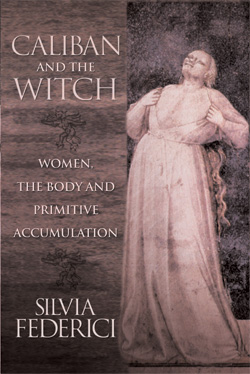
This Halloween season, there is no book I could recommend more highly than Silvia Federici’s brilliant Caliban and the Witch: Women, the Body, and Primitive Accumulation (Autonomedia 2004), which tells the dark saga of the Witch Hunt that consumed Europe for more than 200 years. In uncovering this forgotten history, Federici exposes the origins of capitalism in the heightened oppression of workers (represented by Shakespeare’s character Caliban), and most strikingly, in the brutal subjugation of women. She also brings to light the enormous and colorful European peasant movements that fought against the injustices of their time, connecting their defeat to the imposition of a new patriarchal order that divided male from female workers. Today, as more and more people question the usefulness of a capitalist system that has thrown the world into crisis, Caliban and the Witch stands out as essential reading for unmasking the shocking violence and inequality that capitalism has relied upon from its very creation.
Who Were the Witches?
Parents putting a pointed hat on their young son or daughter before Trick-or-Treating might never pause to wonder this question, seeing witches as just another cartoonish Halloween icon like Frankenstein’s monster or Dracula. But deep within our ritual lies a hidden history that can tell us important truths about our world, as the legacy of past events continues to affect us 500 years later. In this book, Silvia Federici takes us back in time to show how the mysterious figure of the witch is key to understanding the creation of capitalism, the profit-motivated economic system that now reigns over the entire planet.
During the 15th – 17th centuries the fear of witches was ever-present in Europe and Colonial America, so much so that if a woman was accused of witchcraft she could face the cruellest of torture until confession was given, or even be executed based on suspicion alone. There was often no evidence whatsoever. The author recounts, “for more than two centuries, in several European countries, hundreds of thousands of women were tried, tortured, burned alive or hanged, accused of having sold body and soul to the devil and, by magical means, murdered scores of children, sucked their blood, made potions with their flesh, caused the death of their neighbors, destroyed cattle and crops, raised storms, and performed many other abominations” (169).
In other words, just about anything bad that might or might not have happened was blamed on witches during that time. So where did this tidal wave of hysteria come from that took the lives so many poor women, most of whom had almost certainly never flown on broomsticks or stirred eye-of-newt into large black cauldrons?
Caliban underscores that the persecution of witches was not just some error of ignorant peasants, but in fact the deliberate policy of Church and State, the very ruling class of society. To put this in perspective, today witchcraft would be a far-fetched cause for alarm, but the fear of hidden terrorists who could strike at any moment because they “hate our freedom” is widespread. Not surprising, since politicians and the media have been drilling this frightening message into people’s heads for years, even though terrorism is a much less likely cause of death than, say, lack of health care.1 And just as the panic over terrorism has enabled today’s powers-that-be to attempt to remake the Middle East, this book makes the case that the powers-that-were of Medieval Europe exploited or invented the fear of witches to remake European society towards a social paradigm that met their interests.
Interestingly, a major component of both of these crusades was the use of so-called “shock and awe” tactics to astound the population with “spectacular displays of force,” which helped to soften up resistance to drastic or unpopular reforms.2 In the case of the Witch Hunt, shock therapy was applied through the witch burnings – spectacles of such stupefying violence that they paralyzed whole villages and regions into accepting fundamental restructuring of medieval society.3 Federici describes a typical witch burning as, “an important public event, which all the members of the community had to attend, including the children of the witches, especially their daughters who, in some cases, would be whipped in front of the stake on which they could see their mother burning alive” (186).
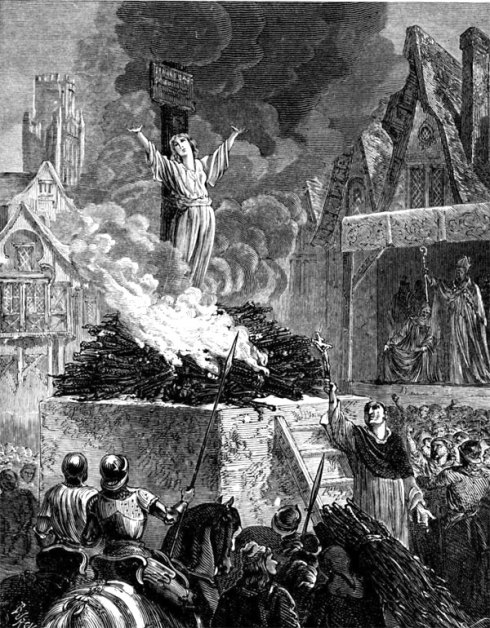
The witch burning was the medieval version of "Shock and Awe"
The book argues that these gruesome executions not only punished “witches” but graphically demonstrated the repercussions for any kind of disobedience to the clergy or nobility. In particular, the witch burnings were meant to terrify women into accepting “a new patriarchal order where women’s bodies, their labor, their sexual and reproductive powers were placed under the control of the state and transformed into economic resources” (170). Read the rest of this entry »
a self-explanatory call to action from Jobs with Justice that is right on. [alex]

|


 The End of Capitalism
Recent Comments