
You are currently browsing the category archive for the ‘Food’ category.
I’ve reposted a nice article which highlights the class dynamics at the heart of the current financial meltdown and potential bailout. It gives a very simple and straightforward summary from a revolutionary point of view, so I’m reposting it.
This is by no means a complete analysis however – for example it overlooks the critical role of oil, which is the lifeblood of the US capitalist economy and motivates many of its military aggression around the world. Specifically, there is a need to understand how the peak in global oil production has affected and continues to undermine the US-led industrial capitalist system, particularly in regards to the bursting of the housing bubble in the first place, along with the rising gas prices, food prices, heating costs, and subsequent inflation of the failing dollar.
Because oil production will never recover to its 2005/6 level, but will continue to decrease more rapidly, there can be no long-term recovery of the global financial markets, and for that reason I disagree with the declaration here that “Capitalism will not collapse…” On the contrary, it WILL collapse, because any system that structurally depends upon constant growth and speculation-upon-that-growth cannot coexist forever on a finite planet where necessary and crucial resources are in permanent and deepening shortage.
The current economic crisis is often compared to other historical crises of capitalism, where after appearing on the verge of death, the system restored itself and came back stronger than ever. Thus we are warned that capitalism is a self-destructive beast, but not a suicidal one. On its face this is solid logic but it overlooks the specific nature of the current crisis and its roots in the global peak oil phenomenon. It is my contention and the purpose of this website to demonstrate that the oil crisis is sucking global industrial capitalism dry like the vampire it is, and that there is no combination of “alternative” energy sources – whether coal, gas, nuclear, ethanol, wind, solar, whatever – that can do for this system what oil does.
Oil is not only the largest energy source, it also provides the material for 99% of pesticides (along with the entire industrial agriculture system), all plastics, almost all pharmaceutical drugs and chemicals, and a massive array of other products and components that keep the industrial economy chugging along. But the real killer is that oil literally fuels almost all transportation of materials and people for this system, including 95% of transportation in the US itself, as well as essentially ALL global air and sea transport. There is simply no way to keep this monster running without more and more petroleum.
Now, just because we’re confident that capitalism won’t recover from the current death-blows doesn’t mean a more vicious and destructive system won’t replace it, which is why this article’s conclusions are relevant and necessary. If we’re headed in the US towards fascism – which is where the rich and their Washington cronies seem to want to take us to protect their wealth and power – the only solution, which will become more and more apparent daily, is to organize a massive resistance here in the US that can stop the vampires and build towards a society based on freedom, justice and democracy.
[alex]
SOME TALKING POINTS ON THE FINANCIAL CRISIS
By Kate Griffiths and Isaac Silver
1. The era of the United States as a “the world’s only superpower” is ending.
The United States economy has not been this bad since the Great Depression. The rulers of the US hoped to retain global power militarily, through the wars in Iraq and Afghanistan, as the country’s raw economic superiority slipped. But these wars cannot be won: opposition among the occupied populations, and growing dissent within the military, prevent any victory on US terms even as the death toll climbs.
2. Beginning during the 1970s, manufacturing stalled, while government and investors focused on the financial sector: banks, real estate, and insurance.
Increasing competition, strong unions, and victories of the Black freedom movement had begun to limit the profits made by US corporations and threaten the power of the ruling class. In response, employers shifted good-paying manufacturing jobs overseas and to nonunionized areas of the USA. As wages stagnated, and workers’ purchasing power declined, workers maintained a precarious hold on our livelihood through working longer hours, sending more household members to work, and buying extensively on credit. The globalization of US capitalism and growth of credit both fueled the financial sector, which provided fluid economic resources that could be quickly moved and re-invested – unlike a physical investment such as a factory or railroad.
3. In 2008, years of government policies favoring the rich provoked instability and sparked collapse of major Wall Street institutions.
As the cost of the basic necessities went up, and wages failed to cover them Read the rest of this entry »
Excerpts from Democracy Now!, May 6, 2008.
[Kevin Phillips, author of “Bad Money: Reckless Finance, Failed Politics, and the Global Crisis of American Capitalism”, surveys the economic crisis facing U.S.-dominated global capitalism – including peak oil, the collapse of the Dollar, rising food costs, and the growing dominance of the banking and credit industries. This is fairly radical stuff coming from a former GOP strategist.]
AMY GOODMAN: What do you think is one of the most serious signs of this overall global crisis of American capitalism?
KEVIN PHILLIPS: Well, not to single out just one, I have an approach I use to say that normally when a country is—United States is—heading into a recession, there are one or two, sometimes three, factors that you worry about. But at this point in time, the American economy, you can think of it as being kind of in a shark tank, and there are like six or seven sharks, and you don’t usually see anything like that number. Read the rest of this entry »
This week, food riots are erupting in the poorest countries of the world, such as Haiti, where the majority of the population lives on under $2 a day. The protesters are calling for the resignation of their government, for its inability to provide basic necessities to the population. See this BBC News short video.
The price of grains, especially wheat (which has doubled in the past year), has been on a steady uphill trend for the past few years, causing major food shortages across much of the Global South.
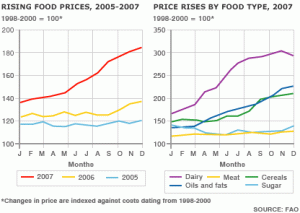
(image from BBC)
I want to highlight 4 underlying causes of this global food shortage:
1) Growing Inequality between the wealthiest and poorest people. Greater affluence in industrializing countries is driving larger levels of meat consumption, which requires far more wheat, other grains, and water to be consumed in order to produce the same amount of food. In fact, the majority of grains produced in the world are now fed to animals for meat. Meanwhile, hundreds of millions of people in the Global South are on the brink of starvation, or literally already starving.
2) Global Warming is causing unreliable and chaotic weather patterns across much of the food-producing regions of the world. Arable lands are turning into deserts as droughts worsen, while other regions are flooding with unseasonable downpours. These combine to create massive agricultural loss.
3) Biofuels like ethanol from corn production in the U.S. are quite literally food being used to fuel industry and automobiles. This manifests in driving up the cost of food for everyone, especially the poor, so that the largest agribusiness firms can earn huge profits, and the illusion of American prosperity surrounding large cars and wasteful consumerism can be maintained at all costs.
4) Most fundamental, The Global Oil Production Peak, which took place in 2006, is causing declining supplies of oil while demand surges across the industrial and industrializing world. We have seen a drastic and increasing rise in the price of oil over this period, which most Americans recognize in the high cost of gasoline. But for the poor of the world, a much more dire situation is emerging with food, because oil and other fossil fuels are the sources for most industrial fertilizers and pesticides, and because the modern system of food production and distribution are heavily dependent on oil for transportation, processing, packaging, refrigeration and cooking. In fact, the average American consumes over 10 calories of fossil fuels for every calorie of food eaten! Most people in the world can’t continue to afford this oil subsidy, and the crisis will only deepen as oil production declines in the coming years.
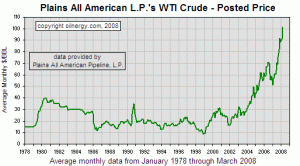
(Image courtesy OILNERGY)
By William M. H. Kötke
13 September, 2007
Countercurrents
The planetary elite are compelled to continue on their path of growth leading toward planetary domination. The international bankers through their control of the industrial world’s privately owned central banks maintain a tether on the money system through their control of the U.S. dollar as the currency of international trade. One important mechanism that allows this is that the largest item in international trade – oil – is sold in dollars. In order to insure the continuance of the dollar economy, they must be able to choose which currency oil is sold for or control the oil – or both. The center of the empire, the U.S., is maintained by debt as the petrodollars and other dollars come into the U.S. at the rate of at least two and a half billion per day (purchasing U.S. government bonds) in order to continue the cycle, which keeps the empire and its military power expanding As the elite carry out their strategies of domination they are racing against time. The monster trends of Peak Oil and energy exhaustion, climate change which will severely disrupt the seasons of growth in the food supply system, the weakness of the dollar and ecological collapse are pursuing them. An exponentially growing world population with growing material consumption based on dwindling resources and a dying planet won’t work, but they have no other option to maintain their power and profit.
Seeds of Change
As the industrial system spins toward exhaustion, seeds of change are sprouting at the base. The people at the base are not revolting in order to take the power that the elite have but are revolting to take power over their own lives. Read the rest of this entry »


 The End of Capitalism
Recent Comments