
You are currently browsing the category archive for the ‘Environmental Justice’ category.
 http://www.democracynow.org/2009/12/17/bolivian_president_evo_morales_on_climate
AMY GOODMAN: Just before we went to air today, I interviewed Evo Morales, Bolivia’s first indigenous president. He was re-elected in a landslide victory earlier this month. On Wednesday, Evo Morales called on world leaders to hold temperature increases over the next century to just one degree Celsius, the most ambitious proposal so far by any head of state. Morales also called on the United States and other wealthy nations to pay an ecological debt to Bolivia and other developing nations.
AMY GOODMAN: President Morales, welcome to Democracy Now!
PRESIDENT EVO MORALES: [translated] Thank you very much for the invitation.
AMY GOODMAN: You spoke yesterday here at the Bella Center and said we cannot end global warming without ending capitalism. What did you mean?
PRESIDENT EVO MORALES: [translated] Capitalism is the worst enemy of humanity. Capitalism—and I’m speaking about irrational development—policies of unlimited industrialization are what destroys the environment. And that irrational industrialization is capitalism. So as long as we don’t review or revise those policies, it’s impossible to attend to humanity and life.
AMY GOODMAN: How would you do that? How would you end capitalism?
PRESIDENT EVO MORALES: [translated] It’s changing economic policies, ending luxury, consumerism. It’s ending the struggle to—or this searching for living better. Living better is to exploit human beings. It’s plundering natural resources. It’s egoism and individualism. Therefore, in those promises of capitalism, there is no solidarity or complementarity. There’s no reciprocity. So that’s why we’re trying to think about other ways of living lives and living well, not living better. Not living better. Living better is always at someone else’s expense. Living better is at the expense of destroying the environment.
AMY GOODMAN: President Morales, what are you calling here—for here at the UN climate summit?
PRESIDENT EVO MORALES: [translated] Defense of the rights of Mother Earth. Read the rest of this entry »
This is a great, short video that shows why “Cap and Trade” schemes to reduce carbon emissions, like what world leaders are discussing at the Copenhagen Summit, are fundamentally flawed. Turns out that selling our atmosphere to corporations might actually be a bad way to stop climate change. It’s just another attempt to bail out capitalism, this time by making a commodity out of our hopes for a sustainable future.
Annie Leonard, creator of the original “Story of Stuff,” has hit another one out of the park by breaking down complex political issues into simple, accessible and visually appealing viral videos. Check it out (And share with family and friends)! [alex]
And here is the original, highly-acclaimed “Story of Stuff”
see more at storyofstuff.com
This shocking article in the UK Independent shows the deadly effects of asbestos in England, where just as in my home town of Ambler, people continue to die from an industry that stopped producing decades ago.
Among the revelations here are that UK officials knew about the “evil effects” of asbestos in 1898, yet it took a century to outlaw. Another startling statistic is that asbestos kills 90,000 people a year worldwide, and the death rate in England will continue to increase until 2016.
More evidence of the social and ecological harm inherent in a capitalist system that values profit above all else.
[alex]
Asbestos: A shameful legacy
The authorities knew it was deadly more than 100 years ago, but it was only banned entirely in 1999. The annual death rate will peak at more than 5,000 in 2016 – now MPs have a chance to do the decent thing.
By Emily Dugan
Sunday, 22 November 2009

Even as the Sanders brothers posed for these photos, each was already sentenced to a terrible death decades later. Why? They had hugged a family friend who worked at the local factory
They called it “the Barking cough”. First it began like any other: a tickle in the chest and slight pain on breathing. Then, within a matter of months, the sufferer was in agony, gasping for air and eventually suffocating to death as a vicious cancer attacked their lungs waiting for the final lingering, inevitable end which might not come for decades.The legacy of the Cape Asbestos factory in Barking, east London, where asbestos-related cancers continue to kill scores of residents, is a deadly one. Hundreds of people have died since the factory closed in 1968.
The story of Barking’s “industrial killing machine” is a story repeated up and down the country where thousands of Britons continue to be blighted by their industrial past. Exposure to asbestos is now the biggest killer in the British workforce, killing about 4,000 people every year – more than who die in traffic accidents. The shocking figures are the grim legacy of the millions of tons of the dust shipped to Britain to make homes, schools, factories and offices fire resistant. It was used in products from household fabrics to hairdryers.
Those most at risk are ordinary workers and their families. Whether it was dockyard workers who unloaded the lethal cargoes, or those in the factories exposed to the fibres, or the carpenters, laggers, plumbers, electricians and shipyard workers who routinely used asbestos for insulation – all suffered. So did the wives who washed the work overalls and the children who hugged their parents or played in the dust-coated streets.
The exposure to asbestos in Britain is largely historical but the death toll is alarmingly etched on our future. Asbestos fibres can lie dormant on victims’ lungs for up to half a century; deaths from asbestos in Britain will continue to rise until 2016.
Nor is it confined to Britain. The World Health Organisation says asbestos currently kills at least 90,000 workers every year. One report estimated the asbestos cancer epidemic could claim anywhere between five and 10 million lives before it is banned worldwide and exposure ceases.
Asbestos was hailed as the “magic mineral” when its tough, flexible but fire-resistant qualities were realised, but for more than a century doctors and others have been warning of its dangers. Asbestos dust was being inhaled into the lungs where it could lie unnoticed before causing crippling illnesses such lung cancer, asbestosis and mesothelioma which one medical professor has described as “perhaps the most terrible cancer known, in which the decline is the most cruel”. Read the rest of this entry »
 After watching the brilliantly-acted and courageous film Silkwood (1983, starring Meryl Streep), I learned the compelling story of Karen Silkwood and her death, which has seemingly been forgotten by America. Karen, only 28, was a union activist working in a Kerr-McGee nuclear power plant in Oklahoma, who died in a suspicious car accident while on her way to meet with a New York Times reporter for a story that would have exposed the company’s dangerous and illegal mishandling of plutonium.
Karen was active in her union, calling attention to the radioactive contamination in the plant, and spent months compiling evidence to show that the company was deliberately covering up the fact that their fuel rods contained imperfections, which could put millions of lives at risk if they sparked a meltdown. The night of her death, many believe Karen was deliberately driven off the road by another car, and her family was later able to sue Kerr-McGee for $1.3 million in damages, but the company admits no wrongdoing.
The nuclear plant where Karen worked was shut down in 1975, one year after her death. When Karen’s story became public controversy, it helped display the dangers inherent to nuclear power, contributing to the amazingly successful anti-nuclear movement that has stopped construction of all new nuclear plants in the US since 1979. Thus is especially important today as some corporate lobbyists are trying to repackage nuclear power as a “clean” or “carbon-free” energy “source.” In fact, it’s none of those things.
Karen’s story is both a warning and an inspiration – that capitalism pushes companies to sometimes do terrible things to protect their profits, even if it means endangering lives, but also that brave people such as Karen Silkwood, in bringing the truth to light, can challenge us to create a better world.
Here is her entry on Wikipedia for more info. [alex]
Karen Silkwood
From Wikipedia, the free encyclopedia
Karen Gay Silkwood (February 19, 1946 – November 13, 1974) was an American labor union activist and chemical technician at the Kerr-McGee plant near Crescent, Oklahoma, United States. Silkwood’s job was making plutonium pellets for nuclear reactor fuel rods. She died under mysterious circumstances after investigating claims of irregularities and wrongdoing at the Kerr-McGee plant.
Early life
Silkwood was born in Longview, Texas, the Read the rest of this entry »
 The Ecology of Freedom: The Emergence and Dissolution of Hierarchy
by Murray Bookchin
1982 Cheshire Books
Murray Bookchin (R.I.P., 2006) was one of the most important American theorists of the 20th century. He is most known for pioneering and promoting social ecology, which holds that “the very notion of the domination of nature by man stems from the very real domination of human by human.” In other words, the only way to resolve the ecological crisis is to create a free and democratic society.
The Ecology of Freedom is one of Bookchin’s classic works, in which he not only outlines social ecology, but exposes hierarchy, “the cultural, traditional and psychological systems of obedience and command”, from its emergence in pre-‘civilized’ patriarchy all the way to capitalism today. The book explains that hierarchy is exclusively a human phenomena, one which has only existed for a relatively short period of time in humanity’s 2 million year history. For that reason, and also because he finds examples of people resisting and overturning hierarchies ever since their emergence, Bookchin believes we can create a world based on social equality, direct democracy and ecological sustainability.
It seems to me this fundamental hope in human possibility is the most essential contribution of this book. In discussing healthier forms of life than we currently inhabit, Bookchin makes a distinction between “organic societies”, which were pre-literate, hunter-gatherer human communities existing before hierarchy took over, and “ecological society”, which he hopes we will create to bring humanity back into balance with nature, but without losing the intellectual and artistic advances of “civilization” (his quote-marks).
Of ‘organic society’ he says “I use the term to denote a spontaneously formed, noncoercive, and egalitarian society – a ‘natural’ society in the very definite sense that it emerges from innate human needs for association, interdependence, and care.” This, he explains, is where we come from. Not a utopia free of problems, but a real society based on the principle of “unity of diversity,” meaning respect for each member of the community, regardless of sex, age, etc. – an arrangement that is free of domination. Read the rest of this entry »
In 1995, multinational oil corporation Shell conspired with the Nigerian government to brutally suppress a popular nonviolent social movement that called for environmental justice in their polluted land. A key moment in this campaign of violence was the military show-trial of Ken Saro-Wiwa, leader of the Ogoni people and nonviolent advocate, which led to his execution.
Shell is currently facing trial in New York in a lawsuit brought by the Wiwa family, charging the oil company with “requesting, financing, and assisting the Nigerian military which used deadly force to repress opposition to Shell’s operations in the Ogoni region of the Niger Delta.”
This short video tells the story of Ken Saro-Wiwa and how corporate and state power merge to violently suppress grassroots social movements in order to protect the exploitation of the environment and workers.
Grace Lee Boggs is a prominent long-time veteran of civil rights and other movements for justice. An Asian-American woman, now in her 80s, she is active in building urban agriculture systems for the community of Detroit. Their efforts to create a sustainable local economy out of a postindustrial urban shell are an example for all urban American cities. [alex]
Detroit: City of Hope
Building a sustainable economy out of the ashes of industry.
By Grace Lee Boggs
Originally published by In These Times
February 17, 2009.
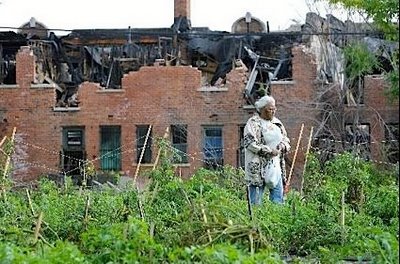
Photographer: Fabrizio Costantini/Bloomberg News. Hazel Williams picks green tomatoes at an Urban Farm off Linwood Avenue in Detroit, on Sept. 22, 2008. Photo by Fabrizio Costantini / Bloomberg.
Detroit is a city of Hope rather than a city of Despair. The thousands of vacant lots and abandoned houses not only provide the space to begin anew but also the incentive to create innovative ways of making our living—ways that nurture our productive, cooperative and caring selves.
The media and pundits keep repeating that today’s economic meltdown is the worst financial crisis since the Great Depression. But in the ’30s, the United States was an overproducing industrial giant, not today’s casino economy.
In the last few decades, once-productive Americans have been transformed into consumers, using more and more of the resources of the earth to foster ways of living that are unsustainable and unsatisfying. This way of life has created suburbs that destroy farmland, wetlands and the natural world, as well as pollute the environment.
The new economy also requires a huge military apparatus to secure global resources and to consume materials for itself, at the same time providing enormous riches for arms merchants and for our otherwise failing auto, air and ship-building sectors.
Instead of trying to resurrect or reform a system whose endless pursuit of economic growth has created a nation of material abundance and spiritual poverty—and instead of hoping for a new FDR to save capitalism with New Deal-like programs—we need to build a new kind of economy from the ground up.
That is what I have learned from 55 years of living and struggling in Detroit, the city that was once the national and international symbol of the miracle of industrialization and is now the national and international symbol of the devastation of deindustrialization.
When I arrived in Detroit in 1953, the population was 2 million, the majority white. Today, it is less than 900,000, majority black. Back then, racism was blatant and overt. Many bars, restaurants and hotels refused service to blacks. Blacks could buy homes in inner city neighborhoods but could not rent apartments in buildings right next door to these homes.
Meanwhile, freeways were enabling white flight to the suburbs, and technology was replacing human beings with robots.
In 1973, we elected our first black mayor, Coleman Young. Young was a gifted politician who was able to eliminate the most egregious examples of racism, especially in the police and fire departments and City Hall. But he was unable to imagine a post-industrial society. So, for 14 years, he tried in vain to woo industrial jobs back to Detroit.
In 1988, toward the end of his fourth term, Young decided that the factories weren’t coming back and that Detroit’s salvation depended on casino gambling, which he said would create 50,000 jobs.
To defeat his proposal, we organized Detroiters Uniting, a coalition of community groups, blue-collar, white-collar and cultural workers, clergy, political leaders and professionals.
Our concern was with how our city had been disintegrating socially, economically, politically, morally and ethically. We were convinced that we could not depend upon one industry or one large corporation to provide us with jobs. It was now up to us—the citizens of Detroit—to create meaningful jobs and income for all citizens.
We needed a new kind of city where citizens take responsibility for their decisions instead of leaving them to politicians or the marketplace.
Greening the Motor City
Read the rest of this entry »
This is a wonderful essay looking at how a Sustainable Economy must be structured democratically and decentralized to the local level. The only thing I would add is that we need a realistic plan of action to get us from the capitalist hellhole we currently inhabit to this accurate vision of a future sustainable society, and we can’t be afraid to confront powerful forces which want to stop us.
For me as a young person in the United States, the heart of the Empire, I see my current role as organizing youth and students in resistance to the forces of domination (war, debt, oppression). Others may be better positioned to organize their workplace or their communities, or to start urban gardens, or other projects. We each have a role to play, and we need to discover it ourselves. [alex]
Building a Sustainable Economy
by Marcin Gerwin
Democracy first
In 1994 the government of Haiti lifted tariffs and allowed imports of cheap, subsidized rice and other crops from abroad. This policy was recommended by the International Monetary Fund and urged by the U.S. government (1). Over the years this tiny change in policy led to an estimated 830,000 job losses, it damaged food security and rural livelihoods, and eventually led to food riots and hunger in 2008 (2). If people in Haiti were to decide by themselves on their country policy, would they choose the recommendations of the IMF that brought them into starvation? Would people of Ecuador allow toxic pollution in the Amazon for the sake of Chevron Texaco profits? Would people in India accept genetically modified seeds of cotton that caused crop failures, spiral of debt and hundreds of farmer suicides? And would people in the USA support bailing out banks with their own money in a way that is not transparent and does not lead to the recovery of the financial system? They wouldn’t. These things happen around the world because we still don’t have true democracy, where people set the rules for themselves.
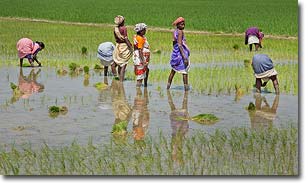 Women sowing rice in India Women sowing rice in IndiaPhoto: Michael Foley |
In 2001 twenty subsistence farmers, small traders, small food processors, and consumers, mostly women, and some of them illiterate, met in Indian village to decide on the future of agriculture in the state of Andhra Pradesh. They were chosen to represent the rural diversity of their state. They presented three different models of development. The official plan, put forward by Chief Minister of the state, was backed by grants and loans from the World Bank and the UK government. The plan was to mechanize, consolidate and genetically engineer agriculture of the state to produce cash crops for export, and to reduce the farming population from 70% to 40%, to have more workers for industry. The second vision involved developing environmentally friendly agriculture to produce cheap organic products for domestic and Northern supermarkets and it was supported by the International Federation of Organic Agriculture Movements and the International Trade Center. The third vision was influenced by Gandhian and indigenous ideas, and involved increasing local self-reliance and sustainability in both agriculture and economics.
Each model was illustrated by videos, farmers and traders could hear the summary of the policies, ask questions, consult with government officials, scientists, corporate and NGO representatives from the state, national and international level. They also considered advantages and disadvantages of each vision, based also upon their own knowledge, priorities and aspirations. After one week they made a decision.
Tom Atlee writes:
In their recommendations (…) they said they wanted self-reliant food and farming, and community control over resources. They wanted to maintain healthy soils, diverse crops, trees and livestock, and to build on their indigenous knowledge, practical skills and local institutions. They wanted to maintain the high percentage of people making their livelihood from the land, and did not want their farms consolidated or mechanized in ways that would displace rural people. Most of them could feed their families through their own sustenance farming. They did not want to end up laboring in dangerous brick kilns outside of Hyderabad, like so many who had left their farms. They also rejected genetically modified crops and the export of their local medicinal plants. (3)
If we wish to make some meaningful changes in the world, we need appropriate tools for that. A number one tool in the earth repair workshop is community-based democracy. It is a key for unlocking the potential for sustainability.


 The End of Capitalism
Recent Comments