
You are currently browsing the category archive for the ‘Enclosures’ category.
 “The Shock Doctrine: The Rise of Disaster Capitalism”
by Naomi Klein
2007 Metropolitan Books
I feel confident saying that The Shock Doctrine is one of the most important political non-fiction works of the last decade. This should be a high school textbook, or at least required reading in college. Naomi Klein applies her extensive vision and intellect to present us with a way of seeing our world that is extremely relevant and powerful: in the pursuit of enormous profits, those running the global economy intentionally exploit terrible catastrophes, or even create them, to take things for themselves that only shocked and traumatized populations would give up. This ambulance-chasing strategy of those in power is defined as the “shock doctrine,” and “disaster capitalism”, alternatively known as “neoliberalism” is the dominant social paradigm it has created.
Although there are flaws here, which I will mention, this book is both timely and well-written; Klein carries the reader through a story about grandiose topics like neoliberalism, torture, psychology, and international politics that is fundamentally readable.
The most important contribution made by this book in my view is the dismantling of the myth that capitalism’s global dominance is a function of democracy or destiny. This is the notion that with the defeat of the Soviet Union, all alternatives to “the free market” have naturally faded into history, presumably because capitalism is so irresistible. To the contrary, Naomi Klein provides numerous case studies to show us the exact opposite is true – the temporary triumph of global capitalism has been fertilized by the victims of natural disasters, terrorist attacks, wars, campaigns of torture, and economic calamity. In short, alternatives to capitalism have been shocked into submission wherever they’ve appeared.
This is no accident, it is part of a conscious crusade by market fundamentalists, those devoted to the pseudo-religious belief that “the market solves all.” Klein explains that the shock doctrine was developed (at least in part) by the patron saint of neoliberalism, free-market economist Milton Friedman. In his words, “only a crisis – actual or perceived – produces real change. When that crisis occurs, the actions that are taken depend on the ideas that are lying around.” And he intended to provide those ideas. It was Friedman’s opus “Capitalism and Freedom” that proclaimed neoliberalism’s core edicts: deregulation, privatization and cutbacks to social services.
Since the 1970s, these teachings have been vigorously applied across the globe by the “holy trinity” of the International Monetary Fund (IMF), the World Bank, and the World Trade Organization (WTO). Read the rest of this entry »
Fundamentalist Consumerism and an Insane Society
February 2009
By Bruce E. Levine
Originally published by ZMag.
At a giant Ikea store in Saudi Arabia in 2004, three people were killed by a stampede of shoppers fighting for one of a limited number of $150 credit vouchers. Similarly, in November 2008, a worker at a New York Wal-Mart was trampled to death by shoppers intent on buying one of a limited number of 50-inch plasma HDTVs.
Jdiniytai Damour, a temporary maintenance worker was killed on “Black Friday.” In the predawn darkness, approximately 2,000 shoppers waited impatiently outside Wal-Mart, chanting, “Push the doors in.” According to Damour’s fellow worker Jimmy Overby, “He was bum-rushed by 200 people. They took the doors off the hinges. He was trampled and killed in front of me.” Witnesses reported that Damour, 34 years old, gasped for air as shoppers continued to surge over him. When police instructed shoppers to leave the store after Damour’s death, many refused, some yelling, “I’ve been in line since yesterday morning.”
The mainstream press covering Damour’s death focused on the mob of crazed shoppers and, to a lesser extent, irresponsible Wal-Mart executives who failed to provide security. However, absent in the corporate press was anything about a consumer culture and an insane society in which marketers, advertisers, and media promote the worship of cheap stuff.
Along with journalists, my fellow mental health professionals have also covered up societal insanity. An exception is the democratic-socialist psychoanalyst Erich Fromm (1900-1980). Fromm, in The Sane Society (1955), wrote: “Yet many psychiatrists and psychologists refuse to entertain the idea that society as a whole may be lacking in sanity. They hold that the problem of mental health in a society is only that of the number of ‘unadjusted’ individuals, and not of a possible unadjustment of the culture itself.”
While people can resist the cheap-stuff propaganda and not worship at Wal-Mart, Ikea, and other big-box cathedrals—and stay out of the path of a mob of fundamentalist consumers—it is difficult to protect oneself from the slow death caused by consumer culture. Human beings are every day and in numerous ways psychologically, socially, and spiritually assaulted by a culture which:
- creates increasing material expectations
- devalues human connectedness
- socializes people to be self-absorbed
- obliterates self-reliance
- alienates people from normal human emotional reactions
- sells false hope that creates more pain
Whose economy is it really? [alex]
Special report: How our economy is killing the Earth
Originally published by New Scientist, 16 October 2008.

Growth is death
THE graphs climbing across these pages (see graph, right, or explore in more detail) are a stark reminder of the crisis facing our planet. Consumption of resources is rising rapidly, biodiversity is plummeting and just about every measure shows humans affecting Earth on a vast scale. Most of us accept the need for a more sustainable way to live, by reducing carbon emissions, developing renewable technology and increasing energy efficiency.
But are these efforts to save the planet doomed? A growing band of experts are looking at figures like these and arguing that personal carbon virtue and collective environmentalism are futile as long as our economic system is built on the assumption of growth. The science tells us that if we are serious about saving Earth, we must reshape our economy.
This, of course, is economic heresy. Growth to most economists is as essential as the air we breathe: it is, they claim, the only force capable of lifting the poor out of poverty, feeding the world’s growing population, meeting the costs of rising public spending and stimulating technological development – not to mention funding increasingly expensive lifestyles. They see no limits to that growth, ever.
In recent weeks it has become clear just how terrified governments are of anything that threatens growth, as they pour billions of public money into a failing financial system. Amid the confusion, any challenge to the growth dogma needs to be looked at very carefully. This one is built on a long-standing question: how do we square Earth’s finite resources with the fact that as the economy grows, the amount of natural resources needed to sustain that activity must grow too? Read the rest of this entry »

“The Revolution Will Not Be Funded: Beyond the Non-Profit Industrial Complex”
by INCITE! Women of Color Against Violence
2007 South End Press
This is a pretty wonderful collection of essays, put together by INCITE! Women of Color Against Violence, covering the rise of the Non-Profit Industrial Complex and it’s vampiric and co-opting effects on radical movements for social change. Some of the essays are more compelling than others, but I particularly found the historical background of the NPIC undercutting and distorting radical movements of the last 25 years revelatory. Plus the case-studies of groups that went for the 501(c)3 tax status and got the foundation grants, only to have it delegitimize and undermine their organizing, were extremely worth reading. Read the rest of this entry »
Part 1 of 9 – a brilliant and vivid look at Neoliberalism and those who struggle against it on all parts of the globe. bilingual (English/Spanish).
Reposted from Indymedia UK.
by David Graeber
The biggest problem facing direct action movements is that we don’t know how to handle victory.
This might seem an odd thing to say because of a lot of us haven’t been feeling particularly victorious of late. Most anarchists today feel the global justice movement was kind of a blip: inspiring, certainly, while it lasted, but not a movement that succeeded either in putting down lasting organizational roots or transforming the contours of power in the world. The anti-war movement was even more frustrating, since anarchists and anarchist tactics were largely marginalized. The war will end, of course, but that’s just because wars always do. No one is feeling they contributed much to it.
I want to suggest an alternative interpretation. Let me lay out three initial propositions here:
1) Odd though it may seem, the ruling classes live in fear of us. They appear to still be haunted by the possibility that, if average Americans really get wind of what they’re up to, they might all end up hanging from trees. It know it seems implausible but it’s hard to come up with any other explanation for the way they go into panic mode the moment there is any sign of mass mobilization, and especially mass direct action, and usually try to distract attention by starting some kind of war.
2) In a way this panic is justified. Mass direct action—especially when organized on democratic lines—is incredibly effective. Over the last thirty years in America, there have been only two instances of mass action of this sort: the anti-nuclear movement in the late ‘70s, and the so called “anti-globalization” movement from roughly 1999-2001. In each case, the movement’s main political goals were reached far more quickly than almost anyone involved imagined possible.
3) The real problem such movements face is that they always get taken by surprise by the speed of their initial success. We are never prepared for victory. It throws us into confusion. We start fighting each other. The ratcheting of repression and appeals to nationalism that inevitably accompanies some new round of war mobilization then plays into the hands of authoritarians on every side of the political spectrum. As a result, by the time the full impact of our initial victory becomes clear, we’re usually too busy feeling like failures to even notice it. Read the rest of this entry »
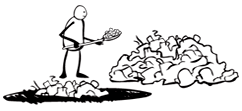
A little 20-min. video that gives a basic lesson in political economy for the average American consumer. Brilliant!
Watch this documentary! It’s only 48 minutes long, a very heartfelt and inspirational documentary of the Zapatista movement of poor indigenous Mexicans against capitalism.



 The End of Capitalism
Recent Comments