
You are currently browsing the category archive for the ‘Empire’ category.
This a review of the newish movie ‘Collapse’, review written by a woman of color named Erinn, which I saw on the Bring the Ruckus website. ‘Collapse’ apparently features Michael Ruppert talking about his apocalyptic visions for the world, filmed from his hideout bunker underground somewhere. Ruppert maintains a horrific blog and used to edit From the Wilderness, a conspiracy-oriented website that intermixes information about peak oil with 9/11 Truth stuff and other scary things.
I was glad to read Erinn’s review, even though I’m not planning to see this film, because it highlights both the racist/classist elements, as well as the lack of grounding in analysis about social change, that continues to hinder the peak oil “movement.”
What Ruppert, and other scaremongers like William Catton of Overshoot and Jay Hanson of dieoff.com have failed to comprehend is that peak oil and other ecological limits do not in themselves guarantee social disaster just because capitalism is collapsing. There are non-capitalist, non-fossil fuel-driven ways of organizing society, some of which would be much better, and some much worse.
Peak oil does present us with a stark dilemma, but like any dilemma we have two paths we can go down – of course there’s the path of continued plunder and violence, militarism and neo-fascism – but there’s also that of freedom, democracy, and sustainability. By hiding this second path from their readers and viewers, Ruppert and other ‘doomers’ inadvertently present compelling arguments for the first.
There’s still plenty of resources to meet everyone’s basic needs of food, shelter, water, etc. But because those in power have control over production, resources are being diverted to socially and ecologically inappropriate ends, like the military, banks, private jets, prisons, tar sands, etc. Never ever forget that there is always a fundamental political choice of how to allocate resources. Until the peak oil ‘movement’ catches on to this reality, it will continue to be dominated by scared, privileged white folks worried about a future catastrophe yet who don’t see the catastrophes that are already affecting most of the peoples of the world.
“We must rapidly begin the shift from a thing-oriented society to a person-oriented society. When machines and computers, profit motives and property rights, are considered more important than people, the giant triplets of racism, extreme materialism, and militarism are incapable of being conquered.” – Dr. Martin Luther King, Jr.
Happy MLK Day!
[alex knight]
by Erinn
So, I went to see a movie called “Collapse.” I read about this movie a little bit before seeing it (full disclosure: I get caught it weird Internet spaces and was reading an article about Mein Kampf. This movie was mentioned in the article for some reason). The premise of the movie is pretty simple: Michael Ruppert believes that he know how and why the US and global economies are currently collapsing (Get it? That’s the movie title…and the country…). The ticket was like $4, which in LA is pretty much like highway robbery.
Originally I went to see this film because it looked interesting and because of the whole $4 thing. About 30 minutes into the movie, I realized that there was a larger discussion to be had here that went beyond reviewing a film. There are aspects of this film that I found interesting and problematic from a practical political perspective, but I think that there is even a more interesting discussion here on the limitations of some supposedly “leftist” and “revolutionary” political ideologies and the complicated nature of the political moment that is in our near future.
So, just to summarize: The film really focuses on Ruppert and the Peak Oil Movement (which to be fair I know little about.) For those of you that are in the same boat as I am, the Peak Oil Movement refers to the idea/scientific principle that there is a limited amount of fossil fuels in the world. Ruppert looks at the fact that Saudi Arabia, which has the largest, recorded landed oil reserves, now drills for oil offshore. As offshore oil drilling is a much more costly endeavor than drilling for oil on land, this could be an indication that the oil in Saudi Arabia, and thus countries with even less oil, is on the global decline as a “dependable” resource. Ruppert identifies the fact that the economic system that the US and the rest of the world operates with requires “infinite resources” while depending on the “finite resource” of oil as the central paradox of our existence today. The movie goes on to note the limitations of other fuel possibilities (with the exception of solar and wind power, Mike identifies other fuel resources as economically and environmentally unfeasible) and declares that “revolution” (which isn’t ever defined in the film) will come from the anger people feel because of the fuel and food shortages that will plague the world in the upcoming decades.
Ruppert constructs a parable to help the audience understand his perspective. He describes the Titanic and himself as a boat-builder on the ship. He’s just been informed that the ship is going to sink and that there are not enough boats on the ship to save everyone on board the ship. (While telling this parable Ruppert seems to be ignoring the racial and gendered histories of this moment…aka white dudes locking poor and “colored” folks in the engine room of the ship.)
Ruppert says that as a boat-builder, he can select from a group of three sets of people to help: Read the rest of this entry »
 http://www.democracynow.org/2009/12/17/bolivian_president_evo_morales_on_climate
AMY GOODMAN: Just before we went to air today, I interviewed Evo Morales, Bolivia’s first indigenous president. He was re-elected in a landslide victory earlier this month. On Wednesday, Evo Morales called on world leaders to hold temperature increases over the next century to just one degree Celsius, the most ambitious proposal so far by any head of state. Morales also called on the United States and other wealthy nations to pay an ecological debt to Bolivia and other developing nations.
AMY GOODMAN: President Morales, welcome to Democracy Now!
PRESIDENT EVO MORALES: [translated] Thank you very much for the invitation.
AMY GOODMAN: You spoke yesterday here at the Bella Center and said we cannot end global warming without ending capitalism. What did you mean?
PRESIDENT EVO MORALES: [translated] Capitalism is the worst enemy of humanity. Capitalism—and I’m speaking about irrational development—policies of unlimited industrialization are what destroys the environment. And that irrational industrialization is capitalism. So as long as we don’t review or revise those policies, it’s impossible to attend to humanity and life.
AMY GOODMAN: How would you do that? How would you end capitalism?
PRESIDENT EVO MORALES: [translated] It’s changing economic policies, ending luxury, consumerism. It’s ending the struggle to—or this searching for living better. Living better is to exploit human beings. It’s plundering natural resources. It’s egoism and individualism. Therefore, in those promises of capitalism, there is no solidarity or complementarity. There’s no reciprocity. So that’s why we’re trying to think about other ways of living lives and living well, not living better. Not living better. Living better is always at someone else’s expense. Living better is at the expense of destroying the environment.
AMY GOODMAN: President Morales, what are you calling here—for here at the UN climate summit?
PRESIDENT EVO MORALES: [translated] Defense of the rights of Mother Earth. Read the rest of this entry »
Guardian / UK Tuesday, December 1, 2009
A Troop Surge Can Only Magnify the Crime Against Afghanistan
If Barack Obama heralds an escalation of the war, he will betray his own message of hope and deepen my people’s pain
by Malalai Joya
After months of waiting, President Obama is about to announce the new US strategy for Afghanistan. His speech may be long awaited, but few are expecting any surprise: it seems clear he will herald a major escalation of the war. In doing so he will be making something worse than a mistake. It is a continuation of a war crime against the suffering people of my country.
I have said before that by installing warlords and drug traffickers in power in Kabul, the US and Nato have pushed us from the frying pan to the fire. Now Obama is pouring fuel on these flames, and this week’s announcement of upwards of 30,000 more troops to Afghanistan will have tragic consequences.
Already this year we have seen the impact of an increase in troops occupying Afghanistan: more violence, and more civilian deaths. My people, the poor of Afghanistan who have known only war and the domination of fundamentalism, are today squashed between two enemies: the US/Nato occupation forces on one hand and warlords and the Taliban on the other.
While we want the withdrawal of one enemy, we don’t believe it is a matter of choosing between two evils. There is an alternative: the democratic-minded parties and intellectuals are our hope for the future of Afghanistan.
It will not be easy, but if we have a little bit of peace we will be better able to fight our own internal enemies – Afghans know what to do with our destiny. We are not a backward people, and we are capable of fighting for democracy, human and women’s rights in Afghanistan. In fact the only way these values will be achieved is if we struggle for them and win them ourselves.
After eight years of war, the situation is as bad as ever for ordinary Afghans, and women in particular. The reality is that only the drug traffickers and warlords have been helped under this corrupt and illegitimate Karzai government. Read the rest of this entry »
Review by Dana Barnett
Originally published by Toward Freedom.
Nov. 25, 2009.
Reviewed: Arm the Spirit: A Woman’s Journey Underground and Back, by Diana Block. Published by AK Press, 2009.
“We had gone underground in the early eighties, not a high-tide period for revolutionary activity in the US. Unlike the people who had formed the Weather Underground Organization in the sixties, we were not swept into clandestinity as a response to the Vietnam War or the militancy of the Black Panthers…As we saw it, armed struggle was still a necessary component of every revolutionary movement, and the movement within the US was no exception.” – Diana Block
How do we decide where to put our political energy? For many of us on the left our politicization began with critiques of the dominant ideology. Our critiques may have been a result of formal education, though for many our critiques were lifeboats we clung to keep from drowning in the chasm between what we were told and what we experienced. Upon confronting contradictions we look for explanations. We attempt to deconstruct the world and then reconstruct it to make sense of it and find our place in it. We make our underlying ideologies conscious. We develop our analysis and principles and then attempt to act in a way that is aligned with their logical conclusions.
As leftist revolutionaries we ask ourselves the same questions at different times in our history. What is to be done? What does revolutionary work look like in our time and what is my role within it?
Diana Block’s memoir, Arm the Spirit: A Woman’s Journey Underground and Back, is an example of a leftist making sense of the world around her, attempting to act with integrity, and searching for political strategy and home. The memoir moves easily back and forth between two aspects of her story. The book begins with Block’s partner, Claude Marks, finding a bug in their car in 1985 after several years of organizing and living clandestinely, and only two months after she gave birth to their first child. This main narrative details her life underground and her re-emergence and re-engagement with organizing from 1995 to the present. It is interspersed with the back story of Block’s experiences, politics, and the context that led to her decision to form a clandestine revolutionary collective to support Third World anti-colonialist armed struggles. Block’s book is her answer to the question of what it means to be a revolutionary in one’s own time. In particular, Block analyzes her role as a white person in the US with feminist, lesbian/queer, anti-imperialist, and anti-racist politics.
I do not feel compelled to use this book, or this review, as a site to evaluate the usefulness of clandestine work, or the question of armed struggle. Read the rest of this entry »
Also published by The Rag Blog and OpEdNews.
 “We stand at a critical moment in Earth’s history, a time when humanity must choose its future. As the world becomes increasingly interdependent and fragile, the future at once holds great peril and great promise. To move forward we must recognize that in the midst of a magnificent diversity of cultures and life forms we are one human family and one Earth community with a common destiny. We must join together to bring forth a sustainable global society founded on respect for nature, universal human rights, economic justice, and a culture of peace. Towards this end, it is imperative that we, the peoples of Earth, declare our responsibility to one another, to the greater community of life, and to future generations. – The Earth Charter” (pg. 1).
David Korten, long-time global justice activist, co-founder of Yes! Magazine, and author of such books as When Corporations Rule the World, lays out the fundamental crossroads facing the world in his 2006 book The Great Turning: From Empire to Earth Community. In response to global climate change, war, oil scarcity, persistent racism and sexism and many other mounting crises, Korten argues we must recognize these as symptoms of a larger system of Empire, so that we might move in a radically different direction of equality, ecological sustainability, and cooperation, which he terms Earth Community. This is a powerful and important book, which excels in overviewing the big picture of threats facing our ecosphere and our communities at the hands of global capitalism1, and translating this into the simplest and most accessible language so we might all do something about it. It’s pretty much anti-capitalism for the masses. And it has the power to inspire many of us to transform our lives and work towards the transformation of society.
Capitalism and Empire
Of course, Korten has made the strategic decision to avoid pointing the finger at “capitalism” as such in order to speak to an American public which largely still confuses the term as equivalent to “freedom” or “democracy.” In fact the “C” word is rarely mentioned in the book, almost never without some sort of modifier as in “corporate capitalism” or “predatory capitalism”, as if those weren’t already features of the system as a whole. Instead, Korten names “Empire” as the culprit responsible for our global economic and ecological predicament, which is defined as a value-system that promotes the views that “Humans are flawed and dangerous”, “Order by dominator hierarchy”, “Compete or die”, “Masculine dominant”, etc. (32).
Korten explains that Empire, “has been a defining feature of the most powerful and influential human societies for some five thousand years, [and] appropriates much of the productive surplus of society to maintain a system of dominator power and elite competition. Racism, sexism, and classism are endemic features” (25). In this way the anarchist concept of the State is repackaged as a transcendent human tendency, which has more to do with conscious decision-making and maturity level than it does with political power. While this compromise does limit the book’s effectiveness in offering solutions later on, it does speak in a language more familiar to the vast non-politicized majority of Americans, and may have the potential to unify a larger movement for change.
Whatever you want to call the system, the danger it presents to the planet is now clear. Korten spells out the grim statistics: “Fossil fuel use is five times what it was [in 1950], and global use of freshwater has tripled… the [Arctic] polar ice cap has thinned by 46 percent over twenty years… [while we’ve seen] a steady increase over the past five decades in severe weather events such as major hurricanes, floods, and droughts. Globally there were only thirteen severe events in the 1950s. By comparison, seventy-two such events occurred during the first nine years of the 1990s” (59-60). If this destruction continues, it’s uncertain if the Earth will survive.
This ecological damage is considered alongside the social damage of billions living without clean water or adequate food, as well as the immense costs of war and genocide. But Korten understands that the danger is relative to where you stand in the social hierarchy – the system creates extreme poverty for many, and an extreme wealth for a few others. He explains how the system is based on a deep inequality that is growing ever worse, “In the 1990s, per capita income fell in fifty-four of the world’s poorest countries… At the other end of the scale, the number of billionaires worldwide swelled from 274 in 1991 to 691 in 2005” (67). The critical point that these few wealthy elites wield excessive power and influence within the system to stop or slow necessary reform could be made more clearly, but at least the book exposes the existence of this upper class, who are usually quite effective at hiding from public scrutiny and outrage over the suffering they are causing.2
Earth Community – Growing a Revolution
Standing at odds with the bastions of Empire is what David Korten calls “Earth Community,” a “higher-order” value-system promoting the views of, “Cooperate and live,” “Love life”, “Defend the rights of all”, “Gender balanced”, etc. (32). Read the rest of this entry »
Not particularly surprising for those who’ve been paying attention to oil reserve estimates, but it’s now official that the International Energy Agency (IEA) has been deliberately distorting their estimates to make it appear that peak oil is much further away than in reality. Also interesting that the US govt has been pressuring the agency to lie about it.
As I state in my Synopsis, peak oil is one of the most important ecological limits, which will prevent global capitalism from continuing to expand – if it hasn’t already. [alex]
Guardian / UK Tuesday, November 10, 2009
Key Oil Figures Were Distorted by US Pressure, Says Whistleblower
Watchdog’s estimates of reserves inflated says top official
by Terry Macalister
The world is much closer to running out of oil than official estimates admit, according to a whistleblower at the International Energy Agency who claims it has been deliberately underplaying a looming shortage for fear of triggering panic buying.
The senior official claims the US has played an influential role in encouraging the watchdog to underplay the rate of decline from existing oil fields while overplaying the chances of finding new reserves.
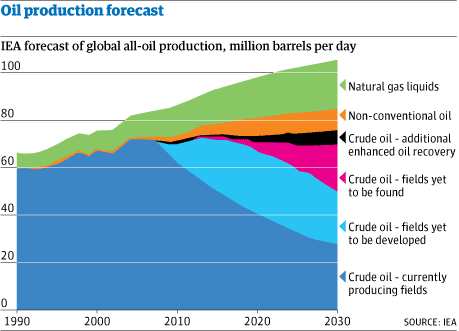
This official oil production estimate is overly-optimistic
The allegations raise serious questions about the accuracy of the organisation’s latest World Energy Outlook on oil demand and supply to be published tomorrow – which is used by the British and many other governments to help guide their wider energy and climate change policies.
In particular they question the prediction in the last World Economic Outlook, believed to be repeated again this year, that oil production can be raised from its current level of 83m barrels a day to 105m barrels. External critics have frequently argued that this cannot be substantiated by firm evidence and say the world has already passed its peak in oil production.
Now the “peak oil” theory is gaining support at the heart of the global energy establishment. “The IEA in 2005 was predicting oil supplies could rise as high as 120m barrels a day by 2030 although it was forced to reduce this gradually to 116m and then 105m last year,” said the IEA source, who was unwilling to be identified for fear of reprisals inside the industry. “The 120m figure always was nonsense but even today’s number is much higher than can be justified and the IEA knows this.
“Many inside the organisation believe that maintaining oil supplies at even 90m to 95m barrels a day would be impossible but there are fears that panic could spread on the financial markets if the figures were brought down further. And the Americans fear the end of oil supremacy because it would threaten their power over access to oil resources,” he added.
A second senior IEA source, who has now left but was also unwilling to give his name, said a key rule at the organisation was that it was “imperative not to anger the Americans” but the fact was that there was not as much oil in the world as had been admitted. “We have [already] entered the ‘peak oil’ zone. I think that the situation is really bad,” he added. Read the rest of this entry »


 The End of Capitalism
Recent Comments