You are currently browsing the category archive for the ‘Economic Crisis’ category.
This essay strikes me as deeply explanatory for the absurd political events that have been taking place in the US in the past year – from trillion-dollar bank bailouts, to the inability to create any meaningful health care reform, to the absolute mocking of the world’s attempts to deal with the catastrophe of climate change – the US government seems to have completely given up on pretending to represent the American public and aligned itself with huge financial and corporate interests, right out in the open.
Those of us with a radical understanding of power know this government has always served the interests of the powerful as its primary mission. But in the past, the politicians at least paid lip service to the public interest in order to save face. This was the era of “hegemony”, roughly meaning the consent of the ruled to their domination.
The public was being screwed, but somehow it was ideologically prepared to believe that “we, the people” had the ultimate say. This was supposed to be a democracy, after all. Sure, the police, prison system, military, and federal enforcement agencies would step in if things got out of hand, but much more effective at keeping the system intact was the “cop in our heads”. As long as we truly believed that it was all for our own good, the corporations just rolled right along, plundering the planet and destroying our communities. And the media made sure we believed it. That’s hegemony.
The reign of George W. Bush really started the break from this paradigm, as we saw for example the outright defiance of the US Constitution and US law when it came to imprisonment of political enemies, justifying torture, spying on millions of American citizens’ phone calls, excessive lying in order to invade and occupy strategic countries, etc etc. At first the public somewhat accepted these moves as “necessary” in the face of terrorism, but Bush’s popularity waned terribly in his second term as people became more informed of what was really happening. In this light Obama’s rhetoric about “change” seems to have initially served to reinvigorate the system with a revived hegemony – to give the US a new image, one of tolerance, diplomacy, and the rule of law.
But the first year of Obama has already shattered these illusions. Obama and his Democrats now appear totally befuddled, their strategy (of putting a smiling face and a few meaningless reforms on a fundamentally broken system) lies in rubble. And a resurgent, perhaps racist, Right appears ready to sweep back into control by playing with the public’s justified resentment and frustration of a continually deteriorating situation.
In this context Jeff Strabone asks us if hegemony is becoming a thing of the past: “Will the state shamelessly turn itself completely over to serving the interests of a powerful few without bothering to pretend that it’s not?”
 I’ve written in my synopsis about the end of capitalism and the possible emergence of neo-fascism, a militarization of society in order to preserve the interests of the powerful, regardless of the environmental and social costs. It seems to me that one indicator of this possible paradigm shift is the increasing shamelessness of the elites. In market-driven capitalism, image is crucial. If a corporation gets bad publicity, they stand to lose money in the stock market. This is one of the few areas of capitalism that is open to democratic intervention. Another area where the public can occasionally intervene is through electing progressive representatives into office.
But it’s these avenues that appear to be closing to us now. Goldman Sachs, Exxon-Mobil, and Blackwater have all gotten terrible publicity in the past few years for their theivery, pollution and murder; but their stocks have never soared higher. Then the public gave Obama and the Democrats an enormous mandate to “change” the country, only to see them cave immediately on almost every campaign promise. The bank bailouts, torturing, and bombing of civilians have, if anything, increased in Obama’s tenure thus far. Perhaps the final insult was the Supreme Court’s decision last week that corporations are “people” with a First Amendment “right to speak” by directly buying politicians. Have they no shame? Apparently not.
So if the consent of the governed is no longer sought, and we’re truly moving into a post-hegemonic era, what can we do to make sure that the breakdown of the capitalist system leads to something better, and not far worse? As Mr. Strabone proclaims, it’s time for civil disobedience. The system has failed us, we must cut off our allegiance from it, confront the powers that be, and start envisioning and constructing the world we want to see replace capitalism. I, for one, wish to see that world based on shared values of democracy, justice, sustainability, freedom and love, and I urge all of you to consider the alternative. [alex]
Post-Shame: Time for Civil Disobedience
by Jeff Strabone
Originally published by Daily Kos.
Tue Jan 26, 2010
One of the duties of the modern nation-state is persuasion. Each state aims to keep its citizens convinced of the legitimacy of its rule. The state may be run chiefly for the enrichment of a few at the cost of the many, but the endurance of the state is widely thought to depend on its ability to sell its rule to the many as a common-sense truism. Or at least that was how it used to work. We may be entering a new era in the evolution of the state, one where the state approaches a state of utter shamelessness.
Antonio Gramsci, in his prison notebooks, called this persuasive activity ‘hegemony’. According to Gramsci, hegemony occludes the domination of the state and the classes whose interests it serves. One does not have to be an Italian communist of the 1920s to see the usefulness of Gramsci’s groundbreaking insight. Broadly speaking, all political actors pursue their agendas by trying to narrow other people’s imaginations in order to make desired outcomes seem common-sensical and undesired outcomes outside the ambit of reasonable thought.
It seems to me that over the past decade, in the United States, the state and a narrow circle of powerful interests—banks, energy companies, and private health insurers in particular—have simply given up trying to persuade the rest of us that their interests were our interests. Could we be moving in the twenty-first century to a state that practices domination without hegemony? Or, to put it in plain English, will the state shamelessly turn itself completely over to serving the interests of a powerful few without bothering to pretend that it’s not? And if it does, how should we respond?
I am not the only one asking these questions. Read the rest of this entry »
This is one of the most timely and insightful articles I’ve read in a long time – the editorial from the new issue of Turbulence magazine. They discuss the economic crisis within the frame of the collapse of the neoliberal order that has been the standard-bearer of global capitalism for the last 30-35 years, resulting in a state of “limbo” where no “deal” exists tying the system together. Nevertheless, the system persists like a zombie, dead and discredited but carried forward by sheer momentum and the fact that nothing else has shown itself capable of replacing it. Our job then, is to hold up an alternative way of life (a new “common ground”) that values communities and the planet above narrow profit, and that job becomes easier by studying analysis like this. Thanks, Turbulence! [alex]
Life in Limbo?
By Turbulence
We are trapped in a state of limbo, neither one thing nor the other. For more than two years, the world has been wracked by a series of interrelated crises, and they show no sign of being resolved anytime soon. The unshakable certainties of neoliberalism, which held us fast for so long, have collapsed. Yet we seem unable to move on. Anger and protest have erupted around different aspects of the crises, but no common or consistent reaction has seemed able to cohere. A general sense of frustration marks the attempts to break free from the morass of a failing world.
There is a crisis of belief in the future, leaving us with the prospect of an endless, deteriorating present that hangs around by sheer inertia. In spite of all this turmoil – this time of ‘crisis’ when it seems like everything could, and should, have changed – it paradoxically feels as though history has stopped. There is an unwillingness, or inability, to face up to the scale of the crisis. Individuals, companies and governments have hunkered down, hoping to ride out the storm until the old world re-emerges in a couple of years. Attempts to wish the ‘green shoots’ of recovery into existence mistake an epochal crisis for a cyclical one; they are little more than wide-eyed boosterism. Yes, astronomical sums of money have prevented the complete collapse of the financial system, but the bailouts have been used to prevent change, not initiate it. We are trapped in a state of limbo.
Crisis in the middle
And yet, something did happen. Recall those frightening yet heady days that began in late 2008, when everything happened so quickly, when the old dogmas fell like autumn leaves? They were real. Something happened there: the tried and tested ways of doings things, well-rehearsed after nearly 30 years of global neoliberalism, started to come unstuck. What had been taken as read no longer made sense. There was a shift in what we call the middle ground: the discourses and practices that define the centre of the political field.
To be sure, the middle ground is not all that there is, but it is what assigns the things in the world around it a greater or lesser degree of relevance, validity or marginality. It constitutes a relatively stable centre against which all else is measured. The farther from the centre an idea, project or practice is, the more likely it is to be ignored, publicly dismissed or disqualified, or in some way suppressed. The closer to it, the more it stands a chance of being incorporated – which in turn will shift the middle more or less. Neither are middle grounds defined ‘from above’, as in some conspiratorial nightmare. They emerge out of different ways of doing and being, thinking and speaking, becoming intertwined in such a way as to reinforce each other individually and as a whole. The more they have become unified ‘from below’ as a middle ground, the more this middle ground acquires the power of unifying ‘from above’. In this sense, the grounds of something like ‘neoliberalism’ were set before something was named as such; but the moment when it was named is a qualitative leap: the point at which relatively disconnected policies, theories and practices became identifiable as forming a whole.
The naming of things like Thatcherism in the UK, or Reaganism in the US, marked such a moment for something that had been constituting itself for some time before, and which has for the past three decades dominated the middle ground: neoliberalism, itself a response to the crisis of the previous middle, Fordism/Keynesianism. The era of the New Deal and its various international equivalents had seen the rise of a powerful working class that had grown used to the idea that its basic needs should be met by the welfare state, that real wages would rise, and that it was always entitled to more. Initially, the centrepiece of the neoliberal project was an attack on this ‘demanding’ working class and the state institutions wherein the old class compromise had been enshrined. Welfare provisions were rolled back, wages held steady or forced downwards, and precariousness increasingly became the general condition of work.
But this attack came at a price. The New Deal had integrated powerful workers’ movements – mass-based trade unions – into the middle ground, helping to stabilise a long period of capitalist growth. And it provided sufficiently high wages to ensure that all the stuff generated by a suddenly vastly more productive industrial system – based on Henry Ford’s assembly line and Frederick Taylor’s ‘scientific management’ – could be bought. Bit by bit, the ferocious attack on the working classes of the global North was offset by low interest rates (i.e. cheap credit) and access to cheap commodities, mass-produced in areas where wages were at their lowest (like China). In the global South, the prospect of one day attaining similar living conditions was promised as a possibility. In this sense, neoliberal globalisation was the globalisation of the American dream: get rich or die trying. Read the rest of this entry »
This is a great, short video that shows why “Cap and Trade” schemes to reduce carbon emissions, like what world leaders are discussing at the Copenhagen Summit, are fundamentally flawed. Turns out that selling our atmosphere to corporations might actually be a bad way to stop climate change. It’s just another attempt to bail out capitalism, this time by making a commodity out of our hopes for a sustainable future.
Annie Leonard, creator of the original “Story of Stuff,” has hit another one out of the park by breaking down complex political issues into simple, accessible and visually appealing viral videos. Check it out (And share with family and friends)! [alex]
And here is the original, highly-acclaimed “Story of Stuff”
see more at storyofstuff.com
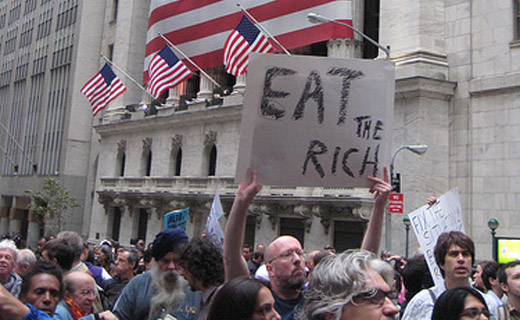 Today, Democracy Now! reported that two major records have been broken in 2009 – Wall St. profits ($35.7 billion in the first half of the year), and the number of Americans going hungry (50 million). These two seemingly unrelated tragedies immediately suggest a common solution – carve up the bloated hulks of Wall St. swine and serve them up to the American people!
On Tuesday, the NY Comptroller’s Office released a report showing that “broker-dealer operations of New York Stock Exchange member firms earned a record $35.7 billion in the first half of 2009.” Through September, $22.5 billion in profits were reported from the four largest firms alone —Goldman Sachs, Merrill Lynch, Morgan Stanley, JPMorgan Chase. These are the same banks who got bailed out by the Federal Government last year – which means that taxpayers like you and I paid for these creeps’ bonuses.
Not coincidentally, these obscene profits were recorded at the same moment that the Department of Agriculture released a report showing that “nearly 50 million people — including almost one child in four — struggled last year to get enough to eat” (as written in the Washington Post on Monday). While the economy has been in the tank and unemployment has surpassed 10% officially, food prices have been skyrocketing, and so millions more Americans are being forced to go without needed nutrition.
Why isn’t it a coincidence? Because the crooks who sent global markets into a freefall last September, causing millions to lose their homes and jobs, have been rewarded for their bad behavior with preferential treatment from Uncle Sam. These Wall St. piggies have been gorging themselves on trillions of U.S. Federally approved dough, while regular folks struggle to pay the rent or put food on the table – without so much as a measly health care reform bill to give hope to their deteriorating condition. Now 1 out of every 4 of our kids are going hungry while the government subsidizes the very stock market slimeballs responsible for creating the trouble to begin with.
“Where’s OUR bailout?” struggling folks are wondering, as they see food prices climb and jobs shipped overseas by the day. 50 million folks are wondering where their next meal is gonna come from… and it’s time to entertain innovative, cost-effective proposals, even if they may seem exotic.
Well it turns out there’s one way to solve this problem without tapping the Treasury for so much as a penny!
It would bring down the cost of high-protein, high-quality food, providing much-needed nutrition to the hungry.
It could create high-paid and unionized manufacturing jobs, right here in the U.S. of A!
It would be environmentally friendly, dolphin-safe, and carbon-neutral (although there may be some associated methane emissions after the plan is implemented).
Best of all, this solution would remove the parasitic, bonus-hungry, pyramid-scheming, derivative-trading, regulation-gutting, President-advising, economy-wrecking, bailout mongers from the picture, allowing the American people to determine our economic future democratically!
And it’s so straightforward even Timothy Geithner could understand it:
Eat the Rich!
[alex, Nov. 19]
below is the transcript from Democracy Now!’s interview of Robert Scheer on these 2 unprecedented reports and what they mean for the economy: Read the rest of this entry »
Also published by The Rag Blog, OpEdNews, Signs of the Times, Interactivist Info Exchange, and Toward Freedom.
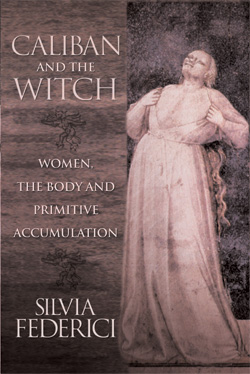 Who Were the Witches? – Patriarchal Terror and the Creation of Capitalism
Alex Knight
November 5, 2009
This Halloween season, there is no book I could recommend more highly than Silvia Federici’s brilliant Caliban and the Witch: Women, the Body, and Primitive Accumulation (Autonomedia 2004), which tells the dark saga of the Witch Hunt that consumed Europe for more than 200 years. In uncovering this forgotten history, Federici exposes the origins of capitalism in the heightened oppression of workers (represented by Shakespeare’s character Caliban), and most strikingly, in the brutal subjugation of women. She also brings to light the enormous and colorful European peasant movements that fought against the injustices of their time, connecting their defeat to the imposition of a new patriarchal order that divided male from female workers. Today, as more and more people question the usefulness of a capitalist system that has thrown the world into crisis, Caliban and the Witch stands out as essential reading for unmasking the shocking violence and inequality that capitalism has relied upon from its very creation.
Who Were the Witches?
Parents putting a pointed hat on their young son or daughter before Trick-or-Treating might never pause to wonder this question, seeing witches as just another cartoonish Halloween icon like Frankenstein’s monster or Dracula. But deep within our ritual lies a hidden history that can tell us important truths about our world, as the legacy of past events continues to affect us 500 years later. In this book, Silvia Federici takes us back in time to show how the mysterious figure of the witch is key to understanding the creation of capitalism, the profit-motivated economic system that now reigns over the entire planet.
During the 15th – 17th centuries the fear of witches was ever-present in Europe and Colonial America, so much so that if a woman was accused of witchcraft she could face the cruellest of torture until confession was given, or even be executed based on suspicion alone. There was often no evidence whatsoever. The author recounts, “for more than two centuries, in several European countries, hundreds of thousands of women were tried, tortured, burned alive or hanged, accused of having sold body and soul to the devil and, by magical means, murdered scores of children, sucked their blood, made potions with their flesh, caused the death of their neighbors, destroyed cattle and crops, raised storms, and performed many other abominations” (169).
In other words, just about anything bad that might or might not have happened was blamed on witches during that time. So where did this tidal wave of hysteria come from that took the lives so many poor women, most of whom had almost certainly never flown on broomsticks or stirred eye-of-newt into large black cauldrons?
Caliban underscores that the persecution of witches was not just some error of ignorant peasants, but in fact the deliberate policy of Church and State, the very ruling class of society. To put this in perspective, today witchcraft would be a far-fetched cause for alarm, but the fear of hidden terrorists who could strike at any moment because they “hate our freedom” is widespread. Not surprising, since politicians and the media have been drilling this frightening message into people’s heads for years, even though terrorism is a much less likely cause of death than, say, lack of health care.1 And just as the panic over terrorism has enabled today’s powers-that-be to attempt to remake the Middle East, this book makes the case that the powers-that-were of Medieval Europe exploited or invented the fear of witches to remake European society towards a social paradigm that met their interests.
Interestingly, a major component of both of these crusades was the use of so-called “shock and awe” tactics to astound the population with “spectacular displays of force,” which helped to soften up resistance to drastic or unpopular reforms.2 In the case of the Witch Hunt, shock therapy was applied through the witch burnings – spectacles of such stupefying violence that they paralyzed whole villages and regions into accepting fundamental restructuring of medieval society.3 Federici describes a typical witch burning as, “an important public event, which all the members of the community had to attend, including the children of the witches, especially their daughters who, in some cases, would be whipped in front of the stake on which they could see their mother burning alive” (186).
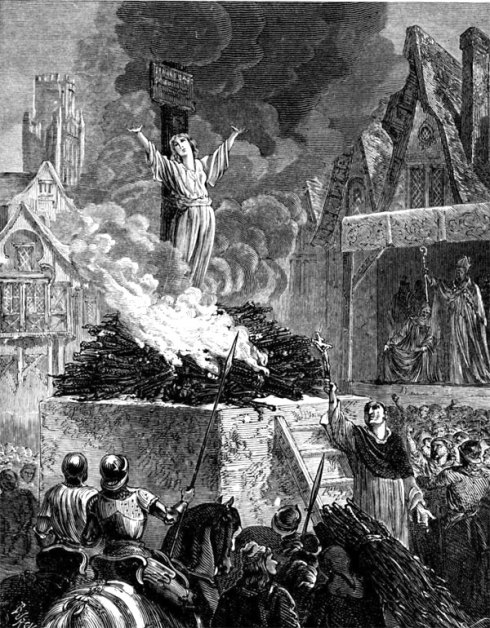
The witch burning was the medieval version of "Shock and Awe"
The book argues that these gruesome executions not only punished “witches” but graphically demonstrated the repercussions for any kind of disobedience to the clergy or nobility. In particular, the witch burnings were meant to terrify women into accepting “a new patriarchal order where women’s bodies, their labor, their sexual and reproductive powers were placed under the control of the state and transformed into economic resources” (170). Read the rest of this entry »


 The End of Capitalism
Recent Comments