
You are currently browsing the category archive for the ‘Climate Crisis’ category.
 Yesterday CNN broke the story that BP is dumping toxic dispersant Corexit 9500 into the Gulf in order to sink the oil under the surface, hiding the true size of the spill and therefore reducing their financial liability. In other words, instead of cleaning up the horrible mess they’ve made, BP has decided to try to hide the disaster as much as possible so they won’t need to pay for it.
Such outrageous corporate irresponsibility perfectly illustrates of how capitalism’s obsession with profits necessarily leads to ecological and social trauma. BP is forced by the stock market to concentrate all their efforts on increasing their bottom line and limiting losses, even if it means driving more oil underwater and away from the cleanup crews.
We need to move to a world where marine life, biodiversity, as well as human health and well-being are valued as more important than a corporation’s profit margin. It fills me with great anger and frustration for every daily tragedy that we have to suffer at the hands of this monstrous system. Even the slightest amount of rationality or simple human empathy would prevent these kinds of machine-brained crimes against the Earth if they were allowed to intervene.
Here’s the transcript, via Crooks and Liars, which also has the video. [alex]
Anderson Cooper talked to Fred McCallister, an investment banker with Allegiance Capital Corporation, who is going to be testifying before the Senate Commerce, Science and Transportation Committee today about something that’s appeared painfully obvious to me for some time now, that BP is using dispersants to hide the size of the oil spill in the hopes if limiting their liability. My only question is why has the government allowed them to do it?
ANDERSON COOPER: Fred McCallister joins us now.
Fred, why do you think that BP would prefer to use dispersants over skimmers?
FRED MCCALLISTER, VICE PRESIDENT, ALLEGIANCE CAPITAL CORPORATION: Anderson, thank you for having me on tonight.
The issue that BP is facing right now is whether to use what’s practices that are normal around the world, which is to try to cause the oil to come to the surface, and then deploy the right amount of equipment and the right type of equipment to gather that oil up and get it out of the Gulf.
Using the dispersants allows the oil to stay under the surface, and this accomplishes several purposes. It allows the — it makes it a lot more difficult to quantify the amount of oil that’s coming out, which has a direct impact on damages and royalties that have to be paid.
It keeps it out of sight and out of mind. And it allows BP to amortize the cost of the cleanup over several years, 10 to 15 years, because some of this oil is going to biodegrade, but a lot of that oil is going to roll up on the beaches for 10 or 15 years.
And if they can amortize that over 10 or 15 years,as opposed to dealing with that over the next 15 months, that’s a much better financial position for BP to be in. Read the rest of this entry »
Also published on The Rag Blog.
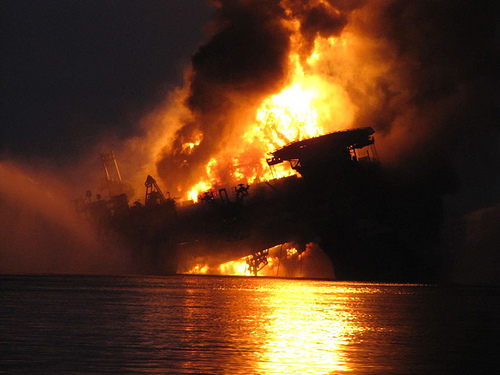
BP Oil Disaster in the Gulf - Energy Department Photo. retrieved from http://www.flickr.com/photos/leonarddoyle/4583740105/in/set-72157624005298860/
Just two weeks after the Massey Energy coal explosion on April 5 that killed 29 miners in West Virginia, the BP oil rig Deepwater Horizon exploded in the Gulf of Mexico, killing 11 more workers. These back-to-back tragedies have brought attention to the fossil fuel industry’s terrible safety record – in both cases there were known safety violations on site, but the government did nothing to prevent disaster from occurring. See the interview below which explains how the federal government approved this BP rig and many more without conducting the environmental review they are legally obligated to.
Unlike the industry executives attempting to shift blame and avoid responsibility, we must look beneath the surface to discover the deeper meaning of these horrible crises.
Is the universe giving us a warning that fossil fuels are going to destroy us? Because if global climate change continues at the rate it has, in the not-too-distant future we will see many thousands, or even millions more deaths as crops dry up, floods destroy coastal wetlands, and diseases migrate to temperate regions. This is no joke. Families and communities are being destroyed so coal and oil corporations can boost their profit margins.
We need to be open to hearing the lessons that are all around us, especially from those who have been silenced and beaten down by capitalism.
Immediately after the Massey explosion and the BP explosion, was Earth Day – April 22. And on this date, indigenous and poor people from around the globe were meeting in Cochabamba, Bolivia for the World People’s Conference on Climate Change, a grassroots response to the corporate fraud that was the Copenhagen Summit. Bolivian President Evo Morales, who was proclaimed “World Hero of Mother Earth” by the United Nations General Assembly in October, hosted the conference, proclaiming “The capitalist system looks to obtain the maximum possible gain, promoting unlimited growth on a finite planet. Capitalism is the source of asymmetries and imbalance in the world.”
30,000 people from 140 countries convened and approved the “Cochabamba Protocol”, which calls for an International Climate Justice tribunal to prosecute climate criminals, and condemns REDDs which put a price on wild forests and encourage development, along with carbon market schemes. The protocal proposes a Universal Declaration of Mother Earth and demands that industrialized polluting nations cut carbon emissions by 50 percent as part of a new, binding climate agreement.
Global momentum is building towards confronting capitalism in terms of the ecological devastation it is causing. Here in the United States, Rising Tide North America is calling for a “Day of Action, Night of Mourning” this Friday, May 14 to call for BP to pay for all cleanup and long-term ecological effects of their spill, for the abolition of offshore oil drilling, and for “a rapid and just transition away from fossil fuels.”
[alex]
Government Exempted BP from Environmental Review
Video/interview published by Democracy Now!
May 7, 2010
JUAN GONZALEZ: Well now to the Gulf of Mexico where the enormous oil slick in the Gulf continues to expand. Interior Secretary Ken Salazar has ordered a 3-week halt to all new offshore drilling permits. Emphasizing that the companies involved had made “major mistakes,” Salazar spoke to reporters Thursday outside BP’s Houston crisis center. He noted that lifting the moratorium on new permits will depend on the outcome of a federal investigation over the Gulf spill and the recommendations to be delivered to President Obama at the end of the month.
- SECRETARY KEN SALAZAR: Minerals Management Service will not be issuing any permits for the construction of new offshore wells. That process will be concluded here on May the 28th. At that point in time, we’ll make decisions about how we plan on moving forward. There is some very major mistakes that were made by companies that were involved. But today is not really the day to deal with those issues. Today and the days ahead really are about trying to get control of the problem.
JUAN GONZALEZ: Secretary Salazar added that the existing offshore oil and natural gas drilling will continue, even as public meetings to discuss new oil drilling off the Virginia coast have been canceled for this month.
AMY GOODMAN: Salazar’s announcement comes on the heel of a Washington Post exposé revealing that the Minerals Management Service had approved BP’s drilling plan in the Gulf of Mexico without any environmental review. The article notes that the agency under Secretary Salazar had quote “categorically excluded” BP’s drilling as well as hundreds of other offshore drilling permits from environmental review. The agency was able to do this using a loophole in the National Environmental Policy Act created for minimally intrusive actions like building outhouses and hiking trails. Well, for more on this story, we’re joined now from Tucson, Arizona by Kieran Suckling, executive director of the Center for Biological Diversity. Welcome to DEMOCRACY NOW!, Kieran. Explain this loophole, how you found it, and what it means for the Gulf.
KIERAN SUCKLING: Well, when a federal government is going to approve a project, it has to go through an environmental review. But for projects that have very, very little impact like building an outhouse or a hiking trail, they can use something called a categorical exclusion and say there’s no impact here at all so we don’t need to spend energy or time doing a review. Well, we looked at the oil drilling permits being issued by the Minerals Management Service in the Gulf, and we were shocked to find out that they were approving hundreds of massive oil drilling permits using this categorical exclusion instead of doing a full environmental impact study. And then, we found out that BP’s drilling permit—the very one that exploded—was done under this loophole and so it was never reviewed by the federal government at all. It was just rubber-stamped. Read the rest of this entry »
This post was sparked after reading Richard Heinberg’s recent article Life After Growth, which is a much more personal introspection of Richard’s story uncovering the realities of peak oil and the limits to growth. I recommend that one, but this earlier essay he wrote on the “End of Growth” I believe may go down in history as required reading.
In it he asks what are the fundamental reasons behind the ongoing economic crisis, arguing persuasively that the role of ecological limits like peak oil cannot be ignored as inhibiting growth both in the long term as well as the short. However, what Richard lacks is an integrated analysis of the social limits to growth, especially the power of social movements all over the globe working against this system of capitalism.
Without a deep appreciation for the rights of poor and exploited people, it is easy to make mistakes, as I believe Richard does in this essay with regards to immigration, for example. Further, without seeing the big picture of people’s resistance to capitalism and yearning for a new, non-growth, sustainable world, it is easy to lose hope. And in these difficult times, hope is our most important natural resource. [alex]
Temporary Recession or the End of Growth?
by Richard Heinberg
August 6, 2009.
.
Everyone agrees: our economy is sick. The inescapable symptoms include declines in consumer spending and consumer confidence, together with a contraction of international trade and available credit. Add a collapse in real estate values and carnage in the automotive and airline industries and the picture looks grim indeed.
But why are both the U.S. economy and the larger global economy ailing? Among the mainstream media, world leaders, and America’s economists-in-chief (Treasury Secretary Geithner and Federal Reserve Chairman Bernanke) there is near-unanimity of opinion: these recent troubles are primarily due to a combination of bad real estate loans and poor regulation of financial derivatives.
This is the Conventional Diagnosis. If it is correct, then the treatment for our economic malady might logically include heavy doses of bailout money for beleaguered financial institutions, mortgage lenders, and car companies; better regulation of derivatives and futures markets; and stimulus programs to jumpstart consumer spending.
But what if this diagnosis is fundamentally flawed? The metaphor needs no belaboring: we all know that tragedy can result from a doctor’s misreading of symptoms, mistaking one disease for another.

Something similar holds for our national and global economic infirmity. If we don’t understand why the world’s industrial and financial metabolism is seizing up, we are unlikely to apply the right medicine and could end up making matters much worse than they would otherwise be.
To be sure: the Conventional Diagnosis is clearly at least partly right. The causal connections between subprime mortgage loans and the crises at Fannie Mae, Freddie Mac, and Lehman Brothers have been thoroughly explored and are well known. Clearly, over the past few years, speculative bubbles in real estate and the financial industry were blown up to colossal dimensions, and their bursting was inevitable. It is hard to disagree with the words of Australian Prime Minister Kevin Rudd, in his July 25 essay in the Sydney Morning Herald: “The roots of the crisis lie in the preceding decade of excess. In it the world enjoyed an extraordinary boom…However, as we later learnt, the global boom was built in large part…on a house of cards. First, in many Western countries the boom was created on a pile of debt held by consumers, corporations and some governments. As the global financier George Soros put it: ‘For 25 years [the West] has been consuming more than we have been producing…living beyond our means.'” (1)
But is this as far as we need look to get to the root of the continuing global economic meltdown?
A case can be made that dire events having to do with real estate, the derivatives markets, and the auto and airline industries were themselves merely symptoms of an even deeper, systemic dysfunction that spells the end of economic growth as we have known it.
In short, I am suggesting an Alternative Diagnosis. This explanation for the economic crisis is not for the faint of heart because, if correct, it implies that the patient is far sicker than even the most pessimistic economists are telling us. But if it is correct, then by ignoring it we risk even greater peril.
Economic Growth, The Financial Crisis, and Peak Oil
For several years, a swelling subculture of commentators (which includes the present author) has been forecasting a financial crash, basing this prognosis on the assessment that global oil production was about to peak. (2) Our reasoning went like this: Read the rest of this entry »

Also published on No Cure for That.
Last week President Obama announced an $8.3 billion loan of taxpayer dollars for the construction of two new nuclear reactors at the Vogtle site in Georgia. He has also proposed tripling the loans for new nuclear reactors to $54 billion in his 2011 budget.
In his announcement he argued, “To meet our growing energy needs and prevent the worst consequences of climate change, we’ll need to increase our supply of nuclear power. It’s that simple.”
Sadly, Mr. Obama is mistaken on all points.
If by “we” the President means to speak on behalf of his Wall St. advisers and the industrial capitalist system he represents, “our” energy needs are not growing. They’re shrinking along with the economy. And while preventing the worst consequences of climate change is necessary, nuclear power is not. It’s not necessary by any stretch of the imagination.
Here are 5 simple reasons why nuclear is not a sustainable solution to the energy woes of the 21st Century:
1. Nuclear is Too Expensive.
In economic hard times such as ours, we need cheap, readily-available sources of energy to create jobs and keep the lights on. Nuclear is the opposite. Nuclear reactors require billions of dollars of government subsidies just to be built, because no private investor wants to throw their money into an expensive and dangerous project that might never produce a return.
To grab those government subsidies, nuclear companies regularly low-ball their price tags, knowing they’ll have to beg for more money later and that the feds will always give in. The recent TIME article “Why Obama’s Nuclear Bet Won’t Pay Off” explains:
If you want to understand why the U.S. hasn’t built a nuclear reactor in three decades, the Vogtle power plant outside Atlanta is an excellent reminder of the insanity of nuclear economics. The plant’s original cost estimate was less than $1 billion for four reactors. Its eventual price tag in 1989 was nearly $9 billion, for only two reactors. But now there’s widespread chatter about a nuclear renaissance, so the Southern Co. is finally trying to build the other two reactors at Vogtle. The estimated cost: $14 billion. And you can be sure that number is way too low, because nuclear cost estimates are always way too low.
Environment America’s report, “Generating Failure: How Building Nuclear Power Plants Would Set America Back in the Race Against Global Warming”, explains nuclear’s faulty economics further:
Market forces have done far more to damage nuclear power than anti-nuclear activists ever did. The dramatic collapse of the nuclear industry in the early 1980s – described by Forbes magazine as the most expensive debacle since the Vietnam War – was caused in large measure by massive cost overruns driven by expensive safety upgrades after the Three Mile Island accident revealed shortcomings in nuclear plant design. These made nuclear power plants far more expensive than they were supposed to be. Some U.S. power companies were driven into bankruptcy and others spent years restoring their balance sheets.
At the end of the day, there are much cheaper and better ways to produce energy. The TIME article points out, “Recent studies have priced new nuclear power at 25 to 30 cents per kilowatt-hour, about four times the cost of producing juice with new wind or coal plants, or 10 times the cost of reducing the need for electricity through investments in efficiency.”
Instead of pouring billions of dollars into something the market wants to keep its distance from, why not spend that money on efficiency improvements or wind and solar, for which there is a growing market and massive public support?
2. Nuclear is Too Inefficient.
A big part of why nuclear is so expensive is that it’s incredibly inefficient as an energy source, requiring a high proportion of energy inputs as compared to what it produces in output. Between the cost of building the plants and equipment (tons of steel, concrete, and intricate machinery), mining the uranium, enriching the uranium, operating under stringent safety regulations, disposing the radioactive waste, and eventually decommissioning the plants, there is a tremendous about of energy and money poured in to nuclear reactors, making the energy they produce proportionaly less impressive than is often touted. Read the rest of this entry »
This essay strikes me as deeply explanatory for the absurd political events that have been taking place in the US in the past year – from trillion-dollar bank bailouts, to the inability to create any meaningful health care reform, to the absolute mocking of the world’s attempts to deal with the catastrophe of climate change – the US government seems to have completely given up on pretending to represent the American public and aligned itself with huge financial and corporate interests, right out in the open.
Those of us with a radical understanding of power know this government has always served the interests of the powerful as its primary mission. But in the past, the politicians at least paid lip service to the public interest in order to save face. This was the era of “hegemony”, roughly meaning the consent of the ruled to their domination.
The public was being screwed, but somehow it was ideologically prepared to believe that “we, the people” had the ultimate say. This was supposed to be a democracy, after all. Sure, the police, prison system, military, and federal enforcement agencies would step in if things got out of hand, but much more effective at keeping the system intact was the “cop in our heads”. As long as we truly believed that it was all for our own good, the corporations just rolled right along, plundering the planet and destroying our communities. And the media made sure we believed it. That’s hegemony.
The reign of George W. Bush really started the break from this paradigm, as we saw for example the outright defiance of the US Constitution and US law when it came to imprisonment of political enemies, justifying torture, spying on millions of American citizens’ phone calls, excessive lying in order to invade and occupy strategic countries, etc etc. At first the public somewhat accepted these moves as “necessary” in the face of terrorism, but Bush’s popularity waned terribly in his second term as people became more informed of what was really happening. In this light Obama’s rhetoric about “change” seems to have initially served to reinvigorate the system with a revived hegemony – to give the US a new image, one of tolerance, diplomacy, and the rule of law.
But the first year of Obama has already shattered these illusions. Obama and his Democrats now appear totally befuddled, their strategy (of putting a smiling face and a few meaningless reforms on a fundamentally broken system) lies in rubble. And a resurgent, perhaps racist, Right appears ready to sweep back into control by playing with the public’s justified resentment and frustration of a continually deteriorating situation.
In this context Jeff Strabone asks us if hegemony is becoming a thing of the past: “Will the state shamelessly turn itself completely over to serving the interests of a powerful few without bothering to pretend that it’s not?”
 I’ve written in my synopsis about the end of capitalism and the possible emergence of neo-fascism, a militarization of society in order to preserve the interests of the powerful, regardless of the environmental and social costs. It seems to me that one indicator of this possible paradigm shift is the increasing shamelessness of the elites. In market-driven capitalism, image is crucial. If a corporation gets bad publicity, they stand to lose money in the stock market. This is one of the few areas of capitalism that is open to democratic intervention. Another area where the public can occasionally intervene is through electing progressive representatives into office.
But it’s these avenues that appear to be closing to us now. Goldman Sachs, Exxon-Mobil, and Blackwater have all gotten terrible publicity in the past few years for their theivery, pollution and murder; but their stocks have never soared higher. Then the public gave Obama and the Democrats an enormous mandate to “change” the country, only to see them cave immediately on almost every campaign promise. The bank bailouts, torturing, and bombing of civilians have, if anything, increased in Obama’s tenure thus far. Perhaps the final insult was the Supreme Court’s decision last week that corporations are “people” with a First Amendment “right to speak” by directly buying politicians. Have they no shame? Apparently not.
So if the consent of the governed is no longer sought, and we’re truly moving into a post-hegemonic era, what can we do to make sure that the breakdown of the capitalist system leads to something better, and not far worse? As Mr. Strabone proclaims, it’s time for civil disobedience. The system has failed us, we must cut off our allegiance from it, confront the powers that be, and start envisioning and constructing the world we want to see replace capitalism. I, for one, wish to see that world based on shared values of democracy, justice, sustainability, freedom and love, and I urge all of you to consider the alternative. [alex]
Post-Shame: Time for Civil Disobedience
by Jeff Strabone
Originally published by Daily Kos.
Tue Jan 26, 2010
One of the duties of the modern nation-state is persuasion. Each state aims to keep its citizens convinced of the legitimacy of its rule. The state may be run chiefly for the enrichment of a few at the cost of the many, but the endurance of the state is widely thought to depend on its ability to sell its rule to the many as a common-sense truism. Or at least that was how it used to work. We may be entering a new era in the evolution of the state, one where the state approaches a state of utter shamelessness.
Antonio Gramsci, in his prison notebooks, called this persuasive activity ‘hegemony’. According to Gramsci, hegemony occludes the domination of the state and the classes whose interests it serves. One does not have to be an Italian communist of the 1920s to see the usefulness of Gramsci’s groundbreaking insight. Broadly speaking, all political actors pursue their agendas by trying to narrow other people’s imaginations in order to make desired outcomes seem common-sensical and undesired outcomes outside the ambit of reasonable thought.
It seems to me that over the past decade, in the United States, the state and a narrow circle of powerful interests—banks, energy companies, and private health insurers in particular—have simply given up trying to persuade the rest of us that their interests were our interests. Could we be moving in the twenty-first century to a state that practices domination without hegemony? Or, to put it in plain English, will the state shamelessly turn itself completely over to serving the interests of a powerful few without bothering to pretend that it’s not? And if it does, how should we respond?
I am not the only one asking these questions. Read the rest of this entry »
This is one of the most timely and insightful articles I’ve read in a long time – the editorial from the new issue of Turbulence magazine. They discuss the economic crisis within the frame of the collapse of the neoliberal order that has been the standard-bearer of global capitalism for the last 30-35 years, resulting in a state of “limbo” where no “deal” exists tying the system together. Nevertheless, the system persists like a zombie, dead and discredited but carried forward by sheer momentum and the fact that nothing else has shown itself capable of replacing it. Our job then, is to hold up an alternative way of life (a new “common ground”) that values communities and the planet above narrow profit, and that job becomes easier by studying analysis like this. Thanks, Turbulence! [alex]
Life in Limbo?
By Turbulence
We are trapped in a state of limbo, neither one thing nor the other. For more than two years, the world has been wracked by a series of interrelated crises, and they show no sign of being resolved anytime soon. The unshakable certainties of neoliberalism, which held us fast for so long, have collapsed. Yet we seem unable to move on. Anger and protest have erupted around different aspects of the crises, but no common or consistent reaction has seemed able to cohere. A general sense of frustration marks the attempts to break free from the morass of a failing world.
There is a crisis of belief in the future, leaving us with the prospect of an endless, deteriorating present that hangs around by sheer inertia. In spite of all this turmoil – this time of ‘crisis’ when it seems like everything could, and should, have changed – it paradoxically feels as though history has stopped. There is an unwillingness, or inability, to face up to the scale of the crisis. Individuals, companies and governments have hunkered down, hoping to ride out the storm until the old world re-emerges in a couple of years. Attempts to wish the ‘green shoots’ of recovery into existence mistake an epochal crisis for a cyclical one; they are little more than wide-eyed boosterism. Yes, astronomical sums of money have prevented the complete collapse of the financial system, but the bailouts have been used to prevent change, not initiate it. We are trapped in a state of limbo.
Crisis in the middle
And yet, something did happen. Recall those frightening yet heady days that began in late 2008, when everything happened so quickly, when the old dogmas fell like autumn leaves? They were real. Something happened there: the tried and tested ways of doings things, well-rehearsed after nearly 30 years of global neoliberalism, started to come unstuck. What had been taken as read no longer made sense. There was a shift in what we call the middle ground: the discourses and practices that define the centre of the political field.
To be sure, the middle ground is not all that there is, but it is what assigns the things in the world around it a greater or lesser degree of relevance, validity or marginality. It constitutes a relatively stable centre against which all else is measured. The farther from the centre an idea, project or practice is, the more likely it is to be ignored, publicly dismissed or disqualified, or in some way suppressed. The closer to it, the more it stands a chance of being incorporated – which in turn will shift the middle more or less. Neither are middle grounds defined ‘from above’, as in some conspiratorial nightmare. They emerge out of different ways of doing and being, thinking and speaking, becoming intertwined in such a way as to reinforce each other individually and as a whole. The more they have become unified ‘from below’ as a middle ground, the more this middle ground acquires the power of unifying ‘from above’. In this sense, the grounds of something like ‘neoliberalism’ were set before something was named as such; but the moment when it was named is a qualitative leap: the point at which relatively disconnected policies, theories and practices became identifiable as forming a whole.
The naming of things like Thatcherism in the UK, or Reaganism in the US, marked such a moment for something that had been constituting itself for some time before, and which has for the past three decades dominated the middle ground: neoliberalism, itself a response to the crisis of the previous middle, Fordism/Keynesianism. The era of the New Deal and its various international equivalents had seen the rise of a powerful working class that had grown used to the idea that its basic needs should be met by the welfare state, that real wages would rise, and that it was always entitled to more. Initially, the centrepiece of the neoliberal project was an attack on this ‘demanding’ working class and the state institutions wherein the old class compromise had been enshrined. Welfare provisions were rolled back, wages held steady or forced downwards, and precariousness increasingly became the general condition of work.
But this attack came at a price. The New Deal had integrated powerful workers’ movements – mass-based trade unions – into the middle ground, helping to stabilise a long period of capitalist growth. And it provided sufficiently high wages to ensure that all the stuff generated by a suddenly vastly more productive industrial system – based on Henry Ford’s assembly line and Frederick Taylor’s ‘scientific management’ – could be bought. Bit by bit, the ferocious attack on the working classes of the global North was offset by low interest rates (i.e. cheap credit) and access to cheap commodities, mass-produced in areas where wages were at their lowest (like China). In the global South, the prospect of one day attaining similar living conditions was promised as a possibility. In this sense, neoliberal globalisation was the globalisation of the American dream: get rich or die trying. Read the rest of this entry »
 http://www.democracynow.org/2009/12/17/bolivian_president_evo_morales_on_climate
AMY GOODMAN: Just before we went to air today, I interviewed Evo Morales, Bolivia’s first indigenous president. He was re-elected in a landslide victory earlier this month. On Wednesday, Evo Morales called on world leaders to hold temperature increases over the next century to just one degree Celsius, the most ambitious proposal so far by any head of state. Morales also called on the United States and other wealthy nations to pay an ecological debt to Bolivia and other developing nations.
AMY GOODMAN: President Morales, welcome to Democracy Now!
PRESIDENT EVO MORALES: [translated] Thank you very much for the invitation.
AMY GOODMAN: You spoke yesterday here at the Bella Center and said we cannot end global warming without ending capitalism. What did you mean?
PRESIDENT EVO MORALES: [translated] Capitalism is the worst enemy of humanity. Capitalism—and I’m speaking about irrational development—policies of unlimited industrialization are what destroys the environment. And that irrational industrialization is capitalism. So as long as we don’t review or revise those policies, it’s impossible to attend to humanity and life.
AMY GOODMAN: How would you do that? How would you end capitalism?
PRESIDENT EVO MORALES: [translated] It’s changing economic policies, ending luxury, consumerism. It’s ending the struggle to—or this searching for living better. Living better is to exploit human beings. It’s plundering natural resources. It’s egoism and individualism. Therefore, in those promises of capitalism, there is no solidarity or complementarity. There’s no reciprocity. So that’s why we’re trying to think about other ways of living lives and living well, not living better. Not living better. Living better is always at someone else’s expense. Living better is at the expense of destroying the environment.
AMY GOODMAN: President Morales, what are you calling here—for here at the UN climate summit?
PRESIDENT EVO MORALES: [translated] Defense of the rights of Mother Earth. Read the rest of this entry »
This is a great, short video that shows why “Cap and Trade” schemes to reduce carbon emissions, like what world leaders are discussing at the Copenhagen Summit, are fundamentally flawed. Turns out that selling our atmosphere to corporations might actually be a bad way to stop climate change. It’s just another attempt to bail out capitalism, this time by making a commodity out of our hopes for a sustainable future.
Annie Leonard, creator of the original “Story of Stuff,” has hit another one out of the park by breaking down complex political issues into simple, accessible and visually appealing viral videos. Check it out (And share with family and friends)! [alex]
And here is the original, highly-acclaimed “Story of Stuff”
see more at storyofstuff.com


 The End of Capitalism
Recent Comments