
You are currently browsing the category archive for the ‘Class’ category.
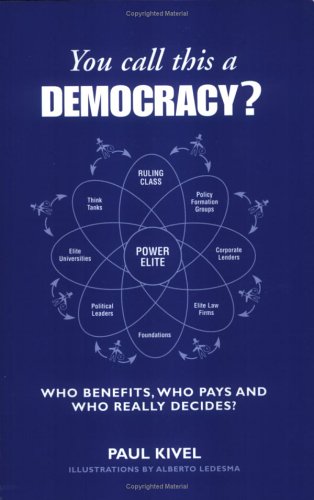
“You Call This a Democracy? Who Benefits, Who Pays, and Who Really Decides?”
by Paul Kivel
2004 Apex Press
Paul Kivel exposes the ruling class of the United States and how it operates in this short, easy-to-read book. With simple concepts and cute illustrations, a nuanced class analysis is presented in a very clear and accessible format.
If the education system was any good at all, “You Call This a Democracy?” would be one of the textbooks used in all high schools. It explains what the ruling class is (those with a family income above $373,000 and net financial wealth of at least $2 million), how it controls the government, media, and economy, and the negative effects we all suffer, such as poverty, wars, disease, pollution, over-working, stress, and meaningless, isolated lives. Kivel particularly does a great job exposing how the ruling class uses racism, sexism, homophobia and other social divisions to keep itself, a relatively small group of basically white Protestant men, in power. Making the connections between systems of oppression is one of the keys to the freedom of everybody, and this book helps move that analysis forward.
There a couple criticisms I could make about the book, first that it doesn’t inspire enough hope or provide much of a systematic solution to the problem that it systematically critiques. And secondly that the book can be cumbersome to read because of a fair amount of repetition coupled with too many general statements about segments of the population. To a certain extent, this was unavoidable in a book of this nature, but I could have used more examples of particular corporations, politicians, and businesspeople and their ilk, even though the examples given in the book are all great.
Definitely check this out if you want to have any idea about the country you’re living in, and how you and your family and everyone you care about are being screwed over by the super-wealthy elite. The path to a democratic future starts when we become informed.
“The war on population always has been, and will continue to be, a war on women’s bodies.”
After reading this article by Betsy Hartmann rebutting recent psuedo-environmental hysteria surrounding overpopulation, I wanted to investigate further how fears of overpopulation facilitate sexist, racist and imperialistic policies by Western countries and NGOs against poor women of color in the Global South.
As Hartmann states with clarity:
“The population controllers have blinders on their eyes when they attribute the cutting down of forests, the polluting of water supplies, and the extinction of species to too many poor people, rather than the unchecked power of large corporations to monopolize resources and ravage the land. Missing from the picture is the question of technological choice: for example, reducing the population of automobiles and investing in public transport worldwide would do much more to curtail climate change than imposing limits on family size.”
This seems to me fundamentally correct. It’s clear that human civilization has overshot the capacity of the Earth to provide for it, that’s not in question. The question is about what forces are responsible for this, and what can we do about it?
For Hartmann and myself, the number of people alive is not nearly as important as the structure of the economic system in which we live. The planet could support 6, or maybe even 9, billion people living a low-impact lifestyle, based on community subsistence and a diet full of fruits and vegetables. But the planet cannot possibly support 6 billion people living like Americans, with their cars, and their computers, and their wars.
As with all things, the debate on “overpopulation” is a political debate, because its a question about who has power and who doesn’t. Placing the blame on poor women is just a way of ignoring the real power-holders: Large multinational corporations and Western capitalist governments.
Below are excerpts from an article that I found helpful in explaining this more clearly. [alex]
10 Reasons to Rethink “Overpopulation”
By the Population and Development Program at Hampshire College
Fears of overpopulation are pervasive in American society. From an early age we are taught that the world is overpopulated and that population pressure is responsible for poverty, hunger, environmental degradation and even political insecurity. If we don’t get population growth under control now, the argument goes, our future is in danger.
Conventional wisdom, however, is not always wise. Placing the blame on population obscures the powerful economic and political forces that threaten the well-being of both people and the planet. It leads to top-down, target-driven population control programs that undermine voluntary family planning and women’s reproductive rights. It reinforces racism, promoting harmful stereotypes of poor people of color. And it prevents the kind of global understanding we need in order to reach across borders to work together for a more just, peaceful and environmentally sustainable world.
Here are ten reasons why we should rethink ‘overpopulation.’
…
2. The focus on population masks the complex causes of poverty and inequality.
A narrow focus on human numbers obscures the way different economic and political systems operate to perpetuate poverty and inequality. It places the blame on the people with the least amount of resources and power rather than on corrupt governments and economic and political elites. It ignores the legacy of colonialism and the continuing unequal relationship between rich and poor countries, including unfavorable terms of trade and the debt burden. It says nothing about the concentration of much wealth in a few hands. In the late 1990s, the 225 people who comprise the ‘ultra-rich’ had a combined wealth of over US $1 trillion, equivalent to the annual income of the poorest 47% of the world’s people.
3. Hunger is not the result of ‘too many mouths’ to feed.
…There is enough food for every man, woman and child to have more than the recommended daily calorie intake. People go hungry because they do not have the land on which to grow food or the money with which to buy it. Read the rest of this entry »

“How the Irish Became White”
by Noel Ignatiev
1995 Routledge
“It is a curious fact,” wrote John Finch, an English Owenite who traveled the United States in 1843, “that the democratic party, and particularly the poorer class of Irish immigrants in America, are greater enemies to the negro population, and greater advocates for the continuance of negro slavery, than any portion of the population in the free States.”
How did the Irish become White? By violently subjugating African Americans, according to this courageous book by Noel Ignatiev.
As a part-Irish American, learning about the injustice that some of my ancestors took part in is deeply troubling, but it’s a history that we need to explore to uncover the true legacy of mass Irish immigration to America, and more fundamentally, the meaning of “Whiteness”.
The Irish in Ireland of the early-19th Century were a revolutionary people: impoverished, agrarian, and determined to break free of the grip of England’s tyranny. But once these same freedom-lovers emigrated to the United States, a peculiar thing happened: they were faced with a society based on racial segregation and industrial capitalism. Moreover, there began a large “Nativist” movement by wealthy Protestant Anglo-Saxons who tried to restrict immigration and subdue Irish/Catholic influence in the New World.
In order to overcome these barriers, the Irish made a strategic choice: escape the bottom-rung of poverty and be accepted into mainstream US society by aggressively aligning themselves with the Democratic Party and doing everything they could to keep African Americans in slavery or otherwise out of the labor market. Thus they earned the right to be considered “White” and receive the benefits and privileges associated with that social category.
Ignatiev makes a compelling case that “When Irish workers encountered Afro-Americans, they fought with them, it is true, but they also fought with immigrants of other nationalities, with each other, and with whomever else they were thrown up against in the marketplace.” In other words, it wasn’t that the Irish were inherently more racist than any other group. Instead, the race riots when rowdy Irish attacked African Americans were largely in response to an economic condition arising in early US capitalism: Northern industrial labor markets were saturated by waves of immigrants and freed slaves competing over lower and lower wages. To secure jobs for themselves, the Irish became the hammer that pounded away at racial segregation to force African Americans out of the factories and into poverty and the ghetto.
By doing so, they also solidified the major distinction between relatively privileged sectors of the US working class and those on the bottom – “Whiteness”. Ignatiev explains: “Since ‘white’ was not a physical description but one term of a social relation which could not exist without its opposite, ‘white man’s work’ was simply, work from which Afro-Americans were excluded.” Read the rest of this entry »
Second in the holiday movie series, The Take journals the Argentinian workers who seized their factories after the economy collapsed in 2001, and the corporations fled the scene. The parallels between Argentina 2001 and the United States 2008 are incredible, first the financial system collapsed, and now in Chicago we see the workers occupying a factory their bosses tried to illegally close. Hopefully next we’ll see the delegitimization of the government and mass popular uprisings against capitalism.
(This is just the first segment of the movie, make sure to click the Up-Arrow button to watch the rest! And you might need to do some Spanish-to-English translating!)
Below is an email circulating the SDS listservs that I’m reposting (I’m not the author). Workers, mostly Latin@s, have seized their workplace from management who was trying to take away their jobs and severance pay. Hopefully this is just the beginning of increased militance and organization by the working class as economic conditions in this country deteriorate and the contradictions – of bosses and banks being bailed out while we lose our jobs – become more glaring and visible.
Here is a news article about the takeover. [alex]
Chicago factory occupied
Lee Sustar reports from Chicago on an occupation by workers who want what’s theirs from management and the Bank of America.
December 6, 2008
WORKERS OCCUPYING the Republic Windows & Doors factory slated for closure are vowing to remain in the Chicago plant until they win the $1.5 million in severance and vacation pay owed them by management.
In a tactic rarely used in the U.S. since the labor struggles of the 1930s, the
workers, members of United Electrical, Radio and Machine Workers of America (UE) Local 1110, refused to leave the plant on December 5, its last scheduled day of operation.
“We decided to do it because this is money that belongs to us,” said Maria
Roman, who’s worked at the plant for eight years. “These are our rights.”
Word of the occupation spread quickly both among labor and immigrant rights activists–the overwhelming majority of the workers are Latinos. Seven local TV news stations showed up to do interviews and live reports, and a steady stream of activists arrived to bring donations of food and money and to plan solidarity actions.
Management claims that it can’t continue operations because its main creditor, Bank of America (BoA), refuses to make any more loans to the company. After workers picketed BoA headquarters December 3, bank officials agreed to sit down with Republic management and UE to discuss the matter at a December 5 meeting arranged by U.S. Rep. Luis Gutierrez (D-Ill), said UE organizer Leah Fried.
BoA had said that it couldn’t discuss the matter with the union directly without written approval from Republic’s management. But Republic representatives failed to show up at the meeting, and plant managers prepared to close the doors for good–violating the federal WARN Act that requires 60 days notice of a plant closure.
The workers decided this couldn’t go unchallenged. “The company and Bank of America are throwing the ball to one another, and we’re in the middle,” said Vicente Rangel, a shop steward and former vice president of Local 1110.
Many workers had suspected the company was planning to go out of business–and perhaps restart operations elsewhere. Several said managers had removed both production and office equipment in recent days.
Furthermore, while inventory records indicated there were plenty of parts in the plant, workers on the production line found shortages. And the order books, while certainly down from the peak years of the housing boom, didn’t square with management’s claims of a total collapse. “Where did all those windows go?” one worker asked.
Workers were especially outraged that Bank of America, which recently received a bailout in taxpayer money, won’t provide credit to Republic. “They get $25 billion from the government, and won’t loan a few million to this company so workers can keep their jobs?” said Ricardo Caceres, who has worked at the plant for six years. Read the rest of this entry »
I recently posted Dmitry Orlov’s great essay ‘Closing the Collapse Gap‘, and here is his latest piece, which he delivered to the 5th Conference on Peak Oil and Community Solutions. I am only reposting excerpts, because the original is very long and somewhat repetitive. I also must warn that although I find Orlov’s insight useful, I have a much more positive view of the collapse of US Imperialism, mainly because I think he is overlooking the benefits of this process for the planet’s ecosystem as well as the possibility of freedom for the majority of the world’s people who are currently suffering under US dominance. Iraqis certainly will have a different view of the collapse of the US Empire than those in the Pentagon.
How about for Americans? Is the collapse of the US better for people who live here? Orlov’s conclusion actually indicates that it may be, especially in terms of rebuilding the social fabric that has been worn away by individualism and consumerism. But he also overlooks the reality of social oppression in the US. Not everyone lives the same “middle class” lifestyle he seems to be taking for granted. There are already millions of Americans on the brink of poverty, or deep in poverty, who don’t worry about losing their SUVs.
The best outcome is for not just a collapse, but a transformation, so that nobody has to go hungry or work their life away just so that the wealthy can take cruises or visit the spa. The current Bailouts are the most striking example of the government having the exactly opposite priorities. Instead of bailing out homeowners, or the poor who lack access to public transportation, they are dumping money into the hands of the real estate and automaking profiteers! We must continue to oppose this nonsense, from Obama or anyone, and make sure that our money is used for the benefit of the majority, not the wealthy few. In a world of shrinking wealth, there should be no rich, and there doesn’t have to be any poor either. [alex]
The Five Stages of Collapse
by Dmitry Orlov
Originally published by Energy Bulletin, Nov. 11, 2008.

1.
Hello, everyone! […] My specialty is in thinking about and, unfortunately, predicting collapse. My method is based on comparison: I watched the Soviet Union collapse, and, since I am also familiar with the details of the situation in the United States, I can make comparisons between these two failed superpowers.
I was born and grew up in Russia, and I traveled back to Russia repeatedly between the late 80s and mid-90s. This allowed me to gain a solid understanding of the dynamics of the collapse process as it unfolded there. By the mid-90s it was quite clear to me that the US was headed in the same general direction. But I couldn’t yet tell how long the process would take, so I sat back and watched.
I am an engineer, and so I naturally tended to look for physical explanations for this process, as opposed to economic, political, or cultural ones. It turns out that one could come up with a very good explanation for the Soviet collapse by following energy flows. What happened in the late 80s is that Russian oil production hit an all-time peak. This coincided with new oil provinces coming on stream in the West – the North Sea in the UK and Norway, and Prudhoe Bay in Alaska – and this suddenly made oil very cheap on the world markets. Soviet revenues plummeted, but their appetite for imported goods remained unchanged, and so they sank deeper and deeper into debt. What doomed them in the end was not even so much the level of debt, but their inability to take on further debt even faster. Once international lenders balked at making further loans, it was game over.
What is happening to the United States now is broadly similar, with certain polarities reversed. The US is an oil importer, burning up 25% of the world’s production, and importing over two-thirds of that. Back in mid-90s, when I first started trying to guess the timing of the US collapse, the arrival of the global peak in oil production was scheduled for around the turn of the century. It turned out that the estimate was off by almost a decade, but that is actually fairly accurate as far as such big predictions go. So here it is the high price of oil that is putting the brakes on further debt expansion. As higher oil prices trigger a recession, the economy starts shrinking, and a shrinking economy cannot sustain an ever-expanding level of debt. At some point the ability to finance oil imports will be lost, and that will be the tipping point, after which nothing will ever be the same.
This is not to say that I am a believer in some sort of energy determinism. If the US were to cut its energy consumption by an order of magnitude, it would still be consuming a staggeringly huge amount, but an energy crisis would be averted. But then this country, as we are used to thinking of it, would no longer exist. Oil is what powers this economy. In turn, it is this oil-based economy that makes it possible to maintain and expand an extravagant level of debt. So, a drastic cut in oil consumption would cause a financial collapse (as opposed to the other way around). A few more stages of collapse would follow, which we will discuss next.[…]
I don’t mean to imply that every part of the country will suddenly undergo a spontaneous existence failure, reverting to an uninhabited wilderness. I agree with John-Michael Greer that the myth of the Apocalypse is not the least bit helpful in coming to terms with the situation. The Soviet experience is very helpful here, because it shows us not only that life goes on, but exactly how it goes on. But I am quite certain that no amount of cultural transformation will help us save various key aspects of this culture: car society, suburban living, big box stores, corporate-run government, global empire, or runaway finance. Read the rest of this entry »
US Senate — Working for Wall St., not us
Jerry Silberman, Oct. 2, 2008
The Wall St. Rescue bill which gained new life with the Senate rubber stamp yesterday will neither halt the decline of the US economy nor penalize the financial gamblers who have been the most immediate cause of this disaster.
Here are two important historical comparisons —
In the late 70’s and early ’80’s, the offensive by big business against workers took the form of demanding concessions in wages and benefits mostly from industrial unions, claiming that if factories weren’t made more “competitive” through reduction of labor costs, they would go out of business. Of course, no employer guaranteed the future of the plant of the job, we were supposed to trust them. Of course, it was a scam. Plants that took concessions closed. Plants that didn’t closed. The economic transformation was based in much larger issues. In plants that closed after concessions, the bosses simply walked away with more, and the workers were left with less. The money stolen by the bosses as a result of concessions helped fund the elimination of thousands of jobs through automation, as well as the transfer of manufacturing plants out of the country. The labor movement at the time was unprepared to fight back, since it bought into the general principles of the bosses, and is still suffering, despite renewed energy in certain unions.
The several “bail outs” that have happened over the past year are identical to those concessions — big business is threatening us with dire consequences if we don’t protect them, while making no promise that anything will get better if we do. Each bailout is bigger than the last, and more futile — except for the corporate executives who are continuing to stash the cash. Each bailout imposes more costs on us, now and in the future, as positive government programs are sacrificed and more debt is imposed on our tax dollar. Right now about 51 cents of every tax dollar goes to the military. Interest on the national debt, that is tax dollars which go directly to pay the government bond holders is the third largest item in the federal budget, right now one half trillion per year. Since about 140 million people file federal income tax returns annually, this means that on average, about $2000 of your taxes are already going to pay off bondholders on Wall St, in Saudi Arabia, China, and many other countries. This number will jump as a result of this bailout. That’s all money not available for schools, health care, environmental protection, etc.
In the early ’30’s the economy collapsed in what is commonly referred to as the Great Depression. Unlike this collapse that began early in the term of Herbert Hoover. By the time of the next presidential election, millions of Americans were impoverished and beginning to organize to fight back. They were marching in the streets for unemployment insurance, refusing to allow people to be evicted from their homes by blockading homes from the sheriff, WWI vets marched on Washington demanding relief and were fired on by current troops under the command of Gen. MacArthur (later of WWII fame) Radical political movements were growing. The new president recognized that some concessions had to be made to the working class by big business or the US would risk a revolutionary situation. Roosevelt, pressured by those movements of ordinary people who couldn’t take it any more, finally convinced Congress to enact several reforms, including unemployment insurance, Social Security, and tough banking regulations (repealed in the Reagan and Bush administrations) to stabilize the economy.
Although there are many very important differences in the current situation from those historical times, there are some very important common threads, the most important being that collective action by working people to challenge the rich and powerful is the key to any change which can create a more stable, secure and healthy life for us. And our goal must be based on a comprehensive vision of a just society, not just trying to protect a niche for ourselves.
I’ve reposted a nice article which highlights the class dynamics at the heart of the current financial meltdown and potential bailout. It gives a very simple and straightforward summary from a revolutionary point of view, so I’m reposting it.
This is by no means a complete analysis however – for example it overlooks the critical role of oil, which is the lifeblood of the US capitalist economy and motivates many of its military aggression around the world. Specifically, there is a need to understand how the peak in global oil production has affected and continues to undermine the US-led industrial capitalist system, particularly in regards to the bursting of the housing bubble in the first place, along with the rising gas prices, food prices, heating costs, and subsequent inflation of the failing dollar.
Because oil production will never recover to its 2005/6 level, but will continue to decrease more rapidly, there can be no long-term recovery of the global financial markets, and for that reason I disagree with the declaration here that “Capitalism will not collapse…” On the contrary, it WILL collapse, because any system that structurally depends upon constant growth and speculation-upon-that-growth cannot coexist forever on a finite planet where necessary and crucial resources are in permanent and deepening shortage.
The current economic crisis is often compared to other historical crises of capitalism, where after appearing on the verge of death, the system restored itself and came back stronger than ever. Thus we are warned that capitalism is a self-destructive beast, but not a suicidal one. On its face this is solid logic but it overlooks the specific nature of the current crisis and its roots in the global peak oil phenomenon. It is my contention and the purpose of this website to demonstrate that the oil crisis is sucking global industrial capitalism dry like the vampire it is, and that there is no combination of “alternative” energy sources – whether coal, gas, nuclear, ethanol, wind, solar, whatever – that can do for this system what oil does.
Oil is not only the largest energy source, it also provides the material for 99% of pesticides (along with the entire industrial agriculture system), all plastics, almost all pharmaceutical drugs and chemicals, and a massive array of other products and components that keep the industrial economy chugging along. But the real killer is that oil literally fuels almost all transportation of materials and people for this system, including 95% of transportation in the US itself, as well as essentially ALL global air and sea transport. There is simply no way to keep this monster running without more and more petroleum.
Now, just because we’re confident that capitalism won’t recover from the current death-blows doesn’t mean a more vicious and destructive system won’t replace it, which is why this article’s conclusions are relevant and necessary. If we’re headed in the US towards fascism – which is where the rich and their Washington cronies seem to want to take us to protect their wealth and power – the only solution, which will become more and more apparent daily, is to organize a massive resistance here in the US that can stop the vampires and build towards a society based on freedom, justice and democracy.
[alex]
SOME TALKING POINTS ON THE FINANCIAL CRISIS
By Kate Griffiths and Isaac Silver
1. The era of the United States as a “the world’s only superpower” is ending.
The United States economy has not been this bad since the Great Depression. The rulers of the US hoped to retain global power militarily, through the wars in Iraq and Afghanistan, as the country’s raw economic superiority slipped. But these wars cannot be won: opposition among the occupied populations, and growing dissent within the military, prevent any victory on US terms even as the death toll climbs.
2. Beginning during the 1970s, manufacturing stalled, while government and investors focused on the financial sector: banks, real estate, and insurance.
Increasing competition, strong unions, and victories of the Black freedom movement had begun to limit the profits made by US corporations and threaten the power of the ruling class. In response, employers shifted good-paying manufacturing jobs overseas and to nonunionized areas of the USA. As wages stagnated, and workers’ purchasing power declined, workers maintained a precarious hold on our livelihood through working longer hours, sending more household members to work, and buying extensively on credit. The globalization of US capitalism and growth of credit both fueled the financial sector, which provided fluid economic resources that could be quickly moved and re-invested – unlike a physical investment such as a factory or railroad.
3. In 2008, years of government policies favoring the rich provoked instability and sparked collapse of major Wall Street institutions.
As the cost of the basic necessities went up, and wages failed to cover them Read the rest of this entry »


 The End of Capitalism
Recent Comments