You are currently browsing the category archive for the ‘Class’ category.
It’s becoming increasingly clear that we can no longer afford to imprison nearly 2 and a half million Americans, a disproportionate number of them black and Latino. The choice is clear: break the bank to continue to punish people for mostly nonviolent offenses, or figure out a new way to operate “criminal justice” that actually heals people rather than just putting them in cages.
If we continue down a neo-fascist path we will be unable to treat prisoners as human beings, and continue to drive a racial wedge into the heart of the nation. Obama must remember that he is Black and stop these Jim Crow shenanigans. [alex]
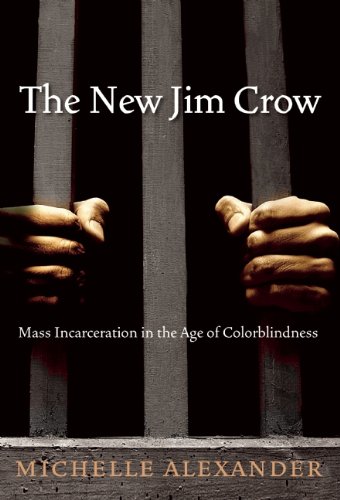
The New Jim Crow
How the War on Drugs Gave Birth to a Permanent American Undercaste
By Michelle Alexander
Originally published by TomDispatch.
Ever since Barack Obama lifted his right hand and took his oath of office, pledging to serve the United States as its 44th president, ordinary people and their leaders around the globe have been celebrating our nation’s “triumph over race.” Obama’s election has been touted as the final nail in the coffin of Jim Crow, the bookend placed on the history of racial caste in America.
Obama’s mere presence in the Oval Office is offered as proof that “the land of the free” has finally made good on its promise of equality. There’s an implicit yet undeniable message embedded in his appearance on the world stage: this is what freedom looks like; this is what democracy can do for you. If you are poor, marginalized, or relegated to an inferior caste, there is hope for you. Trust us. Trust our rules, laws, customs, and wars. You, too, can get to the promised land.
Perhaps greater lies have been told in the past century, but they can be counted on one hand. Racial caste is alive and well in America.
Most people don’t like it when I say this. It makes them angry. In the “era of colorblindness” there’s a nearly fanatical desire to cling to the myth that we as a nation have “moved beyond” race. Here are a few facts that run counter to that triumphant racial narrative:
*There are more African Americans under correctional control today — in prison or jail, on probation or parole — than were enslaved in 1850, a decade before the Civil War began.
*As of 2004, more African American men were disenfranchised (due to felon disenfranchisement laws) than in 1870, the year the Fifteenth Amendment was ratified, prohibiting laws that explicitly deny the right to vote on the basis of race.
* A black child born today is less likely to be raised by both parents than a black child born during slavery. The recent disintegration of the African American family is due in large part to the mass imprisonment of black fathers.
*If you take into account prisoners, a large majority of African American men in some urban areas have been labeled felons for life. (In the Chicago area, the figure is nearly 80%.) These men are part of a growing undercaste — not class, caste — permanently relegated, by law, to a second-class status. They can be denied the right to vote, automatically excluded from juries, and legally discriminated against in employment, housing, access to education, and public benefits, much as their grandparents and great-grandparents were during the Jim Crow era.
Excuses for the Lockdown Read the rest of this entry »
“When you take the time to research and analyze the wealth that has gone to the economic top one percent, you begin to realize just how much we have been robbed.”
Despite the economic crisis, the ultra-rich seem to be making off quite well, even increasing their incomes while the rest of us worry about unemployment, foreclosure, and bankruptcy.
Crooks and Liars recently posted an article, “Richest 400 Americans See Incomes Double, Tax Rates Halved,” which has the latest statistics on income inequality, but to fully understand the widening gap between rich and poor, check out the following essay from David DeGraw.
How long will we permit this to go on? [alex]
The Richest 1% Have Captured America’s Wealth — What’s It Going to Take to Get It Back?
The U.S. already had the highest inequality of wealth in the industrialized world prior to the financial crisis — and it’s gotten even worse.
By David DeGraw / February 19, 2010
Originally published by Alternet. Recovered from The Rag Blog.
“The war against working people should be understood to be a real war… Specifically in the U.S., which happens to have a highly class-conscious business class… And they have long seen themselves as fighting a bitter class war, except they don’t want anybody else to know about it.” — Noam Chomsky
As a record amount of U.S. citizens are struggling to get by, many of the largest corporations are experiencing record-breaking profits, and CEOs are receiving record-breaking bonuses. How could this be happening, how did we get to this point?
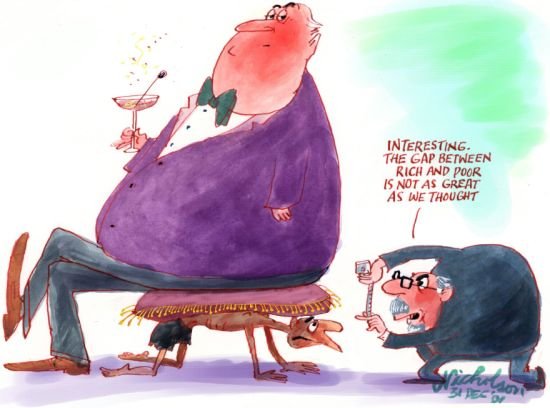 The Economic Elite have escalated their attack on U.S. workers over the past few years; however, this attack began to build intensity in the 1970s. In 1970, CEOs made $25 for every $1 the average worker made. Due to technological advancements, production and profit levels exploded from 1970-2000. With the lion’s share of increased profits going to the CEO’s, this pay ratio dramatically rose to $90 for CEOs to $1 for the average worker.
As ridiculous as that seems, an in-depth study in 2004 on the explosion of CEO pay revealed that, including stock options and other benefits, CEO pay is more accurately $500 to $1.
Paul Buchheit, from DePaul University, revealed, “From 1980 to 2006 the richest 1% of America tripled their after-tax percentage of our nation’s total income, while the bottom 90% have seen their share drop over 20%.” Robert Freeman added, “Between 2002 and 2006, it was even worse: an astounding three-quarters of all the economy’s growth was captured by the top 1%.”
Due to this, the United States already had the highest inequality of wealth in the industrialized world prior to the financial crisis. Since the crisis, which has hit the average worker much harder than CEOs, the gap between the top one percent and the remaining 99% of the U.S. population has grown to a record high. The economic top one percent of the population now owns over 70% of all financial assets, an all time record.
As mentioned before, just look at the first full year of the crisis when workers lost an average of 25 percent off their 401k. During the same time period, the wealth of the 400 richest Americans increased by $30 billion, bringing their total combined wealth to $1.57 trillion, which is more than the combined net worth of 50% of the US population. Just to make this point clear, 400 people have more wealth than 155 million people combined.
Meanwhile, 2009 was a record-breaking year for Wall Street bonuses, as firms issued $150 billion to their executives. 100% of these bonuses are a direct result of our tax dollars, so if we used this money to create jobs, instead of giving them to a handful of top executives, we could have paid an annual salary of $30,000 to 5 million people. Read the rest of this entry »

Review also posted on The Rag Blog.
Review of Men’s Work: How to Stop the Violence That Tears Our Lives Apart
by Paul Kivel
Ballantine Books, 1992
Paul Kivel, cofounder of the Oakland Men’s Project, has given all men (and those concerned about them) a tremendous gift in the form of this inspirational book. This Valentine’s Day, let us accept this gift so that we might heal our relationships to the ones we love and to ourselves.
Men’s Work draws on Kivel’s decades of experience in the movement to end male violence, along with his life experiences as a father, son, partner, and friend, to speak about the trauma and feelings of powerlessness men experience to in our capitalist, patriarchal society. He describes how men reproduce this system by hurting women, trans folks, children, and themselves.
He explains that this is crisis cannot be solved by locking up male offenders, because this will only cause more violence and trauma. Instead, Kivel has devoted his life to helping men understand the roots of their behavior so that they might change, to become more caring and compassionate. One helpful way he approaches these roots is through the “Act Like a Man” box, which shows how patriarchal masculinity limits and hurts men:
men…………………………. men are…
yell at people………………. aggressive
have no emotions………… responsible
get good grades………….. mean
stand up for themselves… bullies
don’t cry……………………. tough
don’t make mistakes…….. angry
know about sex………….. successful
take care of people………. strong
don’t back down…………. in control
push people around…….. active
can take it………………… dominant over women
All men have received this male training, and know that when they step outside these boundaries they will face abuse, scorn, name-calling, accusations of homosexuality or femininity, or violence. The fear of this abuse is ultimately what keeps us inside the Box.
Paul relates, “It is not an irrational fear. This fear in me was built by getting beaten up after school by some older kid in the neighborhood who didn’t like me, by being teased and called names because sometimes I cried after I got beaten up. This fear was built by all the times my dad put me down because I wasn’t good enough in sports., at school, or whatever he decided was the standard that day.” Hearing a man brave enough to tell these kinds of stories was empowering and validated my own experiences.
The book also includes a wealth of activities that the Oakland Men’s Project developed to help men think about violence, masculinity, abuse and privilege, so that they might change their behavior. Read the rest of this entry »
This a review of the newish movie ‘Collapse’, review written by a woman of color named Erinn, which I saw on the Bring the Ruckus website. ‘Collapse’ apparently features Michael Ruppert talking about his apocalyptic visions for the world, filmed from his hideout bunker underground somewhere. Ruppert maintains a horrific blog and used to edit From the Wilderness, a conspiracy-oriented website that intermixes information about peak oil with 9/11 Truth stuff and other scary things.
I was glad to read Erinn’s review, even though I’m not planning to see this film, because it highlights both the racist/classist elements, as well as the lack of grounding in analysis about social change, that continues to hinder the peak oil “movement.”
What Ruppert, and other scaremongers like William Catton of Overshoot and Jay Hanson of dieoff.com have failed to comprehend is that peak oil and other ecological limits do not in themselves guarantee social disaster just because capitalism is collapsing. There are non-capitalist, non-fossil fuel-driven ways of organizing society, some of which would be much better, and some much worse.
Peak oil does present us with a stark dilemma, but like any dilemma we have two paths we can go down – of course there’s the path of continued plunder and violence, militarism and neo-fascism – but there’s also that of freedom, democracy, and sustainability. By hiding this second path from their readers and viewers, Ruppert and other ‘doomers’ inadvertently present compelling arguments for the first.
There’s still plenty of resources to meet everyone’s basic needs of food, shelter, water, etc. But because those in power have control over production, resources are being diverted to socially and ecologically inappropriate ends, like the military, banks, private jets, prisons, tar sands, etc. Never ever forget that there is always a fundamental political choice of how to allocate resources. Until the peak oil ‘movement’ catches on to this reality, it will continue to be dominated by scared, privileged white folks worried about a future catastrophe yet who don’t see the catastrophes that are already affecting most of the peoples of the world.
“We must rapidly begin the shift from a thing-oriented society to a person-oriented society. When machines and computers, profit motives and property rights, are considered more important than people, the giant triplets of racism, extreme materialism, and militarism are incapable of being conquered.” – Dr. Martin Luther King, Jr.
Happy MLK Day!
[alex knight]
by Erinn
So, I went to see a movie called “Collapse.” I read about this movie a little bit before seeing it (full disclosure: I get caught it weird Internet spaces and was reading an article about Mein Kampf. This movie was mentioned in the article for some reason). The premise of the movie is pretty simple: Michael Ruppert believes that he know how and why the US and global economies are currently collapsing (Get it? That’s the movie title…and the country…). The ticket was like $4, which in LA is pretty much like highway robbery.
Originally I went to see this film because it looked interesting and because of the whole $4 thing. About 30 minutes into the movie, I realized that there was a larger discussion to be had here that went beyond reviewing a film. There are aspects of this film that I found interesting and problematic from a practical political perspective, but I think that there is even a more interesting discussion here on the limitations of some supposedly “leftist” and “revolutionary” political ideologies and the complicated nature of the political moment that is in our near future.
So, just to summarize: The film really focuses on Ruppert and the Peak Oil Movement (which to be fair I know little about.) For those of you that are in the same boat as I am, the Peak Oil Movement refers to the idea/scientific principle that there is a limited amount of fossil fuels in the world. Ruppert looks at the fact that Saudi Arabia, which has the largest, recorded landed oil reserves, now drills for oil offshore. As offshore oil drilling is a much more costly endeavor than drilling for oil on land, this could be an indication that the oil in Saudi Arabia, and thus countries with even less oil, is on the global decline as a “dependable” resource. Ruppert identifies the fact that the economic system that the US and the rest of the world operates with requires “infinite resources” while depending on the “finite resource” of oil as the central paradox of our existence today. The movie goes on to note the limitations of other fuel possibilities (with the exception of solar and wind power, Mike identifies other fuel resources as economically and environmentally unfeasible) and declares that “revolution” (which isn’t ever defined in the film) will come from the anger people feel because of the fuel and food shortages that will plague the world in the upcoming decades.
Ruppert constructs a parable to help the audience understand his perspective. He describes the Titanic and himself as a boat-builder on the ship. He’s just been informed that the ship is going to sink and that there are not enough boats on the ship to save everyone on board the ship. (While telling this parable Ruppert seems to be ignoring the racial and gendered histories of this moment…aka white dudes locking poor and “colored” folks in the engine room of the ship.)
Ruppert says that as a boat-builder, he can select from a group of three sets of people to help: Read the rest of this entry »
This is one of the most timely and insightful articles I’ve read in a long time – the editorial from the new issue of Turbulence magazine. They discuss the economic crisis within the frame of the collapse of the neoliberal order that has been the standard-bearer of global capitalism for the last 30-35 years, resulting in a state of “limbo” where no “deal” exists tying the system together. Nevertheless, the system persists like a zombie, dead and discredited but carried forward by sheer momentum and the fact that nothing else has shown itself capable of replacing it. Our job then, is to hold up an alternative way of life (a new “common ground”) that values communities and the planet above narrow profit, and that job becomes easier by studying analysis like this. Thanks, Turbulence! [alex]
Life in Limbo?
By Turbulence
We are trapped in a state of limbo, neither one thing nor the other. For more than two years, the world has been wracked by a series of interrelated crises, and they show no sign of being resolved anytime soon. The unshakable certainties of neoliberalism, which held us fast for so long, have collapsed. Yet we seem unable to move on. Anger and protest have erupted around different aspects of the crises, but no common or consistent reaction has seemed able to cohere. A general sense of frustration marks the attempts to break free from the morass of a failing world.
There is a crisis of belief in the future, leaving us with the prospect of an endless, deteriorating present that hangs around by sheer inertia. In spite of all this turmoil – this time of ‘crisis’ when it seems like everything could, and should, have changed – it paradoxically feels as though history has stopped. There is an unwillingness, or inability, to face up to the scale of the crisis. Individuals, companies and governments have hunkered down, hoping to ride out the storm until the old world re-emerges in a couple of years. Attempts to wish the ‘green shoots’ of recovery into existence mistake an epochal crisis for a cyclical one; they are little more than wide-eyed boosterism. Yes, astronomical sums of money have prevented the complete collapse of the financial system, but the bailouts have been used to prevent change, not initiate it. We are trapped in a state of limbo.
Crisis in the middle
And yet, something did happen. Recall those frightening yet heady days that began in late 2008, when everything happened so quickly, when the old dogmas fell like autumn leaves? They were real. Something happened there: the tried and tested ways of doings things, well-rehearsed after nearly 30 years of global neoliberalism, started to come unstuck. What had been taken as read no longer made sense. There was a shift in what we call the middle ground: the discourses and practices that define the centre of the political field.
To be sure, the middle ground is not all that there is, but it is what assigns the things in the world around it a greater or lesser degree of relevance, validity or marginality. It constitutes a relatively stable centre against which all else is measured. The farther from the centre an idea, project or practice is, the more likely it is to be ignored, publicly dismissed or disqualified, or in some way suppressed. The closer to it, the more it stands a chance of being incorporated – which in turn will shift the middle more or less. Neither are middle grounds defined ‘from above’, as in some conspiratorial nightmare. They emerge out of different ways of doing and being, thinking and speaking, becoming intertwined in such a way as to reinforce each other individually and as a whole. The more they have become unified ‘from below’ as a middle ground, the more this middle ground acquires the power of unifying ‘from above’. In this sense, the grounds of something like ‘neoliberalism’ were set before something was named as such; but the moment when it was named is a qualitative leap: the point at which relatively disconnected policies, theories and practices became identifiable as forming a whole.
The naming of things like Thatcherism in the UK, or Reaganism in the US, marked such a moment for something that had been constituting itself for some time before, and which has for the past three decades dominated the middle ground: neoliberalism, itself a response to the crisis of the previous middle, Fordism/Keynesianism. The era of the New Deal and its various international equivalents had seen the rise of a powerful working class that had grown used to the idea that its basic needs should be met by the welfare state, that real wages would rise, and that it was always entitled to more. Initially, the centrepiece of the neoliberal project was an attack on this ‘demanding’ working class and the state institutions wherein the old class compromise had been enshrined. Welfare provisions were rolled back, wages held steady or forced downwards, and precariousness increasingly became the general condition of work.
But this attack came at a price. The New Deal had integrated powerful workers’ movements – mass-based trade unions – into the middle ground, helping to stabilise a long period of capitalist growth. And it provided sufficiently high wages to ensure that all the stuff generated by a suddenly vastly more productive industrial system – based on Henry Ford’s assembly line and Frederick Taylor’s ‘scientific management’ – could be bought. Bit by bit, the ferocious attack on the working classes of the global North was offset by low interest rates (i.e. cheap credit) and access to cheap commodities, mass-produced in areas where wages were at their lowest (like China). In the global South, the prospect of one day attaining similar living conditions was promised as a possibility. In this sense, neoliberal globalisation was the globalisation of the American dream: get rich or die trying. Read the rest of this entry »
Also published by The Rag Blog and OpEdNews.
 “We stand at a critical moment in Earth’s history, a time when humanity must choose its future. As the world becomes increasingly interdependent and fragile, the future at once holds great peril and great promise. To move forward we must recognize that in the midst of a magnificent diversity of cultures and life forms we are one human family and one Earth community with a common destiny. We must join together to bring forth a sustainable global society founded on respect for nature, universal human rights, economic justice, and a culture of peace. Towards this end, it is imperative that we, the peoples of Earth, declare our responsibility to one another, to the greater community of life, and to future generations. – The Earth Charter” (pg. 1).
David Korten, long-time global justice activist, co-founder of Yes! Magazine, and author of such books as When Corporations Rule the World, lays out the fundamental crossroads facing the world in his 2006 book The Great Turning: From Empire to Earth Community. In response to global climate change, war, oil scarcity, persistent racism and sexism and many other mounting crises, Korten argues we must recognize these as symptoms of a larger system of Empire, so that we might move in a radically different direction of equality, ecological sustainability, and cooperation, which he terms Earth Community. This is a powerful and important book, which excels in overviewing the big picture of threats facing our ecosphere and our communities at the hands of global capitalism1, and translating this into the simplest and most accessible language so we might all do something about it. It’s pretty much anti-capitalism for the masses. And it has the power to inspire many of us to transform our lives and work towards the transformation of society.
Capitalism and Empire
Of course, Korten has made the strategic decision to avoid pointing the finger at “capitalism” as such in order to speak to an American public which largely still confuses the term as equivalent to “freedom” or “democracy.” In fact the “C” word is rarely mentioned in the book, almost never without some sort of modifier as in “corporate capitalism” or “predatory capitalism”, as if those weren’t already features of the system as a whole. Instead, Korten names “Empire” as the culprit responsible for our global economic and ecological predicament, which is defined as a value-system that promotes the views that “Humans are flawed and dangerous”, “Order by dominator hierarchy”, “Compete or die”, “Masculine dominant”, etc. (32).
Korten explains that Empire, “has been a defining feature of the most powerful and influential human societies for some five thousand years, [and] appropriates much of the productive surplus of society to maintain a system of dominator power and elite competition. Racism, sexism, and classism are endemic features” (25). In this way the anarchist concept of the State is repackaged as a transcendent human tendency, which has more to do with conscious decision-making and maturity level than it does with political power. While this compromise does limit the book’s effectiveness in offering solutions later on, it does speak in a language more familiar to the vast non-politicized majority of Americans, and may have the potential to unify a larger movement for change.
Whatever you want to call the system, the danger it presents to the planet is now clear. Korten spells out the grim statistics: “Fossil fuel use is five times what it was [in 1950], and global use of freshwater has tripled… the [Arctic] polar ice cap has thinned by 46 percent over twenty years… [while we’ve seen] a steady increase over the past five decades in severe weather events such as major hurricanes, floods, and droughts. Globally there were only thirteen severe events in the 1950s. By comparison, seventy-two such events occurred during the first nine years of the 1990s” (59-60). If this destruction continues, it’s uncertain if the Earth will survive.
This ecological damage is considered alongside the social damage of billions living without clean water or adequate food, as well as the immense costs of war and genocide. But Korten understands that the danger is relative to where you stand in the social hierarchy – the system creates extreme poverty for many, and an extreme wealth for a few others. He explains how the system is based on a deep inequality that is growing ever worse, “In the 1990s, per capita income fell in fifty-four of the world’s poorest countries… At the other end of the scale, the number of billionaires worldwide swelled from 274 in 1991 to 691 in 2005” (67). The critical point that these few wealthy elites wield excessive power and influence within the system to stop or slow necessary reform could be made more clearly, but at least the book exposes the existence of this upper class, who are usually quite effective at hiding from public scrutiny and outrage over the suffering they are causing.2
Earth Community – Growing a Revolution
Standing at odds with the bastions of Empire is what David Korten calls “Earth Community,” a “higher-order” value-system promoting the views of, “Cooperate and live,” “Love life”, “Defend the rights of all”, “Gender balanced”, etc. (32). Read the rest of this entry »


 The End of Capitalism
Recent Comments