You are currently browsing the category archive for the ‘Capitalism’ category.
This essay strikes me as deeply explanatory for the absurd political events that have been taking place in the US in the past year – from trillion-dollar bank bailouts, to the inability to create any meaningful health care reform, to the absolute mocking of the world’s attempts to deal with the catastrophe of climate change – the US government seems to have completely given up on pretending to represent the American public and aligned itself with huge financial and corporate interests, right out in the open.
Those of us with a radical understanding of power know this government has always served the interests of the powerful as its primary mission. But in the past, the politicians at least paid lip service to the public interest in order to save face. This was the era of “hegemony”, roughly meaning the consent of the ruled to their domination.
The public was being screwed, but somehow it was ideologically prepared to believe that “we, the people” had the ultimate say. This was supposed to be a democracy, after all. Sure, the police, prison system, military, and federal enforcement agencies would step in if things got out of hand, but much more effective at keeping the system intact was the “cop in our heads”. As long as we truly believed that it was all for our own good, the corporations just rolled right along, plundering the planet and destroying our communities. And the media made sure we believed it. That’s hegemony.
The reign of George W. Bush really started the break from this paradigm, as we saw for example the outright defiance of the US Constitution and US law when it came to imprisonment of political enemies, justifying torture, spying on millions of American citizens’ phone calls, excessive lying in order to invade and occupy strategic countries, etc etc. At first the public somewhat accepted these moves as “necessary” in the face of terrorism, but Bush’s popularity waned terribly in his second term as people became more informed of what was really happening. In this light Obama’s rhetoric about “change” seems to have initially served to reinvigorate the system with a revived hegemony – to give the US a new image, one of tolerance, diplomacy, and the rule of law.
But the first year of Obama has already shattered these illusions. Obama and his Democrats now appear totally befuddled, their strategy (of putting a smiling face and a few meaningless reforms on a fundamentally broken system) lies in rubble. And a resurgent, perhaps racist, Right appears ready to sweep back into control by playing with the public’s justified resentment and frustration of a continually deteriorating situation.
In this context Jeff Strabone asks us if hegemony is becoming a thing of the past: “Will the state shamelessly turn itself completely over to serving the interests of a powerful few without bothering to pretend that it’s not?”
 I’ve written in my synopsis about the end of capitalism and the possible emergence of neo-fascism, a militarization of society in order to preserve the interests of the powerful, regardless of the environmental and social costs. It seems to me that one indicator of this possible paradigm shift is the increasing shamelessness of the elites. In market-driven capitalism, image is crucial. If a corporation gets bad publicity, they stand to lose money in the stock market. This is one of the few areas of capitalism that is open to democratic intervention. Another area where the public can occasionally intervene is through electing progressive representatives into office.
But it’s these avenues that appear to be closing to us now. Goldman Sachs, Exxon-Mobil, and Blackwater have all gotten terrible publicity in the past few years for their theivery, pollution and murder; but their stocks have never soared higher. Then the public gave Obama and the Democrats an enormous mandate to “change” the country, only to see them cave immediately on almost every campaign promise. The bank bailouts, torturing, and bombing of civilians have, if anything, increased in Obama’s tenure thus far. Perhaps the final insult was the Supreme Court’s decision last week that corporations are “people” with a First Amendment “right to speak” by directly buying politicians. Have they no shame? Apparently not.
So if the consent of the governed is no longer sought, and we’re truly moving into a post-hegemonic era, what can we do to make sure that the breakdown of the capitalist system leads to something better, and not far worse? As Mr. Strabone proclaims, it’s time for civil disobedience. The system has failed us, we must cut off our allegiance from it, confront the powers that be, and start envisioning and constructing the world we want to see replace capitalism. I, for one, wish to see that world based on shared values of democracy, justice, sustainability, freedom and love, and I urge all of you to consider the alternative. [alex]
Post-Shame: Time for Civil Disobedience
by Jeff Strabone
Originally published by Daily Kos.
Tue Jan 26, 2010
One of the duties of the modern nation-state is persuasion. Each state aims to keep its citizens convinced of the legitimacy of its rule. The state may be run chiefly for the enrichment of a few at the cost of the many, but the endurance of the state is widely thought to depend on its ability to sell its rule to the many as a common-sense truism. Or at least that was how it used to work. We may be entering a new era in the evolution of the state, one where the state approaches a state of utter shamelessness.
Antonio Gramsci, in his prison notebooks, called this persuasive activity ‘hegemony’. According to Gramsci, hegemony occludes the domination of the state and the classes whose interests it serves. One does not have to be an Italian communist of the 1920s to see the usefulness of Gramsci’s groundbreaking insight. Broadly speaking, all political actors pursue their agendas by trying to narrow other people’s imaginations in order to make desired outcomes seem common-sensical and undesired outcomes outside the ambit of reasonable thought.
It seems to me that over the past decade, in the United States, the state and a narrow circle of powerful interests—banks, energy companies, and private health insurers in particular—have simply given up trying to persuade the rest of us that their interests were our interests. Could we be moving in the twenty-first century to a state that practices domination without hegemony? Or, to put it in plain English, will the state shamelessly turn itself completely over to serving the interests of a powerful few without bothering to pretend that it’s not? And if it does, how should we respond?
I am not the only one asking these questions. Read the rest of this entry »
On Thursday, The Supreme Court of the United States decided that corporations could now spend unlimited amounts of money on political candidates, opening the door for billions of dollars from Exxon, Pfizer, Blackwater, Lockheed Martin and others to further buy off our representatives in state and national office. The decision affirms the legal notion that corporations have “personhood”, giving them every First Amendment right associated therewith. In fact, their rights go above and beyond that of an actual human, as normal citizens can only donate some $2,400 to a candidate for a specific election. This voice of the people will be drowned out by the literally billions that can now be spent by corporations.
This decision is a national disgrace and further invites direct corporate control of all aspects of society. Remember that Italian dictator Benito Mussolini, the father of modern fascism, once said “Fascism should more properly be called corporatism because it is the merger of state and corporate power.” We are headed down a dangerous path.
The only way to overturn this decision may be a constitutional amendment, redefining corporations as economic instruments accountable to the communities, and to nature, which they should serve rather than exploit. To achieve this will require a massive reinvigoration of democracy in the United States. [alex]
Whose Rights?
Friday, January 22, 2010
A new Supreme Court decision promotes corporate rights at the expense of the rights of citizens. What happens when the legal structure itself stands in the way of democracy?
by Thomas Linzey and Mari Margil
Yesterday’s U.S. Supreme Court decision in Citizens United v. Federal Election Commission-giving corporations the ability to spend money directly to influence federal elections under the Constitution’s First Amendment-was inevitable. It represents a logical expansion of corporate constitutional “rights”-which include the rights of persons which have been judicially conferred upon corporations. “Personhood” rights mean that corporations possess First Amendment rights to free speech, along with a litany of other rights that are secured to persons under the federal Bill of Rights.
The expansion of corporate rights and privileges under the law has been deliberate, beginning nearly two hundred years ago with the Dartmouth decision in which the Supreme Court ruled that private corporations had rights that municipal corporations-governments composed of “we the people”-did not.
For the past two centuries, new court decisions have only expanded corporate rights and privileges. For those who think that the way to stem this tide is to find the perfect lawsuit, stop looking. It doesn’t exist, for there is no magic bullet.
Rather, in order to reverse decisions like Citizens United, the whole concept of corporate “rights”-and the way they interfere with the exercise of rights by people, communities, and nature-must be examined. And, it’s not simply that corporations have “personhood” rights. It goes well beyond that.
Today’s structure of law gives corporations a spectrum of legal and constitutional rights which they routinely wield against people, communities, and nature. Corporations have more rights, for example, than the communities in which they seek to do business. They can and do use those rights to lobby Congress, impact elections, and to decide for us what we eat, whether mountaintops are blown off or not, whether there are fish in the oceans, and on and on. Their constitutional and other legal rights, together with their wealth, guarantee that they can define the debates that lead to the adoption of new laws-and often write the laws themselves. Read the rest of this entry »
This a review of the newish movie ‘Collapse’, review written by a woman of color named Erinn, which I saw on the Bring the Ruckus website. ‘Collapse’ apparently features Michael Ruppert talking about his apocalyptic visions for the world, filmed from his hideout bunker underground somewhere. Ruppert maintains a horrific blog and used to edit From the Wilderness, a conspiracy-oriented website that intermixes information about peak oil with 9/11 Truth stuff and other scary things.
I was glad to read Erinn’s review, even though I’m not planning to see this film, because it highlights both the racist/classist elements, as well as the lack of grounding in analysis about social change, that continues to hinder the peak oil “movement.”
What Ruppert, and other scaremongers like William Catton of Overshoot and Jay Hanson of dieoff.com have failed to comprehend is that peak oil and other ecological limits do not in themselves guarantee social disaster just because capitalism is collapsing. There are non-capitalist, non-fossil fuel-driven ways of organizing society, some of which would be much better, and some much worse.
Peak oil does present us with a stark dilemma, but like any dilemma we have two paths we can go down – of course there’s the path of continued plunder and violence, militarism and neo-fascism – but there’s also that of freedom, democracy, and sustainability. By hiding this second path from their readers and viewers, Ruppert and other ‘doomers’ inadvertently present compelling arguments for the first.
There’s still plenty of resources to meet everyone’s basic needs of food, shelter, water, etc. But because those in power have control over production, resources are being diverted to socially and ecologically inappropriate ends, like the military, banks, private jets, prisons, tar sands, etc. Never ever forget that there is always a fundamental political choice of how to allocate resources. Until the peak oil ‘movement’ catches on to this reality, it will continue to be dominated by scared, privileged white folks worried about a future catastrophe yet who don’t see the catastrophes that are already affecting most of the peoples of the world.
“We must rapidly begin the shift from a thing-oriented society to a person-oriented society. When machines and computers, profit motives and property rights, are considered more important than people, the giant triplets of racism, extreme materialism, and militarism are incapable of being conquered.” – Dr. Martin Luther King, Jr.
Happy MLK Day!
[alex knight]
by Erinn
So, I went to see a movie called “Collapse.” I read about this movie a little bit before seeing it (full disclosure: I get caught it weird Internet spaces and was reading an article about Mein Kampf. This movie was mentioned in the article for some reason). The premise of the movie is pretty simple: Michael Ruppert believes that he know how and why the US and global economies are currently collapsing (Get it? That’s the movie title…and the country…). The ticket was like $4, which in LA is pretty much like highway robbery.
Originally I went to see this film because it looked interesting and because of the whole $4 thing. About 30 minutes into the movie, I realized that there was a larger discussion to be had here that went beyond reviewing a film. There are aspects of this film that I found interesting and problematic from a practical political perspective, but I think that there is even a more interesting discussion here on the limitations of some supposedly “leftist” and “revolutionary” political ideologies and the complicated nature of the political moment that is in our near future.
So, just to summarize: The film really focuses on Ruppert and the Peak Oil Movement (which to be fair I know little about.) For those of you that are in the same boat as I am, the Peak Oil Movement refers to the idea/scientific principle that there is a limited amount of fossil fuels in the world. Ruppert looks at the fact that Saudi Arabia, which has the largest, recorded landed oil reserves, now drills for oil offshore. As offshore oil drilling is a much more costly endeavor than drilling for oil on land, this could be an indication that the oil in Saudi Arabia, and thus countries with even less oil, is on the global decline as a “dependable” resource. Ruppert identifies the fact that the economic system that the US and the rest of the world operates with requires “infinite resources” while depending on the “finite resource” of oil as the central paradox of our existence today. The movie goes on to note the limitations of other fuel possibilities (with the exception of solar and wind power, Mike identifies other fuel resources as economically and environmentally unfeasible) and declares that “revolution” (which isn’t ever defined in the film) will come from the anger people feel because of the fuel and food shortages that will plague the world in the upcoming decades.
Ruppert constructs a parable to help the audience understand his perspective. He describes the Titanic and himself as a boat-builder on the ship. He’s just been informed that the ship is going to sink and that there are not enough boats on the ship to save everyone on board the ship. (While telling this parable Ruppert seems to be ignoring the racial and gendered histories of this moment…aka white dudes locking poor and “colored” folks in the engine room of the ship.)
Ruppert says that as a boat-builder, he can select from a group of three sets of people to help: Read the rest of this entry »
This is one of the most timely and insightful articles I’ve read in a long time – the editorial from the new issue of Turbulence magazine. They discuss the economic crisis within the frame of the collapse of the neoliberal order that has been the standard-bearer of global capitalism for the last 30-35 years, resulting in a state of “limbo” where no “deal” exists tying the system together. Nevertheless, the system persists like a zombie, dead and discredited but carried forward by sheer momentum and the fact that nothing else has shown itself capable of replacing it. Our job then, is to hold up an alternative way of life (a new “common ground”) that values communities and the planet above narrow profit, and that job becomes easier by studying analysis like this. Thanks, Turbulence! [alex]
Life in Limbo?
By Turbulence
We are trapped in a state of limbo, neither one thing nor the other. For more than two years, the world has been wracked by a series of interrelated crises, and they show no sign of being resolved anytime soon. The unshakable certainties of neoliberalism, which held us fast for so long, have collapsed. Yet we seem unable to move on. Anger and protest have erupted around different aspects of the crises, but no common or consistent reaction has seemed able to cohere. A general sense of frustration marks the attempts to break free from the morass of a failing world.
There is a crisis of belief in the future, leaving us with the prospect of an endless, deteriorating present that hangs around by sheer inertia. In spite of all this turmoil – this time of ‘crisis’ when it seems like everything could, and should, have changed – it paradoxically feels as though history has stopped. There is an unwillingness, or inability, to face up to the scale of the crisis. Individuals, companies and governments have hunkered down, hoping to ride out the storm until the old world re-emerges in a couple of years. Attempts to wish the ‘green shoots’ of recovery into existence mistake an epochal crisis for a cyclical one; they are little more than wide-eyed boosterism. Yes, astronomical sums of money have prevented the complete collapse of the financial system, but the bailouts have been used to prevent change, not initiate it. We are trapped in a state of limbo.
Crisis in the middle
And yet, something did happen. Recall those frightening yet heady days that began in late 2008, when everything happened so quickly, when the old dogmas fell like autumn leaves? They were real. Something happened there: the tried and tested ways of doings things, well-rehearsed after nearly 30 years of global neoliberalism, started to come unstuck. What had been taken as read no longer made sense. There was a shift in what we call the middle ground: the discourses and practices that define the centre of the political field.
To be sure, the middle ground is not all that there is, but it is what assigns the things in the world around it a greater or lesser degree of relevance, validity or marginality. It constitutes a relatively stable centre against which all else is measured. The farther from the centre an idea, project or practice is, the more likely it is to be ignored, publicly dismissed or disqualified, or in some way suppressed. The closer to it, the more it stands a chance of being incorporated – which in turn will shift the middle more or less. Neither are middle grounds defined ‘from above’, as in some conspiratorial nightmare. They emerge out of different ways of doing and being, thinking and speaking, becoming intertwined in such a way as to reinforce each other individually and as a whole. The more they have become unified ‘from below’ as a middle ground, the more this middle ground acquires the power of unifying ‘from above’. In this sense, the grounds of something like ‘neoliberalism’ were set before something was named as such; but the moment when it was named is a qualitative leap: the point at which relatively disconnected policies, theories and practices became identifiable as forming a whole.
The naming of things like Thatcherism in the UK, or Reaganism in the US, marked such a moment for something that had been constituting itself for some time before, and which has for the past three decades dominated the middle ground: neoliberalism, itself a response to the crisis of the previous middle, Fordism/Keynesianism. The era of the New Deal and its various international equivalents had seen the rise of a powerful working class that had grown used to the idea that its basic needs should be met by the welfare state, that real wages would rise, and that it was always entitled to more. Initially, the centrepiece of the neoliberal project was an attack on this ‘demanding’ working class and the state institutions wherein the old class compromise had been enshrined. Welfare provisions were rolled back, wages held steady or forced downwards, and precariousness increasingly became the general condition of work.
But this attack came at a price. The New Deal had integrated powerful workers’ movements – mass-based trade unions – into the middle ground, helping to stabilise a long period of capitalist growth. And it provided sufficiently high wages to ensure that all the stuff generated by a suddenly vastly more productive industrial system – based on Henry Ford’s assembly line and Frederick Taylor’s ‘scientific management’ – could be bought. Bit by bit, the ferocious attack on the working classes of the global North was offset by low interest rates (i.e. cheap credit) and access to cheap commodities, mass-produced in areas where wages were at their lowest (like China). In the global South, the prospect of one day attaining similar living conditions was promised as a possibility. In this sense, neoliberal globalisation was the globalisation of the American dream: get rich or die trying. Read the rest of this entry »
In November, community members in Spokane Washington articulated these Community Bill of Rights, to give neighbors the ability to control their neighborhoods and their futures. It was defeated by massive opposition of corporate and political elites, but the model of communities organizing at the grassroots level for basic economic, social and ecological rights is something that I’m sure will be reproduced and improved upon in the New Year. Happy 2010! [alex]
Spokane Considers Community Bill of Rights
by Mari Margil, November 4, 2009
Thousands of people voted to protect nine basic rights, ranging from the right of the environment to exist and flourish to the rights of residents to have a locally based economy and to determine the future of their neighborhoods.
Of all the candidates, bills, and proposals on ballots around the country yesterday, one of the most exciting is a proposition that didn’t pass.
In Spokane, Washington, despite intense opposition from business interests, a coalition of residents succeeded in bringing an innovative “Community Bill of Rights” to the ballot. Proposition 4 would have amended the city’s Home Rule Charter (akin to a local constitution) to recognize nine basic rights, ranging from the right of the environment to exist and flourish to the rights of residents to have a locally based economy and to determine the future of their neighborhoods.

Communities Take Power - Barnstead, New Hampshire was the first town in the nation to ban corporate water mining.
A coalition of the city’s residents drafted the amendments after finding that they didn’t have the legal authority to make decisions about their own neighborhoods; the amendments were debated and fine-tuned in town hall meetings.
Although the proposition failed to pass, it garnered approximately 25 percent of the vote—despite the fact that opponents of the proposal (developers, the local Chamber of Commerce, and the Spokane Homebuilders) outspent supporters by more than four to one. In particular, they targeted the Sixth Amendment, which would have given residents the ability, for the very first time, to make legally binding, enforceable decisions about what development would be appropriate for their own neighborhood. If a developer sought to build a big-box store, for example, it would need to conform to the neighborhood’s plans.
Nor is development the only issue in which resident would have gained a voice. The drafters and supporters of Proposition 4 sought to build a “healthy, sustainable, and democratic Spokane” by expanding and creating rights for neighborhoods, residents, workers, and the natural environment.
Legal Rights for Communities
Patty Norton, a longtime neighborhood advocate who lives in the Peaceful Valley neighborhood of Spokane, and her neighbors spent years fighting a proposed condominium development that would loom 200 feet high, casting a literal shadow over Peaceful Valley’s historic homes.
Proposition 4 would ensure that “decisions about our neighborhoods are made by the people living there, not big developers,” Patty said. Read the rest of this entry »

Child soldiers in the Congo Civil War
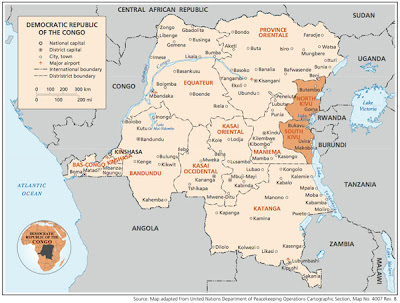
A civil war has been raging in the Democratic Republic of the Congo since.. well.. pretty much since the Belgians conquered the area, committed genocide, and called it a colony, as told in the excellent book King Leopold’s Ghost. But in the past 13 years, warfare has escalated and killed over 6 million Congolese, while rape has become an absolute epidemic and one of the main weapons of war. The UN’s top humanitarian official described the sexual violence against Congolese women as “almost unimaginable” for its frequency and ferocity.
This is a conflict that concerns us all, as it sheds crucial light on the functioning of global capitalism. At the center of the war is a mineral called coltan, short for Columbite-tantalite, which is used in capacitors, a necessary piece of electronics found in virtually every electronic device of modern capitalist society, from laptops to cell phones to cameras and jet engines. See Coltan: Learning the Basics. Coltan is just one of several expensive and rare minerals abundant in this remote region of central Africa, but coltan is ONLY available in this part of the world, which makes it extremely valuable.

Millions of children are exploited to mine coltan and other valuable minerals in the Congo
The DRC government, Uganda, Rwanda, and various militias and guerrilla forces are fighting over control of the land where these minerals are mined. The local residents, whose traditional lifestyles have been disrupted by decades of civil war, are forced to dig tiny amounts of these “conflict minerals” from the soil in inhuman conditions, often with their bare hands. An estimated 2 million of the miners are children, and often they are literal or virtual slaves who are on the brink of starvation. It is a situation which can only be described as hell on earth.
When you hear about such extreme exploitation, you can be pretty sure that some folks are making a hell of a lot of money. In this case, it’s western corporations like Nokia, Motorola, Compaq, Dell, IBM, Sony and many more who rely on extremely cheap capacitors in their electronics to make their profits from our Christmas presents. These companies have thus far avoided scrutiny by outsourcing the more direct business of extracting the minerals to smaller companies.
If there is any hope in this terrible situation, it is that capitalism is reaching the end of its ability to exploit the people of the world the way it has for the last centuries, and through the increased awareness of what is happening in places like the Congo, we as a people will say “Never again.” It is primarily the responsibility of those of us in the wealthy countries to put a stop to this paradigm of rape, slavery, and capitalist profit. Only we have the power to end the madness.
Below is a wonderful article that outlines specific solutions to the Congo civil war. [alex]
Conflict Minerals: A Cover For US Allies and Western Mining Interests?
Kambale Musavuli and Bodia Macharia
Originally published by Huffington Post, Dec. 14, 2009.
As global awareness grows around the Congo and the silence is finally being broken on the current and historic exploitation of Black people in the heart of Africa, myriad Western based “prescriptions” are being proffered. Most of these prescriptions are devoid of social, political, economic and historical context and are marked by remarkable omissions. The conflict mineral approach or efforts emanating from the United States and Europe are no exception to this symptomatic approach which serves more to perpetuate the root causes of Congo’s challenges than to resolve them.
The conflict mineral approach has an obsessive focus on the FDLR and other rebel groups while scant attention is paid to Uganda (which has an International Court of Justice ruling against it for looting and crimes against humanity in the Congo) and Rwanda (whose role in the perpetuation of the conflict and looting of Congo is well documented by UN reports and international arrest warrants for its top officials). Rwanda is the main transit point for illicit minerals coming from the Congo irrespective of the rebel group (FDLR, CNDP or others) transporting the minerals. According to Dow Jones, Rwanda’s mining sector output grew 20% in 2008 from the year earlier due to increased export volumes of tungsten, cassiterite and coltan, the country’s three leading minerals with which Rwanda is not well endowed. In fact, should Rwanda continue to pilfer Congo’s minerals, its annual mineral export revenues are expected to reach $200 million by 2010. Former Assistant Secretary of State for African Affairs Herman Cohen says it best when he notes “having controlled the Kivu provinces for 12 years, Rwanda will not relinquish access to resources that constitute a significant percentage of its gross national product.” As long as the West continues to give the Kagame regime carte blanche, the conflict and instability will endure. Read the rest of this entry »


 The End of Capitalism
Recent Comments