
You are currently browsing the category archive for the ‘Capitalism’ category.
More and more comparisons between today’s market plunge and the Great Depression of 1930s are being made and are needed. This article from Monday favorably compares the collapse of the Dow Jones Industrial Average, the most important measure of industrial economic activity.
It’s interesting to note that Phil Dow, “market strategist for RBC Dain Rauscher & James” admits the possibility that we are witnessing “the end of capitalism.” He denies that this is the case, since “people will start buying cars [and houses] again“. He’s trying to be optimistic of course, but it’s hard to imagine anything more depressing, considering that members of the UN Intergovernmental Panel on Climate Change (IPCC) are now warning that greenhouse gas emissions are rising much more rapidly than their worst-case projections.
A new way of life is on its way that does not rely on consuming ever-increasing mountains of industrial products, and that’s cause for celebration. [alex]
Dow Jones decline rate mimics Great Depression
by Dawn Kawamoto
Originally published by CNET, March 2, 2009.
With the Dow Jones Industrial Average falling below the psychological watermark of 7,000 on Monday, investors may be wondering how it all stacks up against the stock market crash of the Great Depression.
It’s not looking good.
In the here and now, the Dow has dropped 52.5 percent since its high of 14,279.96 on Oct. 11, 2007, to its low point of 6,779.62 during intraday trading on Monday. (Update 1:16 p.m. PST: At Monday’s close it was 6,763.29, a drop of nearly 300 points from the previous close.)
And in taking a similar period of a year and five months in the late 1920s, it’s a case of deja vu.
The rate of decline is mimicking that of the Dow during the Great Depression.
Back on September 3, 1929, the Dow hit a high mark of 381.17. And over a similar length of time, it fell 54.7 percent to 172.36 on January 2, 1931.
“It’s very troubling if you have a mirror image,” said Phil Dow, market strategist for RBC Dain Rauscher & James. Read the rest of this entry »
Anatoly Karlin at Sublime Oblivion has compiled some provocative graphs which suggest that the global peak of oil production has played a large causative role in the global economic meltdown of the past few years. Right off the bat we should look at how skyrocketing oil prices caused global food shortages and price inflation for other necessities, but also how the rising gas prices hurt US Real Estate markets and burst the subprime mortgage bubble. We know how that damage was compounded into the financial crisis and got us where we are, but what hasn’t been studied is the role of oil in originating the breakdown, not to dismiss the role played by lax regulatory oversight, financial mismanagement or straight-up theft by large banks and speculators.
I look forward to this argument on the role of oil being expanded and enriched by an anti-capitalist framework. [alex]
Excerpts from Oily Origins of the Economic Crisis.
Anatoly Karlin, February 18, 2009.
In an article some months ago I suggested that “perhaps this crisis is simply an unconscious recognition of this inconvenient truth?” – namely, the peaking of oil extraction and all that it implies for the continued survival of a financial system built on assumptions of continuous economic growth. In other words, the fashionable approach of focusing on exotic financial instruments, regulatory failures, etc, if a case of mistaking the forest for the trees.
The Oil Drum had a nice graphical summary. According to the author, Gail the Actuary, the chain of causation runs thus:

This explains the extreme severity of the crash – record GDP growth at a time of plateaued oil extraction in the 2005-2008 period was patently unsustainable, so a very big “correction” could not have been unexpected.
And it is quite a correction.
As of the September-November average, global industrial production was plummeting at an annualized rate of -13% and merchandise trade by a truly remarkable -43%. And it is obvious the collapse accelerated since then…

Already far worse than during even the worst month of 2000-2001, the last and only global slowdown for which the IMF has data.
…
Another Oil Drum blogger, Phil Hart, wrote about the dramatic rise and fall in oil prices in terms of simple supply and demand curves…

Oil demand and supply.
His thesis is that because of the geological limits to oil supply, the marginal cost of providing ever more oil is generally low until it reaches some point – say, 85mn barrels a day – and then veers off into the sky (i.e. becomes very inelastic). Demand is also inelastic, since modern society basically runs on oil. Hence there comes a time when the demand curve reaches a point when its intersection with the supply curve – i.e., the market price – starts rising exponentially. Read the rest of this entry »

“How the Irish Became White”
by Noel Ignatiev
1995 Routledge
“It is a curious fact,” wrote John Finch, an English Owenite who traveled the United States in 1843, “that the democratic party, and particularly the poorer class of Irish immigrants in America, are greater enemies to the negro population, and greater advocates for the continuance of negro slavery, than any portion of the population in the free States.”
How did the Irish become White? By violently subjugating African Americans, according to this courageous book by Noel Ignatiev.
As a part-Irish American, learning about the injustice that some of my ancestors took part in is deeply troubling, but it’s a history that we need to explore to uncover the true legacy of mass Irish immigration to America, and more fundamentally, the meaning of “Whiteness”.
The Irish in Ireland of the early-19th Century were a revolutionary people: impoverished, agrarian, and determined to break free of the grip of England’s tyranny. But once these same freedom-lovers emigrated to the United States, a peculiar thing happened: they were faced with a society based on racial segregation and industrial capitalism. Moreover, there began a large “Nativist” movement by wealthy Protestant Anglo-Saxons who tried to restrict immigration and subdue Irish/Catholic influence in the New World.
In order to overcome these barriers, the Irish made a strategic choice: escape the bottom-rung of poverty and be accepted into mainstream US society by aggressively aligning themselves with the Democratic Party and doing everything they could to keep African Americans in slavery or otherwise out of the labor market. Thus they earned the right to be considered “White” and receive the benefits and privileges associated with that social category.
Ignatiev makes a compelling case that “When Irish workers encountered Afro-Americans, they fought with them, it is true, but they also fought with immigrants of other nationalities, with each other, and with whomever else they were thrown up against in the marketplace.” In other words, it wasn’t that the Irish were inherently more racist than any other group. Instead, the race riots when rowdy Irish attacked African Americans were largely in response to an economic condition arising in early US capitalism: Northern industrial labor markets were saturated by waves of immigrants and freed slaves competing over lower and lower wages. To secure jobs for themselves, the Irish became the hammer that pounded away at racial segregation to force African Americans out of the factories and into poverty and the ghetto.
By doing so, they also solidified the major distinction between relatively privileged sectors of the US working class and those on the bottom – “Whiteness”. Ignatiev explains: “Since ‘white’ was not a physical description but one term of a social relation which could not exist without its opposite, ‘white man’s work’ was simply, work from which Afro-Americans were excluded.” Read the rest of this entry »
This is a wonderful essay looking at how a Sustainable Economy must be structured democratically and decentralized to the local level. The only thing I would add is that we need a realistic plan of action to get us from the capitalist hellhole we currently inhabit to this accurate vision of a future sustainable society, and we can’t be afraid to confront powerful forces which want to stop us.
For me as a young person in the United States, the heart of the Empire, I see my current role as organizing youth and students in resistance to the forces of domination (war, debt, oppression). Others may be better positioned to organize their workplace or their communities, or to start urban gardens, or other projects. We each have a role to play, and we need to discover it ourselves. [alex]
Building a Sustainable Economy
by Marcin Gerwin
Democracy first
In 1994 the government of Haiti lifted tariffs and allowed imports of cheap, subsidized rice and other crops from abroad. This policy was recommended by the International Monetary Fund and urged by the U.S. government (1). Over the years this tiny change in policy led to an estimated 830,000 job losses, it damaged food security and rural livelihoods, and eventually led to food riots and hunger in 2008 (2). If people in Haiti were to decide by themselves on their country policy, would they choose the recommendations of the IMF that brought them into starvation? Would people of Ecuador allow toxic pollution in the Amazon for the sake of Chevron Texaco profits? Would people in India accept genetically modified seeds of cotton that caused crop failures, spiral of debt and hundreds of farmer suicides? And would people in the USA support bailing out banks with their own money in a way that is not transparent and does not lead to the recovery of the financial system? They wouldn’t. These things happen around the world because we still don’t have true democracy, where people set the rules for themselves.
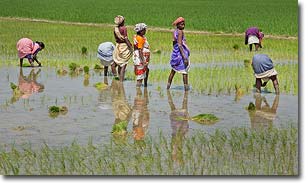 Women sowing rice in India Women sowing rice in IndiaPhoto: Michael Foley |
In 2001 twenty subsistence farmers, small traders, small food processors, and consumers, mostly women, and some of them illiterate, met in Indian village to decide on the future of agriculture in the state of Andhra Pradesh. They were chosen to represent the rural diversity of their state. They presented three different models of development. The official plan, put forward by Chief Minister of the state, was backed by grants and loans from the World Bank and the UK government. The plan was to mechanize, consolidate and genetically engineer agriculture of the state to produce cash crops for export, and to reduce the farming population from 70% to 40%, to have more workers for industry. The second vision involved developing environmentally friendly agriculture to produce cheap organic products for domestic and Northern supermarkets and it was supported by the International Federation of Organic Agriculture Movements and the International Trade Center. The third vision was influenced by Gandhian and indigenous ideas, and involved increasing local self-reliance and sustainability in both agriculture and economics.
Each model was illustrated by videos, farmers and traders could hear the summary of the policies, ask questions, consult with government officials, scientists, corporate and NGO representatives from the state, national and international level. They also considered advantages and disadvantages of each vision, based also upon their own knowledge, priorities and aspirations. After one week they made a decision.
Tom Atlee writes:
In their recommendations (…) they said they wanted self-reliant food and farming, and community control over resources. They wanted to maintain healthy soils, diverse crops, trees and livestock, and to build on their indigenous knowledge, practical skills and local institutions. They wanted to maintain the high percentage of people making their livelihood from the land, and did not want their farms consolidated or mechanized in ways that would displace rural people. Most of them could feed their families through their own sustenance farming. They did not want to end up laboring in dangerous brick kilns outside of Hyderabad, like so many who had left their farms. They also rejected genetically modified crops and the export of their local medicinal plants. (3)
If we wish to make some meaningful changes in the world, we need appropriate tools for that. A number one tool in the earth repair workshop is community-based democracy. It is a key for unlocking the potential for sustainability.
Fundamentalist Consumerism and an Insane Society
February 2009
By Bruce E. Levine
Originally published by ZMag.
At a giant Ikea store in Saudi Arabia in 2004, three people were killed by a stampede of shoppers fighting for one of a limited number of $150 credit vouchers. Similarly, in November 2008, a worker at a New York Wal-Mart was trampled to death by shoppers intent on buying one of a limited number of 50-inch plasma HDTVs.
Jdiniytai Damour, a temporary maintenance worker was killed on “Black Friday.” In the predawn darkness, approximately 2,000 shoppers waited impatiently outside Wal-Mart, chanting, “Push the doors in.” According to Damour’s fellow worker Jimmy Overby, “He was bum-rushed by 200 people. They took the doors off the hinges. He was trampled and killed in front of me.” Witnesses reported that Damour, 34 years old, gasped for air as shoppers continued to surge over him. When police instructed shoppers to leave the store after Damour’s death, many refused, some yelling, “I’ve been in line since yesterday morning.”
The mainstream press covering Damour’s death focused on the mob of crazed shoppers and, to a lesser extent, irresponsible Wal-Mart executives who failed to provide security. However, absent in the corporate press was anything about a consumer culture and an insane society in which marketers, advertisers, and media promote the worship of cheap stuff.
Along with journalists, my fellow mental health professionals have also covered up societal insanity. An exception is the democratic-socialist psychoanalyst Erich Fromm (1900-1980). Fromm, in The Sane Society (1955), wrote: “Yet many psychiatrists and psychologists refuse to entertain the idea that society as a whole may be lacking in sanity. They hold that the problem of mental health in a society is only that of the number of ‘unadjusted’ individuals, and not of a possible unadjustment of the culture itself.”
While people can resist the cheap-stuff propaganda and not worship at Wal-Mart, Ikea, and other big-box cathedrals—and stay out of the path of a mob of fundamentalist consumers—it is difficult to protect oneself from the slow death caused by consumer culture. Human beings are every day and in numerous ways psychologically, socially, and spiritually assaulted by a culture which:
- creates increasing material expectations
- devalues human connectedness
- socializes people to be self-absorbed
- obliterates self-reliance
- alienates people from normal human emotional reactions
- sells false hope that creates more pain
A massive wave of layoffs was announced yesterday by 12 major US corporations, including Caterpillar, General Motors, Home Depot, Sprint Nextel and Pfizer. Microsoft also announced its first-ever mass layoffs of 5,000 workers. Overall, more than 75,000 jobs are being cut from the workforce after Unemployment levels were reported as 7.2% in December, the highest level in over 16 years, with no end to the bleeding in sight.
As more and more workers fill the unemployment rolls, it’s time to ask: where will future jobs come from? While government and corporate bigshots plan yet another “economic stimulus” and bailout of the banks, what long-term jobs can we realistically create right now?
Lots of answers present themselves if we look through the lens of peak oil, and start replacing our oil-based economy with a people-based economy. Instead of relying on greenhouse gas-producing fossil fuels, we can tap into the power of human labor, which happens to be our greatest renewable resource.
Certainly there is a need to employ millions to weatherize homes and build and install solar panels and wind turbines (which Obama may address), but there is also a huge need to re-tool Detroit automakers to STOP producing gas-guzzling individual cars, and start making buses, trains and other forms of public transit. Bicycles are also desperately needed, so we need workers to build them and more to repair them too.
We also need lots more doctors and nurses if we make health care universally available, and social workers and therapists to help deal with the psychological trauma our population has suffered from militarism and soulless consumerism. Since many of these jobs require education and training, we need to hire lots more teachers, and we also need education to be a lot more affordable to so more people can access these kinds of careers.
Perhaps the largest gains in the job sector can be achieved by shifting food production away from mega-scale agribusinesses and fossil-fuel intensive monoculture and factory farms, towards community-based, local, organic, family farming and free-range livestock raising. By breaking up the huge corporate farms into family-size and community-size plots, we can repopulate rural America (and stop suburban sprawl), produce better, healthier food, respect animal rights, and create millions of new landowners. Simultaneously we can follow the example of Cuba and turn our blighted inner-cities into gardens, by utilizing permaculture and organic community-run agriculture, which would reduce crime and poverty in our decaying urban areas, bring quality food to places currently plagued by malnutrition, and create millions upon millions of rewarding and meaningful jobs.
How will we finance it? Simple. Disassemble the huge financial firms and multinational corporate banks whose greed caused this economic crisis and create thousands of local banks and credit unions, run by people in the community (even more jobs!) Taxing the rich would help a lot too, and we can cut tons of wasteful government spending on things like the wars in the Middle East, excessive prisons, and nuclear, biological and chemical weapons. The money is right there, we just need to redirect it to things that actually help people instead of killing them.
This of course requires a revolutionary change in the economic and political structure of the United States, which means average people like you and me having control over the decisions affecting our lives, instead of remaining at the whim of wealthy elites who in the current crisis have shown themselves unable to run a lemonade stand, let alone the global economy.
[alex]
Deluge of layoffs hits U.S. economy
January 27, 2009
By Jerry Hirsch and Maura Reynolds

Scott Olson, Getty Images
A worker walks between Caterpillar earth-moving equipment at a road construction site near Joliet, Ill. The company has announced that it will cut nearly 20,000 jobs as the recession reduces demand for its products.
Companies including Home Depot, Caterpillar, Pfizer and Sprint plan to cut nearly 60,000 jobs, adding urgency to the need to agree on a stimulus plan.
U.S. companies slashed nearly 60,000 jobs Monday, adding impetus to the Obama administration’s efforts to reach agreement on a plan to pump $825 billion into the economy over a two-year period.
But it’s unclear whether even that massive influx of funding and tax cuts would be enough to get companies hiring again in the near term.
The cuts by firms including Caterpillar, General Motors, Texas Instruments, Home Depot, Sprint Nextel and Pfizer brought the total of jobs shed so far this month to 187,550, more than November or December and well over double the number of January 2008, according to employment firm Challenger, Gray & Christmas Inc.
Analysts believe that Obama’s strategy of pouring money into state and local governments could prevent layoffs and furloughs of public sector employees, including teachers, police officers and other government workers.
Economists have estimated that the plan will protect or create 3 million to 4 million jobs in the next two years.
But the U.S. economy lost 2.6 million jobs last year and could lose 2 million more during the first half of this year. Read the rest of this entry »
Interesting to see how second-tier nations are facing such dramatic upheaval, it seems the crisis is being somewhat deflected from the United States and other centers of global capitalism. In the long run of course, the US is LEAST prepared to deal with the energy shortage, and will crash hardest. For now though, the coronation of our new fresh president has kept the myth of American exceptionalism alive, at least for a little longer. [alex]
Riots in Iceland, Latvia and Bulgaria are a Sign of Things to Come
Our third global political column explores the start of an age of rebellion over the financial crisis – beginning in Iceland
by Roger Boyes
January 21, 2009
Icelanders all but stormed their Parliament last night. It was the first session of the chamber after what might appear to be an unusually long Christmas break.
Ordinary islanders were determined to vent their fury at the way that the political class had allowed the country to slip towards bankruptcy. The building was splattered with paint and yoghurt, the crowd yelled and banged pans, fired rockets at the windows and lit a bonfire in front of the main door. Riot police moved in.
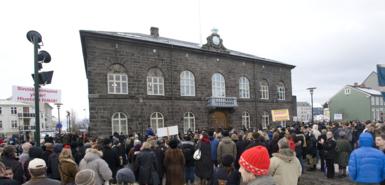
Icelanders vented their fury at the political class's handling of the financial crisis by staging angry protests in Reykjavik
Now in the grand sweep of the current crisis, a riot on a piece of volcanic rock in the north Atlantic may not seem to add up to much. But it is a sign of things to come: a new age of rebellion.
The financial meltdown has become part of the real economy and is now beginning to shape real politics. More and more citizens on the edge of the global crisis are taking to the streets. Bulgaria has been gripped this month by its worst riots since 1997 when street power helped to topple a Socialist government. Now Socialists are at the helm again and are having to fend off popular protests about government incompetence and corruption.
In Latvia – where growth has been in double-digit figures for years – anger is bubbling over at official mismanagement. GDP is expected to contract by 5 per cent this year; salaries will be cut; unemployment will rise. Last week, in a country where demonstrators usually just sing and then go home, 10,000 people besieged parliament.
Iceland, Bulgaria, Latvia: these are not natural protest cultures. Something is going amiss.
The LSE economist Robert Wade – addressing a protest meeting in Reykjavik’s cinema – recently warned that the world was approaching a new tipping point. Starting from March-May 2009, we can expect large-scale civil unrest, he said. “It will be caused by the rise of general awareness throughout Europe, America and Asia that hundreds of millions of people in rich and poor countries are experiencing rapidly falling consumption standards; that the crisis is getting worse not better; and that it has escaped the control of public authorities, national and international.”
Ukraine could be the next to go. The gas pricing deal agreed with Moscow could propel the country towards a serious financial crisis. Russia, too, is looking wobbly. A riot in Vladivostok may have been an omen for things to come. What will happen when the wider economic crisis translates into higher food prices? Or if Gazprom has no choice but to increase domestic gas prices?
Governments have so far managed to deflect attention from their role in the crash, their slipshod monitoring, by declaring themselves to be indispensible to the solution. This may save the skins of politicians in wealthier countries who can credibly and expensively try to prop up banks and sickly industries. But it does not work in countries that are heavily indebted, with bloated and exposed financial sectors. There, the irate crowds are already beginning to demand: why hasn’t a single politician resigned? What has happened to ministerial responsibility? Who will investigate government failure?
Good questions, it seems to me, in these unquiet times.


 The End of Capitalism
Recent Comments