
You are currently browsing the category archive for the ‘Barack Obama’ category.
 http://www.democracynow.org/2009/12/17/bolivian_president_evo_morales_on_climate
AMY GOODMAN: Just before we went to air today, I interviewed Evo Morales, Bolivia’s first indigenous president. He was re-elected in a landslide victory earlier this month. On Wednesday, Evo Morales called on world leaders to hold temperature increases over the next century to just one degree Celsius, the most ambitious proposal so far by any head of state. Morales also called on the United States and other wealthy nations to pay an ecological debt to Bolivia and other developing nations.
AMY GOODMAN: President Morales, welcome to Democracy Now!
PRESIDENT EVO MORALES: [translated] Thank you very much for the invitation.
AMY GOODMAN: You spoke yesterday here at the Bella Center and said we cannot end global warming without ending capitalism. What did you mean?
PRESIDENT EVO MORALES: [translated] Capitalism is the worst enemy of humanity. Capitalism—and I’m speaking about irrational development—policies of unlimited industrialization are what destroys the environment. And that irrational industrialization is capitalism. So as long as we don’t review or revise those policies, it’s impossible to attend to humanity and life.
AMY GOODMAN: How would you do that? How would you end capitalism?
PRESIDENT EVO MORALES: [translated] It’s changing economic policies, ending luxury, consumerism. It’s ending the struggle to—or this searching for living better. Living better is to exploit human beings. It’s plundering natural resources. It’s egoism and individualism. Therefore, in those promises of capitalism, there is no solidarity or complementarity. There’s no reciprocity. So that’s why we’re trying to think about other ways of living lives and living well, not living better. Not living better. Living better is always at someone else’s expense. Living better is at the expense of destroying the environment.
AMY GOODMAN: President Morales, what are you calling here—for here at the UN climate summit?
PRESIDENT EVO MORALES: [translated] Defense of the rights of Mother Earth. Read the rest of this entry »
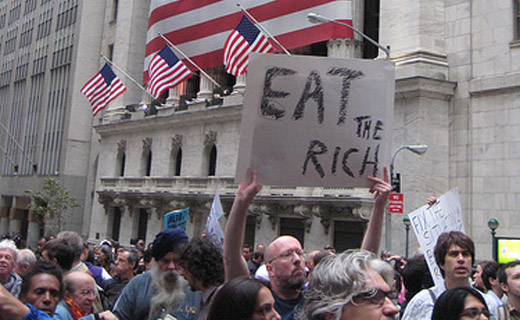 Today, Democracy Now! reported that two major records have been broken in 2009 – Wall St. profits ($35.7 billion in the first half of the year), and the number of Americans going hungry (50 million). These two seemingly unrelated tragedies immediately suggest a common solution – carve up the bloated hulks of Wall St. swine and serve them up to the American people!
On Tuesday, the NY Comptroller’s Office released a report showing that “broker-dealer operations of New York Stock Exchange member firms earned a record $35.7 billion in the first half of 2009.” Through September, $22.5 billion in profits were reported from the four largest firms alone —Goldman Sachs, Merrill Lynch, Morgan Stanley, JPMorgan Chase. These are the same banks who got bailed out by the Federal Government last year – which means that taxpayers like you and I paid for these creeps’ bonuses.
Not coincidentally, these obscene profits were recorded at the same moment that the Department of Agriculture released a report showing that “nearly 50 million people — including almost one child in four — struggled last year to get enough to eat” (as written in the Washington Post on Monday). While the economy has been in the tank and unemployment has surpassed 10% officially, food prices have been skyrocketing, and so millions more Americans are being forced to go without needed nutrition.
Why isn’t it a coincidence? Because the crooks who sent global markets into a freefall last September, causing millions to lose their homes and jobs, have been rewarded for their bad behavior with preferential treatment from Uncle Sam. These Wall St. piggies have been gorging themselves on trillions of U.S. Federally approved dough, while regular folks struggle to pay the rent or put food on the table – without so much as a measly health care reform bill to give hope to their deteriorating condition. Now 1 out of every 4 of our kids are going hungry while the government subsidizes the very stock market slimeballs responsible for creating the trouble to begin with.
“Where’s OUR bailout?” struggling folks are wondering, as they see food prices climb and jobs shipped overseas by the day. 50 million folks are wondering where their next meal is gonna come from… and it’s time to entertain innovative, cost-effective proposals, even if they may seem exotic.
Well it turns out there’s one way to solve this problem without tapping the Treasury for so much as a penny!
It would bring down the cost of high-protein, high-quality food, providing much-needed nutrition to the hungry.
It could create high-paid and unionized manufacturing jobs, right here in the U.S. of A!
It would be environmentally friendly, dolphin-safe, and carbon-neutral (although there may be some associated methane emissions after the plan is implemented).
Best of all, this solution would remove the parasitic, bonus-hungry, pyramid-scheming, derivative-trading, regulation-gutting, President-advising, economy-wrecking, bailout mongers from the picture, allowing the American people to determine our economic future democratically!
And it’s so straightforward even Timothy Geithner could understand it:
Eat the Rich!
[alex, Nov. 19]
below is the transcript from Democracy Now!’s interview of Robert Scheer on these 2 unprecedented reports and what they mean for the economy: Read the rest of this entry »
Very well-spoken article poking fun at our enigmatic president, who continues to flirt with both of the groups who brought him to the Big Dance: the corporate/financial elites who paid for his campaign, and the millions of progressive Americans who mobilized and turned out the vote.
Inspirational words, impressive moves, and boyish good looks have kept the two suitors enamored thus far, but at some point Barack’s going to have to choose his partner for the slowdance. So far he’s been sipping punch with the bankrolling capitalists, who have seduced him with fancy airplanes and false promises, but we, the people have to work up the courage to demand his attention if we have any hope of him coming home with us at the end of the night. And we can’t hide our intentions; let’s make clear that partnering with us means rejecting the system that caused this crisis – capitalism. Let’s be realistic and demand the impossible. [alex]
Fred Astaire in the White House
by Michael Brownstein
Originally published by Reality Sandwich, April 13, 2009.
 “You can never awaken using the same system that put you to sleep in the first place.”
–Gurdjieff
This is an appeal, an open letter, a cry in the night: no matter how cranky it may make us to brush the stardust from our eyes, no matter how many friends we think we’ll lose by looking long and hard at what’s going on around us, let’s try to stay awake. Let’s not lose touch with what we really want for ourselves. Let’s not forget what we know about the nature of consumer capitalism: it is unsustainable and unworkable because it depends on infinite expansion in a finite world. It can only survive by a violent takeover of what belongs to others. Let’s not settle for halfway measures.
And let’s not wait for deliverance from on high.
Because the president we elected — out of so much hope for a definitive break with what came before — is not who he seems. It’s true that unlike the previous inhabitant of the White House (remember him?), Barack Obama is sane, intelligent, and mature. He’s responsive to what others think. He hopes to institute real change in education, health care, the environment.
But even with his great charisma and silver tongue, he’s a proper soldier for the system which is ravishing the planet. As he said in his inauguration speech in January, already aware of the huge financial mess he was inheriting, “We will not apologize for our way of life.”
What do these words mean? They mean that the mall-i-zation of the planet will continue. They mean that the commercialization of all of life will not stop. They mean that our massive so-called footprint will never be substantially downsized.
And they mean that the force which has erased indigenous cultures and plant and animal species, which has sullied our air and soil and water, will essentially not be called into question, no matter how many of its most glaring excesses may be curbed.

“How the Irish Became White”
by Noel Ignatiev
1995 Routledge
“It is a curious fact,” wrote John Finch, an English Owenite who traveled the United States in 1843, “that the democratic party, and particularly the poorer class of Irish immigrants in America, are greater enemies to the negro population, and greater advocates for the continuance of negro slavery, than any portion of the population in the free States.”
How did the Irish become White? By violently subjugating African Americans, according to this courageous book by Noel Ignatiev.
As a part-Irish American, learning about the injustice that some of my ancestors took part in is deeply troubling, but it’s a history that we need to explore to uncover the true legacy of mass Irish immigration to America, and more fundamentally, the meaning of “Whiteness”.
The Irish in Ireland of the early-19th Century were a revolutionary people: impoverished, agrarian, and determined to break free of the grip of England’s tyranny. But once these same freedom-lovers emigrated to the United States, a peculiar thing happened: they were faced with a society based on racial segregation and industrial capitalism. Moreover, there began a large “Nativist” movement by wealthy Protestant Anglo-Saxons who tried to restrict immigration and subdue Irish/Catholic influence in the New World.
In order to overcome these barriers, the Irish made a strategic choice: escape the bottom-rung of poverty and be accepted into mainstream US society by aggressively aligning themselves with the Democratic Party and doing everything they could to keep African Americans in slavery or otherwise out of the labor market. Thus they earned the right to be considered “White” and receive the benefits and privileges associated with that social category.
Ignatiev makes a compelling case that “When Irish workers encountered Afro-Americans, they fought with them, it is true, but they also fought with immigrants of other nationalities, with each other, and with whomever else they were thrown up against in the marketplace.” In other words, it wasn’t that the Irish were inherently more racist than any other group. Instead, the race riots when rowdy Irish attacked African Americans were largely in response to an economic condition arising in early US capitalism: Northern industrial labor markets were saturated by waves of immigrants and freed slaves competing over lower and lower wages. To secure jobs for themselves, the Irish became the hammer that pounded away at racial segregation to force African Americans out of the factories and into poverty and the ghetto.
By doing so, they also solidified the major distinction between relatively privileged sectors of the US working class and those on the bottom – “Whiteness”. Ignatiev explains: “Since ‘white’ was not a physical description but one term of a social relation which could not exist without its opposite, ‘white man’s work’ was simply, work from which Afro-Americans were excluded.” Read the rest of this entry »
A massive wave of layoffs was announced yesterday by 12 major US corporations, including Caterpillar, General Motors, Home Depot, Sprint Nextel and Pfizer. Microsoft also announced its first-ever mass layoffs of 5,000 workers. Overall, more than 75,000 jobs are being cut from the workforce after Unemployment levels were reported as 7.2% in December, the highest level in over 16 years, with no end to the bleeding in sight.
As more and more workers fill the unemployment rolls, it’s time to ask: where will future jobs come from? While government and corporate bigshots plan yet another “economic stimulus” and bailout of the banks, what long-term jobs can we realistically create right now?
Lots of answers present themselves if we look through the lens of peak oil, and start replacing our oil-based economy with a people-based economy. Instead of relying on greenhouse gas-producing fossil fuels, we can tap into the power of human labor, which happens to be our greatest renewable resource.
Certainly there is a need to employ millions to weatherize homes and build and install solar panels and wind turbines (which Obama may address), but there is also a huge need to re-tool Detroit automakers to STOP producing gas-guzzling individual cars, and start making buses, trains and other forms of public transit. Bicycles are also desperately needed, so we need workers to build them and more to repair them too.
We also need lots more doctors and nurses if we make health care universally available, and social workers and therapists to help deal with the psychological trauma our population has suffered from militarism and soulless consumerism. Since many of these jobs require education and training, we need to hire lots more teachers, and we also need education to be a lot more affordable to so more people can access these kinds of careers.
Perhaps the largest gains in the job sector can be achieved by shifting food production away from mega-scale agribusinesses and fossil-fuel intensive monoculture and factory farms, towards community-based, local, organic, family farming and free-range livestock raising. By breaking up the huge corporate farms into family-size and community-size plots, we can repopulate rural America (and stop suburban sprawl), produce better, healthier food, respect animal rights, and create millions of new landowners. Simultaneously we can follow the example of Cuba and turn our blighted inner-cities into gardens, by utilizing permaculture and organic community-run agriculture, which would reduce crime and poverty in our decaying urban areas, bring quality food to places currently plagued by malnutrition, and create millions upon millions of rewarding and meaningful jobs.
How will we finance it? Simple. Disassemble the huge financial firms and multinational corporate banks whose greed caused this economic crisis and create thousands of local banks and credit unions, run by people in the community (even more jobs!) Taxing the rich would help a lot too, and we can cut tons of wasteful government spending on things like the wars in the Middle East, excessive prisons, and nuclear, biological and chemical weapons. The money is right there, we just need to redirect it to things that actually help people instead of killing them.
This of course requires a revolutionary change in the economic and political structure of the United States, which means average people like you and me having control over the decisions affecting our lives, instead of remaining at the whim of wealthy elites who in the current crisis have shown themselves unable to run a lemonade stand, let alone the global economy.
[alex]
Deluge of layoffs hits U.S. economy
January 27, 2009
By Jerry Hirsch and Maura Reynolds

Scott Olson, Getty Images
A worker walks between Caterpillar earth-moving equipment at a road construction site near Joliet, Ill. The company has announced that it will cut nearly 20,000 jobs as the recession reduces demand for its products.
Companies including Home Depot, Caterpillar, Pfizer and Sprint plan to cut nearly 60,000 jobs, adding urgency to the need to agree on a stimulus plan.
U.S. companies slashed nearly 60,000 jobs Monday, adding impetus to the Obama administration’s efforts to reach agreement on a plan to pump $825 billion into the economy over a two-year period.
But it’s unclear whether even that massive influx of funding and tax cuts would be enough to get companies hiring again in the near term.
The cuts by firms including Caterpillar, General Motors, Texas Instruments, Home Depot, Sprint Nextel and Pfizer brought the total of jobs shed so far this month to 187,550, more than November or December and well over double the number of January 2008, according to employment firm Challenger, Gray & Christmas Inc.
Analysts believe that Obama’s strategy of pouring money into state and local governments could prevent layoffs and furloughs of public sector employees, including teachers, police officers and other government workers.
Economists have estimated that the plan will protect or create 3 million to 4 million jobs in the next two years.
But the U.S. economy lost 2.6 million jobs last year and could lose 2 million more during the first half of this year. Read the rest of this entry »


 The End of Capitalism
Recent Comments