You are currently browsing the yearly archive for 2010.
Chris Hedges, author of American Fascists: The Christian Right and the War on America, has been warning us of the threat of neo-fascism in the United States for a few years now. This is one of his best pieces on the subject, comparing what is happening here and now with the Sarah Palins, Glenn Becks, and Tea Partiers to what happened to Yugoslavia 20 years ago.
However I must disagree with Hedges on the phrase ‘liberal elite’ – the ruling class is hardly liberal, unless it’s liberal to invade countries and kill millions of innocent civilians based on lies, or to plunder the atmosphere and seas, or to torture and spy on Americans and others, or any of the other awful things the government and its corporate cronies are carrying out all the time. Barack Obama may have a liberal streak as an individual, but he is carrying out a violent, imperialistic capitalist agenda for the real rulers. [alex]
Is America ‘Yearning for Fascism’?
Chris Hedges
Originally published by TruthDig, March 29, 2010
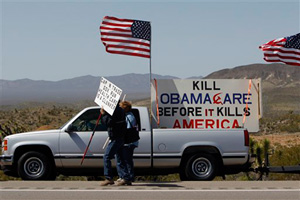
Tea Baggers - AP / Jae C. Hong
The language of violence always presages violence. I watched it in war after war from Latin America to the Balkans. The impoverishment of a working class and the snuffing out of hope and opportunity always produce angry mobs ready to kill and be killed. A bankrupt, liberal elite, which proves ineffectual against the rich and the criminal, always gets swept aside, in times of economic collapse, before thugs and demagogues emerge to play to the passions of the crowd. I have seen this drama. I know each act. I know how it ends. I have heard it in other tongues in other lands. I recognize the same stock characters, the buffoons, charlatans and fools, the same confused crowds and the same impotent and despised liberal class that deserves the hatred it engenders.
“We are ruled not by two parties but one party,” Cynthia McKinney, who ran for president on the Green Party ticket, told me. “It is the party of money and war. Our country has been hijacked. And we have to take the country away from those who have hijacked it. The only question now is whose revolution gets funded.”
The Democrats and their liberal apologists are so oblivious to the profound personal and economic despair sweeping through this country that they think offering unemployed people the right to keep their unemployed children on their nonexistent health care policies is a step forward. They think that passing a jobs bill that will give tax credits to corporations is a rational response to an unemployment rate that is, in real terms, close to 20 percent. They think that making ordinary Americans, one in eight of whom depends on food stamps to eat, fork over trillions in taxpayer dollars to pay for the crimes of Wall Street and war is acceptable. They think that the refusal to save the estimated 2.4 million people who will be forced out of their homes by foreclosure this year is justified by the bloodless language of fiscal austerity. The message is clear. Laws do not apply to the power elite. Our government does not work. And the longer we stand by and do nothing, the longer we refuse to embrace and recognize the legitimate rage of the working class, the faster we will see our anemic democracy die.
The unraveling of America mirrors the unraveling of Yugoslavia. The Balkan war was not caused by ancient ethnic hatreds. It was caused by the economic collapse of Yugoslavia. The petty criminals and goons who took power harnessed the anger and despair of the unemployed and the desperate. They singled out convenient scapegoats from ethnic Croats to Muslims to Albanians to Gypsies. They set in motion movements that unleashed a feeding frenzy leading to war and self-immolation. There is little difference between the ludicrous would-be poet Radovan Karadzic, who was a figure of ridicule in Sarajevo before the war, and the moronic Glenn Beck or Sarah Palin. There is little difference between the Oath Keepers and the Serbian militias. We can laugh at these people, but they are not the fools. We are.
The longer we appeal to the Democrats, who are servants of corporate interests, the more stupid and ineffectual we become. Sixty-one percent of Americans believe the country is in decline, according to a recent NBC News/Wall Street Journal poll, and they are right. Only 25 percent of those polled said the government can be trusted to protect the interests of the American people. If we do not embrace this outrage and distrust as our own it will be expressed through a terrifying right-wing backlash. Read the rest of this entry »
This post was sparked after reading Richard Heinberg’s recent article Life After Growth, which is a much more personal introspection of Richard’s story uncovering the realities of peak oil and the limits to growth. I recommend that one, but this earlier essay he wrote on the “End of Growth” I believe may go down in history as required reading.
In it he asks what are the fundamental reasons behind the ongoing economic crisis, arguing persuasively that the role of ecological limits like peak oil cannot be ignored as inhibiting growth both in the long term as well as the short. However, what Richard lacks is an integrated analysis of the social limits to growth, especially the power of social movements all over the globe working against this system of capitalism.
Without a deep appreciation for the rights of poor and exploited people, it is easy to make mistakes, as I believe Richard does in this essay with regards to immigration, for example. Further, without seeing the big picture of people’s resistance to capitalism and yearning for a new, non-growth, sustainable world, it is easy to lose hope. And in these difficult times, hope is our most important natural resource. [alex]
Temporary Recession or the End of Growth?
by Richard Heinberg
August 6, 2009.
.
Everyone agrees: our economy is sick. The inescapable symptoms include declines in consumer spending and consumer confidence, together with a contraction of international trade and available credit. Add a collapse in real estate values and carnage in the automotive and airline industries and the picture looks grim indeed.
But why are both the U.S. economy and the larger global economy ailing? Among the mainstream media, world leaders, and America’s economists-in-chief (Treasury Secretary Geithner and Federal Reserve Chairman Bernanke) there is near-unanimity of opinion: these recent troubles are primarily due to a combination of bad real estate loans and poor regulation of financial derivatives.
This is the Conventional Diagnosis. If it is correct, then the treatment for our economic malady might logically include heavy doses of bailout money for beleaguered financial institutions, mortgage lenders, and car companies; better regulation of derivatives and futures markets; and stimulus programs to jumpstart consumer spending.
But what if this diagnosis is fundamentally flawed? The metaphor needs no belaboring: we all know that tragedy can result from a doctor’s misreading of symptoms, mistaking one disease for another.

Something similar holds for our national and global economic infirmity. If we don’t understand why the world’s industrial and financial metabolism is seizing up, we are unlikely to apply the right medicine and could end up making matters much worse than they would otherwise be.
To be sure: the Conventional Diagnosis is clearly at least partly right. The causal connections between subprime mortgage loans and the crises at Fannie Mae, Freddie Mac, and Lehman Brothers have been thoroughly explored and are well known. Clearly, over the past few years, speculative bubbles in real estate and the financial industry were blown up to colossal dimensions, and their bursting was inevitable. It is hard to disagree with the words of Australian Prime Minister Kevin Rudd, in his July 25 essay in the Sydney Morning Herald: “The roots of the crisis lie in the preceding decade of excess. In it the world enjoyed an extraordinary boom…However, as we later learnt, the global boom was built in large part…on a house of cards. First, in many Western countries the boom was created on a pile of debt held by consumers, corporations and some governments. As the global financier George Soros put it: ‘For 25 years [the West] has been consuming more than we have been producing…living beyond our means.'” (1)
But is this as far as we need look to get to the root of the continuing global economic meltdown?
A case can be made that dire events having to do with real estate, the derivatives markets, and the auto and airline industries were themselves merely symptoms of an even deeper, systemic dysfunction that spells the end of economic growth as we have known it.
In short, I am suggesting an Alternative Diagnosis. This explanation for the economic crisis is not for the faint of heart because, if correct, it implies that the patient is far sicker than even the most pessimistic economists are telling us. But if it is correct, then by ignoring it we risk even greater peril.
Economic Growth, The Financial Crisis, and Peak Oil
For several years, a swelling subculture of commentators (which includes the present author) has been forecasting a financial crash, basing this prognosis on the assessment that global oil production was about to peak. (2) Our reasoning went like this: Read the rest of this entry »
Engaging the Crisis: Organizing Against Budget Cuts and Community Power in Philadelphia
by Kristin Campbell
Reposted from Organizing Upgrade, March 1, 2010
Organizing Upgrade is honored to offer a preview of this insightful reflection on organizing – Engaging the Crisis: Organizing Against Budget Cuts and Building Community Power in Philadelphia – which will appear in Left Turn magazine #36 (April/May 2010). You can subscribe to Left Turn online at www.leftturn.org or become a monthly sustainer at www.leftturn.org/donate.
On November 6, 2008, just days after Philadelphians poured onto the streets to celebrate the Phillies winning the World Series championship and Barack Obama the US presidency, Mayor Michael Nutter announced a drastic plan to deal with the cities $108 million budget gap. Severe budget cuts were announced, including the closure of 11 public libraries, 62 public swimming pools, 3 public ice skating rinks, and several fire engines. Nutter also stated that 220 city workers would be laid off and that 600 unfilled positions would be eliminated entirely, amounting to the loss of nearly 1,000 precious city jobs. In classic neo-liberal style, the public sector was to sacrifice, while taxpayer money would bail out the private banking institutions.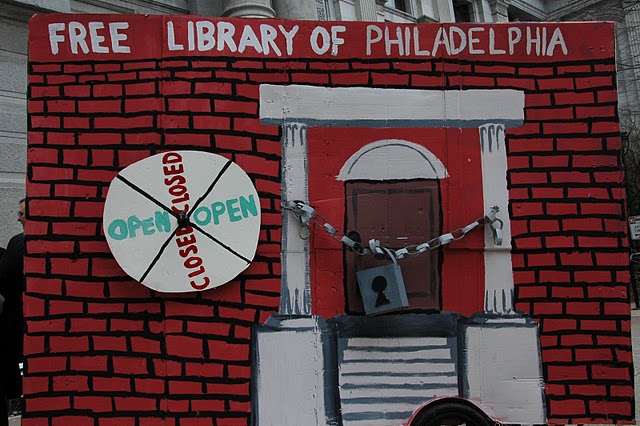
City in crisis
Well before the economic crises of 2008, a decades-long process of economic restructuring and deindustrialization had left Philadelphia, with a population just over 1.4 million, an incredibly under-resourced city. Philadelphia has the highest poverty rate out of the ten largest cities in the US, an eleven percent unemployment rate and a high-school dropout rate that hovers dangerously around 50 percent.
The proposed budget cuts sparked waves of popular outrage especially concerning the closure of the libraries, many of which are located in low-income communities of color and serve as bedrock institutions for many basic resources. Eleanor Childs, a principal of a school that heavily relies on West Philadelphia’s Durham library, and later a member of the Coalition to Save the Libraries, recalls “a groundswell of concern about the closing of the libraries… people rose up. We had our pitchforks. We were ready to fight to keep our libraries open.”
Nutter’s administration set up eight townhall meetings across Philadelphia, designed to calm the citywide uproar. Thousands of people filled the townhall meetings poised to question how such drastic decisions were made without any public input. Under the banner “Tight Times, Tough Choices,” Mayor Nutter and senior city officials attempted to explain the necessity of such deep service cuts. They explained that the impact of the economic crisis on the city had only become apparent in recent weeks, and because the city could not raise significant revenue to offset its financial loses in the timeframe that was needed, rapid cuts were mandatory and effective January 1, 2009.
Community response
In the following days and weeks, Philadelphians quickly mobilized against the decision that their public services and city workers pay for the fallout of a economic system that had already left so many of them struggling. Neighborhood leaders organized impromptu rallies at the eleven branch libraries. Along with organizing people to turn out at the Mayor’s townhall meetings, these rallies gained media attention on both the nightly news and in the major newspapers, demonstrating widespread opposition to the budget cuts. Sherrie Cohen, member of the Coalition to Save the Libraries and long-time resident of the Ogontz neighborhood of North Philly remembers her neighbors coming together to say, “We are not going to let this library close. It’s not gonna happen. We fought for 36 years for a library in our neighborhood.” Read the rest of this entry »
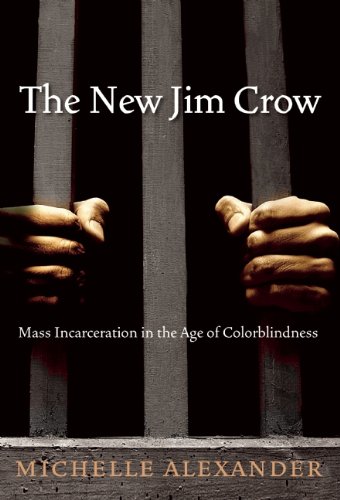
It’s becoming increasingly clear that we can no longer afford to imprison nearly 2 and a half million Americans, a disproportionate number of them black and Latino. The choice is clear: break the bank to continue to punish people for mostly nonviolent offenses, or figure out a new way to operate “criminal justice” that actually heals people rather than just putting them in cages.
If we continue down a neo-fascist path we will be unable to treat prisoners as human beings, and continue to drive a racial wedge into the heart of the nation. Obama must remember that he is Black and stop these Jim Crow shenanigans. [alex]
The New Jim Crow
How the War on Drugs Gave Birth to a Permanent American Undercaste
By Michelle Alexander
Originally published by TomDispatch.
Ever since Barack Obama lifted his right hand and took his oath of office, pledging to serve the United States as its 44th president, ordinary people and their leaders around the globe have been celebrating our nation’s “triumph over race.” Obama’s election has been touted as the final nail in the coffin of Jim Crow, the bookend placed on the history of racial caste in America.
Obama’s mere presence in the Oval Office is offered as proof that “the land of the free” has finally made good on its promise of equality. There’s an implicit yet undeniable message embedded in his appearance on the world stage: this is what freedom looks like; this is what democracy can do for you. If you are poor, marginalized, or relegated to an inferior caste, there is hope for you. Trust us. Trust our rules, laws, customs, and wars. You, too, can get to the promised land.
Perhaps greater lies have been told in the past century, but they can be counted on one hand. Racial caste is alive and well in America.
Most people don’t like it when I say this. It makes them angry. In the “era of colorblindness” there’s a nearly fanatical desire to cling to the myth that we as a nation have “moved beyond” race. Here are a few facts that run counter to that triumphant racial narrative:
*There are more African Americans under correctional control today — in prison or jail, on probation or parole — than were enslaved in 1850, a decade before the Civil War began.
*As of 2004, more African American men were disenfranchised (due to felon disenfranchisement laws) than in 1870, the year the Fifteenth Amendment was ratified, prohibiting laws that explicitly deny the right to vote on the basis of race.
* A black child born today is less likely to be raised by both parents than a black child born during slavery. The recent disintegration of the African American family is due in large part to the mass imprisonment of black fathers.
*If you take into account prisoners, a large majority of African American men in some urban areas have been labeled felons for life. (In the Chicago area, the figure is nearly 80%.) These men are part of a growing undercaste — not class, caste — permanently relegated, by law, to a second-class status. They can be denied the right to vote, automatically excluded from juries, and legally discriminated against in employment, housing, access to education, and public benefits, much as their grandparents and great-grandparents were during the Jim Crow era.
Excuses for the Lockdown Read the rest of this entry »
.
Sexism, egos, and lies: Sometimes you wake up and it is not different
By Lisa Fithian / March 22, 2010
Originally posted on The Rag Blog.

Brandon. Darby. Still from a video / videochannels.com
On December 31, 2008, the Austin Informant Working Group released a statement titled: “Sometimes You Wake Up and It’s Different: Statement on Brandon Darby, the ‘Unnamed’ Informant/Provocateur in the ‘Texas 2.’” It’s been over a year since then and here is my long-overdue version of that story.
It was on December 18, 2008, that I learned unquestionably that Brandon Michael Darby, an Austin activist, was an FBI informant leading up to the 2008 Republican National Convention protests in St. Paul, MN. He was the key witness in the case of two young men from Midland, TX, Bradley Crowder (23) and David McKay (22) who, thanks to Brandon’s involvement, have been convicted of manufacturing Molotov cocktails.
They are now serving two and four years, respectively, in federal prison. In 2010, Brandon will be a key witness in another important case to the Government — the case of the RNC 8, Minneapolis organizers who are facing state conspiracy charges.
The case of the “Texas 2” gained national media attention as a result of Brandon’s unique blend of egomania, the media’s attraction to charismatic and controversial men, and the persistence of the U.S. government to criminalize and crush a growing anti-authoritarian movement. I found myself strangely entwined in the story — past, present and future.
I knew Brandon, and I was given a set of the FBI documents because, as it became apparent from reading them, I was one of the primary people he was reporting on to the FBI. (I, like many others engaged in political protest, am suspect because of my politics not my actions.) Now all of us who knew Brandon and worked closely with him, have been coming to terms with what he did, how he was able to do it, how we were used and abused in the process, and what we might do differently next time.
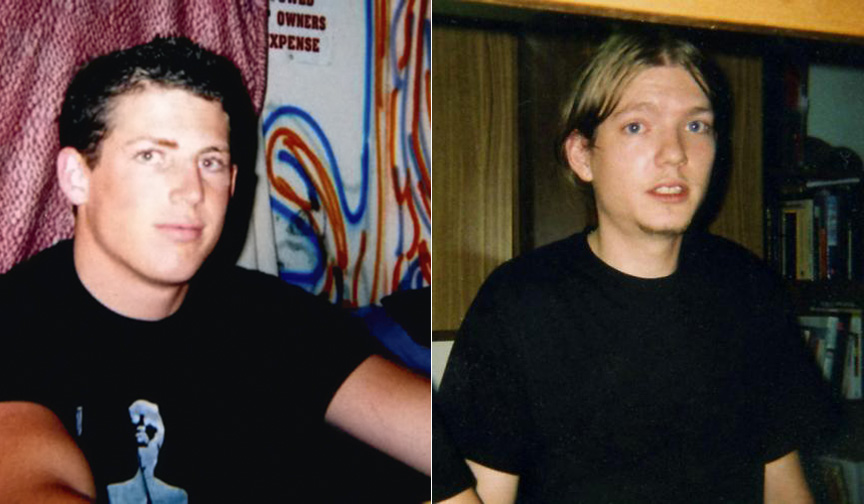
The Texas 2: David McKay and Bradley Crowder.
Waking up
Some of us were more surprised than others when Brandon revealed himself as an informant. My first reaction was deep sadness. I then went through a range of emotions: disbelief, shock, anger, outrage, and at times vindication. I am still hurt and angry, not just with Brandon, but with the whole system that supports and enables him.
I am still struggling with forgiveness for choices made in activist communities and by some of my friends. I understand how difficult it was; Brandon, at times, was also my friend. In the end we must examine the behavior we experienced, reflect on the array of choices we had, and explore what we could do differently to insure this does not happen again.
Brandon’s behavior was problematic long before 2008. Whether or not he was actually working for the state, he was doing their job for them by breeding discord within our politically active communities. I raised my concerns about Brandon’s behavior in New Orleans, in Austin, and also in Minneapolis. Read the rest of this entry »
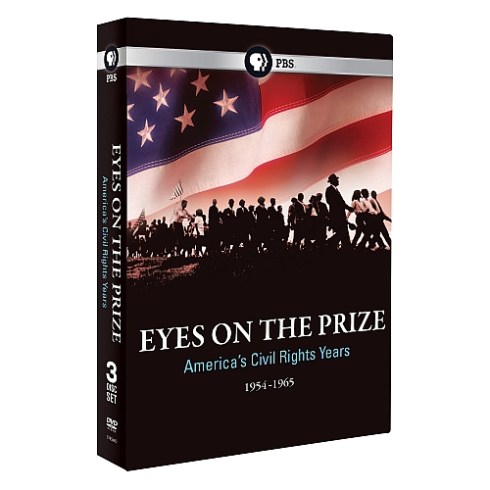 One of the best documentary series ever produced, Eyes on the Prize is a 14-part study of the Civil Rights Movement in the United States. This series is so important because it shows how ordinary people, when organized, can affect dramatic social change.
The Civil Rights Movement remains the most inspiring example of successful social movements in the United States, breaking down the evil system of racial segregation and opening up possibilities for Black people, as well as for other races, that never existed before. It’s important to remember that 50 years ago, most African Americans could not vote, but now we have a Black President.
Obviously the work of the Civil Rights Movement remains unfinished, as we still live in a racist society with many other severe social problems caused by capitalism as well. But as Eyes on the Prize displays so dramatically, the hope we seek lies not in politicians but in our very own hands. We must learn from the past in order to change the future.
I watched episode 1 today and will be viewing the others over the next few weeks. Would you like to watch and discuss the series with me? Please respond by leaving a comment!
Love and struggle,
alex
p.s. anyone know how to embed these videos on WordPress?
Episode 1: Awakenings (1954-1956)
Subjects: Origins of the Civil Rights Movement, Segregation, Black Soldiers in World War II, Brown v. Board of Education, Emmett Till, Rosa Parks, Montgomery Bus Boycott, Martin Luther King Jr, White Citizens Council, Ku Klux Klan, White Allies
Episode 2: Fighting Back (1957-1962)
Subjects: NAACP, Integration v. Segregation, Little Rock AR, The Little Rock 9, James Meredith, University of Mississippi
Episode 3: Ain’t Scared of Your Jails (1960-1961)
Subjects: Student Sit-ins, Nashville TN, Direct Action, Civil Disobedience, Student Nonviolent Coordinating Committee (SNCC), Ella Baker, Boycott Movement, Congress of Racial Equality (CORE), Freedom Rides, Southern Jails
Episode 4: No Easy Walk (1961-1963)
Subjects: Martin Luther King Jr, Southern Christian Leadership Conference (SCLC), Freedom Songs, Albany GA, Bull Connor, Birmingham AL, Fire Hoses and Dogs, John Lewis, March on Washington, John F. Kennedy, Civil Rights Act
Episode 5: Mississippi: Is This America? (1962-1964)
Subjects: Medgar Evers, Murder of Goodman, Chaney, and Schwerner, SNCC, Voting Registration Drives, Mississippi Freedom Summer, Mississippi Freedom Democratic Party, Failure of the Democratic Party
[This is the BEST video in the series. What SNCC did in Mississippi changed America forever.]
Episode 6: Bridge to Freedom (1965) Read the rest of this entry »
Are we living through the twilight of democracy, or the dawn of a new day?
That is up to us.
The Chambersburg Declaration is a brief but promising political document coming out of Pennsylvania, specifically the Community Environmental Legal Defense Fund. Explanation follows. [alex]
photo by neeloyunus on flickr
BY THE UNDERSIGNED IN CHAMBERSBURG, PENNSYLVANIA, ON
SATURDAY, FEBRUARY 20TH, 2010
We declare:
– That the political, legal, and economic systems of the United States allow, in each generation, an elite few to impose policy and governing decisions that threaten the very survival of human and natural communities;
– That the goal of those decisions is to concentrate wealth and greater governing power through the exploitation of human and natural communities, while promoting the belief that such exploitation is necessary for the common good;
– That the survival of our communities depends on replacing this system of governance by the privileged with new community-based democratic decision-making systems;
– That environmental and economic sustainability can be achieved only when the people affected by governing decisions are the ones who make them;
– That, for the past two centuries, people have been unable to secure economic and environmental sustainability primarily through the existing minority-rule system, laboring under the myth that we live in a democracy;
– That most reformers and activists have not focused on replacing the current system of elite decision-making with a democratic one, but have concentrated merely on lobbying the factions in power to make better decisions; and
– That reformers and activists have not halted the destruction of our human or natural communities because they have viewed economic and environmental ills as isolated problems, rather than as symptoms produced by the absence of democracy.
Therefore, let it be resolved:
– That a people’s movement must be created with a goal of revoking the authority of the corporate minority to impose political, legal, and economic systems that endanger our human and natural communities; Read the rest of this entry »
“When you take the time to research and analyze the wealth that has gone to the economic top one percent, you begin to realize just how much we have been robbed.”
Despite the economic crisis, the ultra-rich seem to be making off quite well, even increasing their incomes while the rest of us worry about unemployment, foreclosure, and bankruptcy.
Crooks and Liars recently posted an article, “Richest 400 Americans See Incomes Double, Tax Rates Halved,” which has the latest statistics on income inequality, but to fully understand the widening gap between rich and poor, check out the following essay from David DeGraw.
How long will we permit this to go on? [alex]
The Richest 1% Have Captured America’s Wealth — What’s It Going to Take to Get It Back?
The U.S. already had the highest inequality of wealth in the industrialized world prior to the financial crisis — and it’s gotten even worse.
By David DeGraw / February 19, 2010
Originally published by Alternet. Recovered from The Rag Blog.
“The war against working people should be understood to be a real war… Specifically in the U.S., which happens to have a highly class-conscious business class… And they have long seen themselves as fighting a bitter class war, except they don’t want anybody else to know about it.” — Noam Chomsky
As a record amount of U.S. citizens are struggling to get by, many of the largest corporations are experiencing record-breaking profits, and CEOs are receiving record-breaking bonuses. How could this be happening, how did we get to this point?
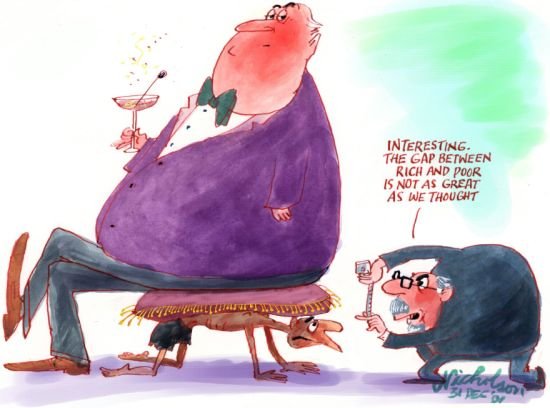 The Economic Elite have escalated their attack on U.S. workers over the past few years; however, this attack began to build intensity in the 1970s. In 1970, CEOs made $25 for every $1 the average worker made. Due to technological advancements, production and profit levels exploded from 1970-2000. With the lion’s share of increased profits going to the CEO’s, this pay ratio dramatically rose to $90 for CEOs to $1 for the average worker.
As ridiculous as that seems, an in-depth study in 2004 on the explosion of CEO pay revealed that, including stock options and other benefits, CEO pay is more accurately $500 to $1.
Paul Buchheit, from DePaul University, revealed, “From 1980 to 2006 the richest 1% of America tripled their after-tax percentage of our nation’s total income, while the bottom 90% have seen their share drop over 20%.” Robert Freeman added, “Between 2002 and 2006, it was even worse: an astounding three-quarters of all the economy’s growth was captured by the top 1%.”
Due to this, the United States already had the highest inequality of wealth in the industrialized world prior to the financial crisis. Since the crisis, which has hit the average worker much harder than CEOs, the gap between the top one percent and the remaining 99% of the U.S. population has grown to a record high. The economic top one percent of the population now owns over 70% of all financial assets, an all time record.
As mentioned before, just look at the first full year of the crisis when workers lost an average of 25 percent off their 401k. During the same time period, the wealth of the 400 richest Americans increased by $30 billion, bringing their total combined wealth to $1.57 trillion, which is more than the combined net worth of 50% of the US population. Just to make this point clear, 400 people have more wealth than 155 million people combined.
Meanwhile, 2009 was a record-breaking year for Wall Street bonuses, as firms issued $150 billion to their executives. 100% of these bonuses are a direct result of our tax dollars, so if we used this money to create jobs, instead of giving them to a handful of top executives, we could have paid an annual salary of $30,000 to 5 million people. Read the rest of this entry »


 The End of Capitalism
Recent Comments