The following article runs in the May 12, 2008 issue of The Nation magazine, one of the largest progressive publications in the United States. -alex

http://www.thenation.com/doc/20080512/hertsgaard

“Running on Empty”
by Mark Hertsgaard
The Nation‘s environment correspondent

It used to be that only environmentalists and paranoids warned about running out of oil. Not anymore. As climate change did over the past few years, peak oil seems poised to become the next big idea commanding the attention of governments, businesses and citizens the world over. The arrival of $119-a-barrel crude and $4-a-gallon gasoline this spring are but the most obvious signs that global oil production has or soon will peak. With global demand inexorably rising, a limited supply will bring higher, more volatile prices and eventually shortages that could provoke–to quote the title of the must-see peak oil documentary–the end of suburbia. If the era of cheap, abundant oil is indeed coming to a close, the world’s economy and, paradoxically, the fight against climate change could be in deep trouble. Read the rest of this entry »


This week, food riots are erupting in the poorest countries of the world, such as Haiti, where the majority of the population lives on under $2 a day. The protesters are calling for the resignation of their government, for its inability to provide basic necessities to the population. See this BBC News short video.

The price of grains, especially wheat (which has doubled in the past year), has been on a steady uphill trend for the past few years, causing major food shortages across much of the Global South.
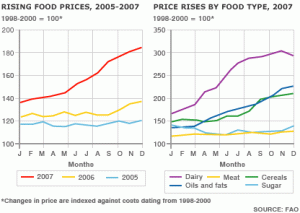
(image from BBC)

I want to highlight 4 underlying causes of this global food shortage:

1) Growing Inequality between the wealthiest and poorest people. Greater affluence in industrializing countries is driving larger levels of meat consumption, which requires far more wheat, other grains, and water to be consumed in order to produce the same amount of food. In fact, the majority of grains produced in the world are now fed to animals for meat. Meanwhile, hundreds of millions of people in the Global South are on the brink of starvation, or literally already starving.

2) Global Warming is causing unreliable and chaotic weather patterns across much of the food-producing regions of the world. Arable lands are turning into deserts as droughts worsen, while other regions are flooding with unseasonable downpours. These combine to create massive agricultural loss.

3) Biofuels like ethanol from corn production in the U.S. are quite literally food being used to fuel industry and automobiles. This manifests in driving up the cost of food for everyone, especially the poor, so that the largest agribusiness firms can earn huge profits, and the illusion of American prosperity surrounding large cars and wasteful consumerism can be maintained at all costs.

4) Most fundamental, The Global Oil Production Peak, which took place in 2006, is causing declining supplies of oil while demand surges across the industrial and industrializing world. We have seen a drastic and increasing rise in the price of oil over this period, which most Americans recognize in the high cost of gasoline. But for the poor of the world, a much more dire situation is emerging with food, because oil and other fossil fuels are the sources for most industrial fertilizers and pesticides, and because the modern system of food production and distribution are heavily dependent on oil for transportation, processing, packaging, refrigeration and cooking. In fact, the average American consumes over 10 calories of fossil fuels for every calorie of food eaten! Most people in the world can’t continue to afford this oil subsidy, and the crisis will only deepen as oil production declines in the coming years.
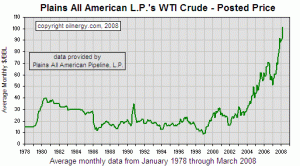
The Rising Price of Oil

(Image courtesy OILNERGY)


“The Revolution Will Not Be Funded: Beyond the Non-Profit Industrial Complex”

by INCITE! Women of Color Against Violence

2007 South End Press

This is a pretty wonderful collection of essays, put together by INCITE! Women of Color Against Violence, covering the rise of the Non-Profit Industrial Complex and it’s vampiric and co-opting effects on radical movements for social change. Some of the essays are more compelling than others, but I particularly found the historical background of the NPIC undercutting and distorting radical movements of the last 25 years revelatory. Plus the case-studies of groups that went for the 501(c)3 tax status and got the foundation grants, only to have it delegitimize and undermine their organizing, were extremely worth reading. Read the rest of this entry »


Check out this awesome essay by Paul Kivel – it really helped me understand my class background (as a member of the “buffer zone”) and how I can relate to others in an accountable way to achieve social change! – Alex

Social Service or Social Change?
Who Benefits from your Work
by Paul Kivel
copyright 2000

MY FIRST ANSWER TO THE QUESTION POSED IN THE TITLE is that we need both, of course. We need to provide services for those most in need, for those trying to survive, for those barely making it. We need to work for social change so that we create a society in which our institutions and organizations are equitable and just and all people are safe, adequately fed, adequately housed, well educated, able to work at safe, decent jobs, and able to participate in the decisions that affect their lives. Although the title of this article may be misleading in contrasting social service provision and social change work, the two do not necessarily go together easily and in many instances do not go together at all. There are some groups working for social change that are providing social service; there are many more groups providing social services that are not working for social change. In fact, many social service agencies may be intentionally or inadvertently working to maintain the status quo.

The Economic Pyramid
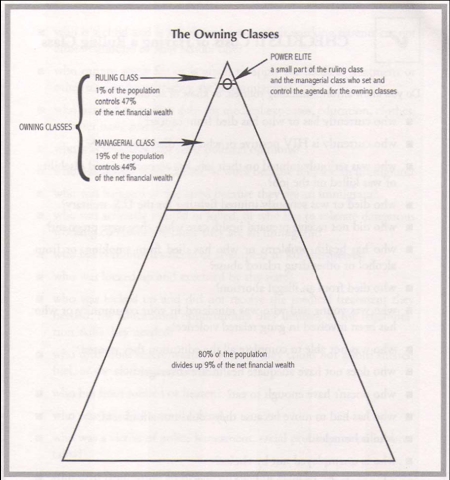
I want to begin by providing a context for this discussion: the present political/economic system here in the United States. Currently our economic structure looks like the pyramid in Figure One in which 1% of the population controls about 47% of the net financial wealthii of the country, and the next 19% of the population controls another 44%. That leaves 80% of the population struggling to gain a share of just 9% of the remaining financial wealth. That majority of 80% doesn’t divide very easily into 9% of resources, which means that many of us spend most of our time trying to get enough money to feed, house, clothe, and otherwise support ourselves and our families.

80% of the population controls 9% of the wealth!
Illustration by Alberto Ledesma Read the rest of this entry »


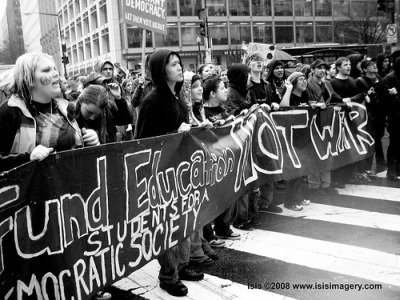
From March 17-21, 2008, Students for a Democratic Society led over 90 student actions across the country to mark the 5th Anniversary of the U.S. Invasion of Iraq! (See newsds.org/march20 for more details of the nationwide SDS actions)

One of the most exciting actions was in Washington DC. DC-SDS’ “Funk the War 3” dance party brought together 500+ youth and students to shut down K Street, where War Profiteers like Lockheed Martin and Bechtel are headquartered.

Those companies were shut down by the mobile antiwar dance party, which also hit up the Armed Forces Recruiting Center and spread the love there.

The action culminated in an SDS-organized blockade of Connecticut and K Sts., where 11 students chained themselves to school desks and demanded money for education, not for war. The intersection was held for over an hour by 200+ youth, despite pouring rain, until it was apparent that police were not willing or able to break up the blockade, and the students declared victory!

The SDS action was the largest and most energetic event of United for Peace and Justice’s “5 Years Too Many” events in DC on March 19th. The week of action brought major media attention to SDS, including 3 days straight of “The Return of Students for a Democratic Society” headlining the front page of MichaelMoore.com, an awesome article in The Nation, and a feature in the New York Times. It seems that SDS has gained a new prominence in the antiwar movement and is taking off right now!

See below for articles, video, audio and images from the 5th Anniversary Actions. Read the rest of this entry »


“Ain’t I a Woman: Black Women and Feminism”

by bell hooks

1981 South End Press

bell hooks is brilliant, let me say that first. I saw her speak recently and she totally blew me away, one of the most inspiring speakers I’ve ever seen. This was her first-ever book, from 1981, so it’s interesting for understanding where she started out, and as a kind of ‘period piece’ where you can tell she was really pushing against the boundaries and limitations of 1970s feminism. Ain’t I A Woman examines the history of the black female in America, including the sexist nature of the black civil rights/freedom movement, and the racist nature of the white feminist movement. It’s a good book for all of these reasons.

However, bell hooks has said that she doesn’t really like this book anymore, and it’s clear that there are some weaknesses here. Read the rest of this entry »


Part 1 of 9 – a brilliant and vivid look at Neoliberalism and those who struggle against it on all parts of the globe. bilingual (English/Spanish).

Enter your email address and subscribe to get the latest End of Capitalism news right in your inbox..

Join 883 other subscribers
You are here

Friendly Websites

Anda La Lucha
- Andalusia Knoll

Feminist Frequency
- Anita Sarkeesian

Recovering Hipster
- Heather

Praxis Makes Perfect
- Joshua Kahn Russell

Organizing for Power
- Lisa Fithian

Misanthropic Anthropologist

For Student Power
- Patrick St. John

AIDS and Social Justice
- Suzy Subways