
I Want a Twenty-Four-Hour Truce During Which There Is No Rape

Speech by Andrea Dworkin.

This was a speech given at the Midwest Regional Conference of the National Organization for Changing Men in the fall of 1983 in St Paul, Minnesota. One of the organizers kindly sent me a tape and a transcript of my speech. The magazine of the men’s movement, M., published it. I was teaching in Minneapolis. This was before Catharine MacKinnon and I had proposed or developed the civil rights approach to pornography as a legislative strategy. Lots of people were in the audience who later became key players in the fight for the civil rights bill. I didn’t know them then. It was an audience of about 500 men, with scattered women. I spoke from notes and was actually on my way to Idaho–an eight-hour trip each way (because of bad air connections) to give a one-hour speech on Art–fly out Saturday, come back Sunday, can’t talk more than one hour or you’ll miss the only plane leaving that day, you have to run from the podium to the car for the two-hour drive to the plane. Why would a militant feminist under this kind of pressure stop off on her way to the airport to say hi to 500 men? In a sense, this was a feminist dream-come-true. What would you say to 500 men if you could? This is what I said, how I used my chance. The men reacted with considerable love and support and also with considerable anger. Both. I hurried out to get my plane, the first hurdle for getting to Idaho. Only one man in the 500 threatened me physically. He was stopped by a woman bodyguard (and friend) who had accompanied me.

I have thought a great deal about how a feminist, like myself, addresses an audience primarily of political men who say that they are antisexist. And I thought a lot about whether there should be a qualitative difference in the kind of speech I address to you. And then I found myself incapable of pretending that I really believe that that qualitative difference exists. I have watched the men’s movement for many years. I am close with some of the people who participate in it. I can’t come here as a friend even though I might very much want to. What I would like to do is to scream: and in that scream I would have the screams of the raped, and the sobs of the battered; and even worse, in the center of that scream I would have the deafening sound of women’s silence, that silence into which we are born because we are women and in which most of us die.

And if there would be a plea or a question or a human address in that scream, it would be this: why are you so slow? Why are you so slow to understand the simplest things; not the complicated ideological things. You understand those. The simple things. The cliches. Simply that women are human to precisely the degree and quality that you are.

And also: that we do not have time. We women. We don’t have forever. Some of us don’t have another week or another day to take time for you to discuss whatever it is that will enable you to go out into those streets and do something. We are very close to death. All women are. And we are very close to rape and we are very close to beating. And we are inside a system of humiliation from which there is no escape for us. We use statistics not to try to quantify the injuries, but to convince the world that those injuries even exist. Those statistics are not abstractions. It is easy to say, “Ah, the statistics, somebody writes them up one way and somebody writes them up another way.” That’s true. But I hear about the rapes one by one by one by one by one, which is also how they happen. Those statistics are not abstract to me. Every three minutes a woman is being raped. Every eighteen seconds a woman is being beaten. There is nothing abstract about it. It is happening right now as I am speaking.

And it is happening for a simple reason. There is nothing complex and difficult about the reason. Men are doing it, because of the kind of power that men have over women. That power is real, concrete, exercised from one body to another body, exercised by someone who feels he has a right to exercise it, exercised in public and exercised in private. It is the sum and substance of women’s oppression. Read the rest of this entry »

More and more comparisons between today’s market plunge and the Great Depression of 1930s are being made and are needed.  This article from Monday favorably compares the collapse of the Dow Jones Industrial Average, the most important measure of industrial economic activity.

It’s interesting to note that Phil Dow, “market strategist for RBC Dain Rauscher & James” admits the possibility that we are witnessing “the end of capitalism.” He denies that this is the case, since “people will start buying cars [and houses] again“. He’s trying to be optimistic of course, but it’s hard to imagine anything more depressing, considering that members of the UN Intergovernmental Panel on Climate Change (IPCC) are now warning that greenhouse gas emissions are rising much more rapidly than their worst-case projections.

A new way of life is on its way that does not rely on consuming ever-increasing mountains of industrial products, and that’s cause for celebration. [alex]

Dow Jones decline rate mimics Great Depression

by Dawn Kawamoto

Originally published by CNET, March 2, 2009.

With the Dow Jones Industrial Average falling below the psychological watermark of 7,000 on Monday, investors may be wondering how it all stacks up against the stock market crash of the Great Depression.

It’s not looking good.

In the here and now, the Dow has dropped 52.5 percent since its high of 14,279.96 on Oct. 11, 2007, to its low point of 6,779.62 during intraday trading on Monday. (Update 1:16 p.m. PST: At Monday’s close it was 6,763.29, a drop of nearly 300 points from the previous close.)

And in taking a similar period of a year and five months in the late 1920s, it’s a case of deja vu.

The rate of decline is mimicking that of the Dow during the Great Depression.

Back on September 3, 1929, the Dow hit a high mark of 381.17. And over a similar length of time, it fell 54.7 percent to 172.36 on January 2, 1931.

“It’s very troubling if you have a mirror image,” said Phil Dow, market strategist for RBC Dain Rauscher & James. Read the rest of this entry »


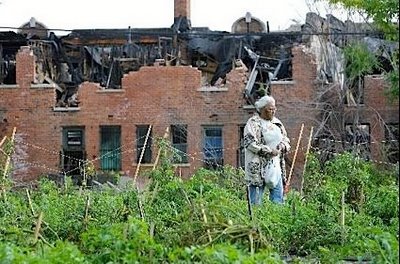
Grace Lee Boggs is a prominent long-time veteran of civil rights and other movements for justice.  An Asian-American woman, now in her 80s, she is active in building urban agriculture systems for the community of Detroit.  Their efforts to create a sustainable local economy out of a postindustrial urban shell are an example for all urban American cities. [alex]

Detroit: City of Hope
Building a sustainable economy out of the ashes of industry.

By Grace Lee Boggs

Originally published by In These Times

February 17, 2009.

Photographer: Fabrizio Costantini/Bloomberg News. Hazel Williams picks green tomatoes at an Urban Farm off Linwood Avenue in Detroit, on Sept. 22, 2008. Photo by Fabrizio Costantini / Bloomberg.

Photographer: Fabrizio Costantini/Bloomberg News. Hazel Williams picks green tomatoes at an Urban Farm off Linwood Avenue in Detroit, on Sept. 22, 2008. Photo by Fabrizio Costantini / Bloomberg.

Detroit is a city of Hope rather than a city of Despair. The thousands of vacant lots and abandoned houses not only provide the space to begin anew but also the incentive to create innovative ways of making our living—ways that nurture our productive, cooperative and caring selves.

The media and pundits keep repeating that today’s economic meltdown is the worst financial crisis since the Great Depression. But in the ’30s, the United States was an overproducing industrial giant, not today’s casino economy.

In the last few decades, once-productive Americans have been transformed into consumers, using more and more of the resources of the earth to foster ways of living that are unsustainable and unsatisfying. This way of life has created suburbs that destroy farmland, wetlands and the natural world, as well as pollute the environment.

The new economy also requires a huge military apparatus to secure global resources and to consume materials for itself, at the same time providing enormous riches for arms merchants and for our otherwise failing auto, air and ship-building sectors.

Instead of trying to resurrect or reform a system whose endless pursuit of economic growth has created a nation of material abundance and spiritual poverty—and instead of hoping for a new FDR to save capitalism with New Deal-like programs—we need to build a new kind of economy from the ground up.

That is what I have learned from 55 years of living and struggling in Detroit, the city that was once the national and international symbol of the miracle of industrialization and is now the national and international symbol of the devastation of deindustrialization.

When I arrived in Detroit in 1953, the population was 2 million, the majority white. Today, it is less than 900,000, majority black. Back then, racism was blatant and overt. Many bars, restaurants and hotels refused service to blacks. Blacks could buy homes in inner city neighborhoods but could not rent apartments in buildings right next door to these homes.

Meanwhile, freeways were enabling white flight to the suburbs, and technology was replacing human beings with robots.

In 1973, we elected our first black mayor, Coleman Young. Young was a gifted politician who was able to eliminate the most egregious examples of racism, especially in the police and fire departments and City Hall. But he was unable to imagine a post-industrial society. So, for 14 years, he tried in vain to woo industrial jobs back to Detroit.

In 1988, toward the end of his fourth term, Young decided that the factories weren’t coming back and that Detroit’s salvation depended on casino gambling, which he said would create 50,000 jobs.

To defeat his proposal, we organized Detroiters Uniting, a coalition of community groups, blue-collar, white-collar and cultural workers, clergy, political leaders and professionals.

Our concern was with how our city had been disintegrating socially, economically, politically, morally and ethically. We were convinced that we could not depend upon one industry or one large corporation to provide us with jobs. It was now up to us—the citizens of Detroit—to create meaningful jobs and income for all citizens.

We needed a new kind of city where citizens take responsibility for their decisions instead of leaving them to politicians or the marketplace.

Greening the Motor City
Read the rest of this entry »


Anatoly Karlin at Sublime Oblivion has compiled some provocative graphs which suggest that the global peak of oil production has played a large causative role in the global economic meltdown of the past few years. Right off the bat we should look at how skyrocketing oil prices caused global food shortages and price inflation for other necessities, but also how the rising gas prices hurt US Real Estate markets and burst the subprime mortgage bubble. We know how that damage was compounded into the financial crisis and got us where we are, but what hasn’t been studied is the role of oil in originating the breakdown, not to dismiss the role played by lax regulatory oversight, financial mismanagement or straight-up theft by large banks and speculators.

I look forward to this argument on the role of oil being expanded and enriched by an anti-capitalist framework. [alex]

Excerpts from Oily Origins of the Economic Crisis.

Anatoly Karlin, February 18, 2009.

In an article some months ago I suggested that “perhaps this crisis is simply an unconscious recognition of this inconvenient truth?” – namely, the peaking of oil extraction and all that it implies for the continued survival of a financial system built on assumptions of continuous economic growth. In other words, the fashionable approach of focusing on exotic financial instruments, regulatory failures, etc, if a case of mistaking the forest for the trees.

The Oil Drum had a nice graphical summary. According to the author, Gail the Actuary, the chain of causation runs thus:

This explains the extreme severity of the crash – record GDP growth at a time of plateaued oil extraction in the 2005-2008 period was patently unsustainable, so a very big “correction” could not have been unexpected.

And it is quite a correction.

As of the September-November average, global industrial production was plummeting at an annualized rate of -13% and merchandise trade by a truly remarkable -43%. And it is obvious the collapse accelerated since then…

Already far worse than during even the worst month of 2000-2001, the last and only global slowdown for which the IMF has data.

Another Oil Drum blogger, Phil Hart, wrote about the dramatic rise and fall in oil prices in terms of simple supply and demand curves…

Oil demand and supply.

His thesis is that because of the geological limits to oil supply, the marginal cost of providing ever more oil is generally low until it reaches some point – say, 85mn barrels a day – and then veers off into the sky (i.e. becomes very inelastic). Demand is also inelastic, since modern society basically runs on oil. Hence there comes a time when the demand curve reaches a point when its intersection with the supply curve – i.e., the market price – starts rising exponentially. Read the rest of this entry »


“How the Irish Became White”

by Noel Ignatiev

1995 Routledge

“It is a curious fact,” wrote John Finch, an English Owenite who traveled the United States in 1843, “that the democratic party, and particularly the poorer class of Irish immigrants in America, are greater enemies to the negro population, and greater advocates for the continuance of negro slavery, than any portion of the population in the free States.”

How did the Irish become White?  By violently subjugating African Americans, according to this courageous book by Noel Ignatiev.

As a part-Irish American, learning about the injustice that some of my ancestors took part in is deeply troubling, but it’s a history that we need to explore to uncover the true legacy of mass Irish immigration to America, and more fundamentally, the meaning of “Whiteness”.

The Irish in Ireland of the early-19th Century were a revolutionary people: impoverished, agrarian, and determined to break free of the grip of England’s tyranny. But once these same freedom-lovers emigrated to the United States, a peculiar thing happened: they were faced with a society based on racial segregation and industrial capitalism. Moreover, there began a large “Nativist” movement by wealthy Protestant Anglo-Saxons who tried to restrict immigration and subdue Irish/Catholic influence in the New World.

In order to overcome these barriers, the Irish made a strategic choice: escape the bottom-rung of poverty and be accepted into mainstream US society by aggressively aligning themselves with the Democratic Party and doing everything they could to keep African Americans in slavery or otherwise out of the labor market. Thus they earned the right to be considered “White” and receive the benefits and privileges associated with that social category.

Ignatiev makes a compelling case that “When Irish workers encountered Afro-Americans, they fought with them, it is true, but they also fought with immigrants of other nationalities, with each other, and with whomever else they were thrown up against in the marketplace.”  In other words, it wasn’t that the Irish were inherently more racist than any other group. Instead, the race riots when rowdy Irish attacked African Americans were largely in response to an economic condition arising in early US capitalism: Northern industrial labor markets were saturated by waves of immigrants and freed slaves competing over lower and lower wages. To secure jobs for themselves, the Irish became the hammer that pounded away at racial segregation to force African Americans out of the factories and into poverty and the ghetto.

By doing so, they also solidified the major distinction between relatively privileged sectors of the US working class and those on the bottom – “Whiteness”. Ignatiev explains: “Since ‘white’ was not a physical description but one term of a social relation which could not exist without its opposite, ‘white man’s work’ was simply, work from which Afro-Americans were excluded.” Read the rest of this entry »


This is a wonderful essay looking at how a Sustainable Economy must be structured democratically and decentralized to the local level.  The only thing I would add is that we need a realistic plan of action to get us from the capitalist hellhole we currently inhabit to this accurate vision of a future sustainable society, and we can’t be afraid to confront powerful forces which want to stop us.

For me as a young person in the United States, the heart of the Empire, I see my current role as organizing youth and students in resistance to the forces of domination (war, debt, oppression).  Others may be better positioned to organize their workplace or their communities, or to start urban gardens, or other projects.  We each have a role to play, and we need to discover it ourselves. [alex]

Building a Sustainable Economy

by Marcin Gerwin

Democracy first

In 1994 the government of Haiti lifted tariffs and allowed imports of cheap, subsidized rice and other crops from abroad. This policy was recommended by the International Monetary Fund and urged by the U.S. government (1). Over the years this tiny change in policy led to an estimated 830,000 job losses, it damaged food security and rural livelihoods, and eventually led to food riots and hunger in 2008 (2). If people in Haiti were to decide by themselves on their country policy, would they choose the recommendations of the IMF that brought them into starvation? Would people of Ecuador allow toxic pollution in the Amazon for the sake of Chevron Texaco profits? Would people in India accept genetically modified seeds of cotton that caused crop failures, spiral of debt and hundreds of farmer suicides? And would people in the USA support bailing out banks with their own money in a way that is not transparent and does not lead to the recovery of the financial system? They wouldn’t. These things happen around the world because we still don’t have true democracy, where people set the rules for themselves.

rice-in-indiaWomen sowing rice in India
Photo: Michael Foley

In 2001 twenty subsistence farmers, small traders, small food processors, and consumers, mostly women, and some of them illiterate, met in Indian village to decide on the future of agriculture in the state of Andhra Pradesh. They were chosen to represent the rural diversity of their state. They presented three different models of development. The official plan, put forward by Chief Minister of the state, was backed by grants and loans from the World Bank and the UK government. The plan was to mechanize, consolidate and genetically engineer agriculture of the state to produce cash crops for export, and to reduce the farming population from 70% to 40%, to have more workers for industry. The second vision involved developing environmentally friendly agriculture to produce cheap organic products for domestic and Northern supermarkets and it was supported by the International Federation of Organic Agriculture Movements and the International Trade Center. The third vision was influenced by Gandhian and indigenous ideas, and involved increasing local self-reliance and sustainability in both agriculture and economics.

Each model was illustrated by videos, farmers and traders could hear the summary of the policies, ask questions, consult with government officials, scientists, corporate and NGO representatives from the state, national and international level. They also considered advantages and disadvantages of each vision, based also upon their own knowledge, priorities and aspirations. After one week they made a decision.

Tom Atlee writes:

In their recommendations (…) they said they wanted self-reliant food and farming, and community control over resources. They wanted to maintain healthy soils, diverse crops, trees and livestock, and to build on their indigenous knowledge, practical skills and local institutions. They wanted to maintain the high percentage of people making their livelihood from the land, and did not want their farms consolidated or mechanized in ways that would displace rural people. Most of them could feed their families through their own sustenance farming. They did not want to end up laboring in dangerous brick kilns outside of Hyderabad, like so many who had left their farms. They also rejected genetically modified crops and the export of their local medicinal plants. (3)

If we wish to make some meaningful changes in the world, we need appropriate tools for that. A number one tool in the earth repair workshop is community-based democracy. It is a key for unlocking the potential for sustainability.

Click here to read more


Fundamentalist Consumerism and an Insane Society

February 2009
By Bruce E. Levine

Originally published by ZMag.

At a giant Ikea store in Saudi Arabia in 2004, three people were killed by a stampede of shoppers fighting for one of a limited number of $150 credit vouchers. Similarly, in November 2008, a worker at a New York Wal-Mart was trampled to death by shoppers intent on buying one of a limited number of 50-inch plasma HDTVs.

Jdiniytai Damour, a temporary maintenance worker was killed on “Black Friday.” In the predawn darkness, approximately 2,000 shoppers waited impatiently outside Wal-Mart, chanting, “Push the doors in.” According to Damour’s fellow worker Jimmy Overby, “He was bum-rushed by 200 people. They took the doors off the hinges. He was trampled and killed in front of me.” Witnesses reported that Damour, 34 years old, gasped for air as shoppers continued to surge over him. When police instructed shoppers to leave the store after Damour’s death, many refused, some yelling, “I’ve been in line since yesterday morning.”

The mainstream press covering Damour’s death focused on the mob of crazed shoppers and, to a lesser extent, irresponsible Wal-Mart executives who failed to provide security. However, absent in the corporate press was anything about a consumer culture and an insane society in which marketers, advertisers, and media promote the worship of cheap stuff.

Along with journalists, my fellow mental health professionals have also covered up societal insanity. An exception is the democratic-socialist psychoanalyst Erich Fromm (1900-1980). Fromm, in The Sane Society (1955), wrote: “Yet many psychiatrists and psychologists refuse to entertain the idea that society as a whole may be lacking in sanity. They hold that the problem of mental health in a society is only that of the number of ‘unadjusted’ individuals, and not of a possible unadjustment of the culture itself.”

While people can resist the cheap-stuff propaganda and not worship at Wal-Mart, Ikea, and other big-box cathedrals—and stay out of the path of a mob of fundamentalist consumers—it is difficult to protect oneself from the slow death caused by consumer culture. Human beings are every day and in numerous ways psychologically, socially, and spiritually assaulted by a culture which:

  • creates increasing material expectations
  • devalues human connectedness
  • socializes people to be self-absorbed
  • obliterates self-reliance
  • alienates people from normal human emotional reactions
  • sells false hope that creates more pain

Read the rest of this entry »


One of Philadelphia’s larger newspapers puts Paul Glover, local currency and mutual aid-based health care advocate, on its cover story. As always, Paul makes wise and witty proposals to help us solve our economic and ecological woes, and now people are finally listening!

My favorite solution: “Neighborhood watch instead of neighborhood watch TV.” [alex]

Prepare for the Best

A guide to surviving — and thriving in — Philadelphia’s new green future.

Published: Jan 28, 2009
CityPaper

The Dark Season closes around Philadelphia. Wolves howl, “Tough times coming!” Young professionals with good jobs study budget cuts, watch stocks flail. Career bureaucrats are laid off; college students wonder who’s hiring. Old-timers remember when Philadelphia staggered through the terrible Depression years without jobs or dollars, while crime and hunger rose. Some districts here never escaped that Depression — they’re still choosing between heating and eating.

As usual, the future will be different. Philadelphia’s responses to global warming and market cooling, high fuel and food prices, health unsurance, mortgages, student debt and war will decide whether our future here becomes vastly better or vastly worse. Whether we’re the Next Great City or Next Great Medieval Village. Imagine Philadelphia with one-tenth the oil and natural gas.

But to hell with tragedy. Let’s quit dreading news. Take the Rocky road. There are Philadelphia solutions for every Philadelphia problem.

Imagine instead that, 20 years from now, Philadelphia’s green economy enables everyone to work a few hours creatively daily, then relax with family and friends to enjoy top-quality local, healthy food. To enjoy clean low-cost warm housing, clean and safe transport, high-quality handcrafted clothes and household goods. To enjoy creating and playing together, growing up and growing old in supportive neighborhoods where everyone is valuable. And to do this while replenishing rather than depleting the planet. Pretty wild, right?

Entirely realistic. Not a pipe dream. And more practical than cynical. The tools, skills and wealth exist.

Mayor Michael Nutter foresees we’ll become the “Greenest City in the United States.” So it’s common-sensible to ask, “What are the tools of such a future?” “What jobs will be created?” “Who has the money?” “Where are the leaders?” “How will Philadelphia look?” “What can we learn from other cities?”

Some of the proposals sketched here can be easily ridiculed, because they disturb comfortable work habits, ancient traditions and sacred hierarchies. Yet they open more doors than are closing. They help us get ready for the green economy, and get there first. Big changes are coming so we might as well enjoy the ride. You have good ideas, too — bring ’em on.

From “Yes We Can” to “Now We Do”

As President Barack Obama says, “Change comes not from the top down, but from the bottom up.” Philadelphia’s chronic miseries suggest that primary dependence on legislators, regulators, police, prisons, bankers and industry won’t save us. They’re essential partners, but the people who will best help us are us. Read the rest of this entry »

Enter your email address and subscribe to get the latest End of Capitalism news right in your inbox..

Join 883 other subscribers
You are here

Friendly Websites

Anda La Lucha
- Andalusia Knoll

Feminist Frequency
- Anita Sarkeesian

Recovering Hipster
- Heather

Praxis Makes Perfect
- Joshua Kahn Russell

Organizing for Power
- Lisa Fithian

Misanthropic Anthropologist

For Student Power
- Patrick St. John

AIDS and Social Justice
- Suzy Subways