“Yes Means Yes! Visions of Female Sexual Power and A World Without Rape”

Jaclyn Friedman & Jessica Valenti

2008 Seal Press

Easily the best book I’ve read this year, if not ever. Yes Means Yes! is an anthology of essays from women and trans folks (and a few men) of all backgrounds, white, black, Latina, Asian, poor, affluent, queer, hetero, sex workers, dominatrices, bloggers, organizers, educators, artists, and survivors, all answering the question, “How can we create a world without rape?”

This book more than any other opened my eyes to the central importance of female sexual power to movement for progressive social change. Through dissecting sexual assault and “rape culture” from ALL angles, the writers articulate that the objectification and control of female bodies is literally the cornerstone of patriarchal society.  Therefore efforts to reclaim female body sovereignty and sexual power are at the forefront of revolutionary change.

This book does not just offer women tips on how to avoid sexual assault (although it does encourage self-defense classes!), it courageously directs blame at the male-dominated society that puts women in dangerous situations on a daily basis.  Similarly, as should be obvious from the title, this work is not just about teaching men to respect “No”, but showing women (all people really) how to love their bodies and embrace their sexuality, in whatever way it manifests.  Enthusiastic consent, responding to “Yes!” and cautious “Maybes”, and taking things one step at a time without assumptions or feelings of entitlement to orgasm, while respecting the ability of a sexual partner to say “Stop.” at any moment, shows a way to the best and most liberatory sex imaginable.

But the book covers so much more than consent. This is a feminist handbook for the masses: well-written, varied, practical, theoretical, yet accessible.

It’s hard to pick a favorite essay, but the one that spoke to me the most was “Killing Misogyny: A Personal Story of Love, Violence, and Strategies for Survival” by Cristina Meztli Tzintún, a personal story about overcoming abusive and controlling male partners. Cristina relates how she got involved with a “radical, feminist” man of color and bonded through activism.  Before she knew it she was years into an abusive relationship that gave her STDs and an inability to leave him, despite his cheating on her with his students, half his age. The pattern mirrored her parents’ disastrous marriage, which made it even more depressing that she could not break free of the cycle of abuse.

While it’s easy to demonize her partner, Alan, a more honest reading will recognize some of his patterns in each of us who have been male-socialized. For example, entitlement to women’s bodies and lack of consideration for the emotional damage wrought by selfish actions are things I know I have to struggle against. Cristina’s bravery in leaving Alan and demanding accountability for his assaults should encourage all of us, that misogyny can in fact be beaten and that personal transformation is an incredibly political act.

I can’t recommend this collection highly enough. Everyone needs to read this book.


“The Mass Psychology of Fascism”

by Wilhelm Reich

1946 The Noonday Press

First written in Germany in 1932 as Hitler was coming to power, then revised in the US in 1944, this is a classic study of the characteristics of fascist movement. Reich, a former Marxist from the Frankfurt School, emphasizes that fascism is not unique to Germany or Japan or Italy, but is instead “the basic emotional attitude of the suppressed man of our authoritarian machine civilization and its mechanistic-mystical conception of life.”

In other words it’s not enough to blame Hitler or the Nazis or any political party for the rise of fascism, we have to understand why millions of people have been, and continue to be, drawn to Right-wing movement (its mass character is what distinguishes fascism from simple authoritarianism).  Finding its base in the Middle Classes, fascist movement feeds upon authoritarian patriarchal social structures, especially the father-dominated family, which prepares children to obey and even revere a harsh “leader.”

But what was most interesting to me about this book is the politics of sexuality.  Reich as a psychiatrist observed that the repression of sexuality, especially from a young age, prepares people for lifetimes of neurotic self-hatred as some of their most basic and healthy life functions become embedded with deep shame and guilt.  I would add, sexual assault and child abuse add much fuel to this fire.  Reich stresses that children, adolescents and women are perpetually denied control over their sexual desires and bodies, which is what gives the patriarchal father so much power in the family, and therefore the sexual repression of masses of people becomes the seeds that grow fascist political movements.

I will write more on this train of thought in my review of Yes Means Yes!, and it’s also something I’ve been sparked to consider after watching the film The Handmaid’s Tale, about a dark future where pollution has made most women sterile, and a Christian fascist movement seizes control of society to make the remaining fertile women into the sex slaves of powerful male leaders.  It’s surprisingly realistic in some scary ways, because it builds from the sad truth that the patriarchal Christian Right is a real force in society and continues to attack the rights of women to control their own bodies and sexuality.  This tendency must be overcome, by women and trans folks taking back their body sovereignty and proclaiming their sexuality as no one’s but their own.


Part 1 of The Handmaid’s Tale. Read the rest of this entry »


[You know the prison-industrial complex has gotten out of hand when white Southern U.S. Senators are calling it out for being racist. – alex]

Why We Must Fix Our Prisons

By Senator Jim Webb, VA

jim-webbAmerica’s criminal justice system has deteriorated to the point that it is a national disgrace. Its irregularities and inequities cut against the notion that we are a society founded on fundamental fairness. Our failure to address this problem has caused the nation’s prisons to burst their seams with massive overcrowding, even as our neighborhoods have become more dangerous. We are wasting billions of dollars and diminishing millions of lives.

Sen. Webb introduces new legislation:
‘It’s time to change the law’

We need to fix the system. Doing so will require a major nationwide recalculation of who goes to prison and for how long and of how we address the long-term consequences of incarceration. Twenty-five years ago, I went to Japan on assignment for PARADE to write a story on that country’s prison system. In 1984, Japan had a population half the size of ours and was incarcerating 40,000 sentenced offenders, compared with 580,000 in the United States. As shocking as that disparity was, the difference between the countries now is even more astounding–and profoundly disturbing. Since then, Japan’s prison population has not quite doubled to 71,000, while ours has quadrupled to 2.3 million.

The United States has by far the world’s highest incarceration rate. With 5% of the world’s population, our country now houses nearly 25% of the world’s reported prisoners. We currently incarcerate 756 inmates per 100,000 residents, a rate nearly five times the average worldwide of 158 for every 100,000. In addition, more than 5 million people who recently left jail remain under “correctional supervision,” which includes parole, probation, and other community sanctions. All told, about one in every 31 adults in the United States is in prison, in jail, or on supervised release. This all comes at a very high price to taxpayers: Local, state, and federal spending on corrections adds up to about $68 billion a year. Read the rest of this entry »


Very well-spoken article poking fun at our enigmatic president, who continues to flirt with both of the groups who brought him to the Big Dance: the corporate/financial elites who paid for his campaign, and the millions of progressive Americans who mobilized and turned out the vote.

Inspirational words, impressive moves, and boyish good looks have kept the two suitors enamored thus far, but at some point Barack’s going to have to choose his partner for the slowdance. So far he’s been sipping punch with the bankrolling capitalists, who have seduced him with fancy airplanes and false promises, but we, the people have to work up the courage to demand his attention if we have any hope of him coming home with us at the end of the night. And we can’t hide our intentions; let’s make clear that partnering with us means rejecting the system that caused this crisis – capitalism. Let’s be realistic and demand the impossible. [alex]

Fred Astaire in the White House

by Michael Brownstein

Originally published by Reality Sandwich, April 13, 2009.

obamadancebig “You can never awaken using the same system that put you to sleep in the first place.”

–Gurdjieff

This is an appeal, an open letter, a cry in the night: no matter how cranky it may make us to brush the stardust from our eyes, no matter how many friends we think we’ll lose by looking long and hard at what’s going on around us, let’s try to stay awake. Let’s not lose touch with what we really want for ourselves. Let’s not forget what we know about the nature of consumer capitalism: it is unsustainable and unworkable because it depends on infinite expansion in a finite world. It can only survive by a violent takeover of what belongs to others. Let’s not settle for halfway measures.

And let’s not wait for deliverance from on high.

Because the president we elected — out of so much hope for a definitive break with what came before — is not who he seems. It’s true that unlike the previous inhabitant of the White House (remember him?), Barack Obama is sane, intelligent, and mature. He’s responsive to what others think. He hopes to institute real change in education, health care, the environment.

But even with his great charisma and silver tongue, he’s a proper soldier for the system which is ravishing the planet. As he said in his inauguration speech in January, already aware of the huge financial mess he was inheriting, “We will not apologize for our way of life.”

What do these words mean? They mean that the mall-i-zation of the planet will continue. They mean that the commercialization of all of life will not stop. They mean that our massive so-called footprint will never be substantially downsized.

And they mean that the force which has erased indigenous cultures and plant and animal species, which has sullied our air and soil and water, will essentially not be called into question, no matter how many of its most glaring excesses may be curbed.

Read the rest of this entry »


More and more people are using the language of peak oil and becoming aware that the future we once took for granted is now being foreclosed (not incidentally, by the same folks who are foreclosing a lot of our homes).  It is increasingly clear that we stand at a cross-roads, and that neither road leads anywhere similar to the global capitalist era we just passed through.

Here are some excerpts from a good article that acknowledges the reasons why the future will be nothing like the past, and lays out the 2 paths we can now head down.  I wrote some thoughts at the end to inspire us to think realistically and demand the impossible. [alex]

Time to Deliver: No Turning Back, Part I.

by Sara Robinson

April 7, 2009

Originally published by Campaign for America’s Future

..[T]he two dominant scenarios about the American future that progressives seem to be wrestling with right now [might be described as]:

1) Permanent Decline — Due to Americans’ native hyperindividualism, political apathy, and overweening willingness to accept personal blame for their country’s failures, the corporatists finally succeed in turning the US into Indonesia. This time, we will not find the will to fight back (or, if we do, it will be too late). As a result, in a few years there will be no more middle class, no upward mobility, few remaining public institutions devoted to the common good, no health care, no education, and no hope of ever restoring American ideals or getting back to some semblance of the America we knew.

2) Reinvented Greatness — Americans get over their deeply individualistic nature, come together, challenge and restrain the global corporatist order, and finally establish the social democracy that the Powers That Be — corporate, military, media, conservative — have denied to us since the 1950s. This happens in synergy with a move to energy and food self-sufficiency, the growth of a sustainable economy, a revival of participatory democracy, and a general renewal of American values that pulses new life into our institutions and assures us a much more stable future.

Conservatives and the mainstream media, of course, are also offering a third scenario:

3) Happy Face — Prop up the banks, keep people in their houses, and by and by everything will get back to “normal” (defined as “how it all was a few years ago.”)

[Sara recognizes that this third “road” is an illusion, for the following underlying realities which cannot be ignored any longer. -alex]

1. Energy regime change

The first reason there’s no going back to the way it was is that there’s simply not enough oil left in the ground — or carbon sinks left in the world — to sustain America as we’ve known it. We may well be able to sustain some semblance of that way of life (or perhaps, find our way to one even more satisfying); but we won’t be running it on oil or coal.

And when the oil goes, so goes the empire. Read the rest of this entry »


Below I’ve reposted a new article by Roger Baker, former ’60s SDSer and current peak oil activist in Austin, TX, linking the Economic Crisis with Peak Oil.  There is more evidence mounting that last year’s global economic downturn was to some degree a direct result of the unprecedented oil price spike that immediately preceded it.

For example, this article (“Jeff Rubin: Oil Prices Caused the Current Recession”) explains that Europe and Japan (which are both more vulnerable to oil prices because they produce less oil than the US but consume plenty) entered recession before the financial subprime crisis hit global markets.

Quote: “Higher oil prices started four of the last five world recessions; we shouldn’t be too surprised if they started this one also.”

Past Recession and Causal? Oil Spikes

Keep in mind the unprecedented nature of this recent oil price spike, where the price of oil went to all-time record levels of nearly $150/barrel. This chart suggests that the economic effects of past price rises will likely pale in comparison to this much greater recent spike, at the end of the day.
recent-oil-spike-vs-past-spikes

Finally, we have this telling quote from Gail the Actuary: “It seems to me that the problem with non-availability of credit, particularly long-term debt, is ultimately tied in with peak oil. It is difficult to have more than a tiny amount of long term debt once an economy is no longer growing.”

My book, The End of Capitalism, will explore this theme in more depth, but it’s worth conjecturing:  If the global economy literally cannot grow any more, because of real and unavoidable limits on vital resources such as oil, how can we anticipate the multi-layered global consequences?

We have arguably begun witnessing the first wave of financial consequences, but this is just the tip of the iceberg.  How might the economy as a whole system have to transform, and if growth as the paradigm of industrial capitalism is literally behind us, what kind of economy will the paradigm shift towards? Will we see a new sustainability rooted in democracy and freedom, or an even greater tyranny than what capitalism has wrought?
[alex]

Some Economic Implications of Peak Oil

By Roger Baker • on April 27, 2009

World oil production probably peaked in 2008. Liquid fuel production, including oil, is indicated by the OPEC data [1] to have reached a peak in July 2008 at about 86 million barrels per day, with its price peaking at about the same time. ASPO International agrees, as indicated on the chart page of their recent newsletters [2].

Peak oil has profound economic implications, most of which are unwelcome. There is good evidence indicating that peak oil triggered the global economic crisis; that oil price was the limiting factor that broke the momentum as the global economy tried to keep expanding. [3,4].

Predictably some factor like the end of cheap oil must limit the ability of global investments to expand exponentially, while paying interest on the global debt bubble. The risk was evenly spread by instruments like credit default swaps, so the collapse was global.There is scholarly confirmation of the role of the 2008 oil shock on the global economy should see the April 2009 Brookings paper “Causes of the Oil Shock of 2007-08″, by UC San Diego economist Dr. James Hamilton: [5,6].

“…Whether we would have avoided those events had the economy not gone into recession, or instead would have merely postponed them, is a matter of conjecture. Regardless of how we answer that question, the evidence to me is persuasive that, had there been no oil shock, we would have described the U.S. economy in 2007:Q4-2008:Q3 as growing slowly, but not in a recession.” Read the rest of this entry »


you-call-this

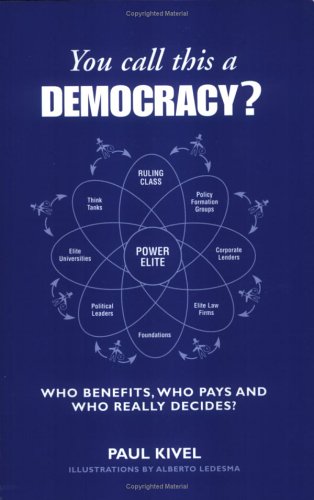
“You Call This a Democracy? Who Benefits, Who Pays, and Who Really Decides?”

by Paul Kivel

2004 Apex Press

Paul Kivel exposes the ruling class of the United States and how it operates in this short, easy-to-read book. With simple concepts and cute illustrations, a nuanced class analysis is presented in a very clear and accessible format.

If the education system was any good at all, “You Call This a Democracy?” would be one of the textbooks used in all high schools. It explains what the ruling class is (those with a family income above $373,000 and net financial wealth of at least $2 million), how it controls the government, media, and economy, and the negative effects we all suffer, such as poverty, wars, disease, pollution, over-working, stress, and meaningless, isolated lives. Kivel particularly does a great job exposing how the ruling class uses racism, sexism, homophobia and other social divisions to keep itself, a relatively small group of basically white Protestant men, in power. Making the connections between systems of oppression is one of the keys to the freedom of everybody, and this book helps move that analysis forward.

There a couple criticisms I could make about the book, first that it doesn’t inspire enough hope or provide much of a systematic solution to the problem that it systematically critiques. And secondly that the book can be cumbersome to read because of a fair amount of repetition coupled with too many general statements about segments of the population. To a certain extent, this was unavoidable in a book of this nature, but I could have used more examples of particular corporations, politicians, and businesspeople and their ilk, even though the examples given in the book are all great.

Definitely check this out if you want to have any idea about the country you’re living in, and how you and your family and everyone you care about are being screwed over by the super-wealthy elite. The path to a democratic future starts when we become informed.


“The war on population always has been, and will continue to be, a war on women’s bodies.”

After reading this article by Betsy Hartmann rebutting recent psuedo-environmental hysteria surrounding overpopulation, I wanted to investigate further how fears of overpopulation facilitate sexist, racist and imperialistic policies by Western countries and NGOs against poor women of color in the Global South.

As Hartmann states with clarity:

“The population controllers have blinders on their eyes when they attribute the cutting down of forests, the polluting of water supplies, and the extinction of species to too many poor people, rather than the unchecked power of large corporations to monopolize resources and ravage the land. Missing from the picture is the question of technological choice: for example, reducing the population of automobiles and investing in public transport worldwide would do much more to curtail climate change than imposing limits on family size.”

This seems to me fundamentally correct. It’s clear that human civilization has overshot the capacity of the Earth to provide for it, that’s not in question. The question is about what forces are responsible for this, and what can we do about it?

For Hartmann and myself, the number of people alive is not nearly as important as the structure of the economic system in which we live. The planet could support 6, or maybe even 9, billion people living a low-impact lifestyle, based on community subsistence and a diet full of fruits and vegetables. But the planet cannot possibly support 6 billion people living like Americans, with their cars, and their computers, and their wars.

As with all things, the debate on “overpopulation” is a political debate, because its a question about who has power and who doesn’t. Placing the blame on poor women is just a way of ignoring the real power-holders: Large multinational corporations and Western capitalist governments.

Below are excerpts from an article that I found helpful in explaining this more clearly. [alex]

10 Reasons to Rethink “Overpopulation”

By the Population and Development Program at Hampshire College

Fears of overpopulation are pervasive in American society. From an early age we are taught that the world is overpopulated and that population pressure is responsible for poverty, hunger, environmental degradation and even political insecurity. If we don’t get population growth under control now, the argument goes, our future is in danger.

Conventional wisdom, however, is not always wise. Placing the blame on population obscures the powerful economic and political forces that threaten the well-being of both people and the planet. It leads to top-down, target-driven population control programs that undermine voluntary family planning and women’s reproductive rights. It reinforces racism, promoting harmful stereotypes of poor people of color. And it prevents the kind of global understanding we need in order to reach across borders to work together for a more just, peaceful and environmentally sustainable world.

Here are ten reasons why we should rethink ‘overpopulation.’

2. The focus on population masks the complex causes of poverty and inequality.

A narrow focus on human numbers obscures the way different economic and political systems operate to perpetuate poverty and inequality. It places the blame on the people with the least amount of resources and power rather than on corrupt governments and economic and political elites. It ignores the legacy of colonialism and the continuing unequal relationship between rich and poor countries, including unfavorable terms of trade and the debt burden. It says nothing about the concentration of much wealth in a few hands. In the late 1990s, the 225 people who comprise the ‘ultra-rich’ had a combined wealth of over US $1 trillion, equivalent to the annual income of the poorest 47% of the world’s people.

3. Hunger is not the result of ‘too many mouths’ to feed.

…There is enough food for every man, woman and child to have more than the recommended daily calorie intake. People go hungry because they do not have the land on which to grow food or the money with which to buy it. Read the rest of this entry »

Enter your email address and subscribe to get the latest End of Capitalism news right in your inbox..

Join 883 other subscribers
You are here

Friendly Websites

Anda La Lucha
- Andalusia Knoll

Feminist Frequency
- Anita Sarkeesian

Recovering Hipster
- Heather

Praxis Makes Perfect
- Joshua Kahn Russell

Organizing for Power
- Lisa Fithian

Misanthropic Anthropologist

For Student Power
- Patrick St. John

AIDS and Social Justice
- Suzy Subways