
You are currently browsing the category archive for the ‘Resistance’ category.
In a dispute which perfectly represents the struggle for “Green Jobs”, workers at the Vestas wind energy plant in the UK have occupied their factory to save 600 jobs and one of the largest wind turbine manufacturing sites in the country. A coalition of labor and environmental groups have organized to support them with daily rallies, while the workers inside wait for the government to step in and start production again. “Now I’m not sure about you but we think it’s about time that if the government can spend billions bailing out the banks – and even nationalise them – then surely they can do the same at Vestas.”
For background and updates, see the workers’ blog: http://savevestas.wordpress.com or this article: Vestas Protest, What’s it All About?
Send messages of support to savevestas@googlemail.com
The events at Vestas have been just one in a series of worker occupations around the world in the wake of the current economic crisis. Workers are not allowing their jobs to be closed down, when corporations and banks are receiving large financial bailouts. This article gives some of the highlights of the new wave of worker militancy. [alex]
Global Trend for Sit-ins and Occupations as Mass Redundancies Continue
Terry Macalister
Originally published by The Guardian, UK – July 24, 2009
Trade union leaders warned tonight that the direct action seen at the Vestas factory was likely to be repeated elsewhere as workers refused to “bend their knee and accept their fate” in the face of mass redundancies caused by recession.
The sit-in at the Isle of Wight wind turbine plant was the latest in Britain, they said, and was part of a wider trend of militant tactics being used as far afield as the US, South Korea and China.
In France, where such tactics have been more common, the manager of a British company was taken hostage by workers today in a dispute over redundancies. About 60 workers at Servisair Cargo at Roissy airport in Paris prevented the director, Abderrahmane El-Aouffir, from leaving the firm’s offices after he refused to meet their demands in the latest case of so-called “boss-napping” to hit France.
The four day Vestas sit-in, which is an embarrassment both to the world’s biggest turbine manufacturer and a government trying to launch a low-carbon jobs revolution, follows a similar occupation in April at three Visteon (car parts manufacturer) plants in the UK in addition to action at Waterford Crystal in Ireland and Prisme Packaging in Dundee.
Tony Woodley, the joint general secretary of the Unite union, whose members were involved at Visteon, said: “I think it is absolutely understandable and justified for workers to fight back where they feel there are no other alternatives and employers act badly.” Read the rest of this entry »
This story was also featured on today’s episode of Democracy Now! Check it out for an interview with Brendan Dunn, member of Olympia Students for a Democratic Society (SDS).
Spy for the US Military Exposed: Spent Last Two Years Spying on Activists
Brendan Maslauskas Dunn
July 27, 2009
“John Jacob” was an activist well liked by many in Tacoma and Olympia, WA.
He was active in the anti-war and anarchist communities in both towns. He
did extensive work with the group Port Militarization Resistance (PMR)
which blocks military shipments to and from Iraq and Afghanistan through
Northwest ports. He went to numerous Students for a Democratic Society
(SDS) events and actions, was interested in starting a chapter or Movement
for a Democratic Society, worked closely with Iraq Veterans Against the
War, but spent most of his time with anarchists. Aside from attending
meetings, events and actions organized by activists, he spent much
personal and leisure time with other anarchists in the area.
But some recent records requests done through the City of Olympia, asking
the City for any information on anarchists/anarchism/anarchy, SDS and the
radical union Industrial Workers of the World, surfaced an email from a
John J Towery II from Fort Lewis Force Protection with a daily force
protection update for Fort Lewis. Interested in this email and the name
attached to it, several activists did some research that eventually
confirmed the identity of “John Jacob” as John J Towery II.
Two anarchists met with John Towery after this information was confirmed.
By his own admission, John Towery spent the past two years spying on
anarchists, Iraq and Afghanistan War veterans, SDSers and anti-war
activists in Tacoma, Olympia and the Pacific Northwest. He admitted that
he reported to an intelligence network that included county sheriffs from
Pierce, Thurston and other WA counties, municipal police agencies from
Tacoma, Olympia, Seattle and elsewhere, WA State Police, the US Army, FBI,
Homeland Security, Joint Terrorism Task Force, and Immigration and Customs Enforcement (ICE) Agency among other agencies. Read the rest of this entry »
 “The Shock Doctrine: The Rise of Disaster Capitalism”
by Naomi Klein
2007 Metropolitan Books
I feel confident saying that The Shock Doctrine is one of the most important political non-fiction works of the last decade. This should be a high school textbook, or at least required reading in college. Naomi Klein applies her extensive vision and intellect to present us with a way of seeing our world that is extremely relevant and powerful: in the pursuit of enormous profits, those running the global economy intentionally exploit terrible catastrophes, or even create them, to take things for themselves that only shocked and traumatized populations would give up. This ambulance-chasing strategy of those in power is defined as the “shock doctrine,” and “disaster capitalism”, alternatively known as “neoliberalism” is the dominant social paradigm it has created.
Although there are flaws here, which I will mention, this book is both timely and well-written; Klein carries the reader through a story about grandiose topics like neoliberalism, torture, psychology, and international politics that is fundamentally readable.
The most important contribution made by this book in my view is the dismantling of the myth that capitalism’s global dominance is a function of democracy or destiny. This is the notion that with the defeat of the Soviet Union, all alternatives to “the free market” have naturally faded into history, presumably because capitalism is so irresistible. To the contrary, Naomi Klein provides numerous case studies to show us the exact opposite is true – the temporary triumph of global capitalism has been fertilized by the victims of natural disasters, terrorist attacks, wars, campaigns of torture, and economic calamity. In short, alternatives to capitalism have been shocked into submission wherever they’ve appeared.
This is no accident, it is part of a conscious crusade by market fundamentalists, those devoted to the pseudo-religious belief that “the market solves all.” Klein explains that the shock doctrine was developed (at least in part) by the patron saint of neoliberalism, free-market economist Milton Friedman. In his words, “only a crisis – actual or perceived – produces real change. When that crisis occurs, the actions that are taken depend on the ideas that are lying around.” And he intended to provide those ideas. It was Friedman’s opus “Capitalism and Freedom” that proclaimed neoliberalism’s core edicts: deregulation, privatization and cutbacks to social services.
Since the 1970s, these teachings have been vigorously applied across the globe by the “holy trinity” of the International Monetary Fund (IMF), the World Bank, and the World Trade Organization (WTO). Read the rest of this entry »
Last night I watched the movie Food Inc., which presents a damning critique of the industrial food system in the United States. The food industry is dominated by a few huge corporations making enormous profits producing non-nutritious, environmentally destructive, farmer-ruining, worker-exploiting, cruel-to-animals and even dangerous food in massive quantities. Worse, the food lobby dominates Washington and with millions of dollars systematically prevents federal regulations which could save lives.
But just as An Inconvenient Truth does, Food Inc. hurts its impressive presentation by missing the landing. The movie tells us exactly what the problem is, but neglects to present an adequate solution to the concerned audience, who by the end of the film is ready to take action. Instead, the makers of Food Inc. tell us that this horrible corrupt system can be undone if we “vote with our dollars” and buy organic yogurt from Wal-Mart, even though Michael Pollan in the film has already told us that organic and healthy foods cost more and many families can’t afford them. Is this film aimed at people who think social change means being more mindful about their personal consumption habits? This might make people feel better, but will it actually stop the machine of destruction that is the industrial food system?
In this essay (below), author Derrick Jensen refutes the logic of this sort of “change” as ineffective – consumers don’t make change, organized citizens/workers/students/communities do. He rightly argues that “moral purity” is a different, and ultimately less noble, goal than “to confront and take down those systems.” This is one of Jensen’s better essays, but I still find it lacking in another crucial measure: Does it inspire hope? Jensen tends towards the apocalyptic, which shuts down people’s ability to see the light at the end of the tunnel, a light which is crucial to help us find our path out of the darkness.
I hope my website provides real solutions to the enormous problems we face, while also inspiring hope that we can achieve those solutions, ourselves. Making better individual consumption/lifestyle decisions is a great thing, and part of the picture, but it’s not enough. We need to work together, to organize, to achieve the social change that is needed, and that we deserve. [alex]
Why personal change does not equal political change
by Derrick Jensen
Published in the July/August 2009 issue of Orion magazine
WOULD ANY SANE PERSON think dumpster diving would have stopped Hitler, or that composting would have ended slavery or brought about the eight-hour workday, or that chopping wood and carrying water would have gotten people out of Tsarist prisons, or that dancing naked around a fire would have helped put in place the Voting Rights Act of 1957 or the Civil Rights Act of 1964? Then why now, with all the world at stake, do so many people retreat into these entirely personal “solutions”?
Part of the problem is that we’ve been victims of a campaign of systematic misdirection. Consumer culture and the capitalist mindset have taught us to substitute acts of personal consumption (or enlightenment) for organized political resistance. An Inconvenient Truth helped raise consciousness about global warming. But did you notice that all of the solutions presented had to do with personal consumption—changing light bulbs, inflating tires, driving half as much—and had nothing to do with shifting power away from corporations, or stopping the growth economy that is destroying the planet? Even if every person in the United States did everything the movie suggested, U.S. carbon emissions would fall by only 22 percent. Scientific consensus is that emissions must be reduced by at least 75 percent worldwide.
Or let’s talk water. We so often hear that the world is running out of water. People are dying from lack of water. Rivers are dewatered from lack of water. Because of this we need to take shorter showers. See the disconnect? Because I take showers, I’m responsible for drawing down aquifers? Well, no. More than 90 percent of the water used by humans is used by agriculture and industry. The remaining 10 percent is split between municipalities and actual living breathing individual humans. Collectively, municipal golf courses use as much water as municipal human beings. People (both human people and fish people) aren’t dying because the world is running out of water. They’re dying because the water is being stolen.
Or let’s talk energy. Kirkpatrick Sale summarized it well: “For the past 15 years the story has been the same every year: individual consumption—residential, by private car, and so on—is never more than about a quarter of all consumption; the vast majority is commercial, industrial, corporate, by agribusiness and government [he forgot military]. So, even if we all took up cycling and wood stoves it would have a negligible impact on energy use, global warming and atmospheric pollution.”
Or let’s talk waste. In 2005, per-capita municipal waste production (basically everything that’s put out at the curb) in the U.S. was about 1,660 pounds. Let’s say you’re a die-hard simple-living activist, and you reduce this to zero. You recycle everything. You bring cloth bags shopping. You fix your toaster. Your toes poke out of old tennis shoes. You’re not done yet, though. Since municipal waste includes not just residential waste, but also waste from government offices and businesses, you march to those offices, waste reduction pamphlets in hand, and convince them to cut down on their waste enough to eliminate your share of it. Uh, I’ve got some bad news. Municipal waste accounts for only 3 percent of total waste production in the United States.
I want to be clear. I’m not saying we shouldn’t live simply. I live reasonably simply myself, but I don’t pretend that not buying much (or not driving much, or not having kids) is a powerful political act, or that it’s deeply revolutionary. It’s not. Personal change doesn’t equal social change. Read the rest of this entry »
For up-to-date coverage of these events, check out Narco News.
As the demonstrations in Iran continue despite mounting repression, another dramatic showdown between military and public has broken out in Honduras after a violent coup organized by the country’s wealthy elites kidnapped left-leaning president Manuel “Mel” Zelaya and removed him from the country. This action has not only been condemned by much of the international community, it was immediately resisted by Hondurans taking to the streets in large numbers.

Image from Narco News

Image from School of Americas Watch
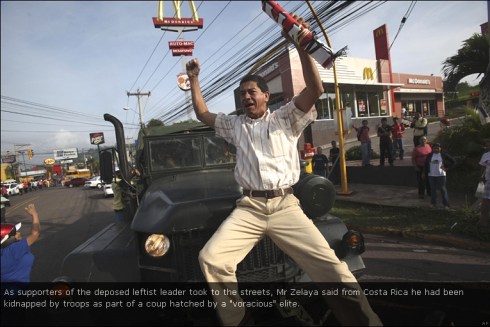
Image from the BBC
Even before the coup had taken place, anxious pedestrians shouted and cursed the approaching soldiers. In this video, one woman hits every soldier passing her. The surging protesters than begin to block military vehicles and surround a tank!
I’ve also reposted an article giving some background on the situation, this one from the School of Americas Watch. The “School of Americas”, now called the “Western Hemisphere Institute for Security Cooperation,” is a combat and torture training institute in Fort Benning, Georgia that has trained thousands of Latin American paramilitary soldiers to return to their countries and terrorize peasant and student movements. Many of these “graduates” have gone on to become fascist generals or dictators in their home countries, as in the current coup in Honduras. The institute remains open to this day, but every year SOA Watch organizes large protests to shut it down.
From: SOA Watch <info@soaw.org>
Date: June 28, 2009 1:26:08 PM EDT
Subject: Military Coup in Honduras
Military Coup in Honduras
A military coup has taken place in Honduras this morning (Sunday, June 28),
led by SOA graduate Romeo Vasquez. Read the rest of this entry »
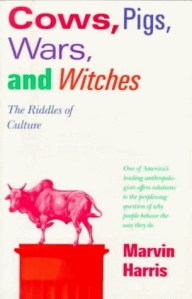 “Cows, Pigs, Wars, and Witches: The Riddles of Culture”
by Marvin Harris
1974 Random House
Why do Jews and Muslims refuse to eat pork? Why were thousands of witches burned at the stake during late medieval Europe? These and other riddles are explored by famous anthropologist Marvin Harris, and his conclusions are simple: people act within social and ecological contexts that make their actions meaningful. Put another way: cultural ideas and practices that seem strange to us may actually be vital and necessary to the people of those cultures.
Harris is especially good at explaining how societies create elaborate rituals to avoid harming the natural ecosystems they depend on, which clarifies the Middle Eastern ban on pig products. It turns out the chubby animals compete with humans for the same foods. Raising them in large numbers would place great strain on a land made fragile by thousands of years of deforestation and desertification. Better to ban them entirely and not risk further ecological damage.
This logic is then extended to elucidate why the institution of warfare probably first arose as a way to limit population pressure on the environment. In Harris’ words, “In most primitive societies, warfare is an effective means of population control because intense, recurring intergroup combat places a premium upon rearing male rather than female infants.” Since the rate of population growth depends on the number of healthy women, privileging males by making their larger bodies necessary for combat is a way of reducing the need to “eat the forest.” Not that male supremacy and violence is the BEST way to curb population growth, but it’s one ritual that societies have adopted to meet that goal.
This discussion of patriarchy leads to an exploration of class. The emergence of “big men”, chiefs, and finally the State is explained as a cascading distortion of the original principles of reciprocity into the rule of redistribution. “Big men” work harder than anyone in their tribe to provide a large feast for their community – with the only goal being prestige. Chiefs similarly pursue prestige, and plan great feasts to show off their managerial skills, but they themselves harvest little food. Finally “we end up with state-level societies ruled over by hereditary kings who perform no basic industrial or agricultural labor and who keep the most and best of everything for themselves.” At the root of this construction of inequality is the impetus to make people work harder to create larger surpluses so that greater social rewards can be given out to show off the leader’s generosity. But only at the State or Imperial level is this hierarchy enforced not by prestige but by force of arms, to stop the poor and working classes from revolting and sharing the fruits of their labor.
The most provocative sections of the book deal with revolutionary movements that fought for this liberation, within the context of the religious wars of Biblical Judea and Late Medieval Europe.
First, Harris tackles the Messiah complex Read the rest of this entry »
This is What Democracy Looks Like is the definitive documentary about the 1999 Seattle protests against the World Trade Organization. Shot from the perspective of organizers, this film shows how the most iconic event of the (successful) movement against corporate globalization was created, day-by-day. We follow students, labor, environmentalists, and everyone seeking global justice as they brave police violence in order to shut down the Seattle Trade Summit, which led eventually to the collapse of the WTO. Creative visuals, hot beats, protest footage and powerful interviews combine into a very inspiring form of art – reminding us that when regular people come together, they can change the course of history. WATCH THIS MOVIE!!!
[This is Part 1 of 11 – make sure to click the Up-Arrow button to watch the rest!]
In 1995, multinational oil corporation Shell conspired with the Nigerian government to brutally suppress a popular nonviolent social movement that called for environmental justice in their polluted land. A key moment in this campaign of violence was the military show-trial of Ken Saro-Wiwa, leader of the Ogoni people and nonviolent advocate, which led to his execution.
Shell is currently facing trial in New York in a lawsuit brought by the Wiwa family, charging the oil company with “requesting, financing, and assisting the Nigerian military which used deadly force to repress opposition to Shell’s operations in the Ogoni region of the Niger Delta.”
This short video tells the story of Ken Saro-Wiwa and how corporate and state power merge to violently suppress grassroots social movements in order to protect the exploitation of the environment and workers.


 The End of Capitalism
Recent Comments