
You are currently browsing the category archive for the ‘Racism’ category.
 “Ain’t I a Woman: Black Women and Feminism”
by bell hooks
1981 South End Press
bell hooks is brilliant, let me say that first. I saw her speak recently and she totally blew me away, one of the most inspiring speakers I’ve ever seen. This was her first-ever book, from 1981, so it’s interesting for understanding where she started out, and as a kind of ‘period piece’ where you can tell she was really pushing against the boundaries and limitations of 1970s feminism. Ain’t I A Woman examines the history of the black female in America, including the sexist nature of the black civil rights/freedom movement, and the racist nature of the white feminist movement. It’s a good book for all of these reasons.
However, bell hooks has said that she doesn’t really like this book anymore, and it’s clear that there are some weaknesses here. Read the rest of this entry »
Part 1 of 8 – a fantastic video – bell hooks is amazing. watch it!
 “The Culture of Make Believe”
by Derrick Jensen
2004 Chelsea Green
Derrick Jensen has a knack for compiling some of the most horrible atrocities ever committed and piecing them together within a compelling and provocative thread. This book is more “socially” focused than A Language Older Than Words (which was more ecological), so in that sense I got more out of it, but it’s probably not as well written as that earlier book.
The best parts here are about the KKK, IWW, J.P. Morgan and the turn of the century big capitalists and war profiteers, the Nazis, and slave labor in the US and around the world. as usual though, he covers about 100 topics in this 600+ page book.
The thing I struggle with when reading Jensen and other ‘anti-civ’ writers is that I agree 99% with their diagnosis of the problem (class society is inherently built on violence and must be dismantled – the industrial ‘economy’ is a machine designed to turn the living into the dead), but their solutions, or lack thereof, are difficult to accept. Instead of organizing for social change or revolution, Jensen advocates that we basically weep for the world we’ve lost, and perhaps engage in property damage…
 “We Want Freedom: A Life in the Black Panther Party”
by Mumia Abu-Jamal
2004 South End Press
This is a great history of the Black Panther Party, Mumia Abu-Jamal’s early life, and even a great overview of the history of black resistance movements from the first slave rebellions – which he says the BPP fits into as an integral piece.
Mumia does a great job explaining the origins and philosophies of the party, as well as covering its history succinctly but in a sweeping way that other books have failed to do. There is a chapter on women in the party, which is of mixed quality, but other chapters, like the ones on COINTELPRO and snitches in the party, are absolutely vital.
Don’t miss the pictures of young Mumia working in the BPP (at age 14…)
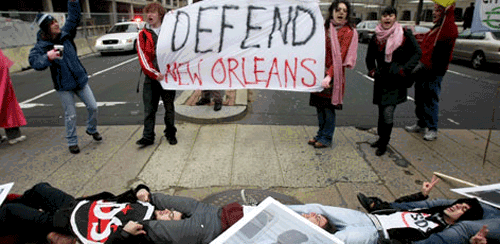

Photo by Alex Wong, Getty Images
Today, as part of a solidarity action with folks struggling to save public housing in New Orleans, members of Students for a Democratic Society (SDS) helped to organize a civil disobedience as a part of a larger demonstration outside the D.C. office of Department of Housing and Urban Development (HUD) organized by the Hip Hop Caucus and the Advancement Project. At the culmination of the rally where the crowd demanded the right of return for New Orleans residents, 6 members of SDS and a local high school student rushed into a nearby intersection and laid down, effectively blocking traffic at three intersections in northeast D.C. When it was clear that the cops were taking their time, the folks lying down, with the support of the rest of the protesters who were standing with them, picked up and moved further into the intersection, shutting down a total of six intersections around the HUD office. After an hour of disrupting busy D.C. streets, folks stretched out on the ground declared victory as the demonstration concluded with protesters marching through the lunchtime streets.
Residents of New Orleans public housing have called on folks from around the country to come down to Louisiana to support their efforts directly or to organize actions in their own cities. The recent Northeast Convention in Philly endorsed this call. This particular D.C. action, due to short notice, was only endorsed by the George Mason University (GMU) chapter of SDS, although members of most local chapters were in attendance. The fight is still going on down in Louisiana, so organize a demonstration in your city to support folks at this critical point in their struggle to return to their homes.
Check out the USA TODAY article for a picture of local SDSers and more details on the situation in New Orleans.
Here is the New Orleans Indymedia article on the D.C. action.
Article by Jasper Conner, GMU SDS
With the country becoming mobilized around racism once again due to the trials of the Jena Six, it is a great opportunity to reflect on the historical movements that made these struggles today possible.
The question is, which movement has the more important legacy for our struggles against racism in America today, Civil Rights, or Black Power?
With that in mind, here are two great links I wanted to share:
An amazing 1963 video – Malcolm X, James Farmer (CORE), Wyatt Tee Walker (SCLC) and Alan Morrison (Ebony Magazine) debate the Race Crisis in America (2 hrs). Take a peek back at the debate during the peak of Civil Rights Movement.
With reflections from 1992 on the question of whether the CR movement succeeded.
Then there is UC Berkeley’s collection of videos and sound recordings of the Black Panther Party, which took a much more militant and radical stance against racist America. A fantastic resource, that you’ll want to bookmark…
 “Ella Baker and the Black Freedom Movement: A Radical Democratic Vision”
by Barbara Ransby
2005 University of North Carolina Press
Just kept getting better as it went on. The writing style was not my favorite, the author seemed overly interested in teasing out categories or labels to apply to Baker’s life, rather than telling the bare facts. A more serious complaint is that the book spends hundreds of pages in Baker’s early life and upbringing, only to speed through the most politically interesting part of her life, in the Black Freedom Movement of the 50s and 60s. I’m sorry, but I can never get enough information about SNCC.
Nevertheless, it’s a good book, makes very useful points about radical democratic movement-building and education (that the role of the organizer is to bring people together and ask tough questions, and help nurture people to determine their own strategy and vision), and shows that Ella Baker above all others was the true mentor and parent of our grassroots organizing struggles today.


 The End of Capitalism
Recent Comments