You are currently browsing the category archive for the ‘Organizing’ category.
In a dispute which perfectly represents the struggle for “Green Jobs”, workers at the Vestas wind energy plant in the UK have occupied their factory to save 600 jobs and one of the largest wind turbine manufacturing sites in the country. A coalition of labor and environmental groups have organized to support them with daily rallies, while the workers inside wait for the government to step in and start production again. “Now I’m not sure about you but we think it’s about time that if the government can spend billions bailing out the banks – and even nationalise them – then surely they can do the same at Vestas.”
For background and updates, see the workers’ blog: http://savevestas.wordpress.com or this article: Vestas Protest, What’s it All About?
Send messages of support to savevestas@googlemail.com
The events at Vestas have been just one in a series of worker occupations around the world in the wake of the current economic crisis. Workers are not allowing their jobs to be closed down, when corporations and banks are receiving large financial bailouts. This article gives some of the highlights of the new wave of worker militancy. [alex]
Global Trend for Sit-ins and Occupations as Mass Redundancies Continue
Terry Macalister
Originally published by The Guardian, UK – July 24, 2009
Trade union leaders warned tonight that the direct action seen at the Vestas factory was likely to be repeated elsewhere as workers refused to “bend their knee and accept their fate” in the face of mass redundancies caused by recession.
The sit-in at the Isle of Wight wind turbine plant was the latest in Britain, they said, and was part of a wider trend of militant tactics being used as far afield as the US, South Korea and China.
In France, where such tactics have been more common, the manager of a British company was taken hostage by workers today in a dispute over redundancies. About 60 workers at Servisair Cargo at Roissy airport in Paris prevented the director, Abderrahmane El-Aouffir, from leaving the firm’s offices after he refused to meet their demands in the latest case of so-called “boss-napping” to hit France.
The four day Vestas sit-in, which is an embarrassment both to the world’s biggest turbine manufacturer and a government trying to launch a low-carbon jobs revolution, follows a similar occupation in April at three Visteon (car parts manufacturer) plants in the UK in addition to action at Waterford Crystal in Ireland and Prisme Packaging in Dundee.
Tony Woodley, the joint general secretary of the Unite union, whose members were involved at Visteon, said: “I think it is absolutely understandable and justified for workers to fight back where they feel there are no other alternatives and employers act badly.” Read the rest of this entry »
Is the economy “recovering”? What does a “jobless recovery” mean anyway? How should workers respond to a deteriorating situation? Professor Richard Wolff drops some knowledge and suggests that workers need to take control of their companies.
 “The Shock Doctrine: The Rise of Disaster Capitalism”
by Naomi Klein
2007 Metropolitan Books
I feel confident saying that The Shock Doctrine is one of the most important political non-fiction works of the last decade. This should be a high school textbook, or at least required reading in college. Naomi Klein applies her extensive vision and intellect to present us with a way of seeing our world that is extremely relevant and powerful: in the pursuit of enormous profits, those running the global economy intentionally exploit terrible catastrophes, or even create them, to take things for themselves that only shocked and traumatized populations would give up. This ambulance-chasing strategy of those in power is defined as the “shock doctrine,” and “disaster capitalism”, alternatively known as “neoliberalism” is the dominant social paradigm it has created.
Although there are flaws here, which I will mention, this book is both timely and well-written; Klein carries the reader through a story about grandiose topics like neoliberalism, torture, psychology, and international politics that is fundamentally readable.
The most important contribution made by this book in my view is the dismantling of the myth that capitalism’s global dominance is a function of democracy or destiny. This is the notion that with the defeat of the Soviet Union, all alternatives to “the free market” have naturally faded into history, presumably because capitalism is so irresistible. To the contrary, Naomi Klein provides numerous case studies to show us the exact opposite is true – the temporary triumph of global capitalism has been fertilized by the victims of natural disasters, terrorist attacks, wars, campaigns of torture, and economic calamity. In short, alternatives to capitalism have been shocked into submission wherever they’ve appeared.
This is no accident, it is part of a conscious crusade by market fundamentalists, those devoted to the pseudo-religious belief that “the market solves all.” Klein explains that the shock doctrine was developed (at least in part) by the patron saint of neoliberalism, free-market economist Milton Friedman. In his words, “only a crisis – actual or perceived – produces real change. When that crisis occurs, the actions that are taken depend on the ideas that are lying around.” And he intended to provide those ideas. It was Friedman’s opus “Capitalism and Freedom” that proclaimed neoliberalism’s core edicts: deregulation, privatization and cutbacks to social services.
Since the 1970s, these teachings have been vigorously applied across the globe by the “holy trinity” of the International Monetary Fund (IMF), the World Bank, and the World Trade Organization (WTO). Read the rest of this entry »
This is What Democracy Looks Like is the definitive documentary about the 1999 Seattle protests against the World Trade Organization. Shot from the perspective of organizers, this film shows how the most iconic event of the (successful) movement against corporate globalization was created, day-by-day. We follow students, labor, environmentalists, and everyone seeking global justice as they brave police violence in order to shut down the Seattle Trade Summit, which led eventually to the collapse of the WTO. Creative visuals, hot beats, protest footage and powerful interviews combine into a very inspiring form of art – reminding us that when regular people come together, they can change the course of history. WATCH THIS MOVIE!!!
[This is Part 1 of 11 – make sure to click the Up-Arrow button to watch the rest!]
Salt of the Earth is a classic organizing movie about striking Mexican-American miners and their wives. Based on an incredible true story, the 1953 film follows the organizing efforts of the town’s women, who must overcome the company’s classism, the sheriff’s racism, as well as their own husband’s sexism, to win the strike (while the men stay at home and take care of the house and children). Highly recommended!
This is just the first segment of the movie, make sure to click the Up-Arrow button to watch the rest!
This is a wonderful essay looking at how a Sustainable Economy must be structured democratically and decentralized to the local level. The only thing I would add is that we need a realistic plan of action to get us from the capitalist hellhole we currently inhabit to this accurate vision of a future sustainable society, and we can’t be afraid to confront powerful forces which want to stop us.
For me as a young person in the United States, the heart of the Empire, I see my current role as organizing youth and students in resistance to the forces of domination (war, debt, oppression). Others may be better positioned to organize their workplace or their communities, or to start urban gardens, or other projects. We each have a role to play, and we need to discover it ourselves. [alex]
Building a Sustainable Economy
by Marcin Gerwin
Democracy first
In 1994 the government of Haiti lifted tariffs and allowed imports of cheap, subsidized rice and other crops from abroad. This policy was recommended by the International Monetary Fund and urged by the U.S. government (1). Over the years this tiny change in policy led to an estimated 830,000 job losses, it damaged food security and rural livelihoods, and eventually led to food riots and hunger in 2008 (2). If people in Haiti were to decide by themselves on their country policy, would they choose the recommendations of the IMF that brought them into starvation? Would people of Ecuador allow toxic pollution in the Amazon for the sake of Chevron Texaco profits? Would people in India accept genetically modified seeds of cotton that caused crop failures, spiral of debt and hundreds of farmer suicides? And would people in the USA support bailing out banks with their own money in a way that is not transparent and does not lead to the recovery of the financial system? They wouldn’t. These things happen around the world because we still don’t have true democracy, where people set the rules for themselves.
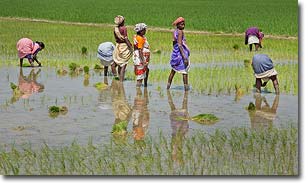 Women sowing rice in India Women sowing rice in IndiaPhoto: Michael Foley |
In 2001 twenty subsistence farmers, small traders, small food processors, and consumers, mostly women, and some of them illiterate, met in Indian village to decide on the future of agriculture in the state of Andhra Pradesh. They were chosen to represent the rural diversity of their state. They presented three different models of development. The official plan, put forward by Chief Minister of the state, was backed by grants and loans from the World Bank and the UK government. The plan was to mechanize, consolidate and genetically engineer agriculture of the state to produce cash crops for export, and to reduce the farming population from 70% to 40%, to have more workers for industry. The second vision involved developing environmentally friendly agriculture to produce cheap organic products for domestic and Northern supermarkets and it was supported by the International Federation of Organic Agriculture Movements and the International Trade Center. The third vision was influenced by Gandhian and indigenous ideas, and involved increasing local self-reliance and sustainability in both agriculture and economics.
Each model was illustrated by videos, farmers and traders could hear the summary of the policies, ask questions, consult with government officials, scientists, corporate and NGO representatives from the state, national and international level. They also considered advantages and disadvantages of each vision, based also upon their own knowledge, priorities and aspirations. After one week they made a decision.
Tom Atlee writes:
In their recommendations (…) they said they wanted self-reliant food and farming, and community control over resources. They wanted to maintain healthy soils, diverse crops, trees and livestock, and to build on their indigenous knowledge, practical skills and local institutions. They wanted to maintain the high percentage of people making their livelihood from the land, and did not want their farms consolidated or mechanized in ways that would displace rural people. Most of them could feed their families through their own sustenance farming. They did not want to end up laboring in dangerous brick kilns outside of Hyderabad, like so many who had left their farms. They also rejected genetically modified crops and the export of their local medicinal plants. (3)
If we wish to make some meaningful changes in the world, we need appropriate tools for that. A number one tool in the earth repair workshop is community-based democracy. It is a key for unlocking the potential for sustainability.
One of Philadelphia’s larger newspapers puts Paul Glover, local currency and mutual aid-based health care advocate, on its cover story. As always, Paul makes wise and witty proposals to help us solve our economic and ecological woes, and now people are finally listening!
My favorite solution: “Neighborhood watch instead of neighborhood watch TV.” [alex]
Prepare for the Best
A guide to surviving — and thriving in — Philadelphia’s new green future.
Published: Jan 28, 2009
CityPaper
The Dark Season closes around Philadelphia. Wolves howl, “Tough times coming!” Young professionals with good jobs study budget cuts, watch stocks flail. Career bureaucrats are laid off; college students wonder who’s hiring. Old-timers remember when Philadelphia staggered through the terrible Depression years without jobs or dollars, while crime and hunger rose. Some districts here never escaped that Depression — they’re still choosing between heating and eating.
 |
As usual, the future will be different. Philadelphia’s responses to global warming and market cooling, high fuel and food prices, health unsurance, mortgages, student debt and war will decide whether our future here becomes vastly better or vastly worse. Whether we’re the Next Great City or Next Great Medieval Village. Imagine Philadelphia with one-tenth the oil and natural gas.
But to hell with tragedy. Let’s quit dreading news. Take the Rocky road. There are Philadelphia solutions for every Philadelphia problem.
Imagine instead that, 20 years from now, Philadelphia’s green economy enables everyone to work a few hours creatively daily, then relax with family and friends to enjoy top-quality local, healthy food. To enjoy clean low-cost warm housing, clean and safe transport, high-quality handcrafted clothes and household goods. To enjoy creating and playing together, growing up and growing old in supportive neighborhoods where everyone is valuable. And to do this while replenishing rather than depleting the planet. Pretty wild, right?
Entirely realistic. Not a pipe dream. And more practical than cynical. The tools, skills and wealth exist.
Mayor Michael Nutter foresees we’ll become the “Greenest City in the United States.” So it’s common-sensible to ask, “What are the tools of such a future?” “What jobs will be created?” “Who has the money?” “Where are the leaders?” “How will Philadelphia look?” “What can we learn from other cities?”
Some of the proposals sketched here can be easily ridiculed, because they disturb comfortable work habits, ancient traditions and sacred hierarchies. Yet they open more doors than are closing. They help us get ready for the green economy, and get there first. Big changes are coming so we might as well enjoy the ride. You have good ideas, too — bring ’em on.
From “Yes We Can” to “Now We Do”
As President Barack Obama says, “Change comes not from the top down, but from the bottom up.” Philadelphia’s chronic miseries suggest that primary dependence on legislators, regulators, police, prisons, bankers and industry won’t save us. They’re essential partners, but the people who will best help us are us. Read the rest of this entry »
Two days before he published this article, David Graeber spoke at the People’s Forum in DC, which was organized by DC SDSers as part of Global Justice Action. The People’s Forum ran simultaneously while the G20 met in DC to save capitalism, because capitalism isn’t in crisis – capitalism is the crisis. The activities included a brainstorming session to explore “What Comes After Capitalism?” and a celebratory “Funeral for Capitalism” where the below pictures were taken. [alex]

At the "Funeral for Capitalism" - photo by Jake Cunningham
Hope in Common
David Graeber
Originally published by InterActivist Info Exchange, November 17, 2008.
We seem to have reached an impasse. Capitalism as we know it appears to be coming apart. But as financial institutions stagger and crumble, there is no obvious alternative. Organized resistance appears scattered and incoherent; the global justice movement a shadow of its former self. There is good reason to believe that, in a generation or so, capitalism will no longer exist: for the simple reason that it’s impossible to maintain an engine of perpetual growth forever on a finite planet. Faced with the prospect, the knee-jerk reaction—even of “progressives”—is, often, fear, to cling to capitalism because they simply can’t imagine an alternative that wouldn’t be even worse.
The first question we should be asking is: How did this happen? Is it normal for human beings to be unable to imagine what a better world would even be like?

photo by Christa H
Hopelessness isn’t natural. It needs to be produced. If we really want to understand this situation, we have to begin by understanding that the last thirty years have seen the construction of a vast bureaucratic apparatus for the creation and maintenance of hopelessness, a kind of giant machine that is designed, first and foremost, to destroy any sense of possible alternative futures. At root is a veritable obsession on the part of the rulers of the world with ensuring that social movements cannot be seen to grow, to flourish, to propose alternatives; that those who challenge existing power arrangements can never, under any circumstances, be perceived to win. To do so requires creating a vast apparatus of armies, prisons, police, various forms of private security firms and police and military intelligence apparatus, propaganda engines of every conceivable variety, most of which do not attack alternatives directly so much as they create a pervasive climate of fear, jingoistic conformity, and simple despair that renders any thought of changing the world seem an idle fantasy. Maintaining this apparatus seems even more important, to exponents of the “free market,” even than maintaining any sort of viable market economy. How else can one explain, for instance, what happened in the former Soviet Union, where one would have imagined the end of the Cold War would have led to the dismantling of the army and KGB and rebuilding the factories, but in fact what happened was precisely the other way around? This is just one extreme example of what has been happening everywhere. Economically, this apparatus is pure dead weight; all the guns, surveillance cameras, and propaganda engines are extraordinarily expensive and really produce nothing, and as a result, it’s dragging the entire capitalist system down with it, and possibly, the earth itself.

photo by Christa H
The spirals of financialization and endless string of economic bubbles we’ve been experience are a direct result of this apparatus. It’s no coincidence that the United States has become both the world’s major military (”security”) power and the major promoter of bogus securities. This apparatus exists to shred and pulverize the human imagination, to destroy any possibility of envisioning alternative futures. As a result, the only thing left to imagine is more and more money, and debt spirals entirely out of control. What is debt, after all, but imaginary money whose value can only be realized in the future: future profits, the proceeds of the exploitation of workers not yet born. Read the rest of this entry »


 The End of Capitalism
Recent Comments