
You are currently browsing the category archive for the ‘Organizing’ category.
Wonderful essay by Stephanie Guilloud on the shifting sands of movement strategy in the wake of the high-tide of the Global Justice Movement, which in Seattle articulated a world beyond capitalism that was not controlled by corporate giants and corrupt governments, but built by democratic cooperation of communities all around the world.
The Seattle direct actions shut down the World Trade Organization for a weekend in 1999, because the WTO had been spreading the corporate agenda across the planet, and this began a string of movement victories that shut down the WTO permanently – by delegitimizing the organization and emboldening Global South nations to refuse rich countries’ poverty-spreading deals and abandon its negotiations.
Now, as Global South nations lead the call for justice in Copenhagen and as we gear up for the US Social Forum in Detroit next summer, it’s a great time to look back at the lessons the movement for justice, democracy and sustainability has learned in the past decade. [alex]
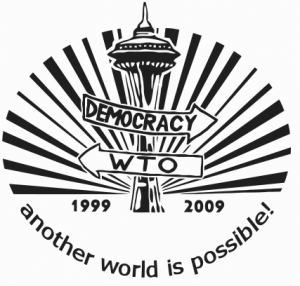 From Seattle to Detroit: 10 Lessons for Movement Building on the 10th Anniversary of the WTO Shutdown
By Stephanie Guilloud November 30, 2009 | Reposted from the Indypendent
For five days in 1999, 80,000 people from Seattle and from all over the country stopped the World Trade Organization from meeting. Despite extreme police and state violence, students, organizers, workers, and community members participated in a public uprising using direct actions, marches, rallies, and mass convergences. Longshoremen shut down every port on the West Coast. Global actions of solidarity happened from India to Italy. Trade ministers, heads of state, and corporate hosts were forced to abandon their agenda and declare the Millenium Ministerial a complete failure. We said we would shut it down, and we did.
“The fact is that the Social Forum and Peoples Movement Assembly process actually started in Seattle. The Social Forum took off from the experience of the ‘Battle of Seattle’ when the Brazilian organizing committee formed in 2000 and held the first World Social Forum in 2001. Ten years later, we come back to where this started. What has been accomplished in the last 10 years? How have our social movements developed to build the power towards real social systemic change in the US? How do we map the new forces and what is the power of the social movement assembly?”
– Ruben Solis, Southwest Workers Union, participant in the Seattle shutdown, and one of the founders of the Grassroots Global Justice Alliance
As one of the founders and leaders of the Direct Action Network and a resident of Olympia, Washington, I offer personal and political reflections on the WTO shutdown as a major turning point in my life as an organizer and in our lives working to build movements in the US. As an organizer with the US Social Forum process and a co-lead to develop the People’s Movement Assembly, I carry these lessons with me on a daily basis. I offer these stories with humility and a sense of responsibility. When I refer to “we” in this brief article, I refer to my community of young people in their early twenties, living in Seattle, Olympia, Portland, and the Bay Area, who, with many others, mobilized, organized, and implemented the direct action strategies we had planned for months.
1.) Know your history: Seattle was a turning point
Seattle was a historic turning point in our movements for racial, economic and gender justice for a few reasons. On a global scale, the demonstrations and effective shutdown of the World Trade Organization’s ministerial was historic because of our position and location in the US. Seattle did not mark the beginning of a movement, it marked the beginning of a significant connection between the US and the rest of the world. Global movements had and have been challenging and confronting financial institutions and their systemic effects for decades. The demonstrations – the five days of direct action, the massive and violent state response, and the subsequent alliances – accomplished a few major shifts in historic directions. The demonstrations exposed to the US public the tangible affects of globalization on regular people’s lives. The effectiveness of the actions and stalling of the meetings allowed for delegates from the global South to challenge the policies and procedures of the WTO. And for the first time in history, the decision-making rounds of a global financial institution collapsed.
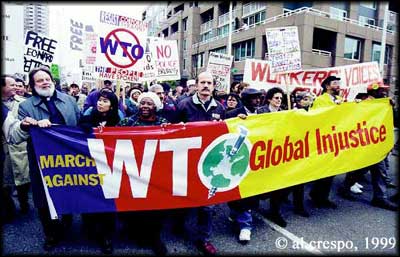
Seattle also opened a door on a new era for movement in the US. The strengths and weaknesses of our organizing efforts served as a spark for new work, new alliances, new conversations, and a new generational drive. It opened the possibility for a generation of people to understand action, movement, and strategy as effective. It also offered an opportunity to see the strengths of innovation and mass organizing, as well as the weaknesses of underdeveloped leadership and lack of connection to long-term transformative practices.
2.) Claim your victories and evaluate your mistakes. Read the rest of this entry »
Review by Dana Barnett
Originally published by Toward Freedom.
Nov. 25, 2009.
Reviewed: Arm the Spirit: A Woman’s Journey Underground and Back, by Diana Block. Published by AK Press, 2009.
“We had gone underground in the early eighties, not a high-tide period for revolutionary activity in the US. Unlike the people who had formed the Weather Underground Organization in the sixties, we were not swept into clandestinity as a response to the Vietnam War or the militancy of the Black Panthers…As we saw it, armed struggle was still a necessary component of every revolutionary movement, and the movement within the US was no exception.” – Diana Block
How do we decide where to put our political energy? For many of us on the left our politicization began with critiques of the dominant ideology. Our critiques may have been a result of formal education, though for many our critiques were lifeboats we clung to keep from drowning in the chasm between what we were told and what we experienced. Upon confronting contradictions we look for explanations. We attempt to deconstruct the world and then reconstruct it to make sense of it and find our place in it. We make our underlying ideologies conscious. We develop our analysis and principles and then attempt to act in a way that is aligned with their logical conclusions.
As leftist revolutionaries we ask ourselves the same questions at different times in our history. What is to be done? What does revolutionary work look like in our time and what is my role within it?
Diana Block’s memoir, Arm the Spirit: A Woman’s Journey Underground and Back, is an example of a leftist making sense of the world around her, attempting to act with integrity, and searching for political strategy and home. The memoir moves easily back and forth between two aspects of her story. The book begins with Block’s partner, Claude Marks, finding a bug in their car in 1985 after several years of organizing and living clandestinely, and only two months after she gave birth to their first child. This main narrative details her life underground and her re-emergence and re-engagement with organizing from 1995 to the present. It is interspersed with the back story of Block’s experiences, politics, and the context that led to her decision to form a clandestine revolutionary collective to support Third World anti-colonialist armed struggles. Block’s book is her answer to the question of what it means to be a revolutionary in one’s own time. In particular, Block analyzes her role as a white person in the US with feminist, lesbian/queer, anti-imperialist, and anti-racist politics.
I do not feel compelled to use this book, or this review, as a site to evaluate the usefulness of clandestine work, or the question of armed struggle. Read the rest of this entry »
Also published by The Rag Blog and OpEdNews.
 “We stand at a critical moment in Earth’s history, a time when humanity must choose its future. As the world becomes increasingly interdependent and fragile, the future at once holds great peril and great promise. To move forward we must recognize that in the midst of a magnificent diversity of cultures and life forms we are one human family and one Earth community with a common destiny. We must join together to bring forth a sustainable global society founded on respect for nature, universal human rights, economic justice, and a culture of peace. Towards this end, it is imperative that we, the peoples of Earth, declare our responsibility to one another, to the greater community of life, and to future generations. – The Earth Charter” (pg. 1).
David Korten, long-time global justice activist, co-founder of Yes! Magazine, and author of such books as When Corporations Rule the World, lays out the fundamental crossroads facing the world in his 2006 book The Great Turning: From Empire to Earth Community. In response to global climate change, war, oil scarcity, persistent racism and sexism and many other mounting crises, Korten argues we must recognize these as symptoms of a larger system of Empire, so that we might move in a radically different direction of equality, ecological sustainability, and cooperation, which he terms Earth Community. This is a powerful and important book, which excels in overviewing the big picture of threats facing our ecosphere and our communities at the hands of global capitalism1, and translating this into the simplest and most accessible language so we might all do something about it. It’s pretty much anti-capitalism for the masses. And it has the power to inspire many of us to transform our lives and work towards the transformation of society.
Capitalism and Empire
Of course, Korten has made the strategic decision to avoid pointing the finger at “capitalism” as such in order to speak to an American public which largely still confuses the term as equivalent to “freedom” or “democracy.” In fact the “C” word is rarely mentioned in the book, almost never without some sort of modifier as in “corporate capitalism” or “predatory capitalism”, as if those weren’t already features of the system as a whole. Instead, Korten names “Empire” as the culprit responsible for our global economic and ecological predicament, which is defined as a value-system that promotes the views that “Humans are flawed and dangerous”, “Order by dominator hierarchy”, “Compete or die”, “Masculine dominant”, etc. (32).
Korten explains that Empire, “has been a defining feature of the most powerful and influential human societies for some five thousand years, [and] appropriates much of the productive surplus of society to maintain a system of dominator power and elite competition. Racism, sexism, and classism are endemic features” (25). In this way the anarchist concept of the State is repackaged as a transcendent human tendency, which has more to do with conscious decision-making and maturity level than it does with political power. While this compromise does limit the book’s effectiveness in offering solutions later on, it does speak in a language more familiar to the vast non-politicized majority of Americans, and may have the potential to unify a larger movement for change.
Whatever you want to call the system, the danger it presents to the planet is now clear. Korten spells out the grim statistics: “Fossil fuel use is five times what it was [in 1950], and global use of freshwater has tripled… the [Arctic] polar ice cap has thinned by 46 percent over twenty years… [while we’ve seen] a steady increase over the past five decades in severe weather events such as major hurricanes, floods, and droughts. Globally there were only thirteen severe events in the 1950s. By comparison, seventy-two such events occurred during the first nine years of the 1990s” (59-60). If this destruction continues, it’s uncertain if the Earth will survive.
This ecological damage is considered alongside the social damage of billions living without clean water or adequate food, as well as the immense costs of war and genocide. But Korten understands that the danger is relative to where you stand in the social hierarchy – the system creates extreme poverty for many, and an extreme wealth for a few others. He explains how the system is based on a deep inequality that is growing ever worse, “In the 1990s, per capita income fell in fifty-four of the world’s poorest countries… At the other end of the scale, the number of billionaires worldwide swelled from 274 in 1991 to 691 in 2005” (67). The critical point that these few wealthy elites wield excessive power and influence within the system to stop or slow necessary reform could be made more clearly, but at least the book exposes the existence of this upper class, who are usually quite effective at hiding from public scrutiny and outrage over the suffering they are causing.2
Earth Community – Growing a Revolution
Standing at odds with the bastions of Empire is what David Korten calls “Earth Community,” a “higher-order” value-system promoting the views of, “Cooperate and live,” “Love life”, “Defend the rights of all”, “Gender balanced”, etc. (32). Read the rest of this entry »
This essay, written following a listening tour across the US, asks some of the most important questions facing social movements today, including “How Do We Build Intergenerational Movements?”, “What About Multiracial Movement Building?” and “How Do We Develop Strategy?”
I read this when it first came out in the summer of 2006 and it pretty much rocked my socks off and made me excited to get involved in the new SDS, so I figured I’d repost it for folks who never got to read it. [alex]
Ten Questions for Movement Building
by Dan Berger and Andy Cornell
Originally published by Monthly Review Zine.
For five weeks in the late spring of 2006, we toured the eastern half of the United States to promote two books — Letters From Young Activists: Today’s Rebels Speak Out (Nation Books, 2005) and Outlaws of America: The Weather Underground and the Politics of Solidarity (AK Press, 2006) — and to get at least a cursory impression of sectors of the movement in this country. We viewed the twenty-eight events not only as book readings but as conscious political conversations about the state of the country, the world, and the movement.
Of course, such quick visits to different parts of the country can only yield so much information. Because this was May and June, we did not speak on any school campuses and were unable to gather a strong sense of the state of campus-based activism. Further, much of the tour came together through personal connections we’ve developed in anarchist, queer, punk, and white anti-racist communities, and, as with any organizing, the audience generally reflected who organized the event and how they went about it rather than the full array of organizing projects transpiring in each town. Yet several crucial questions were raised routinely in big cities and small towns alike (or, alternately, were elided but lay just beneath the surface of the sometimes tense conversations we were party to). Such commonality of concerns and difficulties demonstrates the need for ongoing discussion of these issues within and between local activist communities. Thus, while we don’t pretend to have an authoritative analysis of the movement, we offer this report as part of a broader dialogue about building and strengthening modern revolutionary movements — an attempt to index some common debates and to offer challenges in the interests of pushing the struggle forward.
Challenges and Debates:
The audiences we spoke with tended to be predominantly white and comprised of people self-identified as being on the left, many of whom are active in one or more organizations locally or nationally. We traveled through the Northeast (including a brief visit to Montreal), the rust belt, the Midwest, parts of the South, and the Mid-Atlantic. Some events tended to draw mostly 60s-generation activists, others primarily people in their 20s, and more than a few were genuinely intergenerational. Not surprisingly, events at community centers and libraries afforded more room for conversation than those at bookstores. Crowds ranged anywhere from 10 to 100 people, although the average event had about 25 people. Even where events were small gatherings of friends, they proved to be useful dialogues about pragmatic work. Our goals for the tour were: establishing a sense of different organizing projects; pushing white people in an anti-racist and anti-imperialist direction while highlighting the interrelationship of issues; and grappling with the difficult issues of organizing, leadership, and intergenerational movement building. The following ten questions emerge from our analysis of the political situation based on our travels and meetings with activists of a variety of ages and range of experiences.
1. What Is Organizing?
Every event we did focused on the need for organizing. This call often fell upon sympathetic ears, but was frequently met with questions about how to actually organize and build lasting radical organizations, particularly in terms of maintaining radical politics while reaching beyond insular communities. There are too few institutions training young or new activists in the praxis of organizing and anti-authoritarian leadership development. Read the rest of this entry »
Organizers from Philly will be traveling across PA ahead of the G20 summit in Pittsburgh next week to meet with grassroots movements and strengthen statewide social change networks. This is being called the People’s Caravan. There are still spots available, so please RSVP if you’d like to join the caravan! – alex
A Call to Join the People’s Caravan
Pennsylvania, along with the rest of the world, is in crisis. Many people do not have access to decent housing, education, healthcare, jobs, healthy food, transportation and communication. While we are told that there are not resources to provide for our basic needs, bankers and the ultra-rich get trillions of dollars in bail-out funding, and our services are cut and costly wars are waged. From pools, libraries and health centers in urban areas closing, to factory lay-offs and families losing their farms, Pennsylvanians are feeling the impact of an economic and political system that has placed profit over people. We will not pay for their crisis!
In the coal mines, steel mills, textile mills, family farms and in the front seats of rigs, poor and working Pennsylvanians built this state. As one industry after another has collapsed in Pennsylvania, we’ve become poorer. Our economic crisis didn’t start in 2007. Now, all across the state, local governments and business people are spending our taxpayers’ money on developments that benefit developers and not the communities that paid for it. Meanwhile, our population has been in decline for generations because too many of our young people see no future in our state, and need to look for jobs elsewhere.
What is the G-20?
The G-20 summit is a gathering of financial ministers and heads of states of the 20 richest countries in the world. They are meeting in Pittsburgh, September 24-25 to advance their agenda: cutting essential social services; privatizing schools, healthcare, and social security, promoting “free-trade,” which cuts labor and environmental standards across the globe and places corporate profit above human needs. They are meeting to rebuild the world’s economies- in a way that keeps them on top.
Pittsburgh’s history of economic decline is why it was chosen to host the G-20. It will be promoted as an example of how to rebuild an economy. They’ve done this by bringing in companies that provide low wage jobs while reaping large profit and rebuilding the region with little thought to community benefit. This is unfortunately a familiar story to not just Pennsylvania, but much of the country.
The Caravan
We want to take this opportunity to focus on Pennsylvania, and strengthen our statewide networks. We want to meet up with people who are organizing locally for their dignity and a better Pennsylvania. Whether you are working for better wages, organizing for childcare, demanding healthcare, fighting pollution, struggling to keep your home and put food on the table or to keep your family’s farm; we all have an interest in making our voices heard and working together to advance an agenda for economic human rights.
We will be taking our own vehicles, carpooling and splitting the travel costs. The caravan will depart Philadelphia on Monday morning, September 21, stopping in Lancaster, traveling to York for the afternoon, and then spend the evening in Harrisburg. On Tuesday, September 22, we will rally at the state capitol, make a stop in Altoona, and arrive in Pittsburgh for the G-20 summit.
Join Us!
This is a perfect time to make connections between our struggles and communities so that we can break our isolation and work together. We want you to invite your neighbors, church, family, school, VFW chapter, and your community organizations to join us on this caravan. While we bring stories of our struggles in Philadelphia, we want to learn from people struggling throughout the rest of Pennsylvania.
Contact us if you are interested in organizing a local event along the route that can benefit your work, joining or supporting the caravan. We need RSVP’s, and we can tell you about costs, ride information and answer any other questions.
http://www.g20caravan.info
g20caravan@riseup.net
215-586-9198
The Security Guards at the Art Museum are demanding recognition for their union and an end to poverty wages. Here is their new video presenting their campaign to the incoming CEO of the museum, Timothy Rub:
Welcoming Change at the Philadelphia Museum of Art
The guards are also holding a rally next Sunday to welcome Mr. Rub, check it out! Also see below for more information on the campaign from a recent article in Philadelphia Weekly. [alex]
Welcoming Party for Timothy Rub
2 pm, Sunday, September 6, 2009
The Philadelphia Museum of Art, front “Rocky” steps
•
Join the Philadelphia Security Officers Union and Philly Jobs with Justice as they hold a — “welcoming party” — for incoming museum CEO, Timothy Rub.
•
Security Guards at the museum earn less than $20,000 per year, below the federal poverty line.
•
The Philadelphia Security Officers Union supports the Employee Free Choice Act.
•
We have signed up a majority of the security officers at the Philadelphia Museum on union representation cards.
•
If the Employee Free Choice Act was law right now, we would already be a union.
March with the Philadelphia Security Officers Union in support of card check and the Employee Free Choice Act
2:00 pm—3:30 pm,
come early and take advantage of the free day at the museum
Featuring NYC’s Rude Mechanical Orchestra! It’s a party!
Info: phillyjwj.org
Financial Insecurity
Museum guards ask new director to hear them out.
Philadelphia Weekly, August 25, 2009.
On April 19, Jennifer Collazo woke up with a $2,882.47 hospital bill. The 33-year-old Army veteran is a Philadelphia Museum of Art security guard employed by the private contractor AlliedBarton. Collazo pays into the medical insurance offered by her employer, but when she came down with severe neck and back pain on the job, she discovered that her health benefits didn’t even cover things like the ambulance ride.
Paltry medical coverage combined with low wages has driven Collazo and other museum guards to organize the Philadelphia Security Officers Union (PSOU). While the museum and AlliedBarton have rebuffed them in the past, guards hope that the institution’s incoming director, Timothy Rub, will be open to dialogue when he takes charge early next month. Read the rest of this entry »
 After watching the brilliantly-acted and courageous film Silkwood (1983, starring Meryl Streep), I learned the compelling story of Karen Silkwood and her death, which has seemingly been forgotten by America. Karen, only 28, was a union activist working in a Kerr-McGee nuclear power plant in Oklahoma, who died in a suspicious car accident while on her way to meet with a New York Times reporter for a story that would have exposed the company’s dangerous and illegal mishandling of plutonium.
Karen was active in her union, calling attention to the radioactive contamination in the plant, and spent months compiling evidence to show that the company was deliberately covering up the fact that their fuel rods contained imperfections, which could put millions of lives at risk if they sparked a meltdown. The night of her death, many believe Karen was deliberately driven off the road by another car, and her family was later able to sue Kerr-McGee for $1.3 million in damages, but the company admits no wrongdoing.
The nuclear plant where Karen worked was shut down in 1975, one year after her death. When Karen’s story became public controversy, it helped display the dangers inherent to nuclear power, contributing to the amazingly successful anti-nuclear movement that has stopped construction of all new nuclear plants in the US since 1979. Thus is especially important today as some corporate lobbyists are trying to repackage nuclear power as a “clean” or “carbon-free” energy “source.” In fact, it’s none of those things.
Karen’s story is both a warning and an inspiration – that capitalism pushes companies to sometimes do terrible things to protect their profits, even if it means endangering lives, but also that brave people such as Karen Silkwood, in bringing the truth to light, can challenge us to create a better world.
Here is her entry on Wikipedia for more info. [alex]
Karen Silkwood
From Wikipedia, the free encyclopedia
Karen Gay Silkwood (February 19, 1946 – November 13, 1974) was an American labor union activist and chemical technician at the Kerr-McGee plant near Crescent, Oklahoma, United States. Silkwood’s job was making plutonium pellets for nuclear reactor fuel rods. She died under mysterious circumstances after investigating claims of irregularities and wrongdoing at the Kerr-McGee plant.
Early life
Silkwood was born in Longview, Texas, the Read the rest of this entry »


 The End of Capitalism
Recent Comments