
You are currently browsing the category archive for the ‘Occupied Palestine’ category.
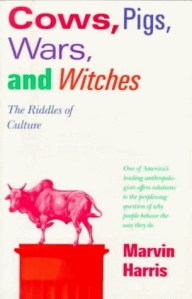 “Cows, Pigs, Wars, and Witches: The Riddles of Culture”
by Marvin Harris
1974 Random House
Why do Jews and Muslims refuse to eat pork? Why were thousands of witches burned at the stake during late medieval Europe? These and other riddles are explored by famous anthropologist Marvin Harris, and his conclusions are simple: people act within social and ecological contexts that make their actions meaningful. Put another way: cultural ideas and practices that seem strange to us may actually be vital and necessary to the people of those cultures.
Harris is especially good at explaining how societies create elaborate rituals to avoid harming the natural ecosystems they depend on, which clarifies the Middle Eastern ban on pig products. It turns out the chubby animals compete with humans for the same foods. Raising them in large numbers would place great strain on a land made fragile by thousands of years of deforestation and desertification. Better to ban them entirely and not risk further ecological damage.
This logic is then extended to elucidate why the institution of warfare probably first arose as a way to limit population pressure on the environment. In Harris’ words, “In most primitive societies, warfare is an effective means of population control because intense, recurring intergroup combat places a premium upon rearing male rather than female infants.” Since the rate of population growth depends on the number of healthy women, privileging males by making their larger bodies necessary for combat is a way of reducing the need to “eat the forest.” Not that male supremacy and violence is the BEST way to curb population growth, but it’s one ritual that societies have adopted to meet that goal.
This discussion of patriarchy leads to an exploration of class. The emergence of “big men”, chiefs, and finally the State is explained as a cascading distortion of the original principles of reciprocity into the rule of redistribution. “Big men” work harder than anyone in their tribe to provide a large feast for their community – with the only goal being prestige. Chiefs similarly pursue prestige, and plan great feasts to show off their managerial skills, but they themselves harvest little food. Finally “we end up with state-level societies ruled over by hereditary kings who perform no basic industrial or agricultural labor and who keep the most and best of everything for themselves.” At the root of this construction of inequality is the impetus to make people work harder to create larger surpluses so that greater social rewards can be given out to show off the leader’s generosity. But only at the State or Imperial level is this hierarchy enforced not by prestige but by force of arms, to stop the poor and working classes from revolting and sharing the fruits of their labor.
The most provocative sections of the book deal with revolutionary movements that fought for this liberation, within the context of the religious wars of Biblical Judea and Late Medieval Europe.
First, Harris tackles the Messiah complex Read the rest of this entry »
Third and possibly last in the holiday movie series, Cry Freedom features Denzel Washington as Steve Biko, Black South African revolutionary during the 60s-70s. The movie criticizes the Apartheid system which restricted Blacks from moving around their country and having decent jobs and education, as well as giving the privileged race the ability to kill indiscriminately, very similar to the current situation in Occupied Palestine.
(This is just the first segment of the movie, make sure to click the Up-Arrow button to watch the rest!)


 The End of Capitalism
Recent Comments