You are currently browsing the category archive for the ‘New World’ category.
How can we move beyond capitalism? What kinds of economic models can we look to, to ensure that the economy is both sustainable in its relationship to the Earth, and empowering of communities on the ground level?
As YES! Magazine regularly does, this article highlights examples of people stepping up to answer these questions of our age. Here they describe how different communities around the US are creating solutions that are both locally rooted and cooperatively run. [alex]
A Different Kind of Ownership Society
by Marjorie Kelly and Shanna Ratner
YES! Magazine
Aug 03, 2010

Photo by Brent Danley.
Innovative strategies for cooperative local ownership make it possible for prosperity to be shared as well as sustainable.
Drive across southern Minnesota near the city of Luverne, and you’ll see clusters of wind turbines poking up through the cornfields. Climb into one of these sleek, gleaming, white towers, and you’ll find sophisticated computer controls monitoring dozens of factors every moment (wind speed, pressure on the blades, and so on). Yet the way the turbines are funded and owned is just as innovative as the technology that runs them.
These wind developments were created by Minwind Energy, a limited liability company that is structured as a cooperative. Back when only corn was harvested in these fields, Minwind invited hundreds of local residents to make investments of $5,000 apiece, eventually raising $4 million to fund the turbines. In return, the residents became owners of the project—alongside the farmers on whose land the turbines stand.
With a policy that no individual can own more than 15 percent, the ownership design is aimed at spreading wealth widely and keeping it rooted locally. According to the Government Accountability Office, keeping a project like Minwind locally owned means that local communities get three times more economic benefit than if the project had absentee owners. Rather than flowing to Wall Street investors or major companies, the dollars generated by these wind farms will flow first through local communities, going to pay local workers, local investors, and local suppliers of all kinds. Wealth stays local.
If sustainable technologies are about the what of the living economy, local and shared ownership designs are about the who: who will own the productive capacity of the nation, who will control it, and who will benefit from the wealth created.
Minwind Energy is also an example of shared ownership, an emerging, broad category of ownership design in which ownership is shared among individuals (as in cooperatives or employee-owned firms) or between individuals and a community organization (as in a community land trust, where families own their homes while a nonprofit owns the land they stand on).
Shared ownership, like local ownership, is a valuable tool for enhancing community wealth over the long term. Both represent the innovations in social technologies that must evolve alongside innovations in physical technologies—like wind turbines, organic agriculture, or sustainably managed forests—if we’re to create an economy in which prosperity is both sustainable and shared. If sustainable technologies are about the what of the living economy, local and shared ownership designs are about the who: who will own the productive capacity of the nation, who will control it, and who will benefit from the wealth created.
Shared ownership takes many forms. For example: Read the rest of this entry »
hey all,
check out this podcast of me being interviewed by Todd Curl. I’m excited to have my views recorded on audio for the first time. in this extensive 2-hour interview, I discuss:
- my hometown of Ambler, PA and its history with asbestos
- my life story of becoming politically aware and active
- peak oil and its interpretations
- the end of capitalism theory
- the nature of capitalism and enclosure
- resistance in China, Arizona, and around the world
- how radicals can use language to speak to everyday people
- healing from abuse and empowering ourselves to live better lives
here it is (click to play audio): Alex Knight Podcast
[alex]
Is Capitalism Approaching the Darkness of Knight?
Todd Curl
The Pigeon Post, August 2, 2010

Here is the interview I did with Alex Knight on Friday, July 30, 2010 at Alex’s home in Philadelphia:
At just 27 years old, Alex is already an accomplished writer and a full time activist for social justice. His site, The End of Capitalism, explores the theory of the unsustainable nature of a profit-driven global system that continues to exploit all of the earth’s resources for the sake of greed and power.
Having grown up in Ambler, Pennsylvania — the ‘Asbestos Capital of the World’ — Alex saw first hand the devastation of his home town through the greed of Keasbey and Mattison Corporation who continued to manufacture Asbestos through the 1970s despite the evidence that had existed for years that Asbestos causes Mesothelioma, a serious form of Lung Cancer.
Seeing the sickness of his community first hand eventually built the foundation for Alex’s future environmental and social activism. While at Lehigh University studying Electrical Engineering, Alex became more intellectually aware of the systemic patterns of exploitation and human/environmental devastation brought on by a long history of a Capitalist system concerned only with profit. Alex went on to get his Master’s in Political Science from Lehigh and now is a full-time activist in the Philadelphia area fighting for real and meaningful progressive change.
As Alex will tell you, there is nothing extraordinary about him. Being the quintessential “All American Boy” — he was born on the 4th of July — Alex discovered that real social change is ameliorated when we decide to join forces and fight the powers that are determined to keep us placated and in a constant state of fear so we will not question our own imprisonment of thought and continue to consume without thought or premeditation. For Alex, grassroots organizing and activism is the key to a sustainable future and when we define ourselves as left, right, Marxist, Anarchist, etc.. we just perpetuate petty semantic divides. Alex is proud to call himself “Progressive” as he is a tireless fighter for justice.
Republished by Energy Bulletin, Countercurrents and OpEdNews.
The following exchange between Michael Carriere and Alex Knight occurred via email, July 2010. Alex Knight was questioned about the End of Capitalism Theory, which states that the global capitalist system is breaking down due to ecological and social limits to growth and that a paradigm shift toward a non-capitalist future is underway.
This is the final part of a four-part interview. Scroll to the bottom for links to the other sections.
Part 3. Life After Capitalism
MC: Moving forward, how would you ideally envision a post-capitalist world? And if capitalism manages to survive (as it has in the past), is there still room for real change?
AK: First let me repeat that even if my theory is right that capitalism is breaking down, it doesn’t suggest that we’ll automatically find ourselves living in a utopia soon. This crisis is an opportunity for us progressives but it is also an opportunity for right-wing forces. If the right seizes the initiative, I fear they could give rise to neo-fascism – a system in which freedoms are enclosed and violated for the purpose of restoring a mythical idea of national glory.
I think this threat is especially credible here in the United States, where in recent years we’ve seen the USA PATRIOT Act, the Supreme Court’s decision that corporations are “persons,” and the stripping of constitutional rights from those labeled “terrorists,” “enemy combatants”, as well as “illegals.” Arizona’s attempt to institute a racial profiling law and turn every police officer into an immigration official may be the face of fascism in America today. Angry whites joining together with the repressive forces of the state to terrorize a marginalized community, Latino immigrants. While we have a black president now, white supremacist sentiment remains widespread in this country, and doesn’t appear to be going away anytime soon. So as we struggle for a better world we may also have to contend with increasing authoritarianism.
I should also state up front that I have no interest in “writing recipes for the cooks of the future.” I can’t prescribe the ideal post-capitalist world and I wouldn’t try. People will create solutions to the crises they face according to what makes most sense in their circumstances. In fact they’re already doing this. Yet, I would like to see your question addressed towards the public at large, and discussed in schools, workplaces, and communities. If we have an open conversation about what a better world would look like, this is where the best solutions will come from. Plus, the practice of imagination will give people a stronger investment in wanting the future to turn out better. So I’ll put forward some of my ideas for life beyond capitalism, in the hope that it spurs others to articulate their visions and initiate conversation on the world we want.
My personal vision has been shaped by my outrage over the two fundamental crises that capitalism has perpetrated: the ecological crisis and the social crisis. I see capitalism as a system of abuse. The system grows by exploiting people and the planet as means to extract profit, and by refusing to be responsible for the ecological and social trauma caused by its abuse. Therefore I believe any real solutions to our problems must be aligned to both ecological justice and social justice. If we privilege one over the other, we will only cause more harm. The planet must be healed, and our communities must be healed as well. I would propose these two goals as a starting point to the discussion.
How do we heal? What does healing look like? Let me expand from there.
Five Guideposts to a New World
I mentioned in response to the first question that I view freedom, democracy, justice, sustainability and love as guideposts that point towards a new world. This follows from what I call a common sense radical approach, because it is not about pulling vision for the future from some ideological playbook or dogma, but from lived experience. Rather than taking pre-formed ideas and trying to make reality fit that conceptual blueprint, ideas should spring from what makes sense on the ground. The five guideposts come from our common values. It doesn’t take an expert to understand them or put them into practice.
In the first section I described how freedom at its core is about self-determination. I said that defined this way it presents a radical challenge to capitalist society because it highlights the lack of power we have under capitalism. We do not have self-determination, and we cannot as long as huge corporations and corrupt politicians control our destinies.
I’ll add that access to land is fundamental to a meaningful definition of freedom. The group Take Back the Land has highlighted this through their work to move homeless and foreclosed families directly into vacant homes in Miami. Everyone needs access to land for the basic security of housing, but also for the ability to feed themselves. Without “food sovereignty,” or the power to provide for one’s own family, community or nation with healthy, culturally and ecologically appropriate food, freedom cannot exist. The best way to ensure that communities have food sovereignty is to ensure they have access to land.
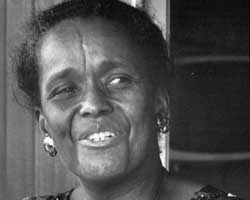
Ella Baker championed the idea of participatory democracy
Similarly, a deeper interpretation of democracy would emphasize participation by an individual or community in the decisions that affect them. For this definition I follow in the footsteps of Ella Baker, the mighty civil rights organizer who championed the idea of participatory democracy. With a lifelong focus on empowering ordinary people to solve their own problems, Ella Baker is known for saying “Strong people don’t need strong leaders.” This was the philosophy of the black students who sat-in at lunch counters in the South to win their right to public accommodations. They didn’t wait for the law to change, or for adults to tell them to do it. The students recognized that society was wrong, and practiced non-violent civil disobedience , becoming empowered by their actions. Then with Ms. Baker’s support they formed the Student Non-violent Coordinating Committee (SNCC) and organized poor blacks in Mississippi to demand their right to vote, passing on the torch of empowerment.
We need to be empowered to manage our own affairs on a large scale. In a participatory democracy, “we, the people” would run the show, not representatives who depend on corporate funding to get elected. “By the people, for the people, of the people” are great words. What if we actually put those words into action in the government, the economy, the media, and all the institutions that affect our lives? Institutions should obey the will of the people, rather than the people obeying the will of institutions. It can happen, but only through organization and active participation of the people as a whole. We must empower ourselves, not wait for someone else to do it. Read the rest of this entry »
Republished by Energy Bulletin, OpEdNews, and Countercurrents, and translated into Turkish for Hafif.org.
The following exchange between Michael Carriere and Alex Knight occurred via email, July 2010. Alex Knight was questioned about the End of Capitalism Theory, which states that the global capitalist system is breaking down due to ecological and social limits to growth and that a paradigm shift toward a non-capitalist future is underway.
This is the third part of a four-part interview. This part is a continuation of Alex’s response to the second question. Click here for Part 2A. Scroll to the bottom for links to the other sections.
Part 2B. Social Limits and the Crisis
MC: Capitalism has faced many moments of crisis over time. Is there something different about the present crisis? What makes the end of capitalism a possibility now?
AK: As I described in the last section, the current crisis can be understood as resulting from a massive collision between capitalism’s relentless need for growth and the world’s limits in capacity to sustain that growth. These limits to growth are both ecological and social. In this section I’ll discuss the concept of social limits to growth.
The Extraordinary Power of Social Movements
Social limits to growth function alongside the ecological limits but are drawn from a different source. By social limits we mean the inability, or unwillingness, of human communities, and humankind as a whole, to support the expansion of capitalism. This broadly includes all forms of resistance to capitalism, a resistance that has arguably been increasing around the world through innumerable forms of alternative lifestyles, refusal to cooperate, protest, and outright rebellion.
As a disclaimer it’s important to recognize that not all resistance is progressive. There are right-wing, fundamentalist, and undemocratic forces that also resist capitalism, for example the Taliban, or North Korea. These are not our allies. They do not share progressive values, we cannot condone their attacks on women, or on freedom more generally, and I don’t see anything to be gained by working with them. However it is important to recognize how these forces are aligned against capitalism and U.S. imperialism, in addition to being aware of the danger they present to our own hopes and dreams.
Progressive resistance, on the other hand, has always taken its strength from grassroots social movements. Silvia Federici writes about the immense and varied peasant movements in medieval Europe that fought for religious and sexual freedom, challenging both feudal lords and emerging capitalist elites. I like to think of these rebels as my European ancestors – they were just commoners but they rose up to fight for a better world. This is the nature of social movements. Ordinary folks, daring to pursue their deepest aspirations, interests and dreams, join together with others who share those desires, and thereby create something extraordinary. The magic exists in the joining-together. Isolated individuals lack the power to accomplish what a group can achieve.
We can appreciate this extraordinary power if we look at how social movements have transformed our lives. A century ago, millions of American workers joined the labor movement and won the 8-hour day, Social Security, and workplace safety. Regular folks carried forward the Civil Rights Movement and broke Southern segregation. The feminist and LGBT movements have transformed the way gender and sexuality are viewed all over the world. It’s hard to overstate how dramatically these and other social movements have improved society. While capitalism has invented ways to co-opt social movements and redirect them into outlets that do not challenge the system on a deep level (like the “non-profit industrial complex”), movements have remained alive and vibrant by empowering people to reach towards a different world.
Have social movements limited capitalist oppression recently? To answer this we need to learn the story of the Global Justice Movement.

Demonstrators tear down a section of security fence in the Mexican resort city of Cancun to confront the World Trade Organization’s Fifth Ministerial summit on Sept. 10, 2003.
The Global Justice Movement
David Graeber, anarchist anthropologist, wrote a remarkable essay called “The Shock of Victory” in which he looks at this movement that suddenly flared up at the turn of the millennium and seemed to disappear just as quickly. Although most Americans may not remember the Global Justice Movement, and those who participated in it may feel demoralized by the fact that capitalism still exists, Graeber points out that many of the movement’s ambitious goals were accomplished. Read the rest of this entry »
Republished by Countercurrents, OpEdNews, Alliance for Sustainable Communities – Lehigh Valley, The Pigeon Post, Dissident Voice and The (Grace Lee) Boggs Blog!
The following exchange between Michael Carriere and Alex Knight occurred via email, July 2010. Alex Knight was questioned about the End of Capitalism Theory, which states that the global capitalist system is breaking down due to ecological and social limits to growth and that a paradigm shift toward a non-capitalist future is underway.
The interview will be available in four parts. Scroll to the bottom to read all of Prof. Carriere’s questions.
Part 1. Crisis and Opportunity
MC: The current financial crisis is clearly a moment of peril for both individuals and the broader system of capitalism. But would it also make sense to see it as a moment of opportunity?
AK: Absolutely. I see opportunity springing from every crack in the structure of capitalism. For all those who wish to see a different world, this moment is dripping with opportunity because the old order is crumbling before our eyes.
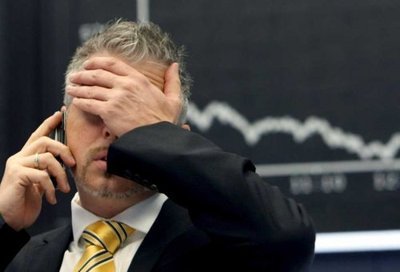
Shock and Awe on the New York Stock Exchange
The crisis extends far beyond the broken financial system. Millions of people are losing their jobs, homes, and savings as the burden of the crisis gets shifted onto the poor and working class. Public faith in the system, both the government and the capitalist economy, has been shattered and is at an all-time low. And it’s not just the economic crisis. The bank bailouts, the endless wars in the Mid East, the BP spill and the meltdown of the climate, and about a dozen other crises have shaken us deeply. It’s become common sense that the system is broken and a major change is needed. Barack Obama was elected in the US precisely by promising this change. Now that he is failing to deliver, more and more people are questioning whether the system can provide any solutions, or whether it’s actually the source of the problem.
Shattered faith is the dominant sentiment today. You can see it in people’s faces – the disappointment, grief, worry, and anger. To me, this loss of faith presents an enormous opening for putting forth a new, non-capitalist way of life. People are ready to hear radical solutions now, like they haven’t been since the Great Depression.
Historic Crossroads
If we go back to 1929, we’ll see some interesting parallels to our current moment. When that depression started, millions lost their livelihoods to pay for the bankers’ crisis. Faith in capitalism sunk to rock bottom. The public flocked to two major ideologies that offered a way out: socialism and fascism.
Socialism presented a solution to the crisis by saying, roughly: “Capitalism is flawed because it divides us into rich and poor, and the rich always take advantage of the poor. We need to organize the poor and workers into unions and political parties so we can take power for the benefit of all.”
Socialism attracted millions of followers, even in the United States. The labor movement was enormous and kept gaining ground through sit-down strikes and other forms of direct action. The Communist Party sent thousands of organizers into the new CIO, at the time a more radical union than the AFL. Socialist viewpoints even started getting through to the mass media and government. Huey Long was elected Senator from Louisiana by promising to “Share Our Wealth,” to radically redistribute the wealth of the country to abolish poverty and unemployment. (He was assassinated.) Socialism challenged President Roosevelt from the left, pushing him to create the social safety net of the New Deal.
On the other side, fascism also emerged as a serious force and attracted a mass following by putting forth something like the following: “The government has sold us out. We are a great nation, but we have been disgraced by liberal elites who are pillaging our economy for the benefit of foreign enemies, dangerous socialists, and undesirable elements (like Jews). We need to restore our national honor and fulfill our God-given mission.”
When people hear the word fascism, they usually think of Nazi Germany or Mussolini’s Italy, where successful fascist movements seized state power and implemented totalitarian control of society. Yet fascism was an international phenomenon during the Depression, and the United States was not immune to its reach. General Smedley Butler, the most decorated Marine in US history, testified before the Senate that wealthy industrialists had approached him as part of a “Business Plot” and tried to convince him to march an army of 500,000 veterans on Washington, DC to install a fascist dictatorship.
Today we are approaching a similar crossroads. When I hear the story of the Business Plot I think about the Tea Party, which has sprung from a base of white supremacist anger, facilitated by right-wing elements of the corporate structure like Fox News. This is an extremely dangerous phenomenon. The “teabaggers” have moved from questioning Obama’s citizenship, to now trying to reverse the gains of the Civil Rights Movement, such as the ability of everyone, regardless of color, to enjoy public accommodations like restaurants.
I think it’s fair to name the Tea Party, Glenn Beck, Sarah Palin, the Christian Right, etc. parts of a potential neo-fascist movement in the United States. Their words and actions too often encourage attacks on people of color, immigrants, Muslims, LGBT folks, and anyone they don’t see as legitimate members of US society. Ultimately, many in this movement are pushing for a different social system taking power in the United States: one that is more authoritarian, less compassionate, more exploitive of the environment, more militaristic, and based on a mythical return to national glory. This is not a throwback to Nazi Germany. It’s a new kind of fascism, a new American fascism. And it’s a serious threat.
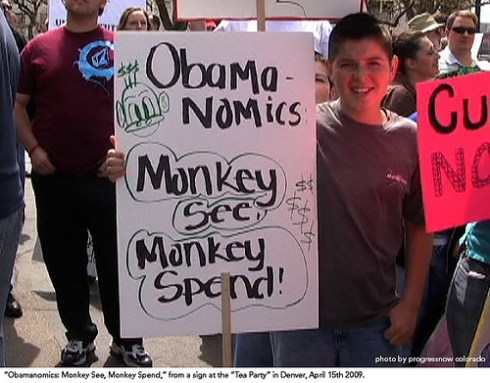
Tea Party racism in Denver, April 15, 2009
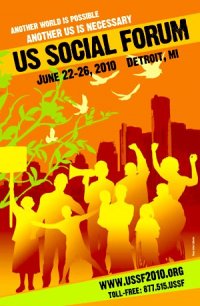
On the other hand, this crisis is also an opportunity for all of us who see capitalism as a destructive force and believe the message of the recent U.S. Social Forum that “Another World is Possible. Another US is Necessary.” “Socialism” in the post-McCarthy/Cold War era of the United States is a dead word, because it carries a lot of baggage from the Soviet Union. Rightly so, the USSR was a terrible dictatorship that is hardly an example to follow. The question is, how do those of us who are progressive and anti-capitalist articulate our ideas to resonate with a mass audience in this moment?
Common Values
I argue that we need to speak to the population in a language of our common values: democracy, freedom, justice, and sustainability. Read the rest of this entry »
 Economic collapse. Ecological disaster. Who’s going to make sense of this chaos? YOU!
Joanna Grim and Alex Knight will facilitate a participatory workshop to explore the questions: Is capitalism coming to an end? if so, Why? and What does this mean for the future of our planet? Are we headed towards a neo-fascist nightmare or is this an opportunity to create real democracy and sustainability?
The End of Capitalism? At the Crossroads of Crisis and Sustainability
When: Wednesday, 06/23/2010 – 3:30pm – 5:30pm
Where: WSU Old Main: 1134, Detroit Michigan!
Who: YOU! along with members of the End of Capitalism Study Group, who recently studied the book “Caliban and the Witch” by Silvia Federici on the origins of capitalism in the witch hunts of Europe.
Why: It’s up to us to figure out what the heck is happening to our world! Bring your ideas and hear ours!
Workshop description:
The ongoing global economic crisis has dramatically called into question the future of capitalism – a system that relies on perpetual growth but exists on a finite Earth. In this workshop, participants will take a “big picture” look at the ecological limits and social limits which lie below the current economic crisis and which threaten capitalist growth. These include climate change, peak oil, the Global Justice Movement and resistance from unexpected sources, like the Chinese labor movement. We will then imagine possible non-capitalist futures, both democratic/sustainable and authoritarian/fascist, in order to understand the historic crossroads at which our movements find themselves.
The goal of this workshop will be to broaden and deepen the anti-capitalist analysis of participants, while creating an open but directed space for us to articulate our vision of the world we are working towards, and the major dangers that are in our path. It will be led by youth members of the End of Capitalism Study Group, and build from the ideas of endofcapitalism.com. This will be a participatory workshop, not a speech, and old/dogmatic ideas will be questioned by new critical perspectives, with the goal of discovering deeper truth about our world and our work for social change in the 21st Century.
More info: http://organize.ussf2010.org/ws/end-capitalism-crossroads-crisis-and-sustainability
The US Social Forum is the nation’s largest gathering of progressive individuals and organizations. It is more than a conference, it is a movement-building process. This year’s Social Forum is the second one, and will be held in Detroit, MI from June 22-26. check out http://ussf2010.org/
RSVP on Facebook: http://www.facebook.com/event.php?eid=113425255370297
Disobeying the Banks: An Interview with Enric Duran
by Scott Pierpont
Originally published by the Institute for Anarchist Studies
On September 17th, 2008, Barcelona-based anticapitalist Enric Duran announced that he had expropriated 492,000 euros. For several years, Duran took out loans that he never intended to pay back and donated all of the money to social movements constructing alternatives to capitalism. This announcement came with the publication of 200,000 free newspapers called Crisi (Catalan for “Crisis”), with an article explaining Duran’s action, and other pieces offering a systemic critique of the current financial and ecological crises. The action got the attention of tens of thousands of everyday people as well as major media outlets, who soon dubbed Duran the “Robin Hood of the Banks.” Duran left the country to avoid prosecution. The group that published the newspapers formed Podem Viure Sense Capitalisme (We Can Live With Out Capitalism) and began region-wide organizing through their website, http://podem.cat, bringing together debtors, squatters, alternative economy networks, environmentalists, and everyday people to build a large-scale alternative to capitalism.
Duran returned to Spain six months after the announcement to participate in the release of another publication. On March 17th, 300,000 copies of Podem (We Can) were distributed across Spain in Catalan as well as Spanish. Duran announced the publication during a student protest at the University of Barcelona, and was soon after arrested by the Mossos d’Esquadra, the Catalan regional police on charges of “ongoing fraud” that were brought against Duran by 6 of the 39 financial entities he took money from. He spent two months in jail. He is currently free on bail, having had his passport seized and required to present himself before a judge once a week. None of the charges have been formally brought to trial.
Since then, Duran has been organizing with the We Can campaign. Focused on networking and the distribution of information about alternatives to capitalism, We Can connects with thousands of people participating in alternative economy projects. Many use the group’s website, which includes a “Debtors’ Community” where people get practical advice on how to avoid paying their debts. Duran has published a book, Insumisión a la banca (Disobeying the Banks), the proceeds from which go to We Can, and continues to give talks and participate in national networks on degrowth and alternative currencies.
This interview was taped in Barcelona in December 2009.
The announcement of your action (September 17th, 2008, two days after Lehman Brothers went down) coincided with a dramatic moment during the financial crisis. Was the date chosen for that reason?
That was the goal, to coincide with a moment of ferment in the crises. When the action began at the end of 2005, the crisis hadn’t arrived yet. But the question became when to make it public so it would coincide with an important moment in the crisis. The end of my action was part of the plan, my strategy, by the summer of 2007, when the crisis began in the United States. In the end it was made public in September 2008, coinciding with the breakdown of the international financial order. It was a complete stroke of luck because it wasn’t possible to put an exact date, as we needed a month to prepare the publication and organize people to pass it out. It was really a stroke of luck.
And you planned this action for three years?
Planning, no…it was three years of execution. Between 2005 and 2008 I carried out the various parts of this action. There was a period of research at the beginning, of figuring out how to do it, but very quickly I moved on to practice, because practice is the best way of experimenting and learning.
In your book you mentioned that this technique of taking out loans was inspired by someone you met who falsified pay stubs. But you also mentioned Lucio Urtubia and his action against Citibank. Do you consider your action an expropriation, just as Lucio’s action was?
Yes, the principle examples were expropriations carried out in a non-aggressive way, an intellectual way, such as falsification, or taking out loans and not paying them back, as I did. I don’t know of any precedent involving loans in a political way, but I did have the example of that person who had told me about it before. So I guess the example of Lucio inspired my broader conception of expropriation and direct action, as did the examples of civil disobedience like Martin Luther King in the United States, or those in other countries who showed that public, illegal action can have a major impact on social consciousness. Read the rest of this entry »
 One of the best documentary series ever produced, Eyes on the Prize is a 14-part study of the Civil Rights Movement in the United States. This series is so important because it shows how ordinary people, when organized, can affect dramatic social change.
The Civil Rights Movement remains the most inspiring example of successful social movements in the United States, breaking down the evil system of racial segregation and opening up possibilities for Black people, as well as for other races, that never existed before. It’s important to remember that 50 years ago, most African Americans could not vote, but now we have a Black President.
Obviously the work of the Civil Rights Movement remains unfinished, as we still live in a racist society with many other severe social problems caused by capitalism as well. But as Eyes on the Prize displays so dramatically, the hope we seek lies not in politicians but in our very own hands. We must learn from the past in order to change the future.
I watched episode 1 today and will be viewing the others over the next few weeks. Would you like to watch and discuss the series with me? Please respond by leaving a comment!
Love and struggle,
alex
p.s. anyone know how to embed these videos on WordPress?
Episode 1: Awakenings (1954-1956)
Subjects: Origins of the Civil Rights Movement, Segregation, Black Soldiers in World War II, Brown v. Board of Education, Emmett Till, Rosa Parks, Montgomery Bus Boycott, Martin Luther King Jr, White Citizens Council, Ku Klux Klan, White Allies
Episode 2: Fighting Back (1957-1962)
Subjects: NAACP, Integration v. Segregation, Little Rock AR, The Little Rock 9, James Meredith, University of Mississippi
Episode 3: Ain’t Scared of Your Jails (1960-1961)
Subjects: Student Sit-ins, Nashville TN, Direct Action, Civil Disobedience, Student Nonviolent Coordinating Committee (SNCC), Ella Baker, Boycott Movement, Congress of Racial Equality (CORE), Freedom Rides, Southern Jails
Episode 4: No Easy Walk (1961-1963)
Subjects: Martin Luther King Jr, Southern Christian Leadership Conference (SCLC), Freedom Songs, Albany GA, Bull Connor, Birmingham AL, Fire Hoses and Dogs, John Lewis, March on Washington, John F. Kennedy, Civil Rights Act
Episode 5: Mississippi: Is This America? (1962-1964)
Subjects: Medgar Evers, Murder of Goodman, Chaney, and Schwerner, SNCC, Voting Registration Drives, Mississippi Freedom Summer, Mississippi Freedom Democratic Party, Failure of the Democratic Party
[This is the BEST video in the series. What SNCC did in Mississippi changed America forever.]
Episode 6: Bridge to Freedom (1965) Read the rest of this entry »


 The End of Capitalism
Recent Comments