
You are currently browsing the category archive for the ‘New World’ category.
We’re almost four years into the 20s and the sooner we bring back the concept of decades the better. Decades give people, especially young people, a temporal identity and a grounding in history. Decades emphasize the importance of now, but also connect us to the past in a way that doesn’t alienate us from our elders or youths in the way the concept of “generations” does automatically. Decades are a key element of narrative storytelling, encourage critical thinking through comparing/contrasting eras, and make it easier to discuss the future. In sum, decades benefit mental health, social inclusion and connection, movement building, and resistance to the aimless void of late capitalism. Our ability to exercise historical agency and preserve historical memory may depend on us reviving this concept.
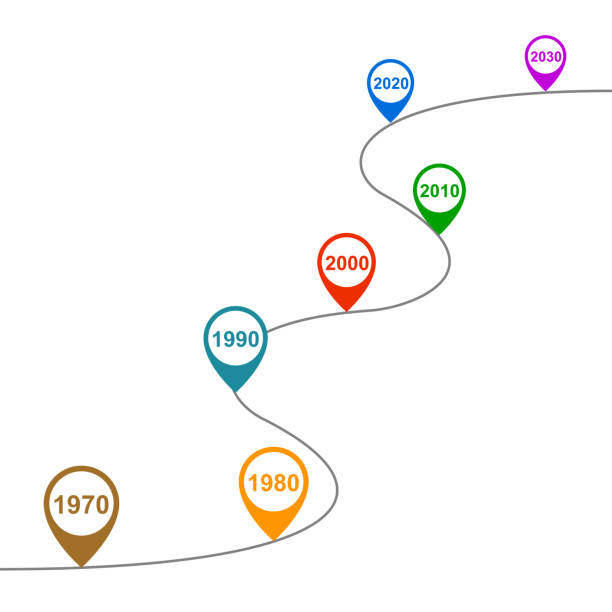
If you’re 35 or older, you remember the 60s, 70s, 80s, and 90s as regular talking points. Both in the historical sense of “what was the spirit of the 60s?” and in the future-focused sense of “this will be THE trend of the 90s.” The concept of decades permeated regular conversation, tying people together and rooting them in a temporal home, whether you were talking about music, sports, film, fashion, politics, games, or literally anything. It made it natural and popular to compare eras of things, which is a basic building block of both historical study as well as critical thinking itself. It also helped people form an identity, in the sense of “I’m a child of the 70s” – one shorthand reference point that contains a vast easily-recalled cultural context filled with people, events, products, art, styles, and social struggles. It was a source of pride to be associated with a decade.
When Y2K hit, the computers were just fine. Better than ever, in fact. But we weren’t, because we suddenly lost a very powerful tool for understanding our social environment. Without the concept of decades, we wandered into an amorphous fog without beginning or end, where we became easy-pickings for a consumer capitalism that thrives by developing isolated, disoriented worker-spectators. When ignorant of our past and uninterested in our future, we rarely make trouble for the ruling class.
At first, some people resisted the change. They coined names for the decade-to-be, but none caught on. They sounded forced, so they were relegated to the realm of jokes (Try to have a serious conversation about “the noughties”). Nothing stepped in to bridge the chasm.
It wasn’t a huge problem at first, because the 90s were such a recent frame of reference, so we could keep the concept of decades alive by just filing the present under “post-90s” or “this decade.” All the conversations we were accustomed to, where we compared trends in pants, or hair, or anarchist politics, kept rolling for a while, they just had this weird stand-in where you’d have to compare previous decades to the vague concept of “now.” As in, “you guys had VCRs in the 80s, but now we have the far-superior technology of DVD players, which will remain popular forever.”
Ten years passed. A new decade was scheduled to be starting, but no one took notice. The concept of decades wasn’t revived. Instead, it faded into oblivion. Maybe we were too buried under the infinite scroll of social media, our heads down, absorbed by our smartphones, or too obsessed by the latest streaming content, that we lost the ability to form long-range narratives. Our shared experience of the era itself began to fracture, as our attention scattered into increasingly fragmented niches of the spectacle, which concealed the fact that we were largely all doing the same thing at the same time. Or maybe we were so emotionally beaten down by the seemingly endless “War on Terror” and apocalyptic ecological catastrophe that we simply didn’t have the energy to think of ourselves as historical agents, and therefore couldn’t be bothered with putting a name on the era we were living through, even though “the teens” was an obvious and pleasant choice.
It’s not as if there weren’t massive and historically-important movements for social change happening in that decade. From the Arab Spring to Occupy Wall Street to Black Lives Matter to MeToo to Transgender visibility, millions of people were organizing, shifting social norms, and becoming empowered to radically improve society in ways perhaps more profound than we know. But compared to movements of the 60s, 70s, 80s, or 90s, these new movements are unusually obscured, and perhaps in danger of being overlooked.
Organizers of these world-changing efforts – people like Alicia Garza and Marisa Holmes – should be recognized and remembered for their actions. Even more importantly, our understanding of how that decade’s movements arose, why they were so effective, and also what their shortcomings were, should be the topic of regular conversation so that we may improve upon them in the future. Yet, it’s nearly impossible to have a productive, civil version of such a discussion on social media, and it may be nearly impossible for a social movement in this day and age to outlast the ephemeral confines of a hashtag.
This is not to suggest that these movements will be forgotten, or to downplay the excellent work of the chroniclers of these efforts, who have produced worthwhile books, documentaries, and other media that actively preserve this historical memory. Instead, I suggest it is unfair to those culture-defining social movements that we can’t immediately recall their powerful messages, images, and actors through a universally-agreed-upon phrase like “the teens” in the same way that “the 60s” immediately conjures such thoughts of the Civil Rights Movement or the anti-Vietnam War movement.
By the way, don’t give me this crap about “generations.” The Civil Rights Movement/Black Freedom Struggle was driven forward by people of all ages, from elders like A. Philip Randolph to middle-aged people like Ella Baker, to children like those who walked out of school to pack the Birmingham jails. As far as I’m aware, the fear-mongering associated with “rebellious youth” has always existed. For sure it existed in the 60s, when the mass media did their best to demonize the anti-authoritarian, hopelessly “feminized” “Baby Boomers”, effectively blaming young people for everything wrong with the world. We’ve come full circle today, blaming those same people, who are now old, for the exact opposite reasons.
“Generations” are a fake conceptual tool used to divide people. Since 2000, as the concept of decades has fallen away, in part it has been superseded by the nefarious concepts of “Millennials” and “Gen. Z.” These are identities which are inherently exclusive, and usually they are invoked for purely negative characterizations. Eventually, “Gen. Z” will get the same scorn that “Boomers” do now, and it will be just as baseless.
In contrast, decades are inherently inclusive. Everyone who was alive in the 90s can reminisce about what that decade was like for them. Even if our experiences were vastly different, we can find common ground through cultural touchstones like The Simpsons or Tupac. That kind of conversation is not just idle nostalgia. It is a collective remembering that allows us to form social bonds with neighbors, co-workers, and fellow activists, to each of whom the 90s is a small building block in their own identity-formation.
If you read comments on Youtube under videos of old music or TV shows (and I’m not recommending you do), you’ll regularly see people lamenting that we no longer live in the [insert decade here]. Some of those commenters are old and feeling nostalgic for the loss of their youth. That’s normal. But some of those commenters are young. They will often mention that they “just turned 16” (or another age of fragile identity-formation). And yet, here they are, wandering the interwebs, watching videos that were produced before they were born and wishing they could time-travel back to the 20th century.
Meanwhile, the 21st century is nearly a quarter complete, and its music and TV shows have been equally valuable, if not more so. But without the decades providing an automatic frame of reference for great artistic works, we struggle to recall exactly when they were released, or how they related to concurrent events in society or technology, or even our own lives. Without decades, people don’t know how to talk to each other about their own time period. And so they don’t. They just slowly forget, as everything is enveloped in a nebulous, meaningless haze.
What stories are children of this century learning about their own time, and where they fit in? What can they be proud of? What can they look forward to?
There’s a bunch of things we could do for a better future for all. Redistributing the wealth of the top 1%. Replacing the private automobile with free public transit. Dismantling the prison-industrial complex in favor of systems of transformative justice and accountability. Planting a billion trees. Those will take a lot of hard work and a long time.
One thing that would take very little effort, would bring us into connection with those around us of all ages, would help us cherish the present and look forward to the future, would empower us to find meaning and feel better, is to reintroduce the concept of decades. We can start now, by acknowledging publicly, and habitually, that we live in the 20s.*
* I mean no disrespect to the decade of the 1920s, a fine decade to study and discuss. But of the decades called “the 20s”, the current decade is far more relevant to everyone living today and for the rest of the 21st century. I don’t know at what point people stopped referring to the 1820s as “the 20s,” but surely it was before 1923.
by Alex Knight, 1/6/17
Republished on Countercurrents.
In 2000, I was 17 years old. I didn’t know the first thing about politics, history, or social change. My first preference in the U.S. Presidential Election was for George W. Bush.[i] Somehow in my ignorance I had figured out that the Democrats were the more popular party, and I reviled what was popular. The President for the last eight years had been a Democrat. I also knew that the society I lived in sucked. It sucked for teenage me, and it sucked in general. So, without any deeper thought on the subject, my infantile rebellion led me to the only alternative in a two-party system, the Republicans. Once again in 2016, “non-college educated white men” like my teenage self followed similar logic to give Donald Trump just enough votes to sneak into the White House. When asked in exit polls what was the “quality that mattered most” in deciding who to vote for, the number one quality voters sought was a candidate who “can bring change.” Of those change-seeking voters, 83% were captured by Trump.

“Power concedes nothing without a demand.” – Frederick Douglass. History teaches us that hope can overcome fear through struggle.
After the election, it’s tempting to curl up into a state of shock and surrender to fear or apathy. The U.S. voting public just elected someone who is openly racist, sexist, and xenophobic. 30 states were won by a man who brags about sexually assaulting women, led a campaign to delegitimize the nation’s first Black president by questioning his citizenship, and wants to build a giant wall on the Mexican border to keep out poor immigrants who he called “rapists.” The people he’s now appointing to run organs of government are quite literally the very worst people in the country, whose entire careers have been based on undermining social and ecological protections. The future looks bleak. Is neo-fascism already here?
In our deeply cynical society, it is the task of revolutionaries to see the silver lining of hope that has just opened before us. We must appreciate that this moment is a great opportunity for radicalizing the millions of people who are dissatisfied with the status quo. Donald Trump is the most disliked major-party candidate to ever run for the Presidency. The election of a despised, buffoonish, billionaire capitalist to head the U.S. government provides anti-capitalists with a glaring demonstration that the system does not work.
In this article we will review how a figure as polarizing as Trump was propelled to become a viable candidate through the mass media’s obsession with celebrity and scandal. We will also explore how the failure of the Hillary Clinton campaign and the Democratic Party reflects the collapse of legitimacy for the status quo and its neoliberal capitalist project. Finally, we will face the threat of neo-fascism and explore what progressive radicals can offer now that a uniquely dangerous, yet uniquely unpopular, man is about to become the face of the U.S. government.
In the years after Bush II was elected, I was fortunate enough to encounter anti-capitalists who showed me and invited me into the amazing tradition of grassroots organizing. I was able to discover an alternative path where my teenage frustrations were sharpened into anti-capitalist critique and a lifelong commitment to social justice. It is now my calling to pay forward the gift that was given to me. We have a choice on how to respond to the election. We can either spend the next 4-8 years wallowing in fears of how everything can go wrong, or we can recognize the special opportunity we have to provide a path for people to discover genuine change, community, and meaning that can only come through participation in radical social movements.
A Billionaire Cartoon Villain is About to Become US President
(In the next two sections, we will analyze how the election reveals the dysfunction of the electoral system and mass media. To jump to the repercussions and how to respond moving forward, click here.)
The system has failed and Donald Trump is the personification of that failure. Before the election, only 38% of the American public had a “favorable” opinion of Trump, as compared with 58% “unfavorable.” That -20% margin makes Donald Trump literally the most unfavorable candidate ever to get the endorsement of a major US political party. Significantly, Hillary Clinton was the second-most unfavorable candidate ever, with a -12.6% gap.
The historic unpopularity of the two major candidates drove down turnout for the two major parties:

The US adult population grows by about 10 million people per 4-year election cycle. While the raw vote totals have remained somewhat stable, support for the two major parties proportional to US population has decayed since 2008. Consequently, 8 million people voted for “third party” candidates in 2016, which is more than in any election since 1996. Gary Johnson of the Libertarian Party and Jill Stein of the Green Party combined for nearly 6 million votes. By comparison, Ralph Nader in 2000 was attacked as a spoiler for getting less than half that total. Putting Trump’s victory in perspective: it’s important to remember that 54% of voters, and nearly 75% of American adults, did not vote for Trump.
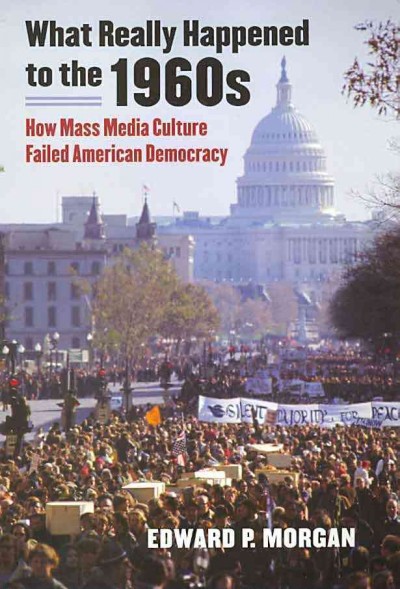 What Really Happened to the 1960s: How Mass Media Culture Failed American Democracy
Edward P. Morgan
2010, University of Kansas Press
Who controls the past, controls the future. Who controls the present, controls the past.
– George Orwell, 1984
As a young and politically naïve college student, I was very fortunate to have the opportunity to take several of Ted Morgan’s classes. His “Movements of the Sixties” course was hugely influential for me, primarily because exposure to the upheavals of that era taught me that the project of transforming our world towards a more democratic, just, and ecologically balanced future has deep roots. Standing confidently atop those long, sturdy roots transmits the possibility and hope that we can indeed change the world, because we already have. Indeed, the black freedom, anti-Vietnam War, women’s liberation, gay and lesbian liberation, welfare rights and other movements of the 60s era so successfully challenged the dominant capitalist institutions of the U.S. that those institutions have been scrambling for the last forty years to systematically minimize the possibility of future freedom struggles.
In this book, Ted Morgan documents a key component of that reaction: the two-pronged mass media campaign to denigrate and obscure the democratic promise that the movements of the sixties still hold, while at the same time co-opting the symbols and imagery of the sixties to make Corporate America “cool” and thereby sell more products. This media reaction has gone hand-in-hand with material forces, such as student debt, coercing the population into inactivity and obedience. In Morgan’s words, the result is a “depoliticized society,” with a “diminished ability to make history” (pg. 7). This book therefore becomes a weapon against rootlessness and despair, which I especially urge young people to read.
The Promise of Democracy
The 1960s are typically remembered as a time of turbulence and change. We all know the iconic images: assassinations, war, protests, urban riots, men on the moon, long hair, drugs, sex, and rock ‘n’ roll. Yet, it’s a decade that Americans are still trying to make sense of, justifying an endless stream of retrospectives like CNN’s latest 10-part weekly series “The Sixties.” Ted Morgan’s necessary book What Really Happened to the 1960s provides answers you won’t find on primetime TV. In his writing, the underlying story of that decade was a clash between capitalism and democracy, one in which perhaps millions of Americans participated in social movements and challenged the country to become more just and more democratic (8). In some ways they succeeded and in others they failed. But as the book’s subtitle, How Mass Media Culture Failed American Democracy suggests, the true history of that struggle has been consistently distorted and hidden from view. What the media still cannot comprehend, or perhaps would seemingly most like to forget, is the democratic promise that formed the basis of those sixties social movements.
“[L]argely disappeared from memory [is] the surge in democratic empowerment in which large numbers of Americans of all ages organized themselves to confront and transform a range of injustices rooted in American institutions” (6, emphasis added).
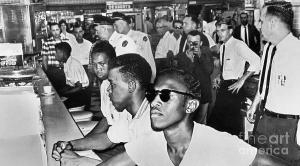
As a practice of democratic empowerment, students initiated the lunch counter sit-ins to challenge legal racial segregation in the South. (1961)
Morgan goes on to define the phrase “democratic empowerment.”
“[D]emocratic empowerment means one’s unfolding ‘freedom to,’ a lifelong discovery of one’s authentic self, the discovery of which progressively frees one from manipulation by others and potentially by the disabling scripts of the unconscious” (51).
In other words, the sixties’ social movements, at their best, were not just about stopping racism or war on a systemic scale, but also about the self-realization of the millions of individuals involved on a personal level. Forty years later, I experienced the same rush of democratic empowerment when I attended my first organizing meeting and realized for the first time that in working with others I had the power to impact the world around me for the better. The meaningfulness and self-confidence that comes from a politically active and engaged life contrasts dramatically from the dominant modes of apathy and self-loathing inoculated into us by capitalist society and its mass media appendages. The experience of activism allows people to see themselves differently and to grow into their full potential, gaining courage as they take on greater and greater challenges – from speaking at a meeting, to holding a picket sign, to risking arrest in direct action.
As civil rights organizer Jim Lawson is quoted, “ordinary people who acted on conscience and took terrible risks were no longer ordinary people. They were by their very actions transformed” (51). Read the rest of this entry »
The following book review was published in the Fall issue of Fifth Estate. I originally wrote a much longer version here. This one’s short and sweet. [alex knight]
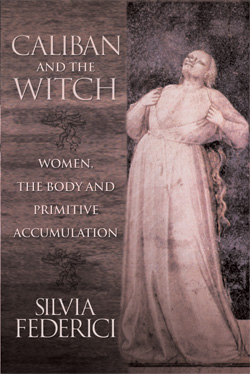
Silvia Federici’s book, Caliban and the Witch: Women, the Body, and Primitive Accumulation, is an essential read for those of us seeking to overthrow systems of domination and build a liberated future.
What is most fascinating about Caliban and the Witch is how it challenges the widely-held belief that capitalism, though perhaps flawed in its current form, was at one time a “progressive” or necessary development. Uncovering the forgotten history of the Witch Hunt that consumed Europe in suspicion and fire for more than 200 years, Federici demonstrates that capitalism has always relied on spectacular violence, particularly against women, people of color, workers, and those cultivating a more egalitarian future.
The book recalls the enormous and colorful peasant movements of the Middle Ages, which pointed towards non-capitalist futures for Europe, and by extension, the world. However, these paths were blocked. The “shock therapy” of the Witch Hunt was used to terrorize rebels and visionaries, impose new discipline on the body, on female sexuality in particular, and usher in a new social system based on a landless working class and the devaluation of women’s labor.
Federici writes, “It is impossible to associate capitalism with any form of liberation or attribute the longevity of the system to its capacity to satisfy human needs. If capitalism has been able to reproduce itself it is only because of the web of inequalities that it has built into the body of the world proletariat, and because of its capacity to globalize exploitation. This process is still unfolding under our eyes, as it has for the last 500 years.”
This personal reflection was written for and performed at a spoken word event on March 2nd in Philadelphia.
“After the Apocalypse” – by Alex Knight
 As I write, it’s March 1, 2013. I never expected to see this date arrive.
When I was 10 or 11, my father and I watched a TV special, probably on FOX, called “Prophecies Revealed,” which rounded up an assortment of fables from Nostradomus on down, to scare the crap out of the audience and get ratings by making people believe the end of the world was right around the corner. One segment talked about the Mayan calendar, and over a background of creepy and violent images, posed the question, “what’s going to happen on December 21, 2012? Will our technologies revolt against us? Will there be some kind of cataclysmic event, like an enormous meteor impact? Will nuclear war finally consume the Earth?”
I feel silly to admit it, but these ideas of imminent doom really stuck with me. Maybe I was just an impressionable kid who had seen too many Terminator movies. Or maybe there is something really appealing, even liberating, about apocalypse – at least for those of us living in a repressive, alienating, hierarchal social system such as zombie-capitalism. The specter of apocalypse seems to substitute in negative form for the positive vision of “social revolution” that radicals a century ago believed in – namely, a way out, an escape. Say what you will about the Rapture – at least it’s a rupture. Meaning, even if the fires of armageddon were a nightmare in the short run, at least the horror of the world we live in would come to an end, and then maybe something better would sprout from the ashes.
Almost immediately after I left home for college, these apocalyptic prophecies were resurrected from the nether-regions of my mind. On September 11th, the World Trade Center and Pentagon were hit by hijacked airplanes. As I watched in my Freshman dormroom, I felt shock, sadness, but also a forbidden and shameful giddiness. The attack was a horrible, evil thing, and I feel awful for those who lost loved ones. But for me at age 18, the dramatic realness of that event was a sharp, sudden puncture to the bubbly propaganda image of 1990’s peaceful hegemonic America. It was the first time I ever realized that the world is not static – it is changing all the time. I had just never looked outside my plastic suburban cage to see the real world, in its full ugliness and beauty. September 11th, as hellish as it was, was for me that rupture – it jarred me into the awareness that there is an exit from the prison of mainstream America, if you’re willing to do a little digging.
I started to listen a bit more to my communist English teacher, be less defensive in response to voices critical of capitalism, and I set off down the rabbit hole. As Bush put the country on the warpath, I transformed myself from a video game junkie into a committed activist devoting every bit of energy I could to making revolution happen in this country, starting by organizing a national student movement against the war, I hoped. Read the rest of this entry »
This document should not be forgotten. Although the New SDS (Students for a Democratic Society) is no longer what it was when this statement was written, the vision expressed herein provides a powerful framework for understanding what it means to organize for social change. Written primarily by Madeline Gardner, Joshua Kahn Russell, Kelly Lenora Lee and Michael Gould-Wartofsky, “Who We Are, What We Are Building” was approved by the direct democratic process of the SDS National Convention in Detroit, July 27th – 30th, 2007. It was subsequently ratified by a vote of SDS chapters. Five years later, it is still worth (re)reading! [alex]

As Students for a Democratic Society, we want to remake a movement – a young left where our struggles can build and sustain a society of justice-making, solidarity, equality, peace and freedom. This demands a broad-based, deep-rooted, and revolutionary transformation of our society. It demands that we build on movements that have come before, and alongside other people’s struggles and movements for liberation.
Together, we affirm that another world is possible: A world beyond oppression, beyond domination, beyond war and empire. A world where people have power over their own lives. We believe we stand on the cusp of something new in our generation. We have the potential to take action, organize, and relate to other movements in ways that many of us have never seen before. Something new is also happening in our society: the organized Left, after decades of decline and crisis, is reinventing itself. People in many places and communities are building movements committed to long-haul, revolutionary change.
SDS can play a vital role by redefining the student and youth movement and how it relates to others. Yet we have a choice ahead of us: We can do what has been done before – reinvent the wheel with the same old cycles – or we can build something new together, something informed by our past and grounded in a vision of what the future might look like. We envision the new SDS in the light of the second alternative.
SDS will forge itself through its actions and speak for itself with its own collective voice. In this statement of organizational vision, we want to highlight the most hopeful ideas and practices in SDS, offering a sense of what our organization might be and what it can offer others. The concepts below are building blocks for our organization.
Here, we begin to evoke our visions for the movement we want to make, but that is not enough: As Students for a Democratic Society, we will work to actually bring it about.
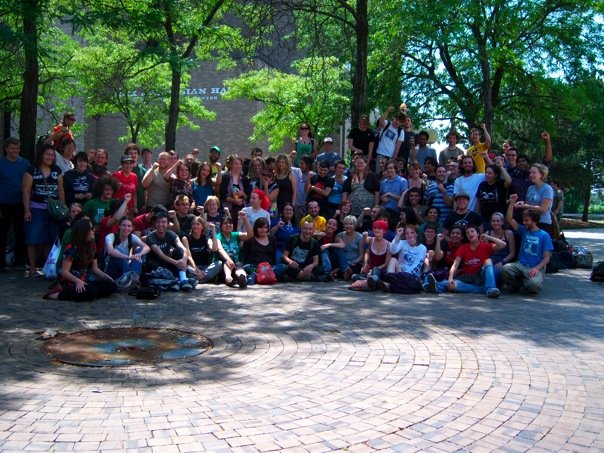
2007 SDS National Convention.
Who We Are
We are here to win.
We really believe we can create a more just society. It is possible, and we can do it – therefore we have a responsibility to do it. Our activism is not simply a matter of “fighting the good fight,” or of insularity or purity, but instead is grounded in the day-to-day reality of what it takes to build a movement that can win concrete objectives and ultimately transform society.
We are in it for the long haul.
Realizing that we can win, we think about what it means to be involved in long-haul struggle, and what it really means to do this for life. We believe there is more to a movement than taking to the streets for a day. We are building our power over the long haul. This helps give perspective on our goals and how we achieve them. We think about how we want the movement – and SDS – to look in five years, in ten years, in twenty years. We think about what we need to do now to get there. We will keep our eyes on the prize.
We are organizers.
[There are a lot of thought-provoking ideas in this article, as we reflect on the Occupy movement, what it was, what it meant, and where we go from here in our movements against zombie-capitalism and for a better world.
I intend to write much more about my reflections on Occupy, don’t worry. – alex]
Originally posted on Bay of Rage (May 16, 2012) (broken link 5/28).
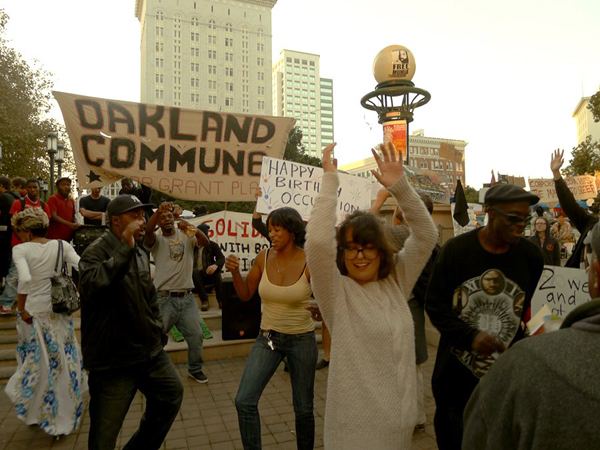 THE COMMUNE
For those of us in Oakland, “Occupy Wall Street” was always a strange fit. While much of the country sat eerily quiet in the years before the Hot Fall of 2011, a unique rebelliousness that regularly erupted in militant antagonisms with the police was already taking root in the streets of the Bay. From numerous anti-police riots triggered by the execution of Oscar Grant on New Year’s Day 2009, to the wave of anti-austerity student occupations in late 2009 and early 2010, to the native protest encampment at Glen Cove in 2011, to the the sequence of Anonymous BART disruptions in the month before Occupy Wall Street kicked off, our greater metropolitan area re-emerged in recent years as a primary hub of struggle in this country. The intersection at 14th and Broadway in downtown Oakland was, more often than not, “ground zero” for these conflicts.
If we had chosen to follow the specific trajectory prescribed by Adbusters and the Zucotti-based organizers of Occupy Wall Street, we would have staked out our local Occupy camp somewhere in the heart of the capitol of West Coast capital, as a beachhead in the enemy territory of San Francisco’s financial district. Some did this early on, following in the footsteps of the growing list of other encampments scattered across the country like a colorful but confused archipelago of anti-financial indignation. According to this logic, it would make no sense for the epicenter of the movement to emerge in a medium sized, proletarian city on the other side of the bay.
We intentionally chose a different path based on a longer trajectory and rooted in a set of shared experiences that emerged directly from recent struggles. Vague populist slogans about the 99%, savvy use of social networking, shady figures running around in Guy Fawkes masks, none of this played any kind of significant role in bringing us to the forefront of the Occupy movement. In the rebel town of Oakland, we built a camp that was not so much the emergence of a new social movement, but the unprecedented convergence of preexisting local movements and antagonistic tendencies all looking for a fight with capital and the state while learning to take care of each other and our city in the most radical ways possible.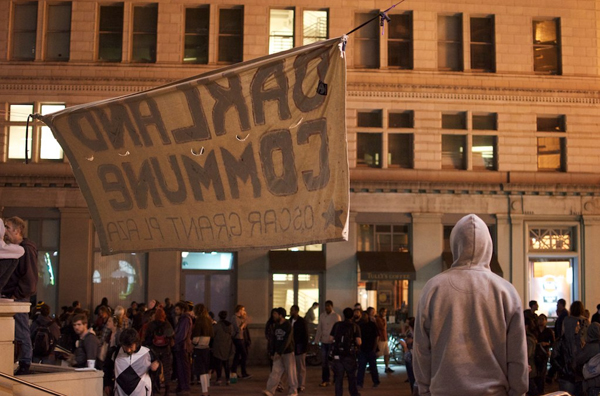
This is what we began to call The Oakland Commune; that dense network of new found affinity and rebelliousness that sliced through seemingly impenetrable social barriers like never before. Our “war machine and our care machine” as one comrade put it. No cops, no politicians, plenty of “autonomous actions”; the Commune materialized for one month in liberated Oscar Grant Plaza at the corner of 14th & Broadway. Here we fed each other, lived together and began to learn how to actually care for one another while launching unmediated assaults on our enemies: local government, the downtown business elite and transnational capital. These attacks culminated with the General Strike of November 2 and subsequent West Coast Port Blockade.
Yesterday I had the honor of speaking alongside George Caffentzis to answer the question, “What is Capitalism?” Certainly this is one of the core questions of our era, as millions of people are becoming politicized during the unending economic crisis and looking for an analysis that can explain what is happening to them. In order to make a better world, we first need to define the system that dominates the current one, and that is capitalism.
Yesterday’s packed event was the first in Occupy Philadelphia‘s ten-part educational series “Dissecting Capitalism.” It was audio and video recorded, the audio is already online HERE. Listen in!
[update 2/13: and here is the video of the talk, in two parts!]
Part 2:
Below is the outline I created for my talk (downloadable HERE). I tried to bring a holistic analysis of the system that could be understandable by the average person, but still contain a nuanced perspective of all the ways capitalism has screwed us over and screwed over our planet. I’ll be fleshing this out over the next several days to revamp the “What is Capitalism?” section of the website. [alex]
What is Capitalism?
“Know Your Enemy” – Rage Against the Machine
2/1/2012 – LAVA
Alex Knight, endofcapitalism.com
- Capitalism is a Global System of Abuse
- Common Sense Radicalism – speak to the core issue in a way everyone can emotionally understand
- How does it feel to live in a capitalist system? Like an abusive relationship.
- “The problem that has no name.”
- Social and ecological trauma
- BP Oil Disaster demonstrates system’s logic: profit over all, total lack of accountability
- Power, Abuse, Resistance

- Power-Over and Power-With
- Internalized Oppression vs. Inherent Need for Self-determination
- Systems of Abuse/Oppression: Patriarchy, White Supremacy, Class
- Some Features of Class Societies:
- Inequality – the few benefit at the expense of the many
- Economic production disconnected from human need
- Forced labor – slavery, wage slavery
- State violence – punishment, repression
- Warfare, Conquest
- Propaganda
- Unsustainable ecological abuse
- Popular resistance
- Capitalism is the most advanced Class Society
- Capitalism: Pyramid of Accumulation
- Financial Speculation
- Commodity Trading, Commodities
- Wage Labor, Wage Labor, Wage Labor
- Enclosures: the largest, but invisible part of the iceberg
- any energy, resources or labor taken by force or without just compensation
- Stages of Capitalism: 1492 – Present


 The End of Capitalism
Recent Comments