
You are currently browsing the category archive for the ‘Latin America’ category.
This is a wonderful essay looking at how a Sustainable Economy must be structured democratically and decentralized to the local level. The only thing I would add is that we need a realistic plan of action to get us from the capitalist hellhole we currently inhabit to this accurate vision of a future sustainable society, and we can’t be afraid to confront powerful forces which want to stop us.
For me as a young person in the United States, the heart of the Empire, I see my current role as organizing youth and students in resistance to the forces of domination (war, debt, oppression). Others may be better positioned to organize their workplace or their communities, or to start urban gardens, or other projects. We each have a role to play, and we need to discover it ourselves. [alex]
Building a Sustainable Economy
by Marcin Gerwin
Democracy first
In 1994 the government of Haiti lifted tariffs and allowed imports of cheap, subsidized rice and other crops from abroad. This policy was recommended by the International Monetary Fund and urged by the U.S. government (1). Over the years this tiny change in policy led to an estimated 830,000 job losses, it damaged food security and rural livelihoods, and eventually led to food riots and hunger in 2008 (2). If people in Haiti were to decide by themselves on their country policy, would they choose the recommendations of the IMF that brought them into starvation? Would people of Ecuador allow toxic pollution in the Amazon for the sake of Chevron Texaco profits? Would people in India accept genetically modified seeds of cotton that caused crop failures, spiral of debt and hundreds of farmer suicides? And would people in the USA support bailing out banks with their own money in a way that is not transparent and does not lead to the recovery of the financial system? They wouldn’t. These things happen around the world because we still don’t have true democracy, where people set the rules for themselves.
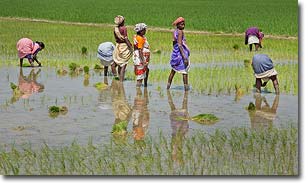 Women sowing rice in India Women sowing rice in IndiaPhoto: Michael Foley |
In 2001 twenty subsistence farmers, small traders, small food processors, and consumers, mostly women, and some of them illiterate, met in Indian village to decide on the future of agriculture in the state of Andhra Pradesh. They were chosen to represent the rural diversity of their state. They presented three different models of development. The official plan, put forward by Chief Minister of the state, was backed by grants and loans from the World Bank and the UK government. The plan was to mechanize, consolidate and genetically engineer agriculture of the state to produce cash crops for export, and to reduce the farming population from 70% to 40%, to have more workers for industry. The second vision involved developing environmentally friendly agriculture to produce cheap organic products for domestic and Northern supermarkets and it was supported by the International Federation of Organic Agriculture Movements and the International Trade Center. The third vision was influenced by Gandhian and indigenous ideas, and involved increasing local self-reliance and sustainability in both agriculture and economics.
Each model was illustrated by videos, farmers and traders could hear the summary of the policies, ask questions, consult with government officials, scientists, corporate and NGO representatives from the state, national and international level. They also considered advantages and disadvantages of each vision, based also upon their own knowledge, priorities and aspirations. After one week they made a decision.
Tom Atlee writes:
In their recommendations (…) they said they wanted self-reliant food and farming, and community control over resources. They wanted to maintain healthy soils, diverse crops, trees and livestock, and to build on their indigenous knowledge, practical skills and local institutions. They wanted to maintain the high percentage of people making their livelihood from the land, and did not want their farms consolidated or mechanized in ways that would displace rural people. Most of them could feed their families through their own sustenance farming. They did not want to end up laboring in dangerous brick kilns outside of Hyderabad, like so many who had left their farms. They also rejected genetically modified crops and the export of their local medicinal plants. (3)
If we wish to make some meaningful changes in the world, we need appropriate tools for that. A number one tool in the earth repair workshop is community-based democracy. It is a key for unlocking the potential for sustainability.
Second in the holiday movie series, The Take journals the Argentinian workers who seized their factories after the economy collapsed in 2001, and the corporations fled the scene. The parallels between Argentina 2001 and the United States 2008 are incredible, first the financial system collapsed, and now in Chicago we see the workers occupying a factory their bosses tried to illegally close. Hopefully next we’ll see the delegitimization of the government and mass popular uprisings against capitalism.
(This is just the first segment of the movie, make sure to click the Up-Arrow button to watch the rest! And you might need to do some Spanish-to-English translating!)
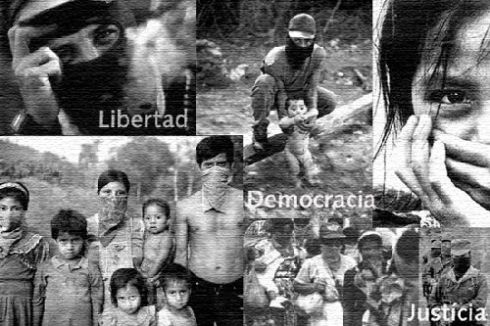
Watch this documentary! It’s only 48 minutes long, a very heartfelt and inspirational documentary of the Zapatista movement of poor indigenous Mexicans against capitalism.
By William M. H. Kötke
13 September, 2007
Countercurrents
The planetary elite are compelled to continue on their path of growth leading toward planetary domination. The international bankers through their control of the industrial world’s privately owned central banks maintain a tether on the money system through their control of the U.S. dollar as the currency of international trade. One important mechanism that allows this is that the largest item in international trade – oil – is sold in dollars. In order to insure the continuance of the dollar economy, they must be able to choose which currency oil is sold for or control the oil – or both. The center of the empire, the U.S., is maintained by debt as the petrodollars and other dollars come into the U.S. at the rate of at least two and a half billion per day (purchasing U.S. government bonds) in order to continue the cycle, which keeps the empire and its military power expanding As the elite carry out their strategies of domination they are racing against time. The monster trends of Peak Oil and energy exhaustion, climate change which will severely disrupt the seasons of growth in the food supply system, the weakness of the dollar and ecological collapse are pursuing them. An exponentially growing world population with growing material consumption based on dwindling resources and a dying planet won’t work, but they have no other option to maintain their power and profit.
Seeds of Change
As the industrial system spins toward exhaustion, seeds of change are sprouting at the base. The people at the base are not revolting in order to take the power that the elite have but are revolting to take power over their own lives. Read the rest of this entry »


 The End of Capitalism
Recent Comments