
You are currently browsing the category archive for the ‘Jobs’ category.
Is the economy “recovering”? What does a “jobless recovery” mean anyway? How should workers respond to a deteriorating situation? Professor Richard Wolff drops some knowledge and suggests that workers need to take control of their companies.
Salt of the Earth is a classic organizing movie about striking Mexican-American miners and their wives. Based on an incredible true story, the 1953 film follows the organizing efforts of the town’s women, who must overcome the company’s classism, the sheriff’s racism, as well as their own husband’s sexism, to win the strike (while the men stay at home and take care of the house and children). Highly recommended!
This is just the first segment of the movie, make sure to click the Up-Arrow button to watch the rest!
Grace Lee Boggs is a prominent long-time veteran of civil rights and other movements for justice. An Asian-American woman, now in her 80s, she is active in building urban agriculture systems for the community of Detroit. Their efforts to create a sustainable local economy out of a postindustrial urban shell are an example for all urban American cities. [alex]
Detroit: City of Hope
Building a sustainable economy out of the ashes of industry.
By Grace Lee Boggs
Originally published by In These Times
February 17, 2009.
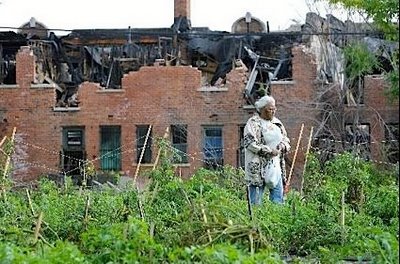
Photographer: Fabrizio Costantini/Bloomberg News. Hazel Williams picks green tomatoes at an Urban Farm off Linwood Avenue in Detroit, on Sept. 22, 2008. Photo by Fabrizio Costantini / Bloomberg.
Detroit is a city of Hope rather than a city of Despair. The thousands of vacant lots and abandoned houses not only provide the space to begin anew but also the incentive to create innovative ways of making our living—ways that nurture our productive, cooperative and caring selves.
The media and pundits keep repeating that today’s economic meltdown is the worst financial crisis since the Great Depression. But in the ’30s, the United States was an overproducing industrial giant, not today’s casino economy.
In the last few decades, once-productive Americans have been transformed into consumers, using more and more of the resources of the earth to foster ways of living that are unsustainable and unsatisfying. This way of life has created suburbs that destroy farmland, wetlands and the natural world, as well as pollute the environment.
The new economy also requires a huge military apparatus to secure global resources and to consume materials for itself, at the same time providing enormous riches for arms merchants and for our otherwise failing auto, air and ship-building sectors.
Instead of trying to resurrect or reform a system whose endless pursuit of economic growth has created a nation of material abundance and spiritual poverty—and instead of hoping for a new FDR to save capitalism with New Deal-like programs—we need to build a new kind of economy from the ground up.
That is what I have learned from 55 years of living and struggling in Detroit, the city that was once the national and international symbol of the miracle of industrialization and is now the national and international symbol of the devastation of deindustrialization.
When I arrived in Detroit in 1953, the population was 2 million, the majority white. Today, it is less than 900,000, majority black. Back then, racism was blatant and overt. Many bars, restaurants and hotels refused service to blacks. Blacks could buy homes in inner city neighborhoods but could not rent apartments in buildings right next door to these homes.
Meanwhile, freeways were enabling white flight to the suburbs, and technology was replacing human beings with robots.
In 1973, we elected our first black mayor, Coleman Young. Young was a gifted politician who was able to eliminate the most egregious examples of racism, especially in the police and fire departments and City Hall. But he was unable to imagine a post-industrial society. So, for 14 years, he tried in vain to woo industrial jobs back to Detroit.
In 1988, toward the end of his fourth term, Young decided that the factories weren’t coming back and that Detroit’s salvation depended on casino gambling, which he said would create 50,000 jobs.
To defeat his proposal, we organized Detroiters Uniting, a coalition of community groups, blue-collar, white-collar and cultural workers, clergy, political leaders and professionals.
Our concern was with how our city had been disintegrating socially, economically, politically, morally and ethically. We were convinced that we could not depend upon one industry or one large corporation to provide us with jobs. It was now up to us—the citizens of Detroit—to create meaningful jobs and income for all citizens.
We needed a new kind of city where citizens take responsibility for their decisions instead of leaving them to politicians or the marketplace.
Greening the Motor City
Read the rest of this entry »
One of Philadelphia’s larger newspapers puts Paul Glover, local currency and mutual aid-based health care advocate, on its cover story. As always, Paul makes wise and witty proposals to help us solve our economic and ecological woes, and now people are finally listening!
My favorite solution: “Neighborhood watch instead of neighborhood watch TV.” [alex]
Prepare for the Best
A guide to surviving — and thriving in — Philadelphia’s new green future.
Published: Jan 28, 2009
CityPaper
The Dark Season closes around Philadelphia. Wolves howl, “Tough times coming!” Young professionals with good jobs study budget cuts, watch stocks flail. Career bureaucrats are laid off; college students wonder who’s hiring. Old-timers remember when Philadelphia staggered through the terrible Depression years without jobs or dollars, while crime and hunger rose. Some districts here never escaped that Depression — they’re still choosing between heating and eating.
 |
As usual, the future will be different. Philadelphia’s responses to global warming and market cooling, high fuel and food prices, health unsurance, mortgages, student debt and war will decide whether our future here becomes vastly better or vastly worse. Whether we’re the Next Great City or Next Great Medieval Village. Imagine Philadelphia with one-tenth the oil and natural gas.
But to hell with tragedy. Let’s quit dreading news. Take the Rocky road. There are Philadelphia solutions for every Philadelphia problem.
Imagine instead that, 20 years from now, Philadelphia’s green economy enables everyone to work a few hours creatively daily, then relax with family and friends to enjoy top-quality local, healthy food. To enjoy clean low-cost warm housing, clean and safe transport, high-quality handcrafted clothes and household goods. To enjoy creating and playing together, growing up and growing old in supportive neighborhoods where everyone is valuable. And to do this while replenishing rather than depleting the planet. Pretty wild, right?
Entirely realistic. Not a pipe dream. And more practical than cynical. The tools, skills and wealth exist.
Mayor Michael Nutter foresees we’ll become the “Greenest City in the United States.” So it’s common-sensible to ask, “What are the tools of such a future?” “What jobs will be created?” “Who has the money?” “Where are the leaders?” “How will Philadelphia look?” “What can we learn from other cities?”
Some of the proposals sketched here can be easily ridiculed, because they disturb comfortable work habits, ancient traditions and sacred hierarchies. Yet they open more doors than are closing. They help us get ready for the green economy, and get there first. Big changes are coming so we might as well enjoy the ride. You have good ideas, too — bring ’em on.
From “Yes We Can” to “Now We Do”
As President Barack Obama says, “Change comes not from the top down, but from the bottom up.” Philadelphia’s chronic miseries suggest that primary dependence on legislators, regulators, police, prisons, bankers and industry won’t save us. They’re essential partners, but the people who will best help us are us. Read the rest of this entry »
A massive wave of layoffs was announced yesterday by 12 major US corporations, including Caterpillar, General Motors, Home Depot, Sprint Nextel and Pfizer. Microsoft also announced its first-ever mass layoffs of 5,000 workers. Overall, more than 75,000 jobs are being cut from the workforce after Unemployment levels were reported as 7.2% in December, the highest level in over 16 years, with no end to the bleeding in sight.
As more and more workers fill the unemployment rolls, it’s time to ask: where will future jobs come from? While government and corporate bigshots plan yet another “economic stimulus” and bailout of the banks, what long-term jobs can we realistically create right now?
Lots of answers present themselves if we look through the lens of peak oil, and start replacing our oil-based economy with a people-based economy. Instead of relying on greenhouse gas-producing fossil fuels, we can tap into the power of human labor, which happens to be our greatest renewable resource.
Certainly there is a need to employ millions to weatherize homes and build and install solar panels and wind turbines (which Obama may address), but there is also a huge need to re-tool Detroit automakers to STOP producing gas-guzzling individual cars, and start making buses, trains and other forms of public transit. Bicycles are also desperately needed, so we need workers to build them and more to repair them too.
We also need lots more doctors and nurses if we make health care universally available, and social workers and therapists to help deal with the psychological trauma our population has suffered from militarism and soulless consumerism. Since many of these jobs require education and training, we need to hire lots more teachers, and we also need education to be a lot more affordable to so more people can access these kinds of careers.
Perhaps the largest gains in the job sector can be achieved by shifting food production away from mega-scale agribusinesses and fossil-fuel intensive monoculture and factory farms, towards community-based, local, organic, family farming and free-range livestock raising. By breaking up the huge corporate farms into family-size and community-size plots, we can repopulate rural America (and stop suburban sprawl), produce better, healthier food, respect animal rights, and create millions of new landowners. Simultaneously we can follow the example of Cuba and turn our blighted inner-cities into gardens, by utilizing permaculture and organic community-run agriculture, which would reduce crime and poverty in our decaying urban areas, bring quality food to places currently plagued by malnutrition, and create millions upon millions of rewarding and meaningful jobs.
How will we finance it? Simple. Disassemble the huge financial firms and multinational corporate banks whose greed caused this economic crisis and create thousands of local banks and credit unions, run by people in the community (even more jobs!) Taxing the rich would help a lot too, and we can cut tons of wasteful government spending on things like the wars in the Middle East, excessive prisons, and nuclear, biological and chemical weapons. The money is right there, we just need to redirect it to things that actually help people instead of killing them.
This of course requires a revolutionary change in the economic and political structure of the United States, which means average people like you and me having control over the decisions affecting our lives, instead of remaining at the whim of wealthy elites who in the current crisis have shown themselves unable to run a lemonade stand, let alone the global economy.
[alex]
Deluge of layoffs hits U.S. economy
January 27, 2009
By Jerry Hirsch and Maura Reynolds

Scott Olson, Getty Images
A worker walks between Caterpillar earth-moving equipment at a road construction site near Joliet, Ill. The company has announced that it will cut nearly 20,000 jobs as the recession reduces demand for its products.
Companies including Home Depot, Caterpillar, Pfizer and Sprint plan to cut nearly 60,000 jobs, adding urgency to the need to agree on a stimulus plan.
U.S. companies slashed nearly 60,000 jobs Monday, adding impetus to the Obama administration’s efforts to reach agreement on a plan to pump $825 billion into the economy over a two-year period.
But it’s unclear whether even that massive influx of funding and tax cuts would be enough to get companies hiring again in the near term.
The cuts by firms including Caterpillar, General Motors, Texas Instruments, Home Depot, Sprint Nextel and Pfizer brought the total of jobs shed so far this month to 187,550, more than November or December and well over double the number of January 2008, according to employment firm Challenger, Gray & Christmas Inc.
Analysts believe that Obama’s strategy of pouring money into state and local governments could prevent layoffs and furloughs of public sector employees, including teachers, police officers and other government workers.
Economists have estimated that the plan will protect or create 3 million to 4 million jobs in the next two years.
But the U.S. economy lost 2.6 million jobs last year and could lose 2 million more during the first half of this year. Read the rest of this entry »
Second in the holiday movie series, The Take journals the Argentinian workers who seized their factories after the economy collapsed in 2001, and the corporations fled the scene. The parallels between Argentina 2001 and the United States 2008 are incredible, first the financial system collapsed, and now in Chicago we see the workers occupying a factory their bosses tried to illegally close. Hopefully next we’ll see the delegitimization of the government and mass popular uprisings against capitalism.
(This is just the first segment of the movie, make sure to click the Up-Arrow button to watch the rest! And you might need to do some Spanish-to-English translating!)
Below is an email circulating the SDS listservs that I’m reposting (I’m not the author). Workers, mostly Latin@s, have seized their workplace from management who was trying to take away their jobs and severance pay. Hopefully this is just the beginning of increased militance and organization by the working class as economic conditions in this country deteriorate and the contradictions – of bosses and banks being bailed out while we lose our jobs – become more glaring and visible.
Here is a news article about the takeover. [alex]
Chicago factory occupied
Lee Sustar reports from Chicago on an occupation by workers who want what’s theirs from management and the Bank of America.
December 6, 2008
WORKERS OCCUPYING the Republic Windows & Doors factory slated for closure are vowing to remain in the Chicago plant until they win the $1.5 million in severance and vacation pay owed them by management.
In a tactic rarely used in the U.S. since the labor struggles of the 1930s, the
workers, members of United Electrical, Radio and Machine Workers of America (UE) Local 1110, refused to leave the plant on December 5, its last scheduled day of operation.
“We decided to do it because this is money that belongs to us,” said Maria
Roman, who’s worked at the plant for eight years. “These are our rights.”
Word of the occupation spread quickly both among labor and immigrant rights activists–the overwhelming majority of the workers are Latinos. Seven local TV news stations showed up to do interviews and live reports, and a steady stream of activists arrived to bring donations of food and money and to plan solidarity actions.
Management claims that it can’t continue operations because its main creditor, Bank of America (BoA), refuses to make any more loans to the company. After workers picketed BoA headquarters December 3, bank officials agreed to sit down with Republic management and UE to discuss the matter at a December 5 meeting arranged by U.S. Rep. Luis Gutierrez (D-Ill), said UE organizer Leah Fried.
BoA had said that it couldn’t discuss the matter with the union directly without written approval from Republic’s management. But Republic representatives failed to show up at the meeting, and plant managers prepared to close the doors for good–violating the federal WARN Act that requires 60 days notice of a plant closure.
The workers decided this couldn’t go unchallenged. “The company and Bank of America are throwing the ball to one another, and we’re in the middle,” said Vicente Rangel, a shop steward and former vice president of Local 1110.
Many workers had suspected the company was planning to go out of business–and perhaps restart operations elsewhere. Several said managers had removed both production and office equipment in recent days.
Furthermore, while inventory records indicated there were plenty of parts in the plant, workers on the production line found shortages. And the order books, while certainly down from the peak years of the housing boom, didn’t square with management’s claims of a total collapse. “Where did all those windows go?” one worker asked.
Workers were especially outraged that Bank of America, which recently received a bailout in taxpayer money, won’t provide credit to Republic. “They get $25 billion from the government, and won’t loan a few million to this company so workers can keep their jobs?” said Ricardo Caceres, who has worked at the plant for six years. Read the rest of this entry »


 The End of Capitalism
Recent Comments