You are currently browsing the category archive for the ‘Jobs’ category.
a self-explanatory call to action from Jobs with Justice that is right on. [alex]

|

This article only scratches the surface of why capitalism as a system based in constant expansion is absolutely incompatible with a planet of real social and ecological limits, peak oil being one. My book will flesh these arguments out in greater detail, but for now check out what Professor Wolff has been cooking up. [alex]
Peak Oil and Peak Capitalism
by Professor Richard Wolff, March 27, 2009.
Originally posted on The Oil Drum, and on Rick Wolff’s homepage.
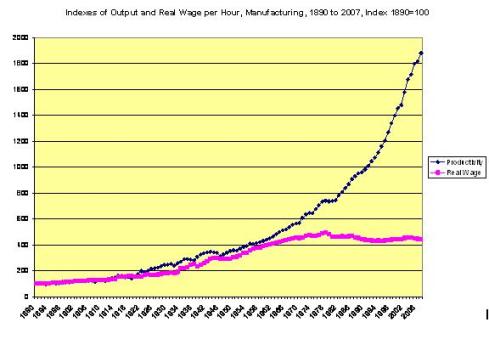
Worker Productivity (blue) vs. Wages (pink), 1890-2009
The concept of peak oil may apply more generally than its friends and foes realize. As we descend into US capitalism’s second major crash in 75 years (with another dozen or so “business cycle downturns” in the interval between crashes), some signs suggest we are at peak capitalism too. Private capitalism (when productive assets are owned by private individuals and groups and when markets rather than state planning dominate the distribution of resources and products) has repeatedly demonstrated a tendency to flare out into overproduction and/or asset inflation bubbles that burst with horrific social consequences. Endless reforms, restructurings, and regulations were all justified in the name not only of extricating us from a crisis but also finally preventing future crises (as Obama repeated this week). They all failed to do that.
The tendency to crisis seems unstoppable, an inherent quality of capitalism. At best, flare outs were caught before they wreaked major havoc, although usually that only postponed and aggravated that havoc. One recent case in point: the stock market crash of early 2000 was limited in its damaging social consequences (recession, etc.) by an historically unprecedented reduction of interest rates and money supply expansion by Alan Greenspan’s Federal Reserve. The resulting real estate bubble temporarily offset the effects of the stock market’s bubble bursting, but when real estate crashed a few years later, what had been deferred hit catastrophically.
Repeated failure to stop its inherent crisis tendency is beginning to tell on the system. The question increasingly insinuates itself even into discourses with a long history of denying its pertinence: has capitalism, qua system, outlived its usefulness? Read the rest of this entry »
After a wild but empowering week of demonstrations in Pittsburgh, here’s a short media recap of some of the highlights. [alex]
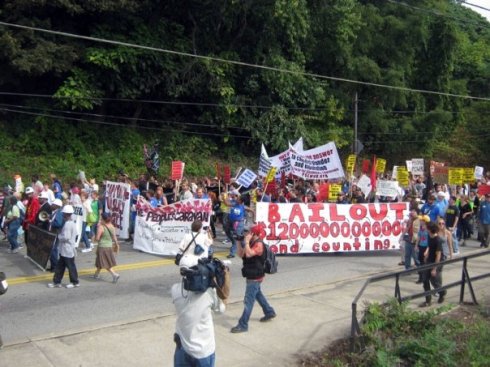
$12 Trillion has been given by the US government to large banks and corporations since last year
Great short news video on why the protesters were in Pittsburgh.
Exposes the police repression felt by the whole city last week, not just protesters.
The successes of mass protest.
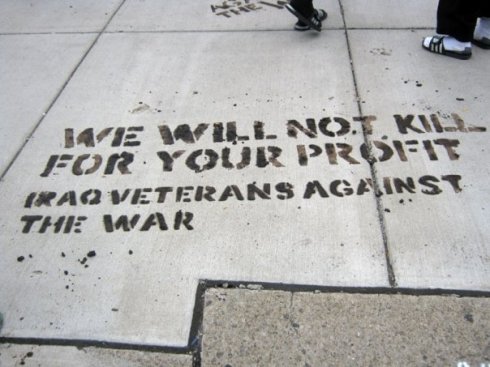
IVAW held a press conference and action Friday morning about no longer sacrificing for war
Finally, see this audio report from Free Speech Radio News for more context.
Organizers from Philly will be traveling across PA ahead of the G20 summit in Pittsburgh next week to meet with grassroots movements and strengthen statewide social change networks. This is being called the People’s Caravan. There are still spots available, so please RSVP if you’d like to join the caravan! – alex
A Call to Join the People’s Caravan
Pennsylvania, along with the rest of the world, is in crisis. Many people do not have access to decent housing, education, healthcare, jobs, healthy food, transportation and communication. While we are told that there are not resources to provide for our basic needs, bankers and the ultra-rich get trillions of dollars in bail-out funding, and our services are cut and costly wars are waged. From pools, libraries and health centers in urban areas closing, to factory lay-offs and families losing their farms, Pennsylvanians are feeling the impact of an economic and political system that has placed profit over people. We will not pay for their crisis!
In the coal mines, steel mills, textile mills, family farms and in the front seats of rigs, poor and working Pennsylvanians built this state. As one industry after another has collapsed in Pennsylvania, we’ve become poorer. Our economic crisis didn’t start in 2007. Now, all across the state, local governments and business people are spending our taxpayers’ money on developments that benefit developers and not the communities that paid for it. Meanwhile, our population has been in decline for generations because too many of our young people see no future in our state, and need to look for jobs elsewhere.
What is the G-20?
The G-20 summit is a gathering of financial ministers and heads of states of the 20 richest countries in the world. They are meeting in Pittsburgh, September 24-25 to advance their agenda: cutting essential social services; privatizing schools, healthcare, and social security, promoting “free-trade,” which cuts labor and environmental standards across the globe and places corporate profit above human needs. They are meeting to rebuild the world’s economies- in a way that keeps them on top.
Pittsburgh’s history of economic decline is why it was chosen to host the G-20. It will be promoted as an example of how to rebuild an economy. They’ve done this by bringing in companies that provide low wage jobs while reaping large profit and rebuilding the region with little thought to community benefit. This is unfortunately a familiar story to not just Pennsylvania, but much of the country.
The Caravan
We want to take this opportunity to focus on Pennsylvania, and strengthen our statewide networks. We want to meet up with people who are organizing locally for their dignity and a better Pennsylvania. Whether you are working for better wages, organizing for childcare, demanding healthcare, fighting pollution, struggling to keep your home and put food on the table or to keep your family’s farm; we all have an interest in making our voices heard and working together to advance an agenda for economic human rights.
We will be taking our own vehicles, carpooling and splitting the travel costs. The caravan will depart Philadelphia on Monday morning, September 21, stopping in Lancaster, traveling to York for the afternoon, and then spend the evening in Harrisburg. On Tuesday, September 22, we will rally at the state capitol, make a stop in Altoona, and arrive in Pittsburgh for the G-20 summit.
Join Us!
This is a perfect time to make connections between our struggles and communities so that we can break our isolation and work together. We want you to invite your neighbors, church, family, school, VFW chapter, and your community organizations to join us on this caravan. While we bring stories of our struggles in Philadelphia, we want to learn from people struggling throughout the rest of Pennsylvania.
Contact us if you are interested in organizing a local event along the route that can benefit your work, joining or supporting the caravan. We need RSVP’s, and we can tell you about costs, ride information and answer any other questions.
http://www.g20caravan.info
g20caravan@riseup.net
215-586-9198
The Security Guards at the Art Museum are demanding recognition for their union and an end to poverty wages. Here is their new video presenting their campaign to the incoming CEO of the museum, Timothy Rub:
Welcoming Change at the Philadelphia Museum of Art
The guards are also holding a rally next Sunday to welcome Mr. Rub, check it out! Also see below for more information on the campaign from a recent article in Philadelphia Weekly. [alex]
Welcoming Party for Timothy Rub
2 pm, Sunday, September 6, 2009
The Philadelphia Museum of Art, front “Rocky” steps
•
Join the Philadelphia Security Officers Union and Philly Jobs with Justice as they hold a — “welcoming party” — for incoming museum CEO, Timothy Rub.
•
Security Guards at the museum earn less than $20,000 per year, below the federal poverty line.
•
The Philadelphia Security Officers Union supports the Employee Free Choice Act.
•
We have signed up a majority of the security officers at the Philadelphia Museum on union representation cards.
•
If the Employee Free Choice Act was law right now, we would already be a union.
March with the Philadelphia Security Officers Union in support of card check and the Employee Free Choice Act
2:00 pm—3:30 pm,
come early and take advantage of the free day at the museum
Featuring NYC’s Rude Mechanical Orchestra! It’s a party!
Info: phillyjwj.org
Financial Insecurity
Museum guards ask new director to hear them out.
Philadelphia Weekly, August 25, 2009.
On April 19, Jennifer Collazo woke up with a $2,882.47 hospital bill. The 33-year-old Army veteran is a Philadelphia Museum of Art security guard employed by the private contractor AlliedBarton. Collazo pays into the medical insurance offered by her employer, but when she came down with severe neck and back pain on the job, she discovered that her health benefits didn’t even cover things like the ambulance ride.
Paltry medical coverage combined with low wages has driven Collazo and other museum guards to organize the Philadelphia Security Officers Union (PSOU). While the museum and AlliedBarton have rebuffed them in the past, guards hope that the institution’s incoming director, Timothy Rub, will be open to dialogue when he takes charge early next month. Read the rest of this entry »
In a dispute which perfectly represents the struggle for “Green Jobs”, workers at the Vestas wind energy plant in the UK have occupied their factory to save 600 jobs and one of the largest wind turbine manufacturing sites in the country. A coalition of labor and environmental groups have organized to support them with daily rallies, while the workers inside wait for the government to step in and start production again. “Now I’m not sure about you but we think it’s about time that if the government can spend billions bailing out the banks – and even nationalise them – then surely they can do the same at Vestas.”
For background and updates, see the workers’ blog: http://savevestas.wordpress.com or this article: Vestas Protest, What’s it All About?
Send messages of support to savevestas@googlemail.com
The events at Vestas have been just one in a series of worker occupations around the world in the wake of the current economic crisis. Workers are not allowing their jobs to be closed down, when corporations and banks are receiving large financial bailouts. This article gives some of the highlights of the new wave of worker militancy. [alex]
Global Trend for Sit-ins and Occupations as Mass Redundancies Continue
Terry Macalister
Originally published by The Guardian, UK – July 24, 2009
Trade union leaders warned tonight that the direct action seen at the Vestas factory was likely to be repeated elsewhere as workers refused to “bend their knee and accept their fate” in the face of mass redundancies caused by recession.
The sit-in at the Isle of Wight wind turbine plant was the latest in Britain, they said, and was part of a wider trend of militant tactics being used as far afield as the US, South Korea and China.
In France, where such tactics have been more common, the manager of a British company was taken hostage by workers today in a dispute over redundancies. About 60 workers at Servisair Cargo at Roissy airport in Paris prevented the director, Abderrahmane El-Aouffir, from leaving the firm’s offices after he refused to meet their demands in the latest case of so-called “boss-napping” to hit France.
The four day Vestas sit-in, which is an embarrassment both to the world’s biggest turbine manufacturer and a government trying to launch a low-carbon jobs revolution, follows a similar occupation in April at three Visteon (car parts manufacturer) plants in the UK in addition to action at Waterford Crystal in Ireland and Prisme Packaging in Dundee.
Tony Woodley, the joint general secretary of the Unite union, whose members were involved at Visteon, said: “I think it is absolutely understandable and justified for workers to fight back where they feel there are no other alternatives and employers act badly.” Read the rest of this entry »


 The End of Capitalism
Recent Comments