
You are currently browsing the category archive for the ‘Housing’ category.
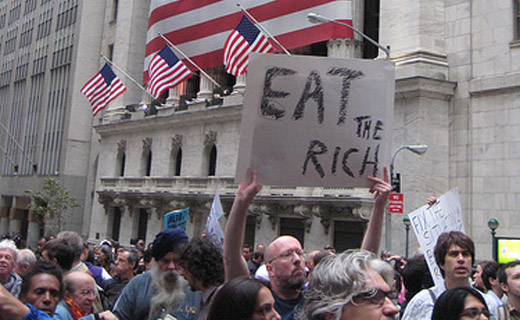 Today, Democracy Now! reported that two major records have been broken in 2009 – Wall St. profits ($35.7 billion in the first half of the year), and the number of Americans going hungry (50 million). These two seemingly unrelated tragedies immediately suggest a common solution – carve up the bloated hulks of Wall St. swine and serve them up to the American people!
On Tuesday, the NY Comptroller’s Office released a report showing that “broker-dealer operations of New York Stock Exchange member firms earned a record $35.7 billion in the first half of 2009.” Through September, $22.5 billion in profits were reported from the four largest firms alone —Goldman Sachs, Merrill Lynch, Morgan Stanley, JPMorgan Chase. These are the same banks who got bailed out by the Federal Government last year – which means that taxpayers like you and I paid for these creeps’ bonuses.
Not coincidentally, these obscene profits were recorded at the same moment that the Department of Agriculture released a report showing that “nearly 50 million people — including almost one child in four — struggled last year to get enough to eat” (as written in the Washington Post on Monday). While the economy has been in the tank and unemployment has surpassed 10% officially, food prices have been skyrocketing, and so millions more Americans are being forced to go without needed nutrition.
Why isn’t it a coincidence? Because the crooks who sent global markets into a freefall last September, causing millions to lose their homes and jobs, have been rewarded for their bad behavior with preferential treatment from Uncle Sam. These Wall St. piggies have been gorging themselves on trillions of U.S. Federally approved dough, while regular folks struggle to pay the rent or put food on the table – without so much as a measly health care reform bill to give hope to their deteriorating condition. Now 1 out of every 4 of our kids are going hungry while the government subsidizes the very stock market slimeballs responsible for creating the trouble to begin with.
“Where’s OUR bailout?” struggling folks are wondering, as they see food prices climb and jobs shipped overseas by the day. 50 million folks are wondering where their next meal is gonna come from… and it’s time to entertain innovative, cost-effective proposals, even if they may seem exotic.
Well it turns out there’s one way to solve this problem without tapping the Treasury for so much as a penny!
It would bring down the cost of high-protein, high-quality food, providing much-needed nutrition to the hungry.
It could create high-paid and unionized manufacturing jobs, right here in the U.S. of A!
It would be environmentally friendly, dolphin-safe, and carbon-neutral (although there may be some associated methane emissions after the plan is implemented).
Best of all, this solution would remove the parasitic, bonus-hungry, pyramid-scheming, derivative-trading, regulation-gutting, President-advising, economy-wrecking, bailout mongers from the picture, allowing the American people to determine our economic future democratically!
And it’s so straightforward even Timothy Geithner could understand it:
Eat the Rich!
[alex, Nov. 19]
below is the transcript from Democracy Now!’s interview of Robert Scheer on these 2 unprecedented reports and what they mean for the economy: Read the rest of this entry »
After a wild but empowering week of demonstrations in Pittsburgh, here’s a short media recap of some of the highlights. [alex]
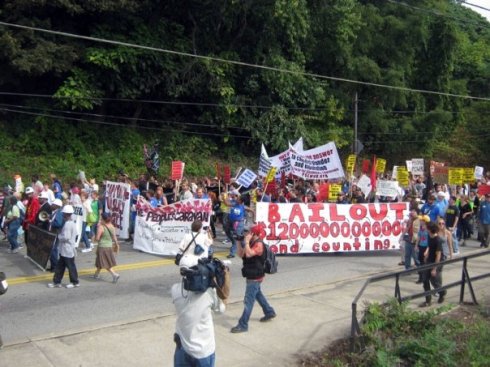
$12 Trillion has been given by the US government to large banks and corporations since last year
Great short news video on why the protesters were in Pittsburgh.
Exposes the police repression felt by the whole city last week, not just protesters.
The successes of mass protest.

IVAW held a press conference and action Friday morning about no longer sacrificing for war
Finally, see this audio report from Free Speech Radio News for more context.
[The tremendous waste and planned destruction that is inherent to capitalism is really quite astounding, but acknowledging this opens a great doorway for all those concerned about social justice and protecting the environment. Rational production, organized by society rather than for profit, would allow a great reduction in environmental damage, without sacrificing social welfare. In fact, as Don Fitz points out, economic production scaled to meet human and ecological needs would be so much more efficient than capitalist production that we could produce far less, while simultaneously increasing quality of life dramatically.
This brief overview of the military, food, health care, etc. industries suggests ways to completely transform and down-scale the economy, which would actually make us all richer. Worth the read! -alex]
We Can Produce Less and Consume More
by Don Fitz
Originally published by ZNet, July 15, 2009.
A major gulf between environmental and social justice activists is “stuff.” Environmentalists (or at least serious ones) say “less.” Social justice organizers have the habit of saying “more.”
This divisive question cuts to the edge of the sort of society we want to build. Deep greens envision a world with much less stuff. A great outline is Annie Leonard’s The Story of Stuff. [1] An excess of human-produced objects destroys species habitat, poisons communities with toxins, depletes oil and intensifies climate change.
Social justice activists, however, have devoted centuries to denouncing capitalism as placing fetters on the expansion of production. Whether the struggle is against racism, for labor rights, or resistance to imperialism, the cry is for the oppressed to have a much bigger piece of the pie.
In response to the current economic crisis, a near-unanimous chorus sings “There must be a stimulus package.” There is considerable debate over the size of the stimulus and what should be stimulated but not a whimper asking whether growth is really a good idea. It is a rare Michael Moore suggesting that auto plants should not produce autos, but rather solar panels and windmills for a society without privately owned cars. [2] It is even more rare to hear suggestions that auto plants should manufacture less and that unemployment could be resolved by shortening the work week.
A shorter work week is not exactly of the top of most environmental agendas. In fact, environmentalists often shoot themselves in the foot when they call for “sacrifices” from those who have already done more than their fair share of doing without.
Production and consumption: A broken connection
These conceptual problems stem from progressives using corporate economic frameworks. The error is believing that there is a connection between the amount of production and the amount of consumption. The common misperception is that an increase in consumption requires increased production, and, conversely, a fall in production means there will be less available to consume.
Accepting corporate economics, environmentalists make the false conclusion that if CO2 levels are to drop, then people must consume less. Social justice activists mistakenly believe that putting people back to work and providing basic necessities for all requires an increase in production. Neither of these are true. The greatest decrease in CO2 levels would come with a change in production and requires no personal sacrifice. Increasing production would not guarantee enough jobs; but, changing production could.
The mistake in economic thinking is hardly surprising since there was a direct link between production and consumption during more than 99% of human history. In pre-capitalist societies, if people wanted more, they produced more of what they wanted. This characterized the first few centuries of capitalism.
But between WWI and WWII, something happened that could only be considered a problem within the capitalist mode of production: Industry had the ability to produce enough to satisfy everyone’s basic needs. The first capitalists to realize this were aghast.
Jeffrey Kaplan chronicles their dismay at the discovery “that the industrial capacity for turning out goods seemed to be increasing at a pace greater than people’s sense that they needed them.” [3] Though a tiny handful of business leaders thought that America should switch to a four hour workday, most concluded that such leisure could breed radicalism and that a failure to increase production would threaten profits.
In 1929 President Herbert Hoover’s Committee on Recent Economic Changes announced the growing corporate consensus that capitalism could best survive by creating artificial needs. The Committee gleefully announced that “Economically we have a boundless field before us; that there are new wants which will make way endlessly for newer wants, as fast as they are satisfied.” [4] Read the rest of this entry »
 “The Shock Doctrine: The Rise of Disaster Capitalism”
by Naomi Klein
2007 Metropolitan Books
I feel confident saying that The Shock Doctrine is one of the most important political non-fiction works of the last decade. This should be a high school textbook, or at least required reading in college. Naomi Klein applies her extensive vision and intellect to present us with a way of seeing our world that is extremely relevant and powerful: in the pursuit of enormous profits, those running the global economy intentionally exploit terrible catastrophes, or even create them, to take things for themselves that only shocked and traumatized populations would give up. This ambulance-chasing strategy of those in power is defined as the “shock doctrine,” and “disaster capitalism”, alternatively known as “neoliberalism” is the dominant social paradigm it has created.
Although there are flaws here, which I will mention, this book is both timely and well-written; Klein carries the reader through a story about grandiose topics like neoliberalism, torture, psychology, and international politics that is fundamentally readable.
The most important contribution made by this book in my view is the dismantling of the myth that capitalism’s global dominance is a function of democracy or destiny. This is the notion that with the defeat of the Soviet Union, all alternatives to “the free market” have naturally faded into history, presumably because capitalism is so irresistible. To the contrary, Naomi Klein provides numerous case studies to show us the exact opposite is true – the temporary triumph of global capitalism has been fertilized by the victims of natural disasters, terrorist attacks, wars, campaigns of torture, and economic calamity. In short, alternatives to capitalism have been shocked into submission wherever they’ve appeared.
This is no accident, it is part of a conscious crusade by market fundamentalists, those devoted to the pseudo-religious belief that “the market solves all.” Klein explains that the shock doctrine was developed (at least in part) by the patron saint of neoliberalism, free-market economist Milton Friedman. In his words, “only a crisis – actual or perceived – produces real change. When that crisis occurs, the actions that are taken depend on the ideas that are lying around.” And he intended to provide those ideas. It was Friedman’s opus “Capitalism and Freedom” that proclaimed neoliberalism’s core edicts: deregulation, privatization and cutbacks to social services.
Since the 1970s, these teachings have been vigorously applied across the globe by the “holy trinity” of the International Monetary Fund (IMF), the World Bank, and the World Trade Organization (WTO). Read the rest of this entry »
One of Philadelphia’s larger newspapers puts Paul Glover, local currency and mutual aid-based health care advocate, on its cover story. As always, Paul makes wise and witty proposals to help us solve our economic and ecological woes, and now people are finally listening!
My favorite solution: “Neighborhood watch instead of neighborhood watch TV.” [alex]
Prepare for the Best
A guide to surviving — and thriving in — Philadelphia’s new green future.
Published: Jan 28, 2009
CityPaper
The Dark Season closes around Philadelphia. Wolves howl, “Tough times coming!” Young professionals with good jobs study budget cuts, watch stocks flail. Career bureaucrats are laid off; college students wonder who’s hiring. Old-timers remember when Philadelphia staggered through the terrible Depression years without jobs or dollars, while crime and hunger rose. Some districts here never escaped that Depression — they’re still choosing between heating and eating.
 |
As usual, the future will be different. Philadelphia’s responses to global warming and market cooling, high fuel and food prices, health unsurance, mortgages, student debt and war will decide whether our future here becomes vastly better or vastly worse. Whether we’re the Next Great City or Next Great Medieval Village. Imagine Philadelphia with one-tenth the oil and natural gas.
But to hell with tragedy. Let’s quit dreading news. Take the Rocky road. There are Philadelphia solutions for every Philadelphia problem.
Imagine instead that, 20 years from now, Philadelphia’s green economy enables everyone to work a few hours creatively daily, then relax with family and friends to enjoy top-quality local, healthy food. To enjoy clean low-cost warm housing, clean and safe transport, high-quality handcrafted clothes and household goods. To enjoy creating and playing together, growing up and growing old in supportive neighborhoods where everyone is valuable. And to do this while replenishing rather than depleting the planet. Pretty wild, right?
Entirely realistic. Not a pipe dream. And more practical than cynical. The tools, skills and wealth exist.
Mayor Michael Nutter foresees we’ll become the “Greenest City in the United States.” So it’s common-sensible to ask, “What are the tools of such a future?” “What jobs will be created?” “Who has the money?” “Where are the leaders?” “How will Philadelphia look?” “What can we learn from other cities?”
Some of the proposals sketched here can be easily ridiculed, because they disturb comfortable work habits, ancient traditions and sacred hierarchies. Yet they open more doors than are closing. They help us get ready for the green economy, and get there first. Big changes are coming so we might as well enjoy the ride. You have good ideas, too — bring ’em on.
From “Yes We Can” to “Now We Do”
As President Barack Obama says, “Change comes not from the top down, but from the bottom up.” Philadelphia’s chronic miseries suggest that primary dependence on legislators, regulators, police, prisons, bankers and industry won’t save us. They’re essential partners, but the people who will best help us are us. Read the rest of this entry »
Now I hope people don’t see this article as ‘support for the Soviet Union’ or something ridiculous like that, but I think this is a very insightful and amusing article, based on a powerpoint presentation. The question is, was the USSR more prepared for the economic collapse it suffered than the US is for the collapse it will soon suffer? Orlov lived through the former and seems to think that it was.
Also note that I strongly disagree with his recommendation to abandon politics – he’s right that politicians are swine but i think he’s wrong in overlooking people’s ability to build a resistance movement that can make real changes to our society, despite politicians best efforts to derail it. So with that, enjoy the article! [alex]
Closing the ‘Collapse Gap’: the USSR was better prepared for collapse than the US
by Dmitry Orlov
Originally published be Energy Bulletin, December 4, 2006.

Good evening, ladies and gentlemen. I am not an expert or a scholar or an activist. I am more of an eye-witness. I watched the Soviet Union collapse, and I have tried to put my observations into a concise message. I will leave it up to you to decide just how urgent a message it is.
My talk tonight is about the lack of collapse-preparedness here in the United States. I will compare it with the situation in the Soviet Union, prior to its collapse. The rhetorical device I am going to use is the “Collapse Gap” – to go along with the Nuclear Gap, and the Space Gap, and various other superpower gaps that were fashionable during the Cold War.

Slide [2] The subject of economic collapse is generally a sad one. But I am an optimistic, cheerful sort of person, and I believe that, with a bit of preparation, such events can be taken in stride. As you can probably surmise, I am actually rather keen on observing economic collapses. Perhaps when I am really old, all collapses will start looking the same to me, but I am not at that point yet.
And this next one certainly has me intrigued. From what I’ve seen and read, it seems that there is a fair chance that the U.S. economy will collapse sometime within the foreseeable future. It also would seem that we won’t be particularly well-prepared for it. As things stand, the U.S. economy is poised to perform something like a disappearing act. And so I am eager to put my observations of the Soviet collapse to good use.

Slide [3] I anticipate that some people will react rather badly to having their country compared to the USSR. I would like to assure you that the Soviet people would have reacted similarly, had the United States collapsed first. Feelings aside, here are two 20th century superpowers, who wanted more or less the same things – things like technological progress, economic growth, full employment, and world domination – but they disagreed about the methods. And they obtained similar results – each had a good run, intimidated the whole planet, and kept the other scared. Each eventually went bankrupt. Read the rest of this entry »


 The End of Capitalism
Recent Comments