
You are currently browsing the category archive for the ‘Empire’ category.
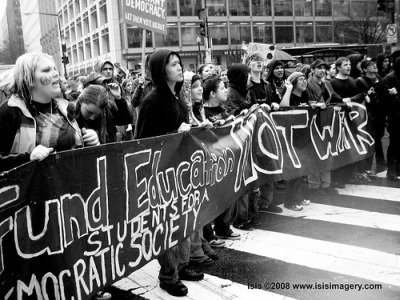
From March 17-21, 2008, Students for a Democratic Society led over 90 student actions across the country to mark the 5th Anniversary of the U.S. Invasion of Iraq! (See newsds.org/march20 for more details of the nationwide SDS actions)
One of the most exciting actions was in Washington DC. DC-SDS’ “Funk the War 3” dance party brought together 500+ youth and students to shut down K Street, where War Profiteers like Lockheed Martin and Bechtel are headquartered.
Those companies were shut down by the mobile antiwar dance party, which also hit up the Armed Forces Recruiting Center and spread the love there.
The action culminated in an SDS-organized blockade of Connecticut and K Sts., where 11 students chained themselves to school desks and demanded money for education, not for war. The intersection was held for over an hour by 200+ youth, despite pouring rain, until it was apparent that police were not willing or able to break up the blockade, and the students declared victory!
The SDS action was the largest and most energetic event of United for Peace and Justice’s “5 Years Too Many” events in DC on March 19th. The week of action brought major media attention to SDS, including 3 days straight of “The Return of Students for a Democratic Society” headlining the front page of MichaelMoore.com, an awesome article in The Nation, and a feature in the New York Times. It seems that SDS has gained a new prominence in the antiwar movement and is taking off right now!
See below for articles, video, audio and images from the 5th Anniversary Actions. Read the rest of this entry »
Part 1 of 9 – a brilliant and vivid look at Neoliberalism and those who struggle against it on all parts of the globe. bilingual (English/Spanish).
Reposted from Indymedia UK.
by David Graeber
The biggest problem facing direct action movements is that we don’t know how to handle victory.
This might seem an odd thing to say because of a lot of us haven’t been feeling particularly victorious of late. Most anarchists today feel the global justice movement was kind of a blip: inspiring, certainly, while it lasted, but not a movement that succeeded either in putting down lasting organizational roots or transforming the contours of power in the world. The anti-war movement was even more frustrating, since anarchists and anarchist tactics were largely marginalized. The war will end, of course, but that’s just because wars always do. No one is feeling they contributed much to it.
I want to suggest an alternative interpretation. Let me lay out three initial propositions here:
1) Odd though it may seem, the ruling classes live in fear of us. They appear to still be haunted by the possibility that, if average Americans really get wind of what they’re up to, they might all end up hanging from trees. It know it seems implausible but it’s hard to come up with any other explanation for the way they go into panic mode the moment there is any sign of mass mobilization, and especially mass direct action, and usually try to distract attention by starting some kind of war.
2) In a way this panic is justified. Mass direct action—especially when organized on democratic lines—is incredibly effective. Over the last thirty years in America, there have been only two instances of mass action of this sort: the anti-nuclear movement in the late ‘70s, and the so called “anti-globalization” movement from roughly 1999-2001. In each case, the movement’s main political goals were reached far more quickly than almost anyone involved imagined possible.
3) The real problem such movements face is that they always get taken by surprise by the speed of their initial success. We are never prepared for victory. It throws us into confusion. We start fighting each other. The ratcheting of repression and appeals to nationalism that inevitably accompanies some new round of war mobilization then plays into the hands of authoritarians on every side of the political spectrum. As a result, by the time the full impact of our initial victory becomes clear, we’re usually too busy feeling like failures to even notice it. Read the rest of this entry »
 “We Want Freedom: A Life in the Black Panther Party”
by Mumia Abu-Jamal
2004 South End Press
This is a great history of the Black Panther Party, Mumia Abu-Jamal’s early life, and even a great overview of the history of black resistance movements from the first slave rebellions – which he says the BPP fits into as an integral piece.
Mumia does a great job explaining the origins and philosophies of the party, as well as covering its history succinctly but in a sweeping way that other books have failed to do. There is a chapter on women in the party, which is of mixed quality, but other chapters, like the ones on COINTELPRO and snitches in the party, are absolutely vital.
Don’t miss the pictures of young Mumia working in the BPP (at age 14…)
See this awesome Graph-Presentation.
Originally published in the Wall Street Journal.
Boom Cuts U.S. Clout,
Revives Middle East;
Dark Days for Detroit
By NEIL KING JR. , CHIP CUMMINS and RUSSELL GOLD
January 3, 2008; Page A1
The surging price of oil, from just over $10 a barrel a decade ago to $100 yesterday, is altering the wealth and influence of nations and industries around the world.
These power shifts will only widen if prices keep climbing, as many analysts predict. Costly oil already is forcing sweeping changes in the airline and auto sectors. It is intensifying the politics of climate change and adding urgency to the search both for fresh sources of crude and for oil alternatives once deemed fringe.
![[Go to graphic.]](https://i0.wp.com/s.wsj.net/public/resources/images/OB-AW546_oil100_20080102152434.jpg)
The long oil-price boom is posing wrenching challenges for the world’s poorest nations, while enriching and emboldening producers in the Middle East, Russia and Venezuela. Their increasing muscle has a flip side: a decline of U.S. clout in many parts of the world.
Steep gasoline prices also threaten America’s long love affair with the automobile, while putting strains on many lower-income people outside big cities, who must spend an increasing share of their budgets just on fuel to get to work. Read the rest of this entry »
By William M. H. Kötke
13 September, 2007
Countercurrents
The planetary elite are compelled to continue on their path of growth leading toward planetary domination. The international bankers through their control of the industrial world’s privately owned central banks maintain a tether on the money system through their control of the U.S. dollar as the currency of international trade. One important mechanism that allows this is that the largest item in international trade – oil – is sold in dollars. In order to insure the continuance of the dollar economy, they must be able to choose which currency oil is sold for or control the oil – or both. The center of the empire, the U.S., is maintained by debt as the petrodollars and other dollars come into the U.S. at the rate of at least two and a half billion per day (purchasing U.S. government bonds) in order to continue the cycle, which keeps the empire and its military power expanding As the elite carry out their strategies of domination they are racing against time. The monster trends of Peak Oil and energy exhaustion, climate change which will severely disrupt the seasons of growth in the food supply system, the weakness of the dollar and ecological collapse are pursuing them. An exponentially growing world population with growing material consumption based on dwindling resources and a dying planet won’t work, but they have no other option to maintain their power and profit.
Seeds of Change
As the industrial system spins toward exhaustion, seeds of change are sprouting at the base. The people at the base are not revolting in order to take the power that the elite have but are revolting to take power over their own lives. Read the rest of this entry »
From TomDispatch, September 25, 2007
Before the invasion of Iraq in March 2003, discussion of Iraqi oil was largely taboo in the American mainstream, while the “No Blood for Oil” signs that dotted antiwar demonstrations were generally derisively dismissed as too simpleminded for serious debate. American officials rarely even mentioned the word “oil” in the same sentence with “Iraq.” When President Bush referred to Iraqi oil, he spoke only of preserving that country’s “patrimony” for its people, a sentiment he and Great Britain’s Prime Minister Tony Blair emphasized in a statement they issued that lacked either the words “oil” or “energy” just as Baghdad fell: “We reaffirm our commitment to protect Iraq’s natural resources, as the patrimony of the people of Iraq, which should be used only for their benefit.”
That May, not long after the President declared “major combat” at an end in Iraq, Deputy Secretary of Defense Paul Wolfowitz did point out the obvious — that Iraq was a country that “floats on a sea of oil.” He also told a Congressional panel: “The oil revenue of that country could bring between 50 and 100 billion dollars over the course of the next two or three years. Read the rest of this entry »
45 min. free video – educational and funny (if you can understand british accents)


 The End of Capitalism
Recent Comments