
You are currently browsing the category archive for the ‘Economic Crisis’ category.
Two stories on CNN.com today show how the deepening oil crisis is sending the addicted US government searching in desperation for more petroleum to come to market, as prices have broken records every day for the last week.
While Congress votes to cut off sending more oil to the Strategic Petroleum Reserve, Bush is in Riyadh pleading with the Saudis to increase production, and being outright denied (see below). Though CNN doesn’t say it, the reason the Saudis won’t do it is most likely that they simply can’t. If Matthew Simmons’ book Twilight in the Desert is correct, Saudi Arabia has no more spare capacity, and therefore can no longer be called on to increase supply when the market gets tight. The US is up the creek without a paddle.
No small fix here or there is going to be anything but a drop in the bucket as this crisis develops. $4-per-gallon gasoline will be remembered as amazingly cheap in a few years, and $100-per-barrel crude oil might never be seen again.
The only solution to this crisis is to create an economy that does not rely on oil, or fossil fuels of any kind for that matter. We can accomplish it by focusing on meeting human needs above the interests of corporations and governments, who are the real petroleum consumers. One positive first step would be to abandon the $3 trillion War against Iraq and use those resources to provide universal health care and universal higher education in the US, the most backwards industrialized nation. Likewise, the smart money is on dropping ethanol and other so-called biofuels like the dead weights they are, and once again making all those millions of tons of corn and other grains available for hungry people to eat.
Common sense forever evades a junkie government.
…
Saudis rebuff Bush’s request to pump more oil
http://www.cnn.com/2008/POLITICS/05/16/bush.saudi.arabia/index.html
RIYADH, Saudi Arabia (CNN) — Saudi Arabia Friday rebuffed President Bush’s request to immediately pump more oil to lower record prices, saying it does not see enough demand to increase production.

President Bush walks with Saudi King Abdullah in Riyadh Friday.

The Saudis said they would increase production if customers demanded it, Steven Hadley, Bush’s national security adviser, said.
Bush is spending much of the day in closed-door meetings with King Abdullah, the Saudi ruler.
Friday’s visit was Bush’s second trip to the kingdom this year, coming as oil prices reached a new record high Friday of more than $127 a barrel. When he traveled to Riyadh in January, his request for the Saudis to pump more oil was also rejected.
Oil prices were just below $100 a barrel in January, and Americans were paying an average of $3.06 for a gallon of gasoline. They were paying $3.78 on Friday, following more than week of record highs every day. Read the rest of this entry »
Excerpts from Democracy Now!, May 6, 2008.
[Kevin Phillips, author of “Bad Money: Reckless Finance, Failed Politics, and the Global Crisis of American Capitalism”, surveys the economic crisis facing U.S.-dominated global capitalism – including peak oil, the collapse of the Dollar, rising food costs, and the growing dominance of the banking and credit industries. This is fairly radical stuff coming from a former GOP strategist.]
AMY GOODMAN: What do you think is one of the most serious signs of this overall global crisis of American capitalism?
KEVIN PHILLIPS: Well, not to single out just one, I have an approach I use to say that normally when a country is—United States is—heading into a recession, there are one or two, sometimes three, factors that you worry about. But at this point in time, the American economy, you can think of it as being kind of in a shark tank, and there are like six or seven sharks, and you don’t usually see anything like that number. Read the rest of this entry »
http://www.chycho.com/?q=oil_us_dollar_euro
Update April 30, 2008: Iran dumps U.S. dollar for oil trades – “Iran, OPEC’s second-largest producer, has stopped conducting oil transactions in U.S. dollars.”
In the last eight years implementing the plans for the Project for the New American Century (PNAC) designed “to promote American global leadership” has backfired.
To accomplish PNAC’s goals, all threats needed to be eliminated. From the onset, the United Sates earmarked two countries as mortal enemies: Venezuela and Iran. With Venezuela, it is well documented that the CIA attempted to overthrow the democratically elected government of Chavez. And with Iran, the United States continues to use it as a scapegoat for its failures in Iraq. These cold war tactics however are proving to be US’s undoing.
The United States is hemorrhaging from every orifice, and oil prices can be used to measure the rapidity of its demise. Read the rest of this entry »
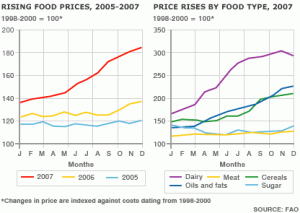
This week, food riots are erupting in the poorest countries of the world, such as Haiti, where the majority of the population lives on under $2 a day. The protesters are calling for the resignation of their government, for its inability to provide basic necessities to the population. See this BBC News short video.
The price of grains, especially wheat (which has doubled in the past year), has been on a steady uphill trend for the past few years, causing major food shortages across much of the Global South.
(image from BBC)
I want to highlight 4 underlying causes of this global food shortage:
1) Growing Inequality between the wealthiest and poorest people. Greater affluence in industrializing countries is driving larger levels of meat consumption, which requires far more wheat, other grains, and water to be consumed in order to produce the same amount of food. In fact, the majority of grains produced in the world are now fed to animals for meat. Meanwhile, hundreds of millions of people in the Global South are on the brink of starvation, or literally already starving.
2) Global Warming is causing unreliable and chaotic weather patterns across much of the food-producing regions of the world. Arable lands are turning into deserts as droughts worsen, while other regions are flooding with unseasonable downpours. These combine to create massive agricultural loss.
3) Biofuels like ethanol from corn production in the U.S. are quite literally food being used to fuel industry and automobiles. This manifests in driving up the cost of food for everyone, especially the poor, so that the largest agribusiness firms can earn huge profits, and the illusion of American prosperity surrounding large cars and wasteful consumerism can be maintained at all costs.
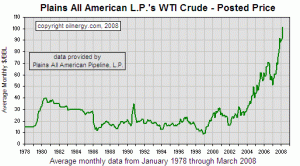
4) Most fundamental, The Global Oil Production Peak, which took place in 2006, is causing declining supplies of oil while demand surges across the industrial and industrializing world. We have seen a drastic and increasing rise in the price of oil over this period, which most Americans recognize in the high cost of gasoline. But for the poor of the world, a much more dire situation is emerging with food, because oil and other fossil fuels are the sources for most industrial fertilizers and pesticides, and because the modern system of food production and distribution are heavily dependent on oil for transportation, processing, packaging, refrigeration and cooking. In fact, the average American consumes over 10 calories of fossil fuels for every calorie of food eaten! Most people in the world can’t continue to afford this oil subsidy, and the crisis will only deepen as oil production declines in the coming years.
(Image courtesy OILNERGY)
See this awesome Graph-Presentation.
Originally published in the Wall Street Journal.
Boom Cuts U.S. Clout,
Revives Middle East;
Dark Days for Detroit
By NEIL KING JR. , CHIP CUMMINS and RUSSELL GOLD
January 3, 2008; Page A1
The surging price of oil, from just over $10 a barrel a decade ago to $100 yesterday, is altering the wealth and influence of nations and industries around the world.
These power shifts will only widen if prices keep climbing, as many analysts predict. Costly oil already is forcing sweeping changes in the airline and auto sectors. It is intensifying the politics of climate change and adding urgency to the search both for fresh sources of crude and for oil alternatives once deemed fringe.
![[Go to graphic.]](https://i0.wp.com/s.wsj.net/public/resources/images/OB-AW546_oil100_20080102152434.jpg)
The long oil-price boom is posing wrenching challenges for the world’s poorest nations, while enriching and emboldening producers in the Middle East, Russia and Venezuela. Their increasing muscle has a flip side: a decline of U.S. clout in many parts of the world.
Steep gasoline prices also threaten America’s long love affair with the automobile, while putting strains on many lower-income people outside big cities, who must spend an increasing share of their budgets just on fuel to get to work. Read the rest of this entry »


 The End of Capitalism
Recent Comments