
You are currently browsing the category archive for the ‘Democracy’ category.
I’ve reposted a nice article which highlights the class dynamics at the heart of the current financial meltdown and potential bailout. It gives a very simple and straightforward summary from a revolutionary point of view, so I’m reposting it.
This is by no means a complete analysis however – for example it overlooks the critical role of oil, which is the lifeblood of the US capitalist economy and motivates many of its military aggression around the world. Specifically, there is a need to understand how the peak in global oil production has affected and continues to undermine the US-led industrial capitalist system, particularly in regards to the bursting of the housing bubble in the first place, along with the rising gas prices, food prices, heating costs, and subsequent inflation of the failing dollar.
Because oil production will never recover to its 2005/6 level, but will continue to decrease more rapidly, there can be no long-term recovery of the global financial markets, and for that reason I disagree with the declaration here that “Capitalism will not collapse…” On the contrary, it WILL collapse, because any system that structurally depends upon constant growth and speculation-upon-that-growth cannot coexist forever on a finite planet where necessary and crucial resources are in permanent and deepening shortage.
The current economic crisis is often compared to other historical crises of capitalism, where after appearing on the verge of death, the system restored itself and came back stronger than ever. Thus we are warned that capitalism is a self-destructive beast, but not a suicidal one. On its face this is solid logic but it overlooks the specific nature of the current crisis and its roots in the global peak oil phenomenon. It is my contention and the purpose of this website to demonstrate that the oil crisis is sucking global industrial capitalism dry like the vampire it is, and that there is no combination of “alternative” energy sources – whether coal, gas, nuclear, ethanol, wind, solar, whatever – that can do for this system what oil does.
Oil is not only the largest energy source, it also provides the material for 99% of pesticides (along with the entire industrial agriculture system), all plastics, almost all pharmaceutical drugs and chemicals, and a massive array of other products and components that keep the industrial economy chugging along. But the real killer is that oil literally fuels almost all transportation of materials and people for this system, including 95% of transportation in the US itself, as well as essentially ALL global air and sea transport. There is simply no way to keep this monster running without more and more petroleum.
Now, just because we’re confident that capitalism won’t recover from the current death-blows doesn’t mean a more vicious and destructive system won’t replace it, which is why this article’s conclusions are relevant and necessary. If we’re headed in the US towards fascism – which is where the rich and their Washington cronies seem to want to take us to protect their wealth and power – the only solution, which will become more and more apparent daily, is to organize a massive resistance here in the US that can stop the vampires and build towards a society based on freedom, justice and democracy.
[alex]
SOME TALKING POINTS ON THE FINANCIAL CRISIS
By Kate Griffiths and Isaac Silver
1. The era of the United States as a “the world’s only superpower” is ending.
The United States economy has not been this bad since the Great Depression. The rulers of the US hoped to retain global power militarily, through the wars in Iraq and Afghanistan, as the country’s raw economic superiority slipped. But these wars cannot be won: opposition among the occupied populations, and growing dissent within the military, prevent any victory on US terms even as the death toll climbs.
2. Beginning during the 1970s, manufacturing stalled, while government and investors focused on the financial sector: banks, real estate, and insurance.
Increasing competition, strong unions, and victories of the Black freedom movement had begun to limit the profits made by US corporations and threaten the power of the ruling class. In response, employers shifted good-paying manufacturing jobs overseas and to nonunionized areas of the USA. As wages stagnated, and workers’ purchasing power declined, workers maintained a precarious hold on our livelihood through working longer hours, sending more household members to work, and buying extensively on credit. The globalization of US capitalism and growth of credit both fueled the financial sector, which provided fluid economic resources that could be quickly moved and re-invested – unlike a physical investment such as a factory or railroad.
3. In 2008, years of government policies favoring the rich provoked instability and sparked collapse of major Wall Street institutions.
As the cost of the basic necessities went up, and wages failed to cover them Read the rest of this entry »

 “No Surrender: Writings from an Anti-Imperialist Political Prisoner”
by David Gilbert
2004 Abraham Guillen Press/Arm the Spirit
I recommend this book. David Gilbert, lifelong political prisoner in New York since 1981, and former member of the Weather Underground (now being exploited in McCain political ads), here writes on many subjects of interest to all anti-imperialist activists.
David’s a great writer; very straightforward, focused, but with tenderness and humor, and he has a way of making sense of complicated and terrible political dramas in short and effective little essays. In addition to essays on Gilbert’s own history in SDS and Weather, the best samples here are on the U.S. white working class historically, the prison system, Colombia, Afghanistan, and neoliberalism. But Gilbert delves into a wide array of subjects from feminism to AIDS to institutional racism in many forms, and always with an amazing insight without requiring a lot of effort on the part of the reader.
It’s a damn shame that this man is behind bars, but luckily he’s still able to share his wisdom with us. Check this out!
updated 12/4/2010
by Alex Knight, endofcapitalism.com
Would you rather receive a hearty welcome or a cordial reception?
Notice the imagery and feelings evoked by the two phrases. The first has a Germanic origin, the second, French. The English language is split along class lines — a reflection of the Norman invasion of England, almost 1000 years ago. German-derived English words carry with them a working class connotation, and French-derived words come off sounding aristocratic and slightly repulsive.
Even though cordial literally means “of the heart” in French (cor is Latin for heart), the picture that comes to my mind is a royal douchebag entering a hall of power amidst classical music and overdressed patrons and nobility. The image I get from hearty welcome is the extreme opposite: a single peasant reaching out to hug me and get me into their little hovel, out of the weather. Class is deeply embedded within our language, each word having its own unique history.
Wikipedia teaches many fun facts. The English language derives mainly from:
- Old German — the Angles and Saxons (from Saxony) conquered Britain in the 5th century, mixing with Scandinavians and developing Old English.
- Old French — the Normans (from Normandy) conquered England in 1066.

William the Conqueror, first Norman king of England, as depicted on the famous Bayeux Tapestry. His royal descendents would speak French until Henry V, 350 years later.
After the Norman invasion, England was dominated by a small French aristocracy, ruling over a much larger German working class. For more than three centuries, the rulers of England spoke French, while the common person spoke a Germanic language (Old English).
The two cultural groups began to intermarry after the Black Death of the 1340s wiped out half of the population, and over time the languages slowly merged, greatly simplifying the grammar of English, but also leaving a huge combined vocabulary.
The really interesting thing is that a lot of words in English carry a class connotation, based on whether they derive from French or from German. Words that mean basically the same thing will have either a formal, fancy, academic, upper-class connotation, or a casual, down-to-earth, gut-level, working-class feeling depending on the origin of the word.
Check this list out!
| German-derived | French-derived |
| begin | commence |
| talk/speak | discuss/converse |
| ask | inquire/demand |
| teach | educate |
| think/wonder | consider/ponder |
| understand | comprehend |
| truth | verity |
| answer | reply |
| before | prior |
| come | arrive |
| meet/find | encounter |
| leave | depart |
| wall | barrier |
| make/build | construct |
| break | destroy |
| small/little | petite |
| feeling | sentiment |
| good | beneficial/pleasant |
| hope | aspire |
| lucky | fortunate |
| help | assist |
| mistake | error |
| forgive | pardon |
| buy | purchase |
| have/own | possess |
| yearly | annual |
| careful/wise | prudent |
| child/youth | juvenile/adolescent |
| earth | soil |
| cold | frigid |
| wild | savage |
| belly/gut | abdomen |
| drink | beverage |
| hungry | famished |
| eat | dine |
.
Notice that the Germanic words are usually shorter, more concrete and direct, while the French words are more elaborate, more abstract and indirect. What kind of person do you imagine speaking the words in the left column vs. the right column?
It’s interesting to me that nature and children are described by the French-derived English words as somehow negative or hostile, as with savage and juvenile. To me this reflects the hatred on the part of the wealthy and powerful for that which is untamed and free.
The medical-industrial complex also uses almost exclusively Latin and French-derived words, to sound more technical. This has the effect of making the body seem lifeless and mechanical, as with abdomen.
Plus, meat words are almost all French-derived, which reflects that while the Anglo-Saxon working class was responsible for hunting/shepherding the animals, it was only the Norman nobility who could actually afford to eat meat.
| German-derived | French-derived |
| cow | beef |
| pig | pork/ham |
| deer | venison |
| sheep | mutton |
| calf | veal |
.
Chicken and fish are the exceptions here, most likely because these meats were less expensive and more available for peasants and workers.
Finally, most of our government/state words are all French: court, judge, jury, indict, appeal, traitor, prison, military, representative, parliament, Congress, president, and marriage.
I notice that when I use the French-derived words, I experience a slight feeling of discomfort, as if I’m trying to impress people with my big words. This is precisely how academia functions, which is why if you attend a university or graduate school, you will be inundated with French and Latin-derived vocabulary, to distinguish you from the uneducated masses with their street language.
Might all of this explain why American conceptions of the French are as snooty, pompous, pretentious, easily-hate-able snobs? In occupied England, THEY WERE!
And for anyone interested in working class revolution, the best way not to talk down to people: stick with the more common Germanic words instead of bureaucratese.
Towards freedom! (not mere liberty)
p.s. George Orwell wrote an awesome essay called Politics of the English Language, where he breaks down how abstract, complex language is a tool for those who seek to confuse the populace, and he outlines how to make use of concrete, plain English to actually reach people. A highly recommended essay for anyone who wants to write.
 “I’ve Got the Light of Freedom: The Organizing Tradition and the Mississippi Freedom Struggle”
by Charles Payne
1991 by University of California Press
I’ve Got the Light of Freedom is a book about organizing, for organizers. It chronicles SNCC and the Mississippi Freedom movement from its beginnings to ends, especially highlighting the individual organizers and families that put the movement together and sustained it.
The book is great because it analyzes the movement from a variety of perspectives, including understanding the strategies, tactics, gender dynamics, class dynamics, white/black organizing dynamics, local/rural dynamics, mentorship and leadership development, state and white repression, and the rise and fall of trust and community that were the backbone of the movement. The thread throughout is the brilliance of the Ella Baker/Septima Clark school of organizing, based on meeting people where they’re at and developing their leadership so they can lead their own fights. It’s about valuing the day-to-day work that sustains organizations above the flashy actions or speeches, and about seeing our work as part of a long-term struggle towards freedom that will need to involve millions of people.
My criticisms Read the rest of this entry »
Student Power and the Sit-in at Evergreen
written by SDSers and sit-in particpants Brendan Maslauskas Dunn, KTeeO Olejnik, Brooke Stepp, and Jamie Hellerman
May 30th marked the 10th day of the sit-in of Evergreen State College administrator Art Costantino’s hallway. Students are demanding the immediate reinstatement of Olympia SDS and have recently added the additional demands that Kelly Beckham, an SDSer be offered her job back as well as compensation for time lost, and a change in the process by which student groups lose their RSO (Registered Student Organization) status that is determined by those most affected, the students and members of these organizations.
The banning of SDS as a student group is an indication of the current political climate at The Evergreen State College, one that has been increasingly suppressing student dissent, which includes the aiding of law enforcement agents in the arresting of students, the handing over of student records to law enforcement agencies, punishing students for their political beliefs and activities. Read the rest of this entry »

“The End of America: A Letter of Warning to a Young Patriot”
by Naomi Wolf
2007 Chelsea Green
Naomi Wolf’s short, straightforward book is a warning that the prospects for fascism emerging in America are real and growing. She lays out 10 steps that governments take in order to concentrate power and stifle dissent, on the road to fascism, all of which are underway in the good ol’ US of A.
1. Invoke an External and Internal Threat
2. Establish Secret Prisons
3. Develop a Paramilitary Force
4. Surveil Ordinary Citizens
5. Infiltrate Citzens’ Groups
6. Arbitrarily Detain and Release Citizens
7. Target Key Individuals
8. Restrict the Press
9. Cast Criticism as ‘Espionage’ and Dissent as ‘Treason’
10. Subvert the Rule of Law
This issue is obviously incredibly relevant today, and I happen to agree that fascism is an imminent threat in the US. But I wasn’t terribly impressed by this book. Read the rest of this entry »
Check out this awesome essay by Paul Kivel – it really helped me understand my class background (as a member of the “buffer zone”) and how I can relate to others in an accountable way to achieve social change! – Alex
Social Service or Social Change?
Who Benefits from your Work
by Paul Kivel
copyright 2000
MY FIRST ANSWER TO THE QUESTION POSED IN THE TITLE is that we need both, of course. We need to provide services for those most in need, for those trying to survive, for those barely making it. We need to work for social change so that we create a society in which our institutions and organizations are equitable and just and all people are safe, adequately fed, adequately housed, well educated, able to work at safe, decent jobs, and able to participate in the decisions that affect their lives. Although the title of this article may be misleading in contrasting social service provision and social change work, the two do not necessarily go together easily and in many instances do not go together at all. There are some groups working for social change that are providing social service; there are many more groups providing social services that are not working for social change. In fact, many social service agencies may be intentionally or inadvertently working to maintain the status quo.
The Economic Pyramid
I want to begin by providing a context for this discussion: the present political/economic system here in the United States. Currently our economic structure looks like the pyramid in Figure One in which 1% of the population controls about 47% of the net financial wealthii of the country, and the next 19% of the population controls another 44%. That leaves 80% of the population struggling to gain a share of just 9% of the remaining financial wealth. That majority of 80% doesn’t divide very easily into 9% of resources, which means that many of us spend most of our time trying to get enough money to feed, house, clothe, and otherwise support ourselves and our families.
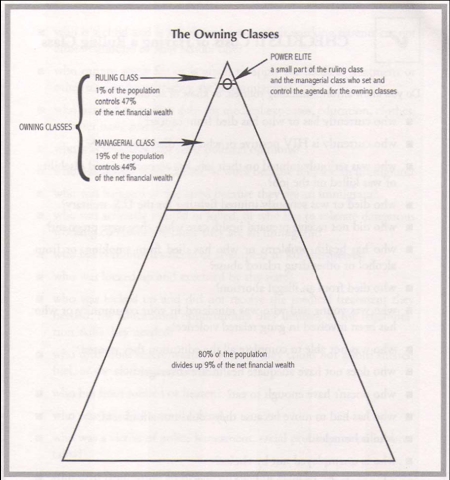
Illustration by Alberto Ledesma Read the rest of this entry »
 “Red Emma Speaks: Selected Writings and Speeches”
Emma Goldman
1972 Random House
Probably the best of the three ‘anarchist’ books I’ve read recently, because Emma Goldman was an American and lived during the 20th century, so has the most relevant things to say about this stupid and messed-up society we live in. Her essays here range from feminism, to education, to sexuality, to prisons, to war, to violence, to revolution and counter-revolution.
My favorite pieces here are the Afterword to her wonderful anti-Bolshevik book “My Disillusionment in Russia” and her essay “There Is No Communism in Russia” – both on the subject of how dictatorship in the name of the people is in no way synonymous with freedom, nor capable of leading to it. Read the rest of this entry »


 The End of Capitalism
Recent Comments