
You are currently browsing the category archive for the ‘Democracy’ category.
 “The Mass Psychology of Fascism”
by Wilhelm Reich
1946 The Noonday Press
First written in Germany in 1932 as Hitler was coming to power, then revised in the US in 1944, this is a classic study of the characteristics of fascist movement. Reich, a former Marxist from the Frankfurt School, emphasizes that fascism is not unique to Germany or Japan or Italy, but is instead “the basic emotional attitude of the suppressed man of our authoritarian machine civilization and its mechanistic-mystical conception of life.”
In other words it’s not enough to blame Hitler or the Nazis or any political party for the rise of fascism, we have to understand why millions of people have been, and continue to be, drawn to Right-wing movement (its mass character is what distinguishes fascism from simple authoritarianism). Finding its base in the Middle Classes, fascist movement feeds upon authoritarian patriarchal social structures, especially the father-dominated family, which prepares children to obey and even revere a harsh “leader.”
But what was most interesting to me about this book is the politics of sexuality. Reich as a psychiatrist observed that the repression of sexuality, especially from a young age, prepares people for lifetimes of neurotic self-hatred as some of their most basic and healthy life functions become embedded with deep shame and guilt. I would add, sexual assault and child abuse add much fuel to this fire. Reich stresses that children, adolescents and women are perpetually denied control over their sexual desires and bodies, which is what gives the patriarchal father so much power in the family, and therefore the sexual repression of masses of people becomes the seeds that grow fascist political movements.
I will write more on this train of thought in my review of Yes Means Yes!, and it’s also something I’ve been sparked to consider after watching the film The Handmaid’s Tale, about a dark future where pollution has made most women sterile, and a Christian fascist movement seizes control of society to make the remaining fertile women into the sex slaves of powerful male leaders. It’s surprisingly realistic in some scary ways, because it builds from the sad truth that the patriarchal Christian Right is a real force in society and continues to attack the rights of women to control their own bodies and sexuality. This tendency must be overcome, by women and trans folks taking back their body sovereignty and proclaiming their sexuality as no one’s but their own.
Part 1 of The Handmaid’s Tale. Read the rest of this entry »
Very well-spoken article poking fun at our enigmatic president, who continues to flirt with both of the groups who brought him to the Big Dance: the corporate/financial elites who paid for his campaign, and the millions of progressive Americans who mobilized and turned out the vote.
Inspirational words, impressive moves, and boyish good looks have kept the two suitors enamored thus far, but at some point Barack’s going to have to choose his partner for the slowdance. So far he’s been sipping punch with the bankrolling capitalists, who have seduced him with fancy airplanes and false promises, but we, the people have to work up the courage to demand his attention if we have any hope of him coming home with us at the end of the night. And we can’t hide our intentions; let’s make clear that partnering with us means rejecting the system that caused this crisis – capitalism. Let’s be realistic and demand the impossible. [alex]
Fred Astaire in the White House
by Michael Brownstein
Originally published by Reality Sandwich, April 13, 2009.
 “You can never awaken using the same system that put you to sleep in the first place.”
–Gurdjieff
This is an appeal, an open letter, a cry in the night: no matter how cranky it may make us to brush the stardust from our eyes, no matter how many friends we think we’ll lose by looking long and hard at what’s going on around us, let’s try to stay awake. Let’s not lose touch with what we really want for ourselves. Let’s not forget what we know about the nature of consumer capitalism: it is unsustainable and unworkable because it depends on infinite expansion in a finite world. It can only survive by a violent takeover of what belongs to others. Let’s not settle for halfway measures.
And let’s not wait for deliverance from on high.
Because the president we elected — out of so much hope for a definitive break with what came before — is not who he seems. It’s true that unlike the previous inhabitant of the White House (remember him?), Barack Obama is sane, intelligent, and mature. He’s responsive to what others think. He hopes to institute real change in education, health care, the environment.
But even with his great charisma and silver tongue, he’s a proper soldier for the system which is ravishing the planet. As he said in his inauguration speech in January, already aware of the huge financial mess he was inheriting, “We will not apologize for our way of life.”
What do these words mean? They mean that the mall-i-zation of the planet will continue. They mean that the commercialization of all of life will not stop. They mean that our massive so-called footprint will never be substantially downsized.
And they mean that the force which has erased indigenous cultures and plant and animal species, which has sullied our air and soil and water, will essentially not be called into question, no matter how many of its most glaring excesses may be curbed.
More and more people are using the language of peak oil and becoming aware that the future we once took for granted is now being foreclosed (not incidentally, by the same folks who are foreclosing a lot of our homes). It is increasingly clear that we stand at a cross-roads, and that neither road leads anywhere similar to the global capitalist era we just passed through.
Here are some excerpts from a good article that acknowledges the reasons why the future will be nothing like the past, and lays out the 2 paths we can now head down. I wrote some thoughts at the end to inspire us to think realistically and demand the impossible. [alex]
Time to Deliver: No Turning Back, Part I.
by Sara Robinson
April 7, 2009
Originally published by Campaign for America’s Future
..[T]he two dominant scenarios about the American future that progressives seem to be wrestling with right now [might be described as]:
1) Permanent Decline — Due to Americans’ native hyperindividualism, political apathy, and overweening willingness to accept personal blame for their country’s failures, the corporatists finally succeed in turning the US into Indonesia. This time, we will not find the will to fight back (or, if we do, it will be too late). As a result, in a few years there will be no more middle class, no upward mobility, few remaining public institutions devoted to the common good, no health care, no education, and no hope of ever restoring American ideals or getting back to some semblance of the America we knew.
2) Reinvented Greatness — Americans get over their deeply individualistic nature, come together, challenge and restrain the global corporatist order, and finally establish the social democracy that the Powers That Be — corporate, military, media, conservative — have denied to us since the 1950s. This happens in synergy with a move to energy and food self-sufficiency, the growth of a sustainable economy, a revival of participatory democracy, and a general renewal of American values that pulses new life into our institutions and assures us a much more stable future.
Conservatives and the mainstream media, of course, are also offering a third scenario:
3) Happy Face — Prop up the banks, keep people in their houses, and by and by everything will get back to “normal” (defined as “how it all was a few years ago.”)
[Sara recognizes that this third “road” is an illusion, for the following underlying realities which cannot be ignored any longer. -alex]
1. Energy regime change
The first reason there’s no going back to the way it was is that there’s simply not enough oil left in the ground — or carbon sinks left in the world — to sustain America as we’ve known it. We may well be able to sustain some semblance of that way of life (or perhaps, find our way to one even more satisfying); but we won’t be running it on oil or coal.
And when the oil goes, so goes the empire. Read the rest of this entry »
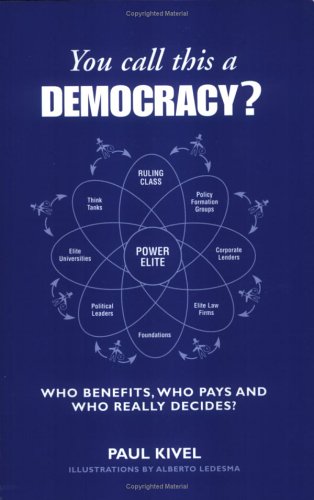
“You Call This a Democracy? Who Benefits, Who Pays, and Who Really Decides?”
by Paul Kivel
2004 Apex Press
Paul Kivel exposes the ruling class of the United States and how it operates in this short, easy-to-read book. With simple concepts and cute illustrations, a nuanced class analysis is presented in a very clear and accessible format.
If the education system was any good at all, “You Call This a Democracy?” would be one of the textbooks used in all high schools. It explains what the ruling class is (those with a family income above $373,000 and net financial wealth of at least $2 million), how it controls the government, media, and economy, and the negative effects we all suffer, such as poverty, wars, disease, pollution, over-working, stress, and meaningless, isolated lives. Kivel particularly does a great job exposing how the ruling class uses racism, sexism, homophobia and other social divisions to keep itself, a relatively small group of basically white Protestant men, in power. Making the connections between systems of oppression is one of the keys to the freedom of everybody, and this book helps move that analysis forward.
There a couple criticisms I could make about the book, first that it doesn’t inspire enough hope or provide much of a systematic solution to the problem that it systematically critiques. And secondly that the book can be cumbersome to read because of a fair amount of repetition coupled with too many general statements about segments of the population. To a certain extent, this was unavoidable in a book of this nature, but I could have used more examples of particular corporations, politicians, and businesspeople and their ilk, even though the examples given in the book are all great.
Definitely check this out if you want to have any idea about the country you’re living in, and how you and your family and everyone you care about are being screwed over by the super-wealthy elite. The path to a democratic future starts when we become informed.
Grace Lee Boggs is a prominent long-time veteran of civil rights and other movements for justice. An Asian-American woman, now in her 80s, she is active in building urban agriculture systems for the community of Detroit. Their efforts to create a sustainable local economy out of a postindustrial urban shell are an example for all urban American cities. [alex]
Detroit: City of Hope
Building a sustainable economy out of the ashes of industry.
By Grace Lee Boggs
Originally published by In These Times
February 17, 2009.
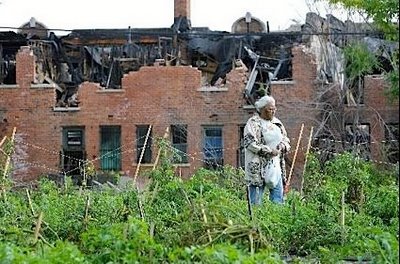
Photographer: Fabrizio Costantini/Bloomberg News. Hazel Williams picks green tomatoes at an Urban Farm off Linwood Avenue in Detroit, on Sept. 22, 2008. Photo by Fabrizio Costantini / Bloomberg.
Detroit is a city of Hope rather than a city of Despair. The thousands of vacant lots and abandoned houses not only provide the space to begin anew but also the incentive to create innovative ways of making our living—ways that nurture our productive, cooperative and caring selves.
The media and pundits keep repeating that today’s economic meltdown is the worst financial crisis since the Great Depression. But in the ’30s, the United States was an overproducing industrial giant, not today’s casino economy.
In the last few decades, once-productive Americans have been transformed into consumers, using more and more of the resources of the earth to foster ways of living that are unsustainable and unsatisfying. This way of life has created suburbs that destroy farmland, wetlands and the natural world, as well as pollute the environment.
The new economy also requires a huge military apparatus to secure global resources and to consume materials for itself, at the same time providing enormous riches for arms merchants and for our otherwise failing auto, air and ship-building sectors.
Instead of trying to resurrect or reform a system whose endless pursuit of economic growth has created a nation of material abundance and spiritual poverty—and instead of hoping for a new FDR to save capitalism with New Deal-like programs—we need to build a new kind of economy from the ground up.
That is what I have learned from 55 years of living and struggling in Detroit, the city that was once the national and international symbol of the miracle of industrialization and is now the national and international symbol of the devastation of deindustrialization.
When I arrived in Detroit in 1953, the population was 2 million, the majority white. Today, it is less than 900,000, majority black. Back then, racism was blatant and overt. Many bars, restaurants and hotels refused service to blacks. Blacks could buy homes in inner city neighborhoods but could not rent apartments in buildings right next door to these homes.
Meanwhile, freeways were enabling white flight to the suburbs, and technology was replacing human beings with robots.
In 1973, we elected our first black mayor, Coleman Young. Young was a gifted politician who was able to eliminate the most egregious examples of racism, especially in the police and fire departments and City Hall. But he was unable to imagine a post-industrial society. So, for 14 years, he tried in vain to woo industrial jobs back to Detroit.
In 1988, toward the end of his fourth term, Young decided that the factories weren’t coming back and that Detroit’s salvation depended on casino gambling, which he said would create 50,000 jobs.
To defeat his proposal, we organized Detroiters Uniting, a coalition of community groups, blue-collar, white-collar and cultural workers, clergy, political leaders and professionals.
Our concern was with how our city had been disintegrating socially, economically, politically, morally and ethically. We were convinced that we could not depend upon one industry or one large corporation to provide us with jobs. It was now up to us—the citizens of Detroit—to create meaningful jobs and income for all citizens.
We needed a new kind of city where citizens take responsibility for their decisions instead of leaving them to politicians or the marketplace.
Greening the Motor City
Read the rest of this entry »
This is a wonderful essay looking at how a Sustainable Economy must be structured democratically and decentralized to the local level. The only thing I would add is that we need a realistic plan of action to get us from the capitalist hellhole we currently inhabit to this accurate vision of a future sustainable society, and we can’t be afraid to confront powerful forces which want to stop us.
For me as a young person in the United States, the heart of the Empire, I see my current role as organizing youth and students in resistance to the forces of domination (war, debt, oppression). Others may be better positioned to organize their workplace or their communities, or to start urban gardens, or other projects. We each have a role to play, and we need to discover it ourselves. [alex]
Building a Sustainable Economy
by Marcin Gerwin
Democracy first
In 1994 the government of Haiti lifted tariffs and allowed imports of cheap, subsidized rice and other crops from abroad. This policy was recommended by the International Monetary Fund and urged by the U.S. government (1). Over the years this tiny change in policy led to an estimated 830,000 job losses, it damaged food security and rural livelihoods, and eventually led to food riots and hunger in 2008 (2). If people in Haiti were to decide by themselves on their country policy, would they choose the recommendations of the IMF that brought them into starvation? Would people of Ecuador allow toxic pollution in the Amazon for the sake of Chevron Texaco profits? Would people in India accept genetically modified seeds of cotton that caused crop failures, spiral of debt and hundreds of farmer suicides? And would people in the USA support bailing out banks with their own money in a way that is not transparent and does not lead to the recovery of the financial system? They wouldn’t. These things happen around the world because we still don’t have true democracy, where people set the rules for themselves.
 Women sowing rice in India Women sowing rice in IndiaPhoto: Michael Foley |
In 2001 twenty subsistence farmers, small traders, small food processors, and consumers, mostly women, and some of them illiterate, met in Indian village to decide on the future of agriculture in the state of Andhra Pradesh. They were chosen to represent the rural diversity of their state. They presented three different models of development. The official plan, put forward by Chief Minister of the state, was backed by grants and loans from the World Bank and the UK government. The plan was to mechanize, consolidate and genetically engineer agriculture of the state to produce cash crops for export, and to reduce the farming population from 70% to 40%, to have more workers for industry. The second vision involved developing environmentally friendly agriculture to produce cheap organic products for domestic and Northern supermarkets and it was supported by the International Federation of Organic Agriculture Movements and the International Trade Center. The third vision was influenced by Gandhian and indigenous ideas, and involved increasing local self-reliance and sustainability in both agriculture and economics.
Each model was illustrated by videos, farmers and traders could hear the summary of the policies, ask questions, consult with government officials, scientists, corporate and NGO representatives from the state, national and international level. They also considered advantages and disadvantages of each vision, based also upon their own knowledge, priorities and aspirations. After one week they made a decision.
Tom Atlee writes:
In their recommendations (…) they said they wanted self-reliant food and farming, and community control over resources. They wanted to maintain healthy soils, diverse crops, trees and livestock, and to build on their indigenous knowledge, practical skills and local institutions. They wanted to maintain the high percentage of people making their livelihood from the land, and did not want their farms consolidated or mechanized in ways that would displace rural people. Most of them could feed their families through their own sustenance farming. They did not want to end up laboring in dangerous brick kilns outside of Hyderabad, like so many who had left their farms. They also rejected genetically modified crops and the export of their local medicinal plants. (3)
If we wish to make some meaningful changes in the world, we need appropriate tools for that. A number one tool in the earth repair workshop is community-based democracy. It is a key for unlocking the potential for sustainability.
One of Philadelphia’s larger newspapers puts Paul Glover, local currency and mutual aid-based health care advocate, on its cover story. As always, Paul makes wise and witty proposals to help us solve our economic and ecological woes, and now people are finally listening!
My favorite solution: “Neighborhood watch instead of neighborhood watch TV.” [alex]
Prepare for the Best
A guide to surviving — and thriving in — Philadelphia’s new green future.
Published: Jan 28, 2009
CityPaper
The Dark Season closes around Philadelphia. Wolves howl, “Tough times coming!” Young professionals with good jobs study budget cuts, watch stocks flail. Career bureaucrats are laid off; college students wonder who’s hiring. Old-timers remember when Philadelphia staggered through the terrible Depression years without jobs or dollars, while crime and hunger rose. Some districts here never escaped that Depression — they’re still choosing between heating and eating.
 |
As usual, the future will be different. Philadelphia’s responses to global warming and market cooling, high fuel and food prices, health unsurance, mortgages, student debt and war will decide whether our future here becomes vastly better or vastly worse. Whether we’re the Next Great City or Next Great Medieval Village. Imagine Philadelphia with one-tenth the oil and natural gas.
But to hell with tragedy. Let’s quit dreading news. Take the Rocky road. There are Philadelphia solutions for every Philadelphia problem.
Imagine instead that, 20 years from now, Philadelphia’s green economy enables everyone to work a few hours creatively daily, then relax with family and friends to enjoy top-quality local, healthy food. To enjoy clean low-cost warm housing, clean and safe transport, high-quality handcrafted clothes and household goods. To enjoy creating and playing together, growing up and growing old in supportive neighborhoods where everyone is valuable. And to do this while replenishing rather than depleting the planet. Pretty wild, right?
Entirely realistic. Not a pipe dream. And more practical than cynical. The tools, skills and wealth exist.
Mayor Michael Nutter foresees we’ll become the “Greenest City in the United States.” So it’s common-sensible to ask, “What are the tools of such a future?” “What jobs will be created?” “Who has the money?” “Where are the leaders?” “How will Philadelphia look?” “What can we learn from other cities?”
Some of the proposals sketched here can be easily ridiculed, because they disturb comfortable work habits, ancient traditions and sacred hierarchies. Yet they open more doors than are closing. They help us get ready for the green economy, and get there first. Big changes are coming so we might as well enjoy the ride. You have good ideas, too — bring ’em on.
From “Yes We Can” to “Now We Do”
As President Barack Obama says, “Change comes not from the top down, but from the bottom up.” Philadelphia’s chronic miseries suggest that primary dependence on legislators, regulators, police, prisons, bankers and industry won’t save us. They’re essential partners, but the people who will best help us are us. Read the rest of this entry »
A massive wave of layoffs was announced yesterday by 12 major US corporations, including Caterpillar, General Motors, Home Depot, Sprint Nextel and Pfizer. Microsoft also announced its first-ever mass layoffs of 5,000 workers. Overall, more than 75,000 jobs are being cut from the workforce after Unemployment levels were reported as 7.2% in December, the highest level in over 16 years, with no end to the bleeding in sight.
As more and more workers fill the unemployment rolls, it’s time to ask: where will future jobs come from? While government and corporate bigshots plan yet another “economic stimulus” and bailout of the banks, what long-term jobs can we realistically create right now?
Lots of answers present themselves if we look through the lens of peak oil, and start replacing our oil-based economy with a people-based economy. Instead of relying on greenhouse gas-producing fossil fuels, we can tap into the power of human labor, which happens to be our greatest renewable resource.
Certainly there is a need to employ millions to weatherize homes and build and install solar panels and wind turbines (which Obama may address), but there is also a huge need to re-tool Detroit automakers to STOP producing gas-guzzling individual cars, and start making buses, trains and other forms of public transit. Bicycles are also desperately needed, so we need workers to build them and more to repair them too.
We also need lots more doctors and nurses if we make health care universally available, and social workers and therapists to help deal with the psychological trauma our population has suffered from militarism and soulless consumerism. Since many of these jobs require education and training, we need to hire lots more teachers, and we also need education to be a lot more affordable to so more people can access these kinds of careers.
Perhaps the largest gains in the job sector can be achieved by shifting food production away from mega-scale agribusinesses and fossil-fuel intensive monoculture and factory farms, towards community-based, local, organic, family farming and free-range livestock raising. By breaking up the huge corporate farms into family-size and community-size plots, we can repopulate rural America (and stop suburban sprawl), produce better, healthier food, respect animal rights, and create millions of new landowners. Simultaneously we can follow the example of Cuba and turn our blighted inner-cities into gardens, by utilizing permaculture and organic community-run agriculture, which would reduce crime and poverty in our decaying urban areas, bring quality food to places currently plagued by malnutrition, and create millions upon millions of rewarding and meaningful jobs.
How will we finance it? Simple. Disassemble the huge financial firms and multinational corporate banks whose greed caused this economic crisis and create thousands of local banks and credit unions, run by people in the community (even more jobs!) Taxing the rich would help a lot too, and we can cut tons of wasteful government spending on things like the wars in the Middle East, excessive prisons, and nuclear, biological and chemical weapons. The money is right there, we just need to redirect it to things that actually help people instead of killing them.
This of course requires a revolutionary change in the economic and political structure of the United States, which means average people like you and me having control over the decisions affecting our lives, instead of remaining at the whim of wealthy elites who in the current crisis have shown themselves unable to run a lemonade stand, let alone the global economy.
[alex]
Deluge of layoffs hits U.S. economy
January 27, 2009
By Jerry Hirsch and Maura Reynolds

Scott Olson, Getty Images
A worker walks between Caterpillar earth-moving equipment at a road construction site near Joliet, Ill. The company has announced that it will cut nearly 20,000 jobs as the recession reduces demand for its products.
Companies including Home Depot, Caterpillar, Pfizer and Sprint plan to cut nearly 60,000 jobs, adding urgency to the need to agree on a stimulus plan.
U.S. companies slashed nearly 60,000 jobs Monday, adding impetus to the Obama administration’s efforts to reach agreement on a plan to pump $825 billion into the economy over a two-year period.
But it’s unclear whether even that massive influx of funding and tax cuts would be enough to get companies hiring again in the near term.
The cuts by firms including Caterpillar, General Motors, Texas Instruments, Home Depot, Sprint Nextel and Pfizer brought the total of jobs shed so far this month to 187,550, more than November or December and well over double the number of January 2008, according to employment firm Challenger, Gray & Christmas Inc.
Analysts believe that Obama’s strategy of pouring money into state and local governments could prevent layoffs and furloughs of public sector employees, including teachers, police officers and other government workers.
Economists have estimated that the plan will protect or create 3 million to 4 million jobs in the next two years.
But the U.S. economy lost 2.6 million jobs last year and could lose 2 million more during the first half of this year. Read the rest of this entry »


 The End of Capitalism
Recent Comments