
You are currently browsing the category archive for the ‘Democracy’ category.
This article only scratches the surface of why capitalism as a system based in constant expansion is absolutely incompatible with a planet of real social and ecological limits, peak oil being one. My book will flesh these arguments out in greater detail, but for now check out what Professor Wolff has been cooking up. [alex]
Peak Oil and Peak Capitalism
by Professor Richard Wolff, March 27, 2009.
Originally posted on The Oil Drum, and on Rick Wolff’s homepage.
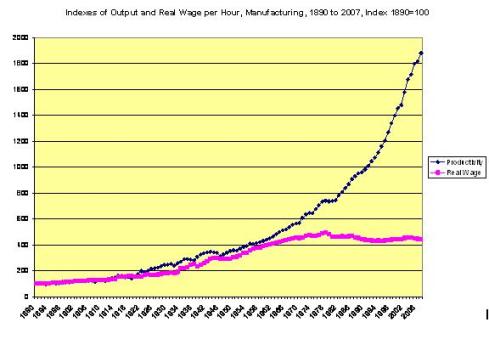
Worker Productivity (blue) vs. Wages (pink), 1890-2009
The concept of peak oil may apply more generally than its friends and foes realize. As we descend into US capitalism’s second major crash in 75 years (with another dozen or so “business cycle downturns” in the interval between crashes), some signs suggest we are at peak capitalism too. Private capitalism (when productive assets are owned by private individuals and groups and when markets rather than state planning dominate the distribution of resources and products) has repeatedly demonstrated a tendency to flare out into overproduction and/or asset inflation bubbles that burst with horrific social consequences. Endless reforms, restructurings, and regulations were all justified in the name not only of extricating us from a crisis but also finally preventing future crises (as Obama repeated this week). They all failed to do that.
The tendency to crisis seems unstoppable, an inherent quality of capitalism. At best, flare outs were caught before they wreaked major havoc, although usually that only postponed and aggravated that havoc. One recent case in point: the stock market crash of early 2000 was limited in its damaging social consequences (recession, etc.) by an historically unprecedented reduction of interest rates and money supply expansion by Alan Greenspan’s Federal Reserve. The resulting real estate bubble temporarily offset the effects of the stock market’s bubble bursting, but when real estate crashed a few years later, what had been deferred hit catastrophically.
Repeated failure to stop its inherent crisis tendency is beginning to tell on the system. The question increasingly insinuates itself even into discourses with a long history of denying its pertinence: has capitalism, qua system, outlived its usefulness? Read the rest of this entry »
After a wild but empowering week of demonstrations in Pittsburgh, here’s a short media recap of some of the highlights. [alex]
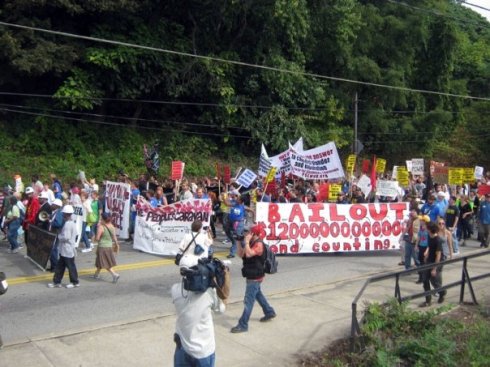
$12 Trillion has been given by the US government to large banks and corporations since last year
Great short news video on why the protesters were in Pittsburgh.
Exposes the police repression felt by the whole city last week, not just protesters.
The successes of mass protest.
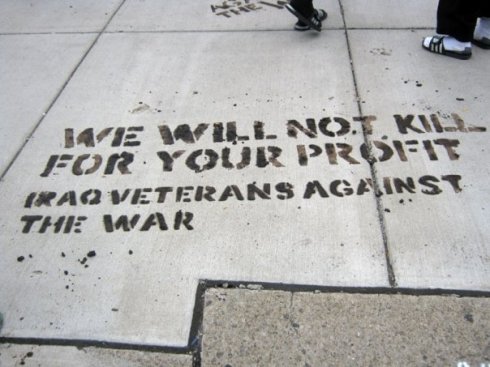
IVAW held a press conference and action Friday morning about no longer sacrificing for war
Finally, see this audio report from Free Speech Radio News for more context.
Organizers from Philly will be traveling across PA ahead of the G20 summit in Pittsburgh next week to meet with grassroots movements and strengthen statewide social change networks. This is being called the People’s Caravan. There are still spots available, so please RSVP if you’d like to join the caravan! – alex
A Call to Join the People’s Caravan
Pennsylvania, along with the rest of the world, is in crisis. Many people do not have access to decent housing, education, healthcare, jobs, healthy food, transportation and communication. While we are told that there are not resources to provide for our basic needs, bankers and the ultra-rich get trillions of dollars in bail-out funding, and our services are cut and costly wars are waged. From pools, libraries and health centers in urban areas closing, to factory lay-offs and families losing their farms, Pennsylvanians are feeling the impact of an economic and political system that has placed profit over people. We will not pay for their crisis!
In the coal mines, steel mills, textile mills, family farms and in the front seats of rigs, poor and working Pennsylvanians built this state. As one industry after another has collapsed in Pennsylvania, we’ve become poorer. Our economic crisis didn’t start in 2007. Now, all across the state, local governments and business people are spending our taxpayers’ money on developments that benefit developers and not the communities that paid for it. Meanwhile, our population has been in decline for generations because too many of our young people see no future in our state, and need to look for jobs elsewhere.
What is the G-20?
The G-20 summit is a gathering of financial ministers and heads of states of the 20 richest countries in the world. They are meeting in Pittsburgh, September 24-25 to advance their agenda: cutting essential social services; privatizing schools, healthcare, and social security, promoting “free-trade,” which cuts labor and environmental standards across the globe and places corporate profit above human needs. They are meeting to rebuild the world’s economies- in a way that keeps them on top.
Pittsburgh’s history of economic decline is why it was chosen to host the G-20. It will be promoted as an example of how to rebuild an economy. They’ve done this by bringing in companies that provide low wage jobs while reaping large profit and rebuilding the region with little thought to community benefit. This is unfortunately a familiar story to not just Pennsylvania, but much of the country.
The Caravan
We want to take this opportunity to focus on Pennsylvania, and strengthen our statewide networks. We want to meet up with people who are organizing locally for their dignity and a better Pennsylvania. Whether you are working for better wages, organizing for childcare, demanding healthcare, fighting pollution, struggling to keep your home and put food on the table or to keep your family’s farm; we all have an interest in making our voices heard and working together to advance an agenda for economic human rights.
We will be taking our own vehicles, carpooling and splitting the travel costs. The caravan will depart Philadelphia on Monday morning, September 21, stopping in Lancaster, traveling to York for the afternoon, and then spend the evening in Harrisburg. On Tuesday, September 22, we will rally at the state capitol, make a stop in Altoona, and arrive in Pittsburgh for the G-20 summit.
Join Us!
This is a perfect time to make connections between our struggles and communities so that we can break our isolation and work together. We want you to invite your neighbors, church, family, school, VFW chapter, and your community organizations to join us on this caravan. While we bring stories of our struggles in Philadelphia, we want to learn from people struggling throughout the rest of Pennsylvania.
Contact us if you are interested in organizing a local event along the route that can benefit your work, joining or supporting the caravan. We need RSVP’s, and we can tell you about costs, ride information and answer any other questions.
http://www.g20caravan.info
g20caravan@riseup.net
215-586-9198
 The Ecology of Freedom: The Emergence and Dissolution of Hierarchy
by Murray Bookchin
1982 Cheshire Books
Murray Bookchin (R.I.P., 2006) was one of the most important American theorists of the 20th century. He is most known for pioneering and promoting social ecology, which holds that “the very notion of the domination of nature by man stems from the very real domination of human by human.” In other words, the only way to resolve the ecological crisis is to create a free and democratic society.
The Ecology of Freedom is one of Bookchin’s classic works, in which he not only outlines social ecology, but exposes hierarchy, “the cultural, traditional and psychological systems of obedience and command”, from its emergence in pre-‘civilized’ patriarchy all the way to capitalism today. The book explains that hierarchy is exclusively a human phenomena, one which has only existed for a relatively short period of time in humanity’s 2 million year history. For that reason, and also because he finds examples of people resisting and overturning hierarchies ever since their emergence, Bookchin believes we can create a world based on social equality, direct democracy and ecological sustainability.
It seems to me this fundamental hope in human possibility is the most essential contribution of this book. In discussing healthier forms of life than we currently inhabit, Bookchin makes a distinction between “organic societies”, which were pre-literate, hunter-gatherer human communities existing before hierarchy took over, and “ecological society”, which he hopes we will create to bring humanity back into balance with nature, but without losing the intellectual and artistic advances of “civilization” (his quote-marks).
Of ‘organic society’ he says “I use the term to denote a spontaneously formed, noncoercive, and egalitarian society – a ‘natural’ society in the very definite sense that it emerges from innate human needs for association, interdependence, and care.” This, he explains, is where we come from. Not a utopia free of problems, but a real society based on the principle of “unity of diversity,” meaning respect for each member of the community, regardless of sex, age, etc. – an arrangement that is free of domination. Read the rest of this entry »
Is the economy “recovering”? What does a “jobless recovery” mean anyway? How should workers respond to a deteriorating situation? Professor Richard Wolff drops some knowledge and suggests that workers need to take control of their companies.
This is What Democracy Looks Like is the definitive documentary about the 1999 Seattle protests against the World Trade Organization. Shot from the perspective of organizers, this film shows how the most iconic event of the (successful) movement against corporate globalization was created, day-by-day. We follow students, labor, environmentalists, and everyone seeking global justice as they brave police violence in order to shut down the Seattle Trade Summit, which led eventually to the collapse of the WTO. Creative visuals, hot beats, protest footage and powerful interviews combine into a very inspiring form of art – reminding us that when regular people come together, they can change the course of history. WATCH THIS MOVIE!!!
[This is Part 1 of 11 – make sure to click the Up-Arrow button to watch the rest!]
Salt of the Earth is a classic organizing movie about striking Mexican-American miners and their wives. Based on an incredible true story, the 1953 film follows the organizing efforts of the town’s women, who must overcome the company’s classism, the sheriff’s racism, as well as their own husband’s sexism, to win the strike (while the men stay at home and take care of the house and children). Highly recommended!
This is just the first segment of the movie, make sure to click the Up-Arrow button to watch the rest!


 The End of Capitalism
Recent Comments