You are currently browsing the category archive for the ‘Democracy’ category.
Are we living through the twilight of democracy, or the dawn of a new day?
That is up to us.
The Chambersburg Declaration is a brief but promising political document coming out of Pennsylvania, specifically the Community Environmental Legal Defense Fund. Explanation follows. [alex]

photo by neeloyunus on flickr
BY THE UNDERSIGNED IN CHAMBERSBURG, PENNSYLVANIA, ON
SATURDAY, FEBRUARY 20TH, 2010
We declare:
– That the political, legal, and economic systems of the United States allow, in each generation, an elite few to impose policy and governing decisions that threaten the very survival of human and natural communities;
– That the goal of those decisions is to concentrate wealth and greater governing power through the exploitation of human and natural communities, while promoting the belief that such exploitation is necessary for the common good;
– That the survival of our communities depends on replacing this system of governance by the privileged with new community-based democratic decision-making systems;
– That environmental and economic sustainability can be achieved only when the people affected by governing decisions are the ones who make them;
– That, for the past two centuries, people have been unable to secure economic and environmental sustainability primarily through the existing minority-rule system, laboring under the myth that we live in a democracy;
– That most reformers and activists have not focused on replacing the current system of elite decision-making with a democratic one, but have concentrated merely on lobbying the factions in power to make better decisions; and
– That reformers and activists have not halted the destruction of our human or natural communities because they have viewed economic and environmental ills as isolated problems, rather than as symptoms produced by the absence of democracy.
Therefore, let it be resolved:
– That a people’s movement must be created with a goal of revoking the authority of the corporate minority to impose political, legal, and economic systems that endanger our human and natural communities; Read the rest of this entry »
This essay strikes me as deeply explanatory for the absurd political events that have been taking place in the US in the past year – from trillion-dollar bank bailouts, to the inability to create any meaningful health care reform, to the absolute mocking of the world’s attempts to deal with the catastrophe of climate change – the US government seems to have completely given up on pretending to represent the American public and aligned itself with huge financial and corporate interests, right out in the open.
Those of us with a radical understanding of power know this government has always served the interests of the powerful as its primary mission. But in the past, the politicians at least paid lip service to the public interest in order to save face. This was the era of “hegemony”, roughly meaning the consent of the ruled to their domination.
The public was being screwed, but somehow it was ideologically prepared to believe that “we, the people” had the ultimate say. This was supposed to be a democracy, after all. Sure, the police, prison system, military, and federal enforcement agencies would step in if things got out of hand, but much more effective at keeping the system intact was the “cop in our heads”. As long as we truly believed that it was all for our own good, the corporations just rolled right along, plundering the planet and destroying our communities. And the media made sure we believed it. That’s hegemony.
The reign of George W. Bush really started the break from this paradigm, as we saw for example the outright defiance of the US Constitution and US law when it came to imprisonment of political enemies, justifying torture, spying on millions of American citizens’ phone calls, excessive lying in order to invade and occupy strategic countries, etc etc. At first the public somewhat accepted these moves as “necessary” in the face of terrorism, but Bush’s popularity waned terribly in his second term as people became more informed of what was really happening. In this light Obama’s rhetoric about “change” seems to have initially served to reinvigorate the system with a revived hegemony – to give the US a new image, one of tolerance, diplomacy, and the rule of law.
But the first year of Obama has already shattered these illusions. Obama and his Democrats now appear totally befuddled, their strategy (of putting a smiling face and a few meaningless reforms on a fundamentally broken system) lies in rubble. And a resurgent, perhaps racist, Right appears ready to sweep back into control by playing with the public’s justified resentment and frustration of a continually deteriorating situation.
In this context Jeff Strabone asks us if hegemony is becoming a thing of the past: “Will the state shamelessly turn itself completely over to serving the interests of a powerful few without bothering to pretend that it’s not?”
 I’ve written in my synopsis about the end of capitalism and the possible emergence of neo-fascism, a militarization of society in order to preserve the interests of the powerful, regardless of the environmental and social costs. It seems to me that one indicator of this possible paradigm shift is the increasing shamelessness of the elites. In market-driven capitalism, image is crucial. If a corporation gets bad publicity, they stand to lose money in the stock market. This is one of the few areas of capitalism that is open to democratic intervention. Another area where the public can occasionally intervene is through electing progressive representatives into office.
But it’s these avenues that appear to be closing to us now. Goldman Sachs, Exxon-Mobil, and Blackwater have all gotten terrible publicity in the past few years for their theivery, pollution and murder; but their stocks have never soared higher. Then the public gave Obama and the Democrats an enormous mandate to “change” the country, only to see them cave immediately on almost every campaign promise. The bank bailouts, torturing, and bombing of civilians have, if anything, increased in Obama’s tenure thus far. Perhaps the final insult was the Supreme Court’s decision last week that corporations are “people” with a First Amendment “right to speak” by directly buying politicians. Have they no shame? Apparently not.
So if the consent of the governed is no longer sought, and we’re truly moving into a post-hegemonic era, what can we do to make sure that the breakdown of the capitalist system leads to something better, and not far worse? As Mr. Strabone proclaims, it’s time for civil disobedience. The system has failed us, we must cut off our allegiance from it, confront the powers that be, and start envisioning and constructing the world we want to see replace capitalism. I, for one, wish to see that world based on shared values of democracy, justice, sustainability, freedom and love, and I urge all of you to consider the alternative. [alex]
Post-Shame: Time for Civil Disobedience
by Jeff Strabone
Originally published by Daily Kos.
Tue Jan 26, 2010
One of the duties of the modern nation-state is persuasion. Each state aims to keep its citizens convinced of the legitimacy of its rule. The state may be run chiefly for the enrichment of a few at the cost of the many, but the endurance of the state is widely thought to depend on its ability to sell its rule to the many as a common-sense truism. Or at least that was how it used to work. We may be entering a new era in the evolution of the state, one where the state approaches a state of utter shamelessness.
Antonio Gramsci, in his prison notebooks, called this persuasive activity ‘hegemony’. According to Gramsci, hegemony occludes the domination of the state and the classes whose interests it serves. One does not have to be an Italian communist of the 1920s to see the usefulness of Gramsci’s groundbreaking insight. Broadly speaking, all political actors pursue their agendas by trying to narrow other people’s imaginations in order to make desired outcomes seem common-sensical and undesired outcomes outside the ambit of reasonable thought.
It seems to me that over the past decade, in the United States, the state and a narrow circle of powerful interests—banks, energy companies, and private health insurers in particular—have simply given up trying to persuade the rest of us that their interests were our interests. Could we be moving in the twenty-first century to a state that practices domination without hegemony? Or, to put it in plain English, will the state shamelessly turn itself completely over to serving the interests of a powerful few without bothering to pretend that it’s not? And if it does, how should we respond?
I am not the only one asking these questions. Read the rest of this entry »
On Thursday, The Supreme Court of the United States decided that corporations could now spend unlimited amounts of money on political candidates, opening the door for billions of dollars from Exxon, Pfizer, Blackwater, Lockheed Martin and others to further buy off our representatives in state and national office. The decision affirms the legal notion that corporations have “personhood”, giving them every First Amendment right associated therewith. In fact, their rights go above and beyond that of an actual human, as normal citizens can only donate some $2,400 to a candidate for a specific election. This voice of the people will be drowned out by the literally billions that can now be spent by corporations.
This decision is a national disgrace and further invites direct corporate control of all aspects of society. Remember that Italian dictator Benito Mussolini, the father of modern fascism, once said “Fascism should more properly be called corporatism because it is the merger of state and corporate power.” We are headed down a dangerous path.
The only way to overturn this decision may be a constitutional amendment, redefining corporations as economic instruments accountable to the communities, and to nature, which they should serve rather than exploit. To achieve this will require a massive reinvigoration of democracy in the United States. [alex]
Whose Rights?
Friday, January 22, 2010
A new Supreme Court decision promotes corporate rights at the expense of the rights of citizens. What happens when the legal structure itself stands in the way of democracy?
by Thomas Linzey and Mari Margil
Yesterday’s U.S. Supreme Court decision in Citizens United v. Federal Election Commission-giving corporations the ability to spend money directly to influence federal elections under the Constitution’s First Amendment-was inevitable. It represents a logical expansion of corporate constitutional “rights”-which include the rights of persons which have been judicially conferred upon corporations. “Personhood” rights mean that corporations possess First Amendment rights to free speech, along with a litany of other rights that are secured to persons under the federal Bill of Rights.
The expansion of corporate rights and privileges under the law has been deliberate, beginning nearly two hundred years ago with the Dartmouth decision in which the Supreme Court ruled that private corporations had rights that municipal corporations-governments composed of “we the people”-did not.
For the past two centuries, new court decisions have only expanded corporate rights and privileges. For those who think that the way to stem this tide is to find the perfect lawsuit, stop looking. It doesn’t exist, for there is no magic bullet.
Rather, in order to reverse decisions like Citizens United, the whole concept of corporate “rights”-and the way they interfere with the exercise of rights by people, communities, and nature-must be examined. And, it’s not simply that corporations have “personhood” rights. It goes well beyond that.
Today’s structure of law gives corporations a spectrum of legal and constitutional rights which they routinely wield against people, communities, and nature. Corporations have more rights, for example, than the communities in which they seek to do business. They can and do use those rights to lobby Congress, impact elections, and to decide for us what we eat, whether mountaintops are blown off or not, whether there are fish in the oceans, and on and on. Their constitutional and other legal rights, together with their wealth, guarantee that they can define the debates that lead to the adoption of new laws-and often write the laws themselves. Read the rest of this entry »
In November, community members in Spokane Washington articulated these Community Bill of Rights, to give neighbors the ability to control their neighborhoods and their futures. It was defeated by massive opposition of corporate and political elites, but the model of communities organizing at the grassroots level for basic economic, social and ecological rights is something that I’m sure will be reproduced and improved upon in the New Year. Happy 2010! [alex]
Spokane Considers Community Bill of Rights
by Mari Margil, November 4, 2009
Thousands of people voted to protect nine basic rights, ranging from the right of the environment to exist and flourish to the rights of residents to have a locally based economy and to determine the future of their neighborhoods.
Of all the candidates, bills, and proposals on ballots around the country yesterday, one of the most exciting is a proposition that didn’t pass.
In Spokane, Washington, despite intense opposition from business interests, a coalition of residents succeeded in bringing an innovative “Community Bill of Rights” to the ballot. Proposition 4 would have amended the city’s Home Rule Charter (akin to a local constitution) to recognize nine basic rights, ranging from the right of the environment to exist and flourish to the rights of residents to have a locally based economy and to determine the future of their neighborhoods.

Communities Take Power - Barnstead, New Hampshire was the first town in the nation to ban corporate water mining.
A coalition of the city’s residents drafted the amendments after finding that they didn’t have the legal authority to make decisions about their own neighborhoods; the amendments were debated and fine-tuned in town hall meetings.
Although the proposition failed to pass, it garnered approximately 25 percent of the vote—despite the fact that opponents of the proposal (developers, the local Chamber of Commerce, and the Spokane Homebuilders) outspent supporters by more than four to one. In particular, they targeted the Sixth Amendment, which would have given residents the ability, for the very first time, to make legally binding, enforceable decisions about what development would be appropriate for their own neighborhood. If a developer sought to build a big-box store, for example, it would need to conform to the neighborhood’s plans.
Nor is development the only issue in which resident would have gained a voice. The drafters and supporters of Proposition 4 sought to build a “healthy, sustainable, and democratic Spokane” by expanding and creating rights for neighborhoods, residents, workers, and the natural environment.
Legal Rights for Communities
Patty Norton, a longtime neighborhood advocate who lives in the Peaceful Valley neighborhood of Spokane, and her neighbors spent years fighting a proposed condominium development that would loom 200 feet high, casting a literal shadow over Peaceful Valley’s historic homes.
Proposition 4 would ensure that “decisions about our neighborhoods are made by the people living there, not big developers,” Patty said. Read the rest of this entry »
Also published by The Rag Blog and OpEdNews.
 “We stand at a critical moment in Earth’s history, a time when humanity must choose its future. As the world becomes increasingly interdependent and fragile, the future at once holds great peril and great promise. To move forward we must recognize that in the midst of a magnificent diversity of cultures and life forms we are one human family and one Earth community with a common destiny. We must join together to bring forth a sustainable global society founded on respect for nature, universal human rights, economic justice, and a culture of peace. Towards this end, it is imperative that we, the peoples of Earth, declare our responsibility to one another, to the greater community of life, and to future generations. – The Earth Charter” (pg. 1).
David Korten, long-time global justice activist, co-founder of Yes! Magazine, and author of such books as When Corporations Rule the World, lays out the fundamental crossroads facing the world in his 2006 book The Great Turning: From Empire to Earth Community. In response to global climate change, war, oil scarcity, persistent racism and sexism and many other mounting crises, Korten argues we must recognize these as symptoms of a larger system of Empire, so that we might move in a radically different direction of equality, ecological sustainability, and cooperation, which he terms Earth Community. This is a powerful and important book, which excels in overviewing the big picture of threats facing our ecosphere and our communities at the hands of global capitalism1, and translating this into the simplest and most accessible language so we might all do something about it. It’s pretty much anti-capitalism for the masses. And it has the power to inspire many of us to transform our lives and work towards the transformation of society.
Capitalism and Empire
Of course, Korten has made the strategic decision to avoid pointing the finger at “capitalism” as such in order to speak to an American public which largely still confuses the term as equivalent to “freedom” or “democracy.” In fact the “C” word is rarely mentioned in the book, almost never without some sort of modifier as in “corporate capitalism” or “predatory capitalism”, as if those weren’t already features of the system as a whole. Instead, Korten names “Empire” as the culprit responsible for our global economic and ecological predicament, which is defined as a value-system that promotes the views that “Humans are flawed and dangerous”, “Order by dominator hierarchy”, “Compete or die”, “Masculine dominant”, etc. (32).
Korten explains that Empire, “has been a defining feature of the most powerful and influential human societies for some five thousand years, [and] appropriates much of the productive surplus of society to maintain a system of dominator power and elite competition. Racism, sexism, and classism are endemic features” (25). In this way the anarchist concept of the State is repackaged as a transcendent human tendency, which has more to do with conscious decision-making and maturity level than it does with political power. While this compromise does limit the book’s effectiveness in offering solutions later on, it does speak in a language more familiar to the vast non-politicized majority of Americans, and may have the potential to unify a larger movement for change.
Whatever you want to call the system, the danger it presents to the planet is now clear. Korten spells out the grim statistics: “Fossil fuel use is five times what it was [in 1950], and global use of freshwater has tripled… the [Arctic] polar ice cap has thinned by 46 percent over twenty years… [while we’ve seen] a steady increase over the past five decades in severe weather events such as major hurricanes, floods, and droughts. Globally there were only thirteen severe events in the 1950s. By comparison, seventy-two such events occurred during the first nine years of the 1990s” (59-60). If this destruction continues, it’s uncertain if the Earth will survive.
This ecological damage is considered alongside the social damage of billions living without clean water or adequate food, as well as the immense costs of war and genocide. But Korten understands that the danger is relative to where you stand in the social hierarchy – the system creates extreme poverty for many, and an extreme wealth for a few others. He explains how the system is based on a deep inequality that is growing ever worse, “In the 1990s, per capita income fell in fifty-four of the world’s poorest countries… At the other end of the scale, the number of billionaires worldwide swelled from 274 in 1991 to 691 in 2005” (67). The critical point that these few wealthy elites wield excessive power and influence within the system to stop or slow necessary reform could be made more clearly, but at least the book exposes the existence of this upper class, who are usually quite effective at hiding from public scrutiny and outrage over the suffering they are causing.2
Earth Community – Growing a Revolution
Standing at odds with the bastions of Empire is what David Korten calls “Earth Community,” a “higher-order” value-system promoting the views of, “Cooperate and live,” “Love life”, “Defend the rights of all”, “Gender balanced”, etc. (32). Read the rest of this entry »
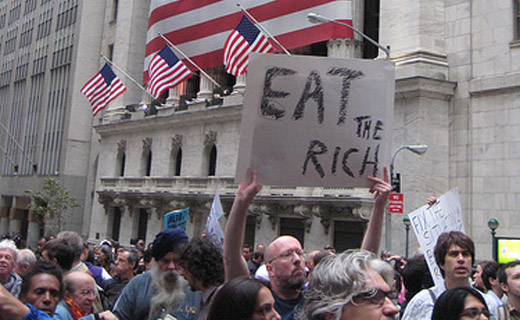 Today, Democracy Now! reported that two major records have been broken in 2009 – Wall St. profits ($35.7 billion in the first half of the year), and the number of Americans going hungry (50 million). These two seemingly unrelated tragedies immediately suggest a common solution – carve up the bloated hulks of Wall St. swine and serve them up to the American people!
On Tuesday, the NY Comptroller’s Office released a report showing that “broker-dealer operations of New York Stock Exchange member firms earned a record $35.7 billion in the first half of 2009.” Through September, $22.5 billion in profits were reported from the four largest firms alone —Goldman Sachs, Merrill Lynch, Morgan Stanley, JPMorgan Chase. These are the same banks who got bailed out by the Federal Government last year – which means that taxpayers like you and I paid for these creeps’ bonuses.
Not coincidentally, these obscene profits were recorded at the same moment that the Department of Agriculture released a report showing that “nearly 50 million people — including almost one child in four — struggled last year to get enough to eat” (as written in the Washington Post on Monday). While the economy has been in the tank and unemployment has surpassed 10% officially, food prices have been skyrocketing, and so millions more Americans are being forced to go without needed nutrition.
Why isn’t it a coincidence? Because the crooks who sent global markets into a freefall last September, causing millions to lose their homes and jobs, have been rewarded for their bad behavior with preferential treatment from Uncle Sam. These Wall St. piggies have been gorging themselves on trillions of U.S. Federally approved dough, while regular folks struggle to pay the rent or put food on the table – without so much as a measly health care reform bill to give hope to their deteriorating condition. Now 1 out of every 4 of our kids are going hungry while the government subsidizes the very stock market slimeballs responsible for creating the trouble to begin with.
“Where’s OUR bailout?” struggling folks are wondering, as they see food prices climb and jobs shipped overseas by the day. 50 million folks are wondering where their next meal is gonna come from… and it’s time to entertain innovative, cost-effective proposals, even if they may seem exotic.
Well it turns out there’s one way to solve this problem without tapping the Treasury for so much as a penny!
It would bring down the cost of high-protein, high-quality food, providing much-needed nutrition to the hungry.
It could create high-paid and unionized manufacturing jobs, right here in the U.S. of A!
It would be environmentally friendly, dolphin-safe, and carbon-neutral (although there may be some associated methane emissions after the plan is implemented).
Best of all, this solution would remove the parasitic, bonus-hungry, pyramid-scheming, derivative-trading, regulation-gutting, President-advising, economy-wrecking, bailout mongers from the picture, allowing the American people to determine our economic future democratically!
And it’s so straightforward even Timothy Geithner could understand it:
Eat the Rich!
[alex, Nov. 19]
below is the transcript from Democracy Now!’s interview of Robert Scheer on these 2 unprecedented reports and what they mean for the economy: Read the rest of this entry »
Walden Bello explains the logic of breaking with corporate globalization and points the way towards a more socially and ecologically responsible economic paradigm. Includes “11 pillars of deglobalization.” [alex]
The Virtues of Deglobalization
by Akbayan! Representative Walden Bello
originally posted on Foreign Policy in Focus
reposted from Focus on the Global South.
The current global downturn, the worst since the Great Depression 70 years ago, pounded the last nail into the coffin of globalization. Already beleaguered by evidence that showed global poverty and inequality increasing, even as most poor countries experienced little or no economic growth, globalization has been terminally discredited in the last two years. As the much-heralded process of financial and trade interdependence went into reverse, it became the transmission belt not of prosperity but of economic crisis and collapse.
End of an Era
In their responses to the current economic crisis, governments paid lip service to global coordination but propelled separate stimulus programs meant to rev up national markets. In so doing, governments quietly shelved export-oriented growth, long the driver of many economies, though paid the usual nostrums to advancing trade liberalization as a means of countering the global downturn by completing the Doha Round of trade negotiations under the World Trade Organization. There is increasing acknowledgment that there will be no returning to a world centrally dependent on free-spending American consumers, since many are bankrupt and nobody has taken their place.
Moreover, whether agreed on internationally or unilaterally set up by national governments, a whole raft of restrictions will almost certainly be imposed on finance capital, the untrammeled mobility of which has been the cutting edge of the current crisis.
Intellectual discourse, however, hasn’t yet shown many signs of this break with orthodoxy. Neoliberalism, with its emphasis on free trade, the primacy of private enterprise, and a minimalist role for the state, continues to be the default language among policymakers. Establishment critics of market fundamentalism, including Joseph Stiglitz and Paul Krugman, have become entangled in endless debates over how large stimulus programs should be, and whether or not the state should retain an interventionist presence or, once stabilized, return the companies and banks to the private sector. Moreover some, such as Stiglitz, continue to believe in what they perceive to be the economic benefits of globalization while bemoaning its social costs.
But trends are fast outpacing both ideologues and critics of neoliberal globalization, and developments thought impossible a few years ago are gaining steam. “The integration of the world economy is in retreat on almost every front,” writes the Economist. While the magazine says that corporations continue to believe in the efficiency of global supply chains, “like any chain, these are only as strong as their weakest link. A danger point will come if firms decide that this way of organizing production has had its day.”
“Deglobalization,” a term that the Economist attributes to me, is a development that the magazine, the world’s prime avatar of free market ideology, views as negative. I believe, however, that deglobalization is an opportunity. Indeed, Read the rest of this entry »


 The End of Capitalism
Recent Comments