
You are currently browsing the category archive for the ‘Democracy’ category.
A very useful article showing how the needs of people to be heard, to listen, and to have their voices count for something, are met through the General Assembly process of the Occupy movement. [alex]
A Therapist Talks About the Occupy Wall Street Events
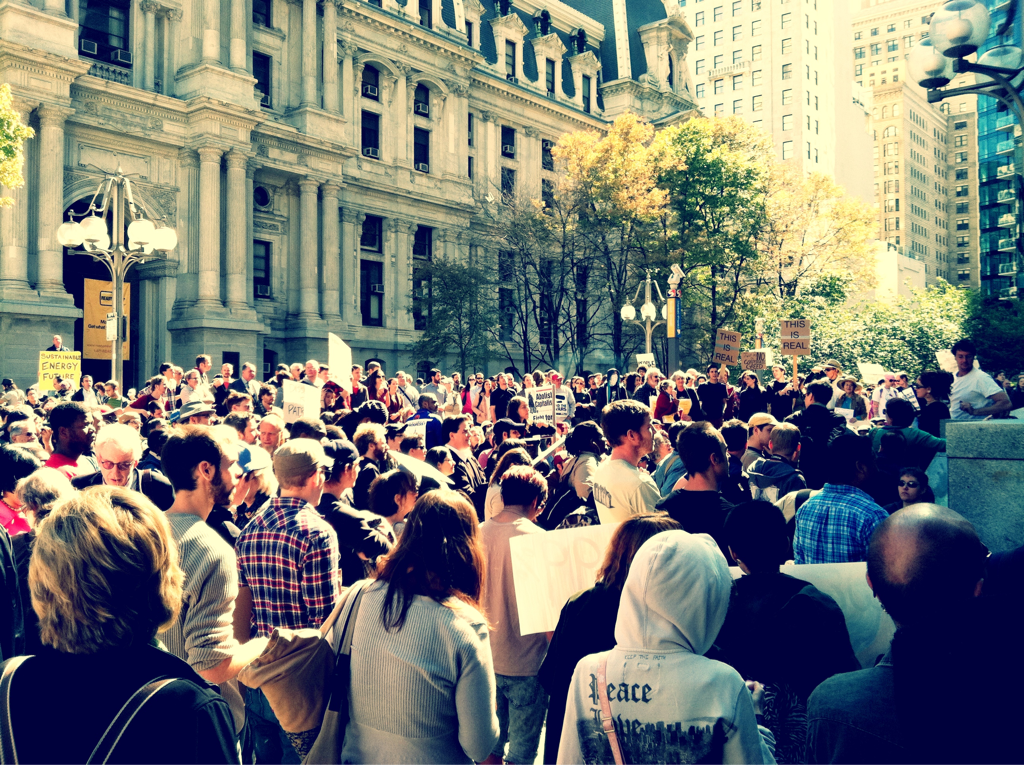
Occupy Philly General Assembly, October 6, 2011
By Lane Arye
Originally published by In Front and Center.
Last night I was talking with a group of activists/organizers from around the country about their impressions of the OWS movement. They were curious how the insights of a therapist and conflict facilitator schooled in Worldwork (which was developed by Arnold Mindell) might be useful to folks in the movement. After our teleconference, the activists encouraged me to write this.
First off, OWS is surrounded by a host of critics, from long-time social change organizers to mainstream media. (Much of the media criticism has been debriefed, so I’m focusing on internal criticisms I have heard.)
We can learn from critics in at least two ways. They can help us improve by pointing out what we genuinely need to change. Paradoxically, they may be criticizing us for something we actually need to do more congruently. Seen from this angle, critics may be highlighting strengths we don’t yet know we have.
Take one criticism: The General Assemblies lead to a kind of individualism of people wanting to be heard and contribute, unaware of the impact on the thousand people listening. In one recent GA, a small group of frustrated men hijacked the meeting, cursing and physically threatening the entire assembly. Even in less dramatic situations, most GA’s are filled with judgment, fracturing statements, and individuals repeating each other just so they can get themselves heard.
From one point of view, the criticism is valid. Yes, Western individualism can be very problematic and it is always a good time to learn to become communitarian. But perhaps there is also something beautiful about this individualism. People have the sense that they can finally speak up about the economy, that their voice is important, that they do not have to shut up and listen to talking heads who supposedly know better.
It can be useful to think about this in terms of roles. (Just as an actor plays many different roles, we all play different roles in our lives, sometimes without awareness.) Individuals wanting to be heard at a General Assembly might be in the role of someone who wants attention. “Pay attention to me! I have something to say!” For years our “democratic” system has ignored these voices. They have been excluded by money, a political system that merely offers citizens a chance to vote, and a financial system bent on inequality. But now this role is finding a public voice.
A timely and valuable article by one of the facilitators of the Occupy Wall St. process, David Graeber. I was there for the occupation’s humble beginnings last Saturday, but since then it has become a sensation among the conscious and concerned population of this country. Why? Because finally there is an ongoing, unignorable, and vibrant manifestation against the Wall St. crooks who quite blatantly stole trillions of dollars from us.
Whether the occupation on Lower Manhattan lasts, or grows, or dies in the coming weeks, the global upheaval will continue and become an ever-present feature of the 21st Century. Our theory is that capitalism has entered a crisis from which it will never recover. The youth can feel it, we know we have no future within the existing system. The only question is, what alternative models can we move to, when everything feels so bleak?
The Wall St. occupiers have followed the examples of Egypt, Greece, and Spain in using the direct democratic process of the “general assembly.” This means thousands of young people are having their first exhilarating taste of their voice being part of the actual exercise of power – participating in a movement. In truth, this is our best hope, so spread it and bring that exhilaration to your friends and family.
If we have a general assembly in every town, every workplace, every school, then capitalism is over for real. [alex]
“Occupy Wall St. Rediscovers the Radical Imagination”
by David Graeber
Originally published the The Guardian UK, September 25, 2011.

Youth of the multiracial working class - always at the front of things. Police arrested over 80 people during this 9/24 march, and pepper sprayed more. Photo by davids camera craft
The young people protesting in Wall Street and beyond reject this vain economic order. They have come to reclaim the future.
Why are people occupying Wall Street? Why has the occupation – despite the latest police crackdown – sent out sparks across America, within days, inspiring hundreds of people to send pizzas, money, equipment and, now, to start their own movements called OccupyChicago, OccupyFlorida, in OccupyDenver or OccupyLA?
There are obvious reasons. We are watching the beginnings of the defiant self-assertion of a new generation of Americans, a generation who are looking forward to finishing their education with no jobs, no future, but still saddled with enormous and unforgivable debt. Most, I found, were of working-class or otherwise modest backgrounds, kids who did exactly what they were told they should: studied, got into college, and are now not just being punished for it, but humiliated – faced with a life of being treated as deadbeats, moral reprobates.
Is it really surprising they would like to have a word with the financial magnates who stole their future?
Just as in Europe, we are seeing the results of colossal social failure. The occupiers are the very sort of people, brimming with ideas, whose energies a healthy society would be marshaling to improve life for everyone. Instead, they are using it to envision ways to bring the whole system down. Read the rest of this entry »
Upheaval Productions has produced some impressive documentary and interview footage on the most pressing issues of our day. Here I am reposting 3 of their courageous interviews with 3 modern-day visionaries: Malalai Joya, a heroic voice of reason from the warzone of Afghanistan, Charles Bowden, who continues to shed necessary light on the underlying causes of US-Mexico border violence, drug trade and immigration, and George Katsiaficas, who has spent his life studying revolutions and popular uprisings around the world, and how ordinary people make positive social change.
Each video is about 10 minutes. I learned a lot from all three interviews, and I’m sure you will too. Enjoy!
Malalai Joya is an Afghan activist, author, and former politician. She served as an elected member of the 2003 Loya Jirga and was a parliamentary member of the National Assembly of Afghanistan, until she was expelled for denouncing other members as warlords and war criminals.
She has been a vocal critic of both the US/NATO occupation and the Karzai government, as well as the Taliban and Islamic fundamentalists. After surviving four assassination attempts she currently lives underground in Afghanistan, continuing her work from safe houses. After the release of her memoir, A Woman Among Warlords, she recently concluded a US speaking tour. She sat down for an interview with David Zlutnick while in San Francisco on April 9, 2011. Read the rest of this entry »
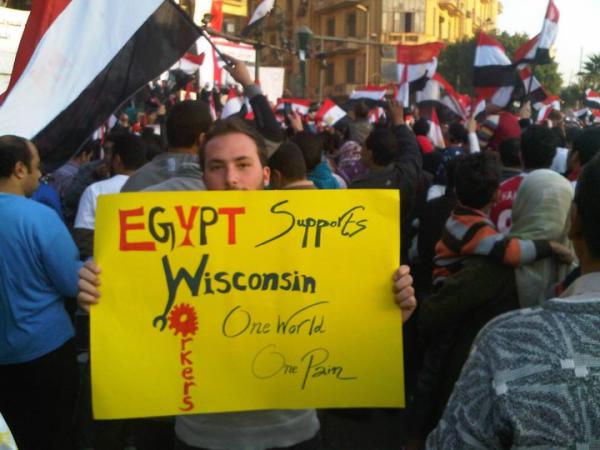 As the “democracy uprising” spreads from Tunisia, to Egypt, and now to Wisconsin, it seems the whole world is starting to look a little more like Latin America. Social movements “south of the border” have been pumping out progressive change, and winning, for a couple decades now. This victorious and active Latin left goes back at least to the Venezuelan “Caracazo” of 1989, an uprising very similar to what we’ve been watching lately in Tahrir Square, Cairo. This was long before Chavez showed up on the scene, you may notice.
As the following interview of Ben Dangl highlights, leftist states such as Venezuela are not by themselves particularly revolutionary, and in fact often play a counter-revolutionary role. Democratic, participatory, grassroots social movements have always been the real engine of change. Political leaders can choose to follow those movements (“lead by obeying” in Zapatista language), or they can choose to be largely a facade for neoliberalism and reaction. The question is not the quality of the leader, but the quality of the movement holding that leader’s feet to the fire.
This is the reason President Obama has been largely a flop. As FDR said to labor organizers in 1932, “I agree with you, I want to do it, now make me do it.” Real leadership comes from below.
Let’s hope we can follow the examples of Bolivia, Egypt, and Madison, WI and continue to work towards a global movement for justice. [alex]
Dancing with Dynamite in Latin America
by Nikolas Kozloff
Originally published by Huffington Post.
February 11, 2011.
Recently, I sat down with Benjamin Dangl, author of the recently released Dancing with Dynamite: Social Movements and States in Latin America, for an interview.
NK: You’ve written an extremely ambitious book which takes the reader all across South America. One of the most impressive things about the work is that it is largely based on your own personal interviews with political participants at the grassroots as opposed to mere secondary research. How long did it take to research and what was the most fascinating country that you worked in?
BD: The book is the result of over eight years of research, traveling and interviewing across Latin America. This period of time coincided with the rise to power of most of the region’s current leftist leaders, and so the interviews I draw from in the book reflect a lot of the initial hope and subsequent disappointment among many social movements. The most interesting place I’ve worked in is definitely Bolivia, where the power of the grassroots movements is the strongest, and the impressive relationship between these movements and the government of Evo Morales is constantly changing.
NK: It can be tough in many ways to conduct research in South America. What prompted your interest in the subject matter and what were some of the obstacles that you encountered along the way?
BD: The main things that drew me to writing about politics and social issues in Latin America were the impact US foreign policy and corporate activity had on the region, and the hopeful and relatively under-reported social struggles going on. On the one hand, the connection to the US in the so-called war on drugs, and the corporate looting of natural resources, were all issues I thought more readers of English-based media in the US should know about. And the sophisticated organizing tactics, grassroots strategies and victories of social movements in the region were stories I wanted to help amplify and spread in the US, for the sake of awareness, solidarity and lessons to be learned. The main obstacle in doing this research is the actual cost of the traveling. I’ve worked all kinds of odd jobs over the years, in construction, farming, and various kinds of manual labor, to pay for the plane tickets to get to Latin America in order to conduct research and writing on the ground.
NK: Here in the U.S., many on the left idealize Chávez and the like, yet you suggest that many ostensibly leftist regimes may sap the energy of today’s social movements. How has this happened, and could one say, therefore, that “Pink Tide” regimes may ultimately exert a counter-productive or even pernicious effect upon local politics in their respective countries?
BD: The way this relationship has played out is different in each country. Some Latin American presidents, upon taking power, have been more willing and able than others to collaborate with the social movements that help bring them into office. The relationships in Venezuela and Bolivia are probably the healthiest in this sense. In other countries, such as Brazil with President Lula and the Landless Farmers Movements, the Ecuadorian President Rafael Correa and the indigenous movements there, the relationship has been more difficult, with the governments repressing, criminalizing and demobilizing movements when possible. Dancing with Dynamite looks at how this relationship, this dance, has played out in seven different countries. It tells a story beyond what the presidents and major politicians have been doing or saying, and focuses more on the history of the past decade from the perspective of the grassroots. And this view from below is something I think more people in the US left would benefit from focusing on, if anything to understand the full picture of what’s been driving these momentous changes over the past ten years.
NK: Of all the South American countries you describe, Bolivia seems to have the most revolutionary potential. Why is this so, and what new radical developments can we expect from Bolivia in the coming years?

Also published by OpEdNews, Countercurrents, and The Rag Blog.
Take Back the Land: Land, Gentrification and the Umoja Village Shantytown
by Max Rameau
Nia Press, 2008
Review by Alex Knight, endofcapitalism.com
I first heard about a group called Take Back the Land, which was illegally moving homeless families into empty homes in Miami, in a study group about the Civil Rights movement and the grassroots organizing that made it so powerful. The reference was highly appropriate. In many ways, Take Back the Land is a direct heir of that bottom-up, Black self-empowerment, civil disobedient, movement-building tradition, and is one of the most inspiring examples of a group renewing and developing that tradition today.
In our moment of crisis and stagnation, here is a group full of creativity, improvisation, and highly potent political analysis. Through its actions, the group proclaims: ‘Families are being foreclosed on and kicked out onto the street? We’re not going to lobby Washington and hope for some crumbs to come down. We’ll take matters into our own hands and move people directly into homes!’ This is precisely the spirit of direct action and participatory democracy that kick-started the Civil Rights movement, and the spirit that we need if we are to escape the human suffering that the elite are imposing on the poor and working class in this economic crisis.
Max Rameau, author of this book and a principal organizer in Take Back the Land Miami, came and spoke in Philadelphia a few months ago. I was struck not only by how charismatic and effective a speaker he was (something I could say about many smooth-talking political or corporate salesmen of our age), but by how Max was able to break down complex, abstract theoretical questions into common language that was easily understood. In this way, he demystifies politics and translates concepts usually reserved for academics or professionals in such a way that average, everyday people can take away something new and useful from the exchange. It’s clear that his primary goal is not an ego-trip to show off his brilliance, or to sell books and make money, but to do something much more difficult and meaningful: to spark movement to force the US government to recognize housing as a human right.
This book is written in that same frank style. In fact, it’s basically a how-to on grassroots housing organizing. It’s short – only 132 pages – but all you need to know is laid out here: the political context of Miami and nationally in terms of lack of affordable housing and gentrification that drives poor and Black people out of their homes, the strategic decisions and organizing that go into launching a new organization and campaign, the challenges and joys of working with homeless people, and the difficult and deceptive terrain of interacting with politicians, who are often agents of larger and more powerful corporate forces. Max Rameau just tells the story of his group, but in such a provocatively specific way. He explains to us exactly how things were done, who did them, who interfered and how, and he’s not at all afraid to name names.
The book centers on the incredible story of the Umoja Village, a shantytown built by Take Back the Land and allies on a vacant lot in a poor Black section of Miami. Because “In South Florida… local governments responded to the [housing] crisis by actively decreasing the number of low-income housing units” (pg. 23), Take Back the Land took the initiative to seize land and invite homeless people to take up residence there. The purpose of the action was not only to house people, an immediate need, but to draw attention to the crisis and to the government’s inaction, thereby hopefully shaming them into creating more low-income housing. Read the rest of this entry »
 In fact it’s no mystery at all. It’s been well-documented for half a century now that the main cause of cancer is industrial pollution and the immense and growing quantity of toxic shit in our air, water, food, and bodies.
There’s no escaping it either. You can eat healthy and vegetarian, live out in a rural area where there’s no factories spewing death into the air, avoid filling your life with plastics and chemicals, and you’ll still be at risk, because even polar bears on the North Pole are getting dioxins built up in their fatty tissue. Dioxin, by the way, is the most toxic and carcinogenic substance ever seen on the face of the Earth. It can give you cancer from even a few parts per trillion – that’s 12 zeros. Dioxin is shot up into the air as a consequence of PVC production, and now it’s in our food, our bodies, and mother’s breast milk. (See “Dying from Dioxin” by Lois Marie Gibbs – on Google Books)
This article by Alan Grossman is succinct and clear. Studies show that cancer is caused by human activity, or more accurately, by industrial activity. I would go further and say that cancer is caused by the capitalist system, because in a human-scale and democratic economy, we could incorporate rational decision-making and say, “OK, if PVC is so fucking toxic, maybe we should make something that costs a bit more but doesn’t give us cancer.”
Unfortunately, in our capitalist system Big Business runs the show and their concern is not rationality, but profit. Period. That’s why capitalism is not only giving so many of us and our loved ones this deadly condition, capitalism is itself is a form of cancer. Capitalism sees ALL life, human or otherwise, through the lens of profit. “Can this make money?” is the bottom line for why our biosphere is under assault in so many forms – from the Gulf spill to the melting of the climate. As the late Edward Abbey once quipped, “Growth for growth’s sake is the ideology of the cancer cell.”
So I ask you, dear reader, is it fair to proclaim that the only cure for cancer is an end to the capitalist system? Because that’s what it looks like to me.
[alex]
Cancer – The Number One Killer – And Its Environmental Causes
by Alan Grossman
Originally published by Huffington Post, August 17, 2010.
The World Health Organization projects that this year cancer will become the world’s leading cause of death. Why the epidemic of cancer? Death certificates in the United States show cancer as being the eighth leading cause of death in 1900.
Why has it skyrocketed to now surpass heart disease as number one?
Is it because people live longer and have to die of something? That’s a factor, but not the prime reason as reflected by the jump in age-adjusted cancer being far above what could be expected from increased longevity. And it certainly doesn’t explain the steep hike in childhood cancers. Is it lifestyle, diet and genetics, as we have often been told? They are factors, but not key reasons.
The cause of the cancer epidemic, as numerous studies have now documented, is largely environmental — the result of toxic substances in the water we drink, the food we eat, the consumer products we use, the air we breathe. (Some of the pollution is voluntarily caused — by smoking. But most is involuntary.)
As the President’s Cancer Panel declared in May, in a 240-page report titled “Reducing Environmental Cancer Risk: What We Can Do Now,” : “The American people — even before they are born — are bombarded continually with myriad combinations of these dangerous exposures.” It said: “With the growing body of evidence linking environmental exposures to cancer, the public is becoming increasingly aware of the unacceptable burden of cancer resulting from environmental and occupational exposures that could have been prevented through appropriate national action.”
It pointed to chemicals and radiation as major causes of cancer and stated: “Cancer continues to shatter and steal the lives of Americans. Approximately 41 percent of Americans will be diagnosed with cancer at some point in their lives, and about 21 percent will die from the cancer. The incidence of some cancers, including some most common among children, is increasing…The burgeoning number and complexity of known or suspected environmental carcinogens compel us to act to protect public health.” Read the rest of this entry »
hey all,
check out this podcast of me being interviewed by Todd Curl. I’m excited to have my views recorded on audio for the first time. in this extensive 2-hour interview, I discuss:
- my hometown of Ambler, PA and its history with asbestos
- my life story of becoming politically aware and active
- peak oil and its interpretations
- the end of capitalism theory
- the nature of capitalism and enclosure
- resistance in China, Arizona, and around the world
- how radicals can use language to speak to everyday people
- healing from abuse and empowering ourselves to live better lives
here it is (click to play audio): Alex Knight Podcast
[alex]
Is Capitalism Approaching the Darkness of Knight?
Todd Curl
The Pigeon Post, August 2, 2010

Here is the interview I did with Alex Knight on Friday, July 30, 2010 at Alex’s home in Philadelphia:
At just 27 years old, Alex is already an accomplished writer and a full time activist for social justice. His site, The End of Capitalism, explores the theory of the unsustainable nature of a profit-driven global system that continues to exploit all of the earth’s resources for the sake of greed and power.
Having grown up in Ambler, Pennsylvania — the ‘Asbestos Capital of the World’ — Alex saw first hand the devastation of his home town through the greed of Keasbey and Mattison Corporation who continued to manufacture Asbestos through the 1970s despite the evidence that had existed for years that Asbestos causes Mesothelioma, a serious form of Lung Cancer.
Seeing the sickness of his community first hand eventually built the foundation for Alex’s future environmental and social activism. While at Lehigh University studying Electrical Engineering, Alex became more intellectually aware of the systemic patterns of exploitation and human/environmental devastation brought on by a long history of a Capitalist system concerned only with profit. Alex went on to get his Master’s in Political Science from Lehigh and now is a full-time activist in the Philadelphia area fighting for real and meaningful progressive change.
As Alex will tell you, there is nothing extraordinary about him. Being the quintessential “All American Boy” — he was born on the 4th of July — Alex discovered that real social change is ameliorated when we decide to join forces and fight the powers that are determined to keep us placated and in a constant state of fear so we will not question our own imprisonment of thought and continue to consume without thought or premeditation. For Alex, grassroots organizing and activism is the key to a sustainable future and when we define ourselves as left, right, Marxist, Anarchist, etc.. we just perpetuate petty semantic divides. Alex is proud to call himself “Progressive” as he is a tireless fighter for justice.
Republished by Energy Bulletin, Countercurrents and OpEdNews.
The following exchange between Michael Carriere and Alex Knight occurred via email, July 2010. Alex Knight was questioned about the End of Capitalism Theory, which states that the global capitalist system is breaking down due to ecological and social limits to growth and that a paradigm shift toward a non-capitalist future is underway.
This is the final part of a four-part interview. Scroll to the bottom for links to the other sections.
Part 3. Life After Capitalism
MC: Moving forward, how would you ideally envision a post-capitalist world? And if capitalism manages to survive (as it has in the past), is there still room for real change?
AK: First let me repeat that even if my theory is right that capitalism is breaking down, it doesn’t suggest that we’ll automatically find ourselves living in a utopia soon. This crisis is an opportunity for us progressives but it is also an opportunity for right-wing forces. If the right seizes the initiative, I fear they could give rise to neo-fascism – a system in which freedoms are enclosed and violated for the purpose of restoring a mythical idea of national glory.
I think this threat is especially credible here in the United States, where in recent years we’ve seen the USA PATRIOT Act, the Supreme Court’s decision that corporations are “persons,” and the stripping of constitutional rights from those labeled “terrorists,” “enemy combatants”, as well as “illegals.” Arizona’s attempt to institute a racial profiling law and turn every police officer into an immigration official may be the face of fascism in America today. Angry whites joining together with the repressive forces of the state to terrorize a marginalized community, Latino immigrants. While we have a black president now, white supremacist sentiment remains widespread in this country, and doesn’t appear to be going away anytime soon. So as we struggle for a better world we may also have to contend with increasing authoritarianism.
I should also state up front that I have no interest in “writing recipes for the cooks of the future.” I can’t prescribe the ideal post-capitalist world and I wouldn’t try. People will create solutions to the crises they face according to what makes most sense in their circumstances. In fact they’re already doing this. Yet, I would like to see your question addressed towards the public at large, and discussed in schools, workplaces, and communities. If we have an open conversation about what a better world would look like, this is where the best solutions will come from. Plus, the practice of imagination will give people a stronger investment in wanting the future to turn out better. So I’ll put forward some of my ideas for life beyond capitalism, in the hope that it spurs others to articulate their visions and initiate conversation on the world we want.
My personal vision has been shaped by my outrage over the two fundamental crises that capitalism has perpetrated: the ecological crisis and the social crisis. I see capitalism as a system of abuse. The system grows by exploiting people and the planet as means to extract profit, and by refusing to be responsible for the ecological and social trauma caused by its abuse. Therefore I believe any real solutions to our problems must be aligned to both ecological justice and social justice. If we privilege one over the other, we will only cause more harm. The planet must be healed, and our communities must be healed as well. I would propose these two goals as a starting point to the discussion.
How do we heal? What does healing look like? Let me expand from there.
Five Guideposts to a New World
I mentioned in response to the first question that I view freedom, democracy, justice, sustainability and love as guideposts that point towards a new world. This follows from what I call a common sense radical approach, because it is not about pulling vision for the future from some ideological playbook or dogma, but from lived experience. Rather than taking pre-formed ideas and trying to make reality fit that conceptual blueprint, ideas should spring from what makes sense on the ground. The five guideposts come from our common values. It doesn’t take an expert to understand them or put them into practice.
In the first section I described how freedom at its core is about self-determination. I said that defined this way it presents a radical challenge to capitalist society because it highlights the lack of power we have under capitalism. We do not have self-determination, and we cannot as long as huge corporations and corrupt politicians control our destinies.
I’ll add that access to land is fundamental to a meaningful definition of freedom. The group Take Back the Land has highlighted this through their work to move homeless and foreclosed families directly into vacant homes in Miami. Everyone needs access to land for the basic security of housing, but also for the ability to feed themselves. Without “food sovereignty,” or the power to provide for one’s own family, community or nation with healthy, culturally and ecologically appropriate food, freedom cannot exist. The best way to ensure that communities have food sovereignty is to ensure they have access to land.
Ella Baker championed the idea of participatory democracy
Similarly, a deeper interpretation of democracy would emphasize participation by an individual or community in the decisions that affect them. For this definition I follow in the footsteps of Ella Baker, the mighty civil rights organizer who championed the idea of participatory democracy. With a lifelong focus on empowering ordinary people to solve their own problems, Ella Baker is known for saying “Strong people don’t need strong leaders.” This was the philosophy of the black students who sat-in at lunch counters in the South to win their right to public accommodations. They didn’t wait for the law to change, or for adults to tell them to do it. The students recognized that society was wrong, and practiced non-violent civil disobedience , becoming empowered by their actions. Then with Ms. Baker’s support they formed the Student Non-violent Coordinating Committee (SNCC) and organized poor blacks in Mississippi to demand their right to vote, passing on the torch of empowerment.
We need to be empowered to manage our own affairs on a large scale. In a participatory democracy, “we, the people” would run the show, not representatives who depend on corporate funding to get elected. “By the people, for the people, of the people” are great words. What if we actually put those words into action in the government, the economy, the media, and all the institutions that affect our lives? Institutions should obey the will of the people, rather than the people obeying the will of institutions. It can happen, but only through organization and active participation of the people as a whole. We must empower ourselves, not wait for someone else to do it. Read the rest of this entry »


 The End of Capitalism
Recent Comments